
The Persistence of Fire and Earth on the Banks of the Tajo
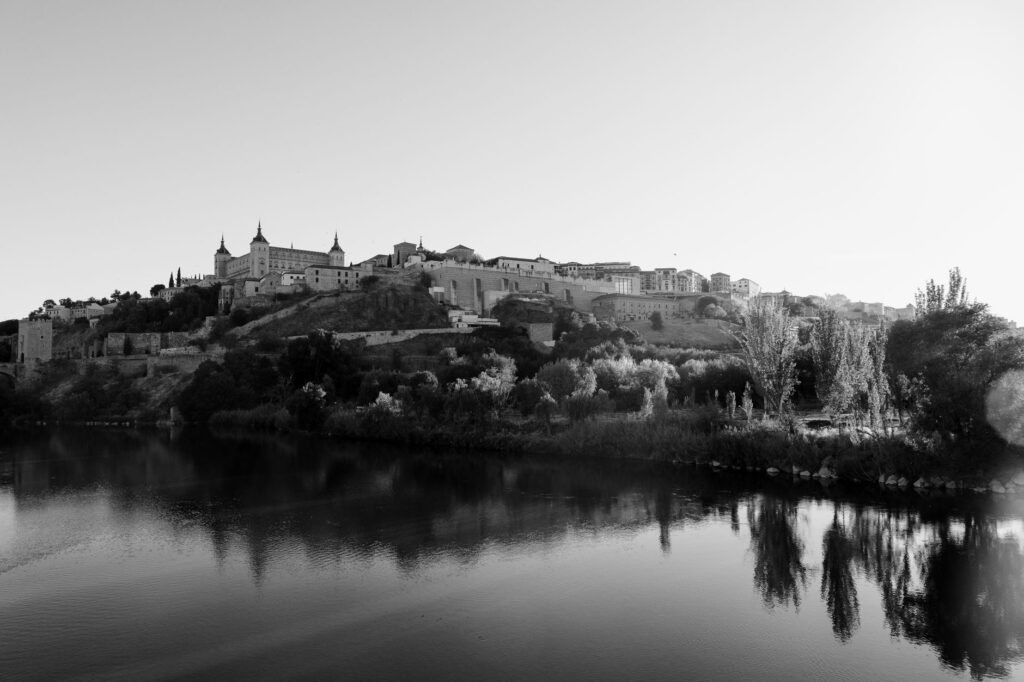
Just a few meters from the gentle flow of the Tajo River, the air in Talavera de la Reina carries an unmistakable aroma: damp clay, the smoke of centuries-old kilns, and metallic oxides. This is no nostalgic recreation staged for passing visitors, but the daily pulse of a city whose identity was sealed in fire during the sixteenth century. Here, clay is never merely a building material or a utilitarian resource; it is the physical medium upon which generations of potters and painters have poured the visual history of the Iberian Peninsula. Inside traditional workshops, time is measured not in hours, but in firing cycles and the infinite patience required to prepare raw earths long before they receive the first brushstroke.
International recognition of this tradition, solidified by its inscription on UNESCO’s Representative List of the Intangible Cultural Heritage of Humanity, sparked a profound reassessment of the health of local workshops. Far from existing as a relic protected under a glass case, Talavera ceramics maintain a constant, creative tension between absolute fidelity to Renaissance recipes and the disruptive influx of contemporary languages. Today’s master artisans do not merely restore historical panels for palaces and convents across the globe; they engage in active dialogues with international architects and designers who look to Talavera glaze as an organic antidote to industrial standardization.
The Alchemy of the Workshop: From Wedging to the Potter’s Wheel
Stepping across the threshold of a traditional workshop in the San Andrés neighborhood is akin to entering a territory where physics and chemistry coexist intuitively. Raw materials—precise blends of local clays chosen for their plasticity and thermal resistance—undergo prolonged aging in underground pits. This maturation process, which can last for months, eliminates internal stresses and ensures that the ceramic biscuit will withstand the thermal shock of the kiln without fracturing. Veteran potters insist that the success of any piece is determined long before the clay touches the wheel, at the exact moment of calculating shrinkage and density.
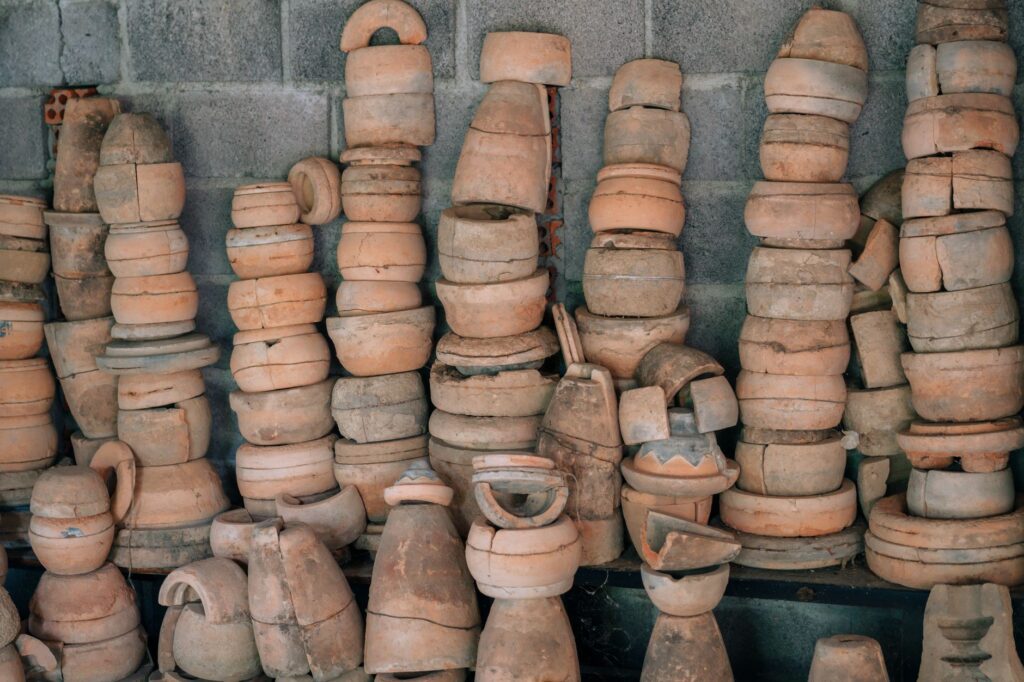
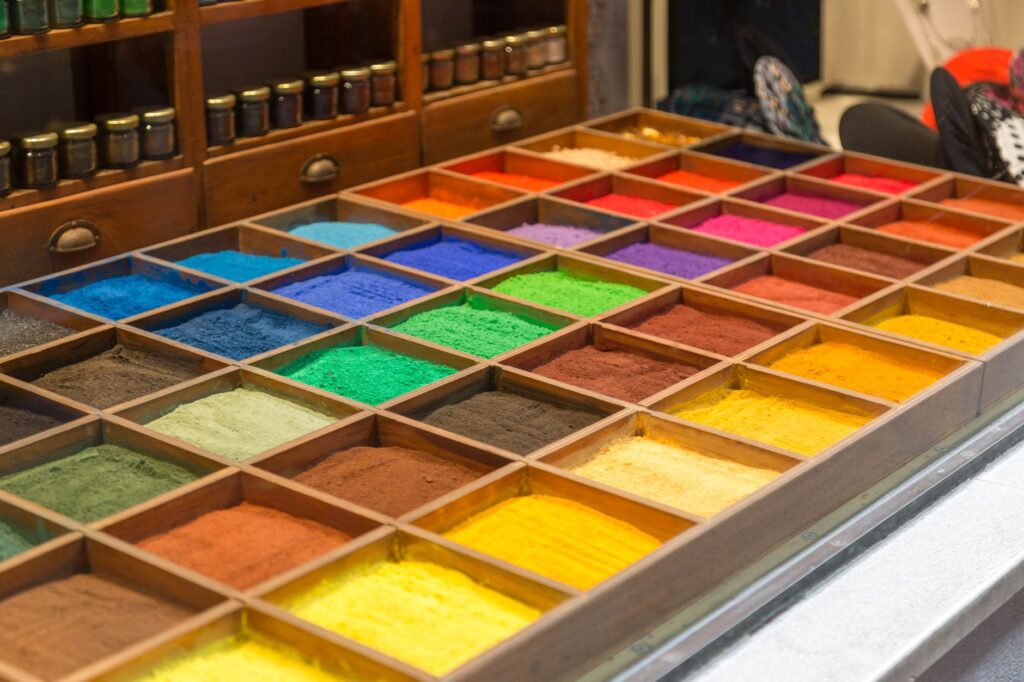
At the wheel, the movement of hands is an exercise in micrometric precision guided by muscular memory. Every plate, basin, or tile acquires its definitive thickness through gestures repeated thousands of times over decades. Simultaneously, the preparation of pigments constitutes another of the great secrets of the Talavera school. The characteristic cobalt blue, green tones derived from copper, manganese for browns, and antimony yellow are ground by hand using mortars and agate stones. This meticulous grinding ensures that, during high-temperature firing, the colors fuse seamlessly with the stanniferous glaze, generating that signature visual depth that has mesmerized collectors for centuries.
Clay tolerates no lies: if the artisan’s hand hesitates for even a single second, the fire will ruthlessly expose that weakness without hesitation.
The Chromatic Palette and the Rigor of the Brushstroke
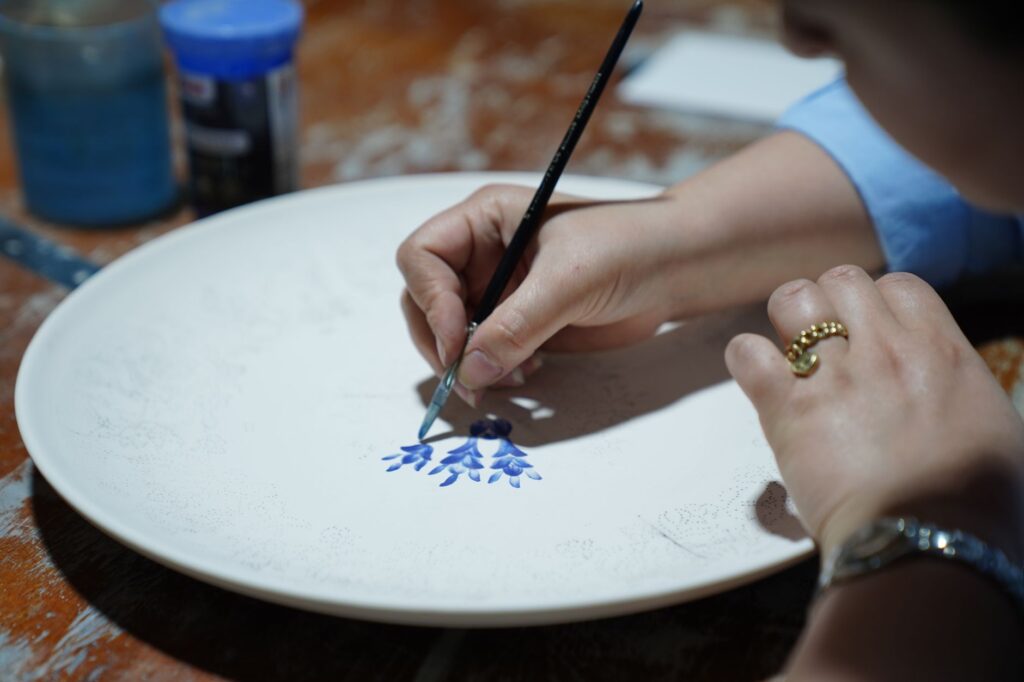
Once the piece has survived its initial low-temperature firing—transforming into what is known as the biscuit—it is submerged in an opaque white glaze bath composed essentially of tin and lead. This white, porous, and absorbent surface acts as an unforgiving blotting paper. The ceramic painter has a single opportunity to execute the stroke; the pigment, suspended in water with organic binders, instantly penetrates the raw glaze, precluding any attempt at correction or erasure. The dexterity required demands absolute mastery of pulse and a profound understanding of how the oxides will react once subjected to the true heat of the main kiln.
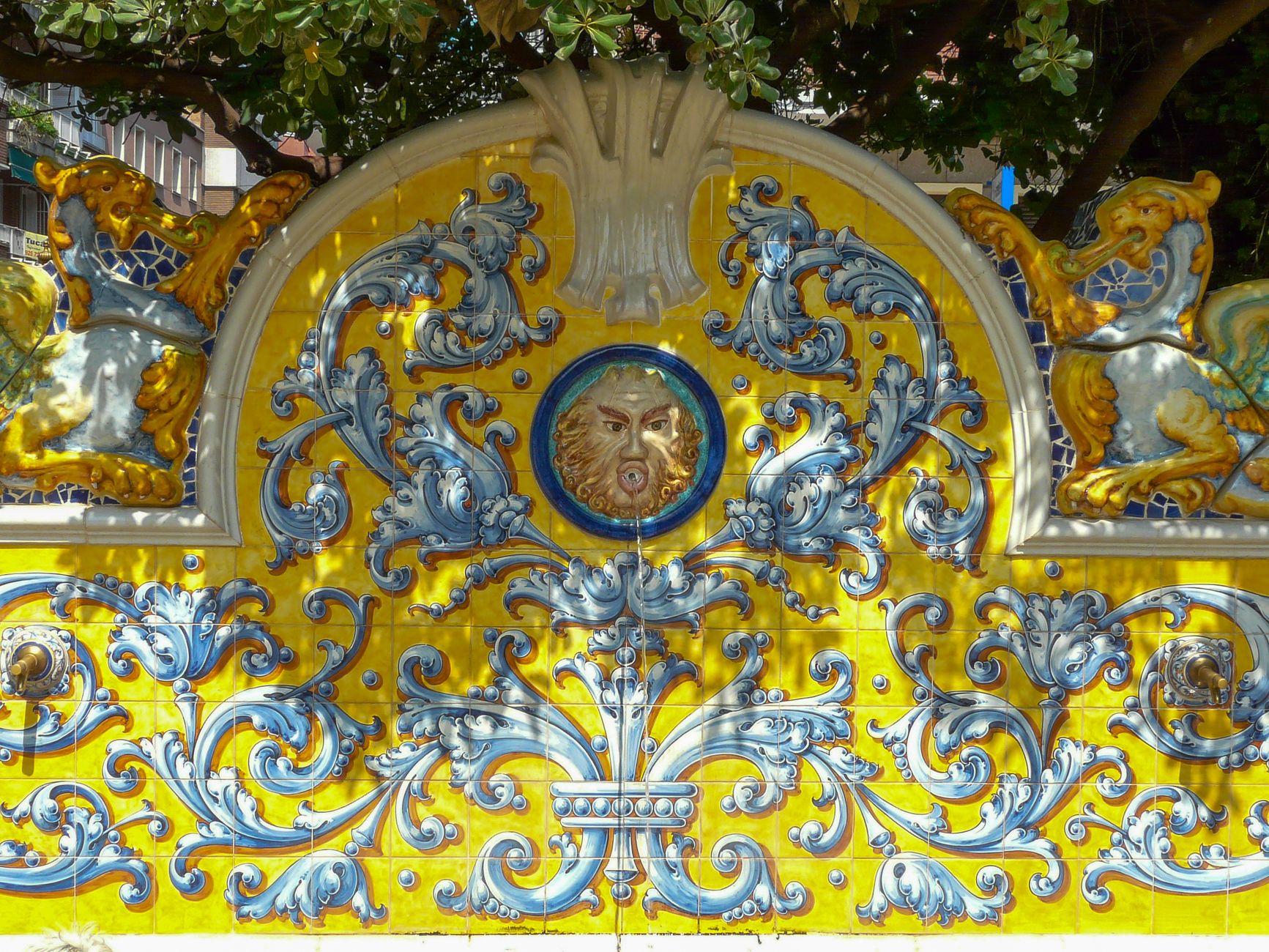
The traditional iconography of Talavera de la Reina is organized into well-defined series that local workshops continue to study with devotion. The Renaissance series, characterized by grotesque motifs, mythological figures, and plant friezes inspired by Italian engravings, contrasts with the sober strength of the Chinese-influenced series or the polychrome motifs of the Baroque period. In contemporary studios, this heritage is analyzed not as an unalterable dogma, but as a grammatical alphabet. Young artists reinterpret traditional geometric rhythms and chromatic ranges, applying them to large mural installations that decorate subway stations, institutional facades, and contemporary art collections in Madrid, Paris, and New York.
The Architecture of Heat: Kilns and Fire Control
The beating heart of any workshop is undeniably its firing system. Although the vast majority of contemporary studios have incorporated state-of-the-art electric and gas kilns to guarantee temperature stability and comply with environmental regulations, traditional direct-draft wood-fired kilns still command a reverential fascination. Firing one of these refractory brick colossi requires a ritual spanning several days, burning carefully selected olive or holm oak wood whose calorific value and combustion speed are thoroughly understood by master kiln operators.
Controlling the atmosphere inside the kiln—alternating oxidizing and reducing phases depending on the cycle stage—is what grants glazed pieces their unmistakable vibrancy and subtle tonal variations that industrial production can never replicate. Losses due to breakage or firing defects are accepted as a natural part of the craft, a constant reminder that ceramics is an art form where nature intervenes decisively. Artisans examine the pieces as they emerge from the kiln with a mixture of relief and critical scrutiny, evaluating the gloss of the glaze and the absence of unwanted bubbles or crazing before granting final approval.
Generational Handover and the Guild’s New Challenges
The future of the ceramic tradition in Talavera de la Reina is currently debated between the urgency of heritage preservation and the adaptation to the demands of the global art and high-end decor market. Local ceramic schools, heirs to a long educational tradition, face the challenge of attracting new generations in an economic environment where artisanal processes compete against cheap Asian industrial knockoffs. Yet a hopeful phenomenon is underway: young creators from fine arts and industrial design backgrounds are choosing to settle in the region to learn directly from veteran masters, fusing secular techniques with contemporary sensibilities.
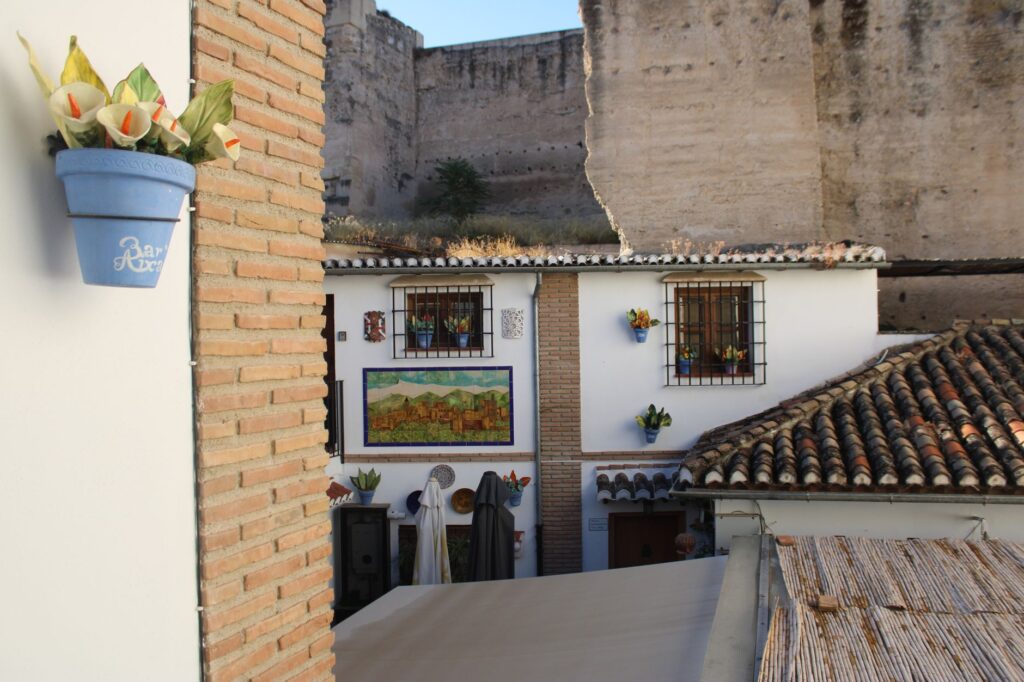
This convergence of knowledge has helped diversify the town’s cultural and tourism offerings. Travelers arriving in Talavera today no longer look solely for mass-produced decorative souvenirs, but rather for immersive experiences that include introductory workshops, guided visits to active studios, and specialized lectures on the history of ceramic chemistry. Local institutions, in collaboration with guild associations, have promoted signposted routes connecting historic kilns preserved in old quarters with active creators’ studios, fostering respectful, high-value cultural tourism.
Preserving this craft does not mean mummifying the past; it means equipping present hands with the tools needed to keep writing upon clay.
Practical guide
How to get there: Talavera de la Reina is exceptionally well-connected by road via the A-5 highway, located about 120 kilometers southwest of Madrid. By rail, the regional mid-distance line connects the city station with Madrid-Atocha and Extremadura through regular daily services.
When to visit: The spring months (April to June) and autumn (September to November) offer ideal temperatures for exploring the workshops on foot without the intense summer heat. Furthermore, these periods coincide with peak workshop activity ahead of annual exhibitions.
Where to visit: The Ruiz de Luna Museum is the essential initial stop to understand the historical evolution of Talavera ceramics through exceptional collections ranging from the sixteenth century to the present day. Additionally, the circuit of artisanal workshops in the old quarter and the Talavera la Vieja neighborhood allows direct access to masters in the middle of their creative processes.
Accommodation and gastronomy: The hotel offer combines small boutique hotels housed in restored historic Castilian manor houses with functional establishments. Gastronomically, traditional game dishes, Toledano breadcrumbs, and convent sweets stand out, perfectly rounding off a day of cultural immersion.
The Silent Echo of the Potter’s Courtyard
When dusk begins to settle over the banks of the Tajo and the bustle of the workshops subsides, a subtle echo lingers in the air—an almost imperceptible vibration emitted by the silence of the interior courtyards where freshly glazed pieces rest. In those secluded spaces, far removed from the noise of the outside world, the true dimension of this craft becomes entirely clear. It is not merely a matter of manufacturing beautiful objects or keeping tourist statistics afloat; it is a continuous act of cultural resistance, a way of preserving the tactile memory of humanity modeled out of water, earth, and fire. The traveler who pauses to contemplate the weathered hands of a master potter smoothing the rim of a basin realizes they are witnessing one of the oldest and purest rituals of civilization, a luminous reminder that true beauty always demands time, patience, and unconditional devotion.