
At the exact intersection where the continental currents of the Rhône River lose their momentum to merge with the salinity of the Mediterranean Sea, the Camargue emerges: a vast alluvial plain spanning over 150,000 hectares where land and water maintain a perpetual negotiation. For over a century, this biogeographical crossroads suffered severe fragmentation due to industrial salt extraction, river channelization, and intensive agriculture. Today, however, the Camarguais ecosystem leads one of the most ambitious and rigorous ecological and hydrological restoration projects in Southern Europe, demonstrating that the coexistence between ancestral human activity and wild nature preservation is not only possible, but essential.
The transformation of the region does not stem from a mere aesthetic desire for conservation, but from a pressing environmental urgency. Rising sea levels, saltwater intrusion into freshwater aquifers, and altered seasonal rainfall patterns demanded the abandonment of rigid containment infrastructure. In its place, biologists, local communities, farmers, and public administrations have established a flexible water governance model that allows thousands of hectares of former salt pans to return to the natural dynamics of the sea, restoring ecological connectivity and safeguarding the habitat of hundreds of migratory bird species.
The Hydrological Crossroads of the Rhône Delta
Understanding the Camargue requires a deep comprehension of its hydraulic nature. The delta is divided into two main arms, the Petit Rhône to the west and the Grand Rhône to the east, trapping within its perimeter a complex network of brackish lagoons, temporary marshes, reed beds, and shifting coastal dunes. The core of this intricate system is the Étang de Vaccarès, a central natural reserve whose salinity and water levels depend on a delicate equilibrium between continental freshwater inputs and controlled seawater entries managed through coastal sluice gates.
For decades, the overriding priority was to isolate the delta from river floods and marine storm surges. However, the construction of continuous dikes severed the natural supply of riverine sediments, accelerating beach erosion and leading to gradual land subsidence. As global climate patterns become increasingly volatile, managers at the Camargue Regional Natural Park have fundamentally shifted their strategy: absolute containment has given way to ‘room for the river’ concepts and planned acceptance of controlled marine inundations.
The End of Industrial Salt Extraction and Ecological Rewilding
The true turning point in the recent history of the Camargue occurred with the gradual cessation of large-scale industrial salt extraction operations in the Salin-de-Giraud and Aigues-Mortes sectors. The acquisition of more than 6,500 hectares of former industrial salt pans by the Conservatoire du Littoral transformed these heavily anthropized grounds into a living laboratory for environmental restoration. Mechanical pumping stations were dismantled, obsolete interior dikes were removed, and natural tidal flows were restored.
This process of assisted rewilding has allowed former evapotranspirative crystallization basins to progressively regain their natural salinity gradients. Halophytic flora, such as glasswort and sea lavender, has recolonized the soils, creating a lush carpet of reddish and ochre tones that feeds benthic crustaceans, microorganisms, and fish larvae essential to the entire coastal food web.
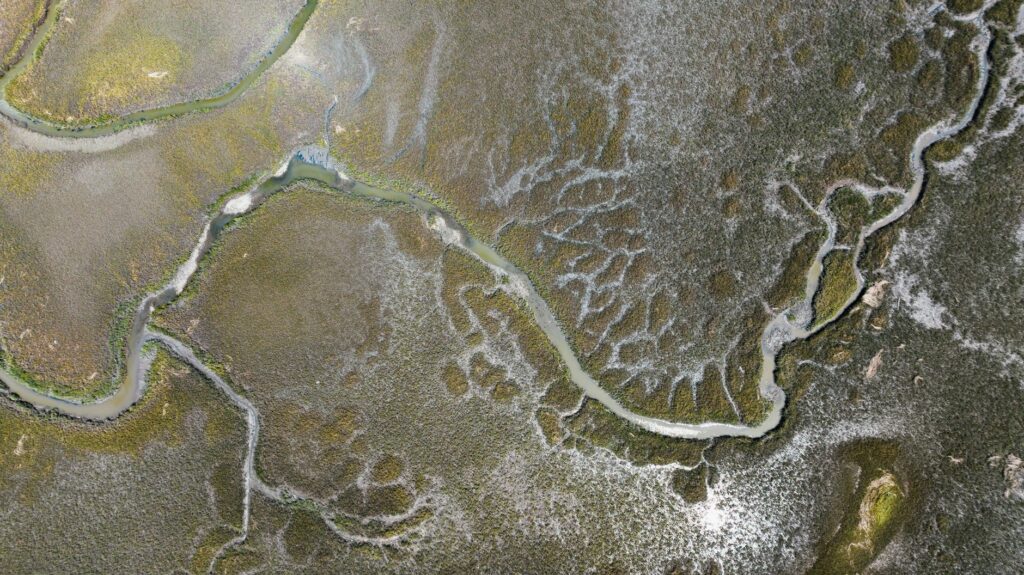
Returning former industrial salt pans to tidal dynamics is not a loss of territory to the sea, but an act of ecological wisdom aimed at building a living, resilient coastal defense.
Greater Flamingos as Bioindicators of Deltaic Health
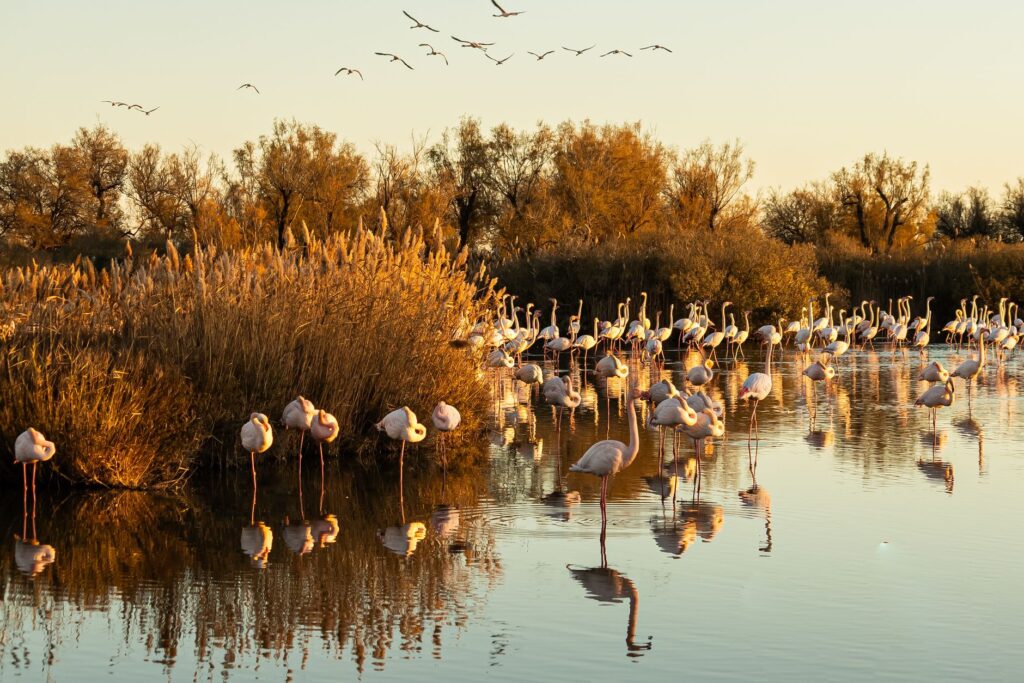
No creature embodies the success of this transformation more vividly than the greater flamingo (Phoenicopterus roseus). The Camargue harbors one of the most vital nesting sites in the entire Mediterranean Basin, concentrated at the Fangassier lagoon. The health of the flamingo colony is inextricably linked to the abundance of Artemia salina, a microscopic crustacean that thrives exclusively in high-salinity waters and provides these birds with their iconic pink plumage.
Daily scientific monitoring conducted by the Tour du Valat Biological Station—a pioneering research center established in 1954—demonstrates that salt pan restoration has stabilized avian populations. Flamingos are far from the sole beneficiaries: endangered species such as the pied avocet, the collared pratincole, and various heron species now find within the delta a secure refuge for breeding and foraging along their migratory flyways between Africa and Northern Europe.
Pastoral Traditions and the Gardians as Stewards of the Wetland
Conservation in the Camargue cannot be divorced from the human presence of the gardian, the traditional cowboy who manages the herds of wild white horses and black Camargue cattle. Far from being a mere folkloric attraction, the extensive pastoral system practiced across the semi-wild manades (ranch estates) serves as an essential habitat management tool. Camargue horses and bulls, adapted to grazing with their hooves submerged in brackish waters, naturally control the overgrowth of tall reeds and rushes.
This continuous grazing prevents open marshes from being overgrown by dense woody vegetation, maintaining a heterogeneous mosaic of microhabitats required by ground-nesting waders. The relationship between manadiers and conservation biologists has evolved from historic skepticism into a collaborative alliance: ranchers receive support to certify their meat under sustainable local designations, while committing their herd densities to ecological carrying capacities established by scientific teams.

Dyke Dismantling and Reclaiming Natural Coastal Dynamics
The most complex challenge facing the delta is coastal erosion intensified by rising Mediterranean sea temperatures. Instead of constructing ever-higher concrete seawalls, coastal engineers in the region have adopted soft defense strategies. Along the beaches of Beauduc and Piemanson, sand dunes are permitted to migrate freely in response to the prevailing Mistral winds and easterly winter storms.
By removing artificial rock revetments, sediment transport processes have been allowed to re-establish organically. During severe winter storms, seawater temporarily surges into interior lowlands, periodically salinizing soils and renewing endemic vegetation communities. This spatial flexibility functions as a natural buffer zone that absorbs wave energy before it reaches inhabited settlements and agricultural fields further inland.
Soft Mobility and Non-Invasive Avian Observation
Tourism management across the Camargue has been restructured to avoid overcrowding in fragile habitats. Motorized vehicular access has been severely restricted along the protected perimeter of the Étang de Vaccarès and within core nature reserves. In its place, an integrated network of low-impact mobility routes has been established, allowing visitors to explore the delta via touring bicycles, guided horseback trails, and elevated pedestrian boardwalks constructed from recycled timber.

Access to bird hides and observation towers, such as those at the Pont de Gau Ornithological Park or the Marais du Vigueirat, is strictly regulated to eliminate visual and acoustic disturbances. Visitors move through camouflaged tunnels built from native reed thatch, enabling close observation of natural wildlife behaviors without disrupting feeding or courtship routines. Additionally, small electric boats and traditional flat-bottomed wooden barges offer quiet riverine transport along the tributaries of the delta.
Socio-Economic Adaptation: Sustainable Agriculture and Artisanal Fisheries
Preserving this living landscape does not necessitate economic stagnation, but rather a transition toward certified sustainable practices. The cultivation of Camargue rice (PGI), introduced on a large scale in the mid-20th century to desalinate soils by flooding fields with freshwater pumped from the Rhône, has initiated a shift toward organic conservation agriculture. Rice growers today utilize crop rotations with legumes and biological pest controls, significantly reducing agrochemical runoff into the delta’s canal network.
Meanwhile, artisanal fishing guilds operating in the coastal lagoons maintain centuries-old practices such as the capetchade—a system of stationary fyke nets that allows juvenile and non-target species to be returned to the water unharmed. Selective fishing for the critically endangered European eel is governed by strict catch quotas and seasonal closures mutually agreed upon by fishermen and marine scientific institutes.

The future of the marsh is not decided against human presence, but through the collective intelligence of those who have learned to interpret the language of water and salt.
Practical guide
Planning a responsible journey through the Camargue requires an understanding of its dynamic seasonal rhythms and strict adherence to environmental regulations designed to guarantee its protection.
- Getting there and getting around: The railway hubs of Arles and Aigues-Mortes provide convenient regional connections. From these gateway cities, the optimal mode of transport is the ViaRhôna cycle path network connecting the hinterland to the coast. Hybrid or electric bicycles can be rented easily in peripheral urban centers.
- Best time to visit: Spring (April to June) offers unparalleled opportunities for birdwatching during peak nesting and courtship displays. Autumn (September to November) features spectacular migratory gatherings and pleasant weather, avoiding midsummer heat and heavy mosquito activity.
- Environmental etiquette: Visitors must remain strictly on designated trails at all times. Unleashed dogs are prohibited in all nesting zones, and drone operation is banned throughout the entire territory of the Regional Natural Park. Maintain a respectful distance from grazing herds of horses and cattle.
- Recommended gear: Waterproof footwear or sturdy hiking boots for muddy terrain, high-magnification binoculars for non-intrusive bird observation, eco-friendly insect repellent, and biodegradable sunscreen.
- Ethical lodging and dining: Choose accommodations registered as gîtes ruraux or guest houses holding the Valeurs Parc Naturel Régional certification. Support the local economy by sampling PGI Camargue rice, PDO bull meat, and artisanally harvested Fleur de Sel.
The Ethereal Horizon Where Salt and Sky Converge
As the setting sun bathes the quiet waters of the Étang de Vaccarès in deep shades of crimson and violet, the silhouette of a flamingo flock taking flight against the horizon offers silent testimony to ecological resilience. The Camargue is no longer a wilderness frontier that human engineering seeks to subdue through heavy infrastructure. It has emerged instead as an open-air classroom for managing environmental uncertainty and coexisting with natural forces.
The defining challenge of the 21st century will not be preventing the marshland from changing, but ensuring that change sustains the biological rhythm of this alluvial sanctuary. In the steady gaze of a gardian surveying the marsh on horseback, in the conscious choice of a farmer reducing synthetic inputs, and in the meticulous work of a scientist measuring lagoon salinity, the Camargue demonstrates that the most enduring conservation is that which takes root in culture, community memory, and an abiding reverence for the power of water.