
Introduction to New Zealand’s Amphibious Edge
The extreme southwest of New Zealand’s South Island, carved by millennia of glacial advance and retreat, constitutes one of the most remote, boundless, and climatically extreme landscapes in the Southern Hemisphere. In this region, known geographically as Fiordland, the land does not easily yield to human transit. Vertical granite walls soaring over a thousand meters high plunge straight down into dark, deep waters, while skies frequently unload annual precipitation exceeding seven thousand millimeters. In this scenario of geological solitude, connectivity is not merely a matter of tourist convenience or commercial logistics; it is a complex exercise in amphibious survival and high-precision engineering that constantly challenges the limits of modern technology.
The backbone of this transport system consists of an extraordinarily fragile network of mountain roads, tunnels carved into living rock, high-efficiency ferry fleets, and air connections entirely dependent on fickle oceanic weather. Understanding how the ferries crossing inland lakes operate, how constant avalanche risks are mitigated at the Homer Pass, and how isolated enclaves in Doubtful Sound are supplied requires delving into a framework where nature relentlessly enforces its own rules. Far from the global standardization of transport infrastructure, Fiordland operates as a living laboratory where the seafaring tradition of Polynesian navigators intersects with some of the world’s most advanced traffic management systems.

The Route of Rock and Gloom: The Homer Tunnel and the Road to Milford
Accessing Milford Sound (Piopiotahi in the Māori language) by land requires traversing the sole road artery connecting the interior of the mountain range with the western coast: State Highway 94. This winding corridor, starting in the alpine township of Te Anau, represents one of the most daring and costly civil engineering feats in New Zealand’s history. The critical bottleneck of this route lies at the Homer Gorge, where the road pierces the mountain via a single-lane tunnel stretching twelve hundred and fifty meters, carved entirely through solid granite at an altitude exceeding nine hundred meters above sea level.
Originally constructed during the 1930s under extremely adverse weather conditions and with rudimentary technology, the Homer Tunnel continues to operate today under severe physical limitations. Its cross-section is narrow, preventing simultaneous passage of tourist buses and heavy freight vehicles, and requiring a coordinated system of traffic lights and temporary queue management operated by road crews stationed at both portals. The geological vulnerability of the environment is constant: rockfalls, winter snow avalanches, and the hydraulic saturation of surrounding slopes demand daily maintenance and continuous preventive patrol work.

Inland Navigation: Barges and Ferries Across Lakes and Fjords
Once the alpine labyrinth is conquered and the head of the fjords is reached, land mobility ceases entirely, yielding to maritime and lacustrine transport. In Milford Sound, a diversified fleet of vessels—ranging from high-speed catamarans to smaller craft specialized in scientific research and sustainable tourism—operates under strict environmental regulations designed to protect the fragile marine ecology of surface freshwater layers, characterized by a dark lens of rainwater floating over the saltwater of the Tasman Sea.
Further south, in the fjord system of Doubtful Sound (Patea), logistical complexity increases exponentially. Lacking a direct road connecting the mainland to the fjord, all passenger and freight traffic must first cross Lake Manapouri via a regular ferry service. Once on the western shore of the lake, travelers and supplies are transferred onto special coaches that traverse Wilmot Pass via a paved industrial service road, originally built for the Manapouri underground hydroelectric project. This chained intermodal transfer—boat, bus, boat—exemplifies the extreme difficulty of moving people and resources in a territory where fragmented topography prohibits any direct transport solution.
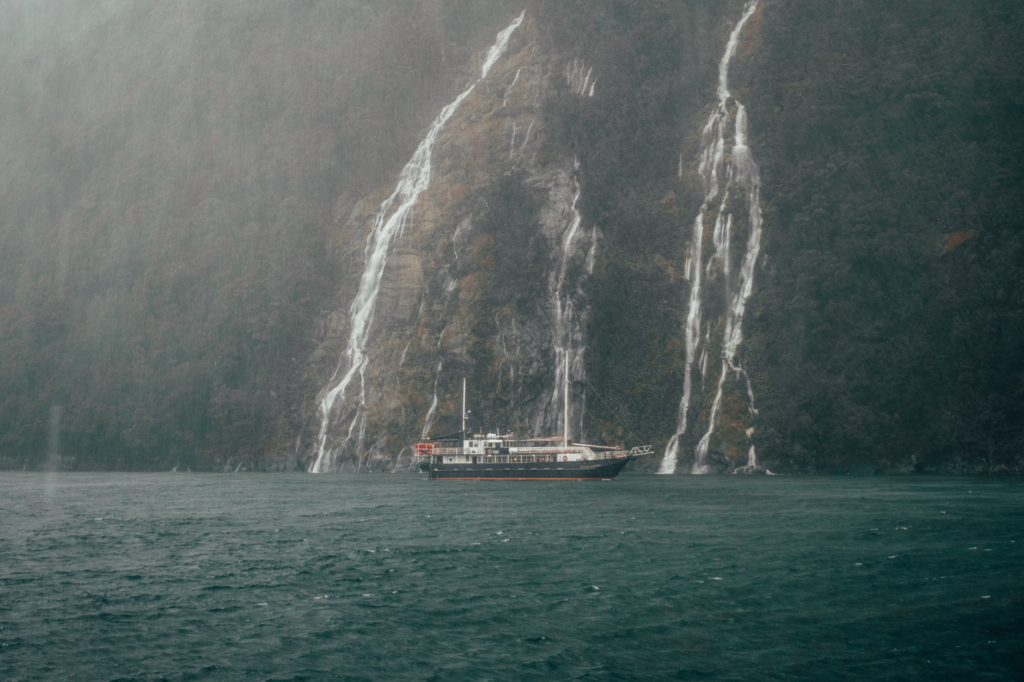
Fiordland’s infrastructure does not conquer the territory; it merely negotiates a temporary truce with the verticality of the elements and the fury of southern gales.
Engineering Against the Climate: Maintenance Logistics in Extreme Conditions
Keeping this transport network operational demands a permanent mobilization of technical and human resources by the New Zealand Transport Agency and local private operators. Heavy downpours frequently trigger massive landslides that block road access for days, temporarily isolating tour operators and small resident communities in the area. To counter this, automated early warning systems, dynamic rock-catch fences, and slope movement radars have been installed to detect instabilities in real time before structural collapses occur.
Similarly, the energy and logistical supply of tourist and conservation facilities located in the heart of the national park depend on a strictly regulated transport chain. Vessels operating in the fjords must comply with zero-discharge regulations for grey and black water, and the fuel required for generators and marine engines is transported under the highest environmental safety protocols. Any failure in the logistical chain—whether due to an unexpected closure of the Homer Tunnel or windstorms on the lakes—immediately impacts the regional economy and the safety of travelers transiting this remote corner of the planet.

Cultural Integration and Māori Custodianship of the Land
The transport and mobility system in Fiordland cannot be understood solely from a Western technical perspective; it is deeply intertwined with the worldview and historical rights of the Māori people, specifically the iwi (tribes) of Ngāi Tahu. For them, the fjords are sacred places (taonga) sculpted by the demiurge god Tū Te Rakiwhānoa, and every valley, mountain pass, and watercourse bears ancestral names that recount a history of origin and deep respect for the natural environment.
In recent decades, the governance of transport and tourism within the national park has evolved toward a co-management model where Māori authorities actively participate in decisions regarding visitor flows, navigation license limits, and the protection of historic trails, such as the renowned Milford Track. This collaboration ensures that the expansion of mobility infrastructure does not compromise the spiritual or ecological integrity of a landscape that continues to be perceived, above all, as a wild sanctuary where human presence must always remain ephemeral and respectful.

Practical guide
Planning a journey or transit through the Fiordland region requires absolute logistical rigor due to extreme geographical and climatic conditions. Below are the essential guidelines for understanding and navigating this transport network:
- Main Land Access: State Highway 94 (Milford Road) starts in Te Anau. Checking real-time road status and Homer Tunnel restrictions through the transport agency’s digital information boards before setting out is mandatory.
- Fuel Limitations: There are no fuel stations or electric vehicle charging points along the route between Te Anau and Milford Sound (a distance of approximately 120 kilometers one way). Filling up completely before departure is compulsory.
- Weather Management: Weather conditions shift dramatically within minutes. Gale-force winds and sudden snowfalls can close mountain passes even during the austral summer months.
- Advance Bookings: Milford Sound ferry services and multimodal connections to Doubtful Sound operate with strictly limited quotas to protect the environment, requiring bookings months in advance.
- Environmental Regulations: A strict ‘leave no trace’ policy is enforced. Overnight stays in vehicles outside authorized campgrounds are prohibited, and proper management of personal waste is mandatory throughout the national park.
Epilogue: Suspended Silence in the Mirror of the Fjords
When the last ferry docks at the sheltered wharves of Milford Sound and the echo of engines fades away among the vertical granite walls, the landscape reclaims its awe-inspiring original silence. In this southern confine, where human engineering barely manages to trace a thin line of continuity between unreachable mountains and deep oceans, travel acquires an almost contemplative dimension. The fragility of the roads and the indomitable force of the tides remind the traveler that certain places on Earth are not meant to be dominated, but solely traversed with gratitude, humility, and a profound respect for the ancient rhythms of the Earth.