The Architecture of Weightlessness
Human fascination with dwelling on water responds to an ancestral impulse of suspension. This is not merely an aesthetic whim or a passing trend in contemporary design, but a radical way of reconfiguring the relationship between the human body and the landscape. When an architectural structure rests upon a liquid surface, the ground ceases to be a static plane and becomes a dynamic element that responds to wind, currents, and the natural rhythm of the tides. This report examines how specific contemporary spaces—featured in global design selections such as those by Condé Nast Traveler—succeed in suspending daily life over sheets of water, offering an experience where the boundary between the inhabited interior and the aquatic medium completely dissolves.
Living or staying overnight on water alters temporal perception. The constant, gentle sound of waves lapping against floating foundations or wooden pilings acts as a natural metronome that deactivates urban urgency. In a global context where excessive visual and acoustic stimuli saturate the travel experience, these aquatic refuges propose an alternative based on subtraction. Here, luxury does not reside in the accumulation of superfluous services, but in the quality of isolation, the precise orientation of large windows toward the horizon, and the opportunity to observe the complete cycle of light reflected on the liquid surface without interruptions other than the passing of local wildlife.
Floating Engineering in the Pacific Northwest
Washington state, on the northwestern coast of the United States, is home to some of the most refined expressions of modern floating architecture. Unlike the tropical overwater bungalows that dominate the collective imagination of the South Pacific, the aquatic retreats of the American Northwest respond to a temperate, humid, and deeply forested climate. Here, structures on the water integrate into an environment dominated by century-old fir trees, morning mists, and sheltered inlets where the water acquires an almost impenetrable dark green hue.
Local designers and architects working with floating platforms in this region face considerable technical challenges. Tidal fluctuations demand flexible yet extraordinarily secure anchoring systems capable of maintaining structural stability without disturbing the delicate marine ecosystems of the seafloor. The result is a lightweight construction typology, frequently clad in local wood treated to withstand persistent moisture, featuring large glass surfaces that act as panoramic screens. From the inside, the traveler experiences the sensation of navigating without ever leaving the comfort of a meticulously equipped contemporary home.
Water is not merely a visual backdrop; it is the invisible foundation that conditions every movement and every sound within the living space.
Landscape integration in these latitudes relies on absolute respect for natural scale. The straight lines of contemporary architecture subtly contrast with the organic shapes of the surrounding forest, creating a highly engaging visual tension. Flat roofs and perimeter terraces allow for an immediate connection with the outdoors, inviting the observation of seabirds, seals, and the subtle ripples caused by minor river traffic. It is an architecture that teaches how to observe the surroundings through stillness.
Interior Design as an Extension of the Horizon
When the perimeter of a living space is entirely surrounded by water, interior design must submit to a logic radically different from that of conventional terrestrial construction. Loud colors and cluttered decorative elements lose their meaning against the chromatic force of the exterior landscape, which constantly shifts in intensity according to weather conditions. For this reason, the finest floating retreats embrace neutral palettes: light woods, raw linen textiles, polished concrete, and black steel that frame the exterior without competing with it.
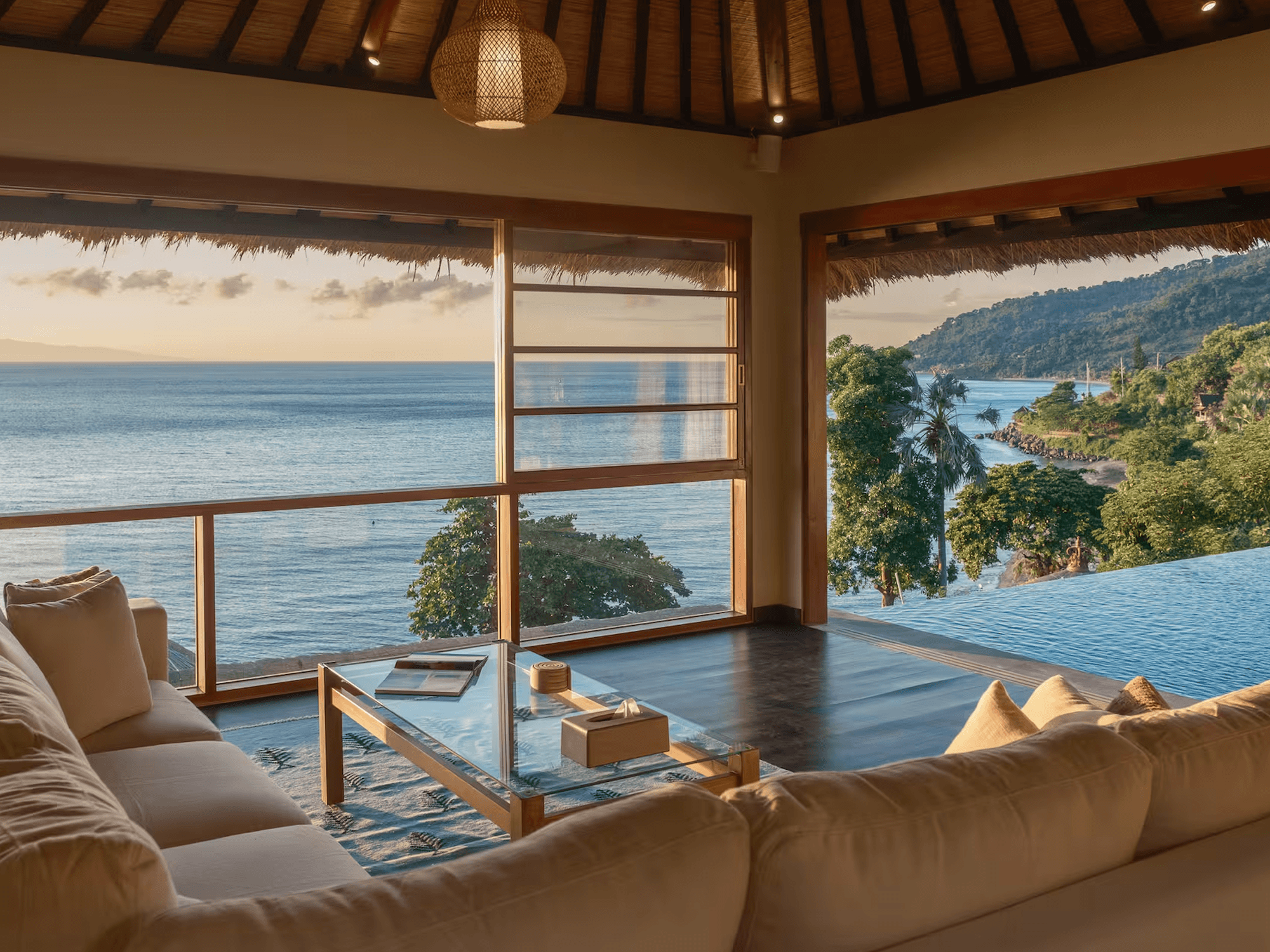
Furniture is frequently custom-designed to optimize space and guarantee maximum stability. Low sofas, beds oriented directly toward the windows, and integrated shelving aim to maintain a low visual profile, avoiding any obstruction of the line of sight toward the aquatic horizon. Artificial lighting is planned with extreme care to minimize reflections on the glass at night, allowing the interior to visually merge with the darkness of the water and the celestial vault.
- Priority use of natural materials resistant to saline or fluvial corrosion.
- Bioclimatic orientation to harness natural cross-ventilation over the water’s surface.
- Suppression of excessive dividing elements to foster spatial continuity.
- Warm, subdued lighting systems oriented toward nocturnal integration with the environment.
This minimalist approach does not seek punitive austerity, but mental clarity. By eliminating the visual noise of the interior, the traveler can concentrate on the subtle events of the aquatic environment: the shifting reflection of clouds on the ceiling, the wake left by a fish, or the rhythmic sound of rain striking directly upon the surrounding water’s surface.
Sustainability and Respect for Aquatic Ecosystems
Dwelling on water entails an inescapable environmental responsibility. Contemporary floating structures located in protected natural enclaves must comply with rigorous regulations to ensure their presence does not alter water quality or interfere with the biological corridors of local fauna. Waste management, greywater and blackwater treatment, and the use of renewable energies are critical aspects in the design of these spaces.
Many of these accommodations incorporate advanced solar panel systems integrated into roofs and rainwater harvesting technologies. Furthermore, the use of non-invasive floating foundations—avoiding the massive driving of metal or concrete piles into sensitive seabeds—allows underwater flora, such as macroalgae meadows, to continue receiving sunlight and fulfilling their essential ecological function in carbon capture and water oxygenation.
The contemporary traveler increasingly values this ecological coherence. It is no longer enough for a space to offer sophisticated aesthetics or a privileged location; transparency regarding its environmental footprint is demanded. Operators of these floating retreats typically provide detailed information on their conservation practices, indirectly educating the guest about the fragility of the aquatic ecosystems they are temporarily inhabiting.
Water as Therapy: Silence and Disconnection
Beyond architecture and sustainability, the irresistible attraction toward these floating accommodations lies in their proven capacity to induce states of deep relaxation. Environmental psychology has demonstrated in numerous studies that proximity to water—the so-called blue space—significantly reduces cortisol levels, lowers blood pressure, and stimulates brain activity associated with creativity and introspection.
The continuous murmur of water acts as a natural white noise that masks the harsh sounds of modern life, facilitating the transition toward more restorative sleep. This acoustic and visual disconnection is the true contemporary luxury. Instead of screens and constant notifications, the guest faces the uninterrupted contemplation of water movement, an exercise in mindfulness that occurs spontaneously without the need for guided meditation techniques.
Suspension over water operates as a psychological truce, an interlude where time loses its usual velocity and priorities naturally realign.
This isolation should not be understood as an experience of deprivation, but as a reunion with primary biological rhythms. By synchronizing rest with the sunrise and sunset over the liquid surface, the body recovers sleep-wake patterns that urban artificial illumination frequently disrupts.
Vernacular Architecture and Contemporary Reinterpretation
The idea of living on water is not an invention of contemporary design. Entire civilizations have built their homes on lakes, rivers, and estuaries for millennia, from prehistoric pile dwellings in the European Alps to the floating communities of Southeast Asia and Lake Titicaca in South America. What sets the modern floating retreats highlighted in international travel publications apart is the technological reinterpretion of this vernacular wisdom.
While traditional water architecture primarily responded to survival needs, defense, or proximity to fluvial trade routes, the current version prioritizes aesthetic experience, thermal comfort, and mindful landscape contemplation. However, today’s most insightful architects recover ancestral construction principles: precise elevation above maximum flood levels, the use of breathable local materials, and the integration of passive ventilation systems that harness the cool breezes generated by water evaporation.
This historical continuity enriches the traveler’s experience, who not only inhabits a cutting-edge design space but connects, through construction form, with a millennia-old tradition of human adaptation to the liquid medium.
Practical guide
Planning a stay in a floating retreat requires keeping in mind a series of specific logistical considerations that differ markedly from booking a conventional hotel or an urban apartment.
How to get there: Most floating accommodations are located in secluded settings. In regions like Washington state, access typically requires a car journey followed by a short trip on a private boat or seaplane. Coordinating transfers with property managers well in advance is essential.
When to visit: The ideal season depends on the purpose of the trip. If absolute isolation and the contemplation of misty landscapes are desired, autumn and winter months offer a unique atmosphere. For outdoor activities like kayaking, swimming, or wildlife viewing, summer months are highly recommended.
Recommended packing: Due to space limitations on access boats and the floating nature of the structures, traveling light with flexible bags (preferably duffels or backpacks rather than rigid wheeled suitcases) is advised. Non-slip nautical footwear and layered waterproof clothing are essential.
Code of conduct: These spaces operate under strict environmental regulations. Discharging any substance into the water is strictly prohibited, the use of biodegradable toiletries is encouraged, and rigorous respect for wildlife tranquility and neighboring residents is expected.
The Final Reflection: The Poetry of the Liquid Threshold
As evening falls, when daylight slowly fades and the water’s surface adopts a metallic, dark texture, the floating retreat transforms into a solitary lantern over the landscape. In that precise instant, architecture ceases to be a physical object and becomes a state of mind. The distance between the shore and the floating platform—barely a few meters of dark water—is perceived as a protective abyss separating the active world from absolute stillness. It is on that threshold where travel acquires its true meaning: not in the accumulation of visited destinations, but in the ability to find, amid the immensity of water, a place of one’s own from which to observe the world with profound serenity.
Source in EN: Condé Nast Traveler – 11 Airbnbs Around the World That Are Practically Floating on Water (https://www.cntraveler.com/gallery/airbnbs-around-the-world-that-are-practically-floating-on-water)