
The Origins of a Railway Suspended Between Myths and Gorges
The history of the Pelion railway does not respond to the whims of modern tourism, but rather to an urgent economic necessity forged in the late nineteenth century. Designed by the Italian engineer Evaristo de Chirico —father of the celebrated metaphysical painter Giorgio de Chirico—, this metric-gauge route was conceived to connect the commercial port of Volos with the fertile villages suspended on the mountain of the centaurs. The layout demanded titanic civil engineering, overcoming impossible gradients through a mixed adhesion system and a winding path that defied rocky abysses over the Pagasetic Gulf.
Unlike Greece’s major national arteries, this line was designed from the outset on a human scale. The original carriages, made of varnished wood and reduced dimensions, were built to negotiate extremely tight curve radii. Every kilometer of track required the patient labor of local stonemasons who carved gray limestone to erect retaining walls, depressed arch viaducts, and small tunnels that today appear to sprout directly from the mountain’s geology. The landscape integration of the infrastructure is such that the passage of the convoy feels more like a natural phenomenon than a mechanical intrusion.
For decades, the train constituted the only reliable umbilical cord for transporting olives, apples, timber, and passengers who descended toward the sea or sought the cool refuge of the chestnut forests. Although the massive arrival of road transport led to its temporary closure late in the last century, the collective commitment of engineers, historians, and residents successfully rescued this jewel of civil engineering from abandonment. Today, traveling along its tracks is tantamount to stepping into a three-dimensional archive of nineteenth-century railway technology.
The Architecture of Stations and the Rhythm of Stone
The railway journey unfolds through a series of stations and stops that constitute authentic architectural landmarks. Traditional masonry buildings with black slate roofs and woodwork painted in ochre tones mark the halts along a route where time seems to have slowed its pace. In Ano Lechonia, the traditional starting point of the proper ascent, the original maintenance workshops are preserved, equipped with early twentieth-century machinery still operating via pulleys and leather drive belts.

As the convoy gains altitude, the architecture of the landscape shifts subtly. The olive groves of the coastal plain give way to terraces meticulously supported by dry-stone walls, locally known as xilies. These agricultural structures, erected without mortar, demonstrate an ancestral mastery of hydraulics and slope containment, protecting crops from torrential erosion. The train runs literally along the spine of these terraces, offering the traveler a privileged perspective on the mastery with which humanity has historically inhabited Thessaly’s rugged topography.
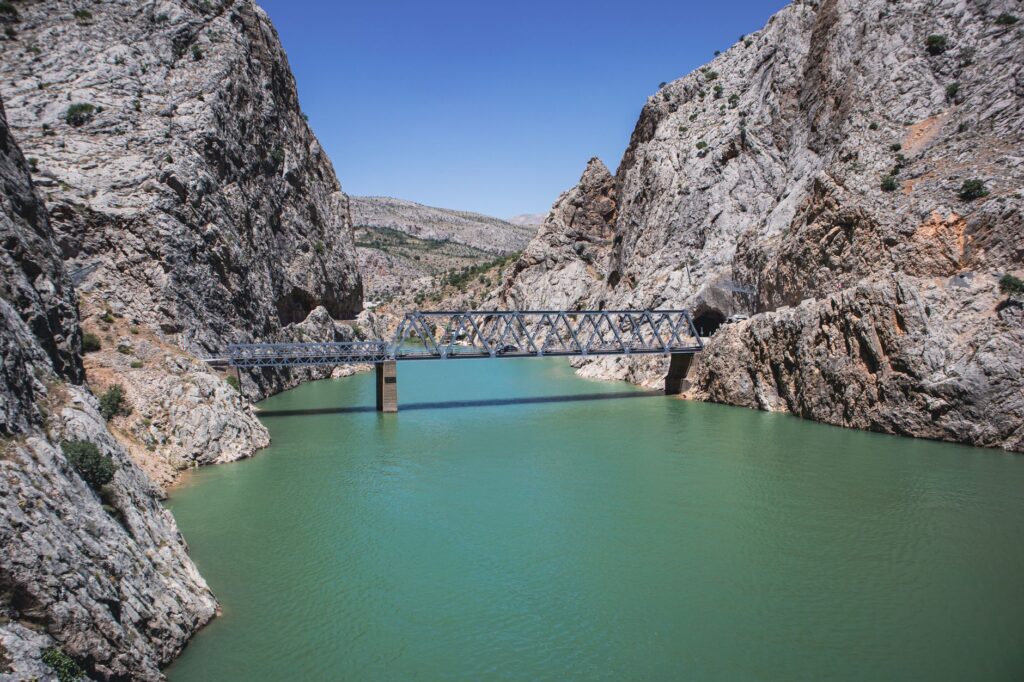
The metal bridges spanning the main ravines deserve special mention. Assembled with hot rivets and wrought iron lattice girders imported from Europe’s primary industrial centers of the era, these structures endure the passage of time and railway formations with absolute elegance. Their ongoing maintenance requires artisanal techniques that preserve structural authenticity, avoiding unsightly modern concrete additions and keeping alive the dialogue between industrial metal and millennial stone.
The Pelion metric line is not merely a restored means of transport; it is a masterclass in how nineteenth-century engineering negotiated gravity without fracturing the soul of the territory.
The Plant Geography: From the Blue Gulf to the Centaur Peaks
The ecosystem winding alongside the Pelion train constitutes one of the richest botanical corridors in mainland Greece. Starting almost at sea level, where the sea breeze impregnates the carriages with the scent of salt and Aleppo pines, the ascent gradually introduces the traveler into the domains of Mediterranean lushness. Scrublands of rockrose and mastic progressively give way to dense oriental plane forests whose monumental crowns form authentic botanical tunnels over the track.
In the intermediate sections, at mid-altitude, centuries-old chestnut trees and deciduous oaks dominate. Here, the mountainous microclimate generates constant humidity that favors the growth of ferns and mosses clinging to retaining walls. During autumn months, the landscape acquires a deep chromatic palette of ochres and deep golds that contrasts radically with the intense blue of the Aegean Sea, visible intermittently through gaps in the wooded gorges.

Local wildlife, though elusive, finds a safe haven in this protected corridor. Birds of prey soaring on thermal currents rising from the gulf are frequently sighted, alongside foxes and wild boars in the shadier zones of the journey. The leisurely pace of the train, which rarely exceeds thirty kilometers per hour, allows for serene observation of the natural environment, transforming the trip into an exercise in active contemplation far removed from the anesthetic speed of contemporary transport.
Invisible Engineering: Bridges, Tunnels, and the Historic Rack System
Understanding the technical complexity of the Pelion railway requires examining the challenges overcome by its builders along its most emblematic section, especially in the vicinity of Milies. Although much of the route relies exclusively on the natural adhesion of steel wheels to rails, the topography forced engineers to project bold solutions in certain spots to conquer severe gradients without compromising the safety of cargo and passengers.
The tunnels, excavated manually with picks and dynamite in bedrock of schist and limestone, largely lack concrete lining, leaving the geological brutality of the mountain exposed. Seepage water drains through small lateral channels carved into the stone, a rudimentary yet extraordinarily efficient system preventing moisture accumulation on the track. On the viaducts, load calculations were executed with such generous safety margins that the original metal structures remain operational after more than a century of uninterrupted service.
Maintaining this infrastructure requires specialized crews who manually inspect the condition of screw spikes, hardwood sleepers, and the micrometric leveling of rails. This railroad goldsmithing work ensures that the journey retains its characteristic vibration, a dull and rhythmic clatter connecting the passenger to the physical materiality of ancient mechanical displacement.

Life at the Stops: Local Economy and Living Memory
Each stop along the route functions as a thermometer of social vitality within mountain communities. In stations like Drakeia or Mines, residents and small producers maintain a symbiotic relationship with the passing train. This is not a folkloric recreation intended for passive visitor consumption, but rather the survival of daily dynamics where the convoy continues to play a structuring role for regional cohesion.
On the platforms, the aromas of local aromatic herbs —such as mountain orchid and mountain tea (Sideritis)— blend with the characteristic scent of burnt coal and lubricating oil emitted by historic locomotives. Local artisans take advantage of brief stops to display products derived from traditional harvesting, ranging from chestnut preserves to wild berry liqueurs crafted according to recipes passed down through generations.
This human-scale economy contrasts sharply with standardized tourist flows. The traveler disembarking at Milies, the final station of the route, finds no impersonal hotel complexes, but rather a network of stone manor houses converted into small family-run accommodations where hospitality responds to traditional codes of reciprocity and mutual respect.
Preserving a railway line of this nature is not an exercise in inert nostalgia, but a lucid commitment to mobility models where travel recovers its condition as a significant experience.
Practical guide
Planning a journey on the historic Pelion railway requires understanding its seasonal nature and unique operation, conditioned by heritage preservation.
How to get there: The natural gateway is the city of Volos, located about three and a half hours by car or bus from Athens or Thessaloniki. Volos also features a small international airport with seasonal connections.
Schedule and operations: The historic train typically operates on weekends from spring through late autumn, alongside reinforced daily frequencies during peak summer months. It is essential to check updated official schedules on the Hellenic Train website before planning your visit.
The journey: The full line connects the Ano Lechonia station with the picturesque village of Milies. The trip takes approximately ninety minutes each way, covering a distance of twenty-nine kilometers marked by bridges and tunnels.

Recommended accommodations: Overnight stays are advised in rehabilitated traditional stone houses (xenones) in villages such as Milies, Vizitza, or Pinakates, where stone and wood architecture remains intact.
Local gastronomy: Essential to try spoon dishes prepared with mountain garden produce, wood-oven braised meats, and traditional spetsofai (local sausages with peppers and tomatoes).
Safety regulations: During the journey, leaning excessively out of windows is strictly prohibited due to the narrowness of certain tunnels and the proximity of tree vegetation to the sides of the convoy.
The Echo of the Whistle Among Centenarian Chestnuts
When the sun begins to decline behind the peaks of Mount Pelion and the last rays of light pierce the chestnut canopy, the train embarks on its return journey toward the coast. At that precise instant, the metallic roar of the locomotive merges with the eternal murmur of water descending through mountain streams. Seated beside the weathered wooden window, one realizes that the true magnitude of this journey lies not in the distance covered, but in the capacity of slowness to restore the traveler’s consciousness of inhabited space. The final whistle, prolonged and melancholic, echoes across the valleys as a reminder that authentic modernity sometimes consists of knowing how to preserve the unhurried rhythm of the world.