Introduction to the Vegetal Sanctuary of Western Kyoto
On the western fringe of Kyoto, where the urban grid yields to the steep slopes of the Atago mountain range, lies a territory where time appears to be measured by the oscillation of bamboo stalks. The Arashiyama district is neither a mere postcard enclave nor an aesthetic refuge for visitors seeking the stereotypical image of traditional Japan; it is, in its biological and social architecture, a complex wellness ecosystem where nature and human intervention have engaged in dialogue for over a millennium. Far from the hustle and bustle of major urban temples, this green labyrinth offers a masterclass in how physical space can directly influence human neurobiology, reducing cortisol levels and reordering vital rhythms through sensory immersion.
The genesis of this landscape does not stem from the caprice of spontaneous forestry, but rather from meticulous planning initiated during the Heian period, when the imperial aristocracy chose these river foothills to erect their villas for recreation and contemplation. Today, experiencing its main trails and venturing into the surrounding forests demands a gaze that looks beyond mass tourism. It requires understanding the structure of the moso bamboo—a species introduced from China in the 9th century—whose physical flexibility is the exact counterpart of a philosophy of life rooted in resilience and detachment. This report examines the invisible infrastructure sustaining this natural sanctuary, from the hydraulic engineering of its riverbeds to modern research on forest bathing, or shinrin-yoku.
The Vegetal Architecture of Moso Bamboo and Its Sensory Impact
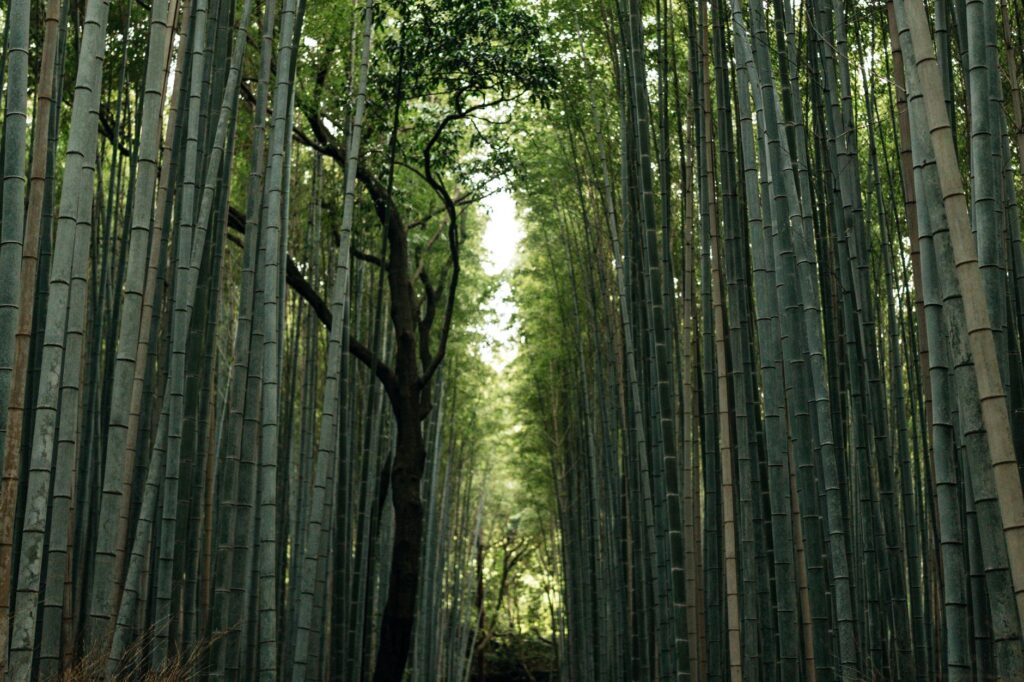
The most immediate element capturing the traveler’s senses is the relentless verticality of the moso bamboo stalks, which can reach twenty-five meters in height and cast a greenish gloom of near-sacred quality. Unlike the deciduous forests of Central Europe or the boreal firs, the Arashiyama forest functions as a natural acoustic resonator. The density of the culms and the absence of low branches allow the wind to blow through them, generating a characteristic murmuring sound—a low-frequency acoustic profile that studies have shown capable of inducing alpha brainwaves in humans, associated with deep relaxation and meditation.
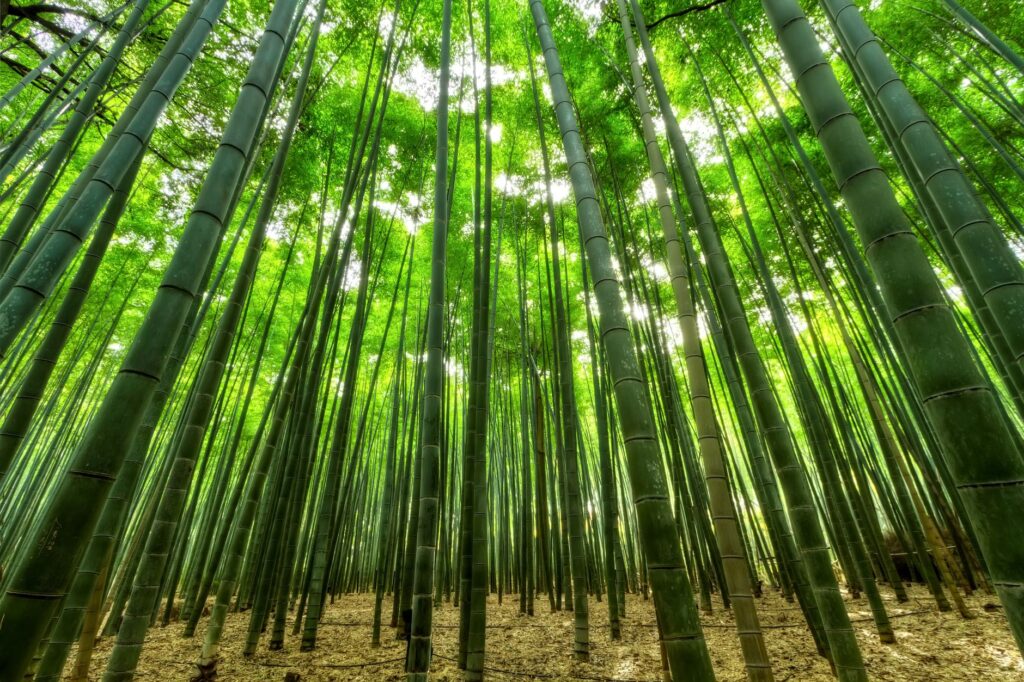
This phenomenon is not merely poetic; it possesses a rigorous botanical basis. Each moso stalk is composed of nodes and internodes reinforced with silica fibers, granting it rigidity combined with an extreme bending capacity in the face of typhoons periodically lashing the Japanese archipelago. For the traveler walking along the paved central path, the sensation of smallness before these vegetal columns acts as an immediate cognitive disconnect. The filtration properties of sunlight through dense foliage eliminate harsh glares, creating a lighting environment that stabilizes circadian rhythms and mitigates visual fatigue accumulated from modern screens.
Hydraulic Engineering and Management of the Hozu River
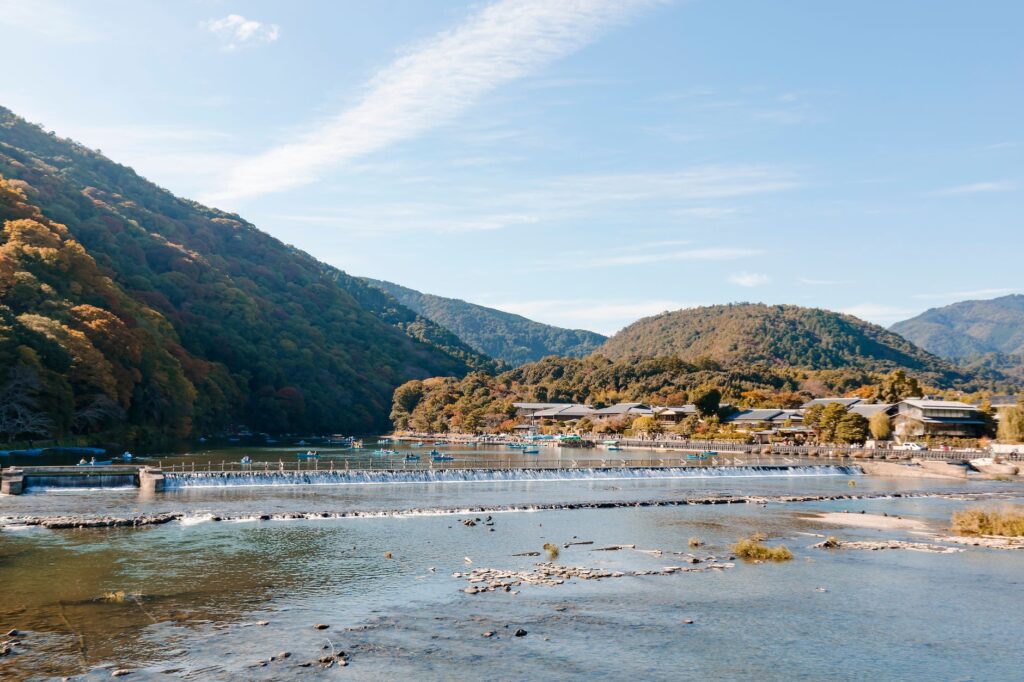
It is impossible to understand the ecological stability of Arashiyama without analyzing its umbilical relationship with the Hozu River, whose current carves the rocky canyon emptying into the famous Togetsukyo Bridge. For centuries, seasonal floods and drought periods threatened both human settlements and the fragile soils where the bamboo takes root. The historical response was pioneering hydraulic engineering combining dry-stone containment with the channeling of secondary ditches to ensure constant subsurface moisture without causing waterlogging lethal to surface roots.
Traditional dikes, locally known as hoku, were designed using granite blocks fitted together without mortar, allowing water to filter in a controlled manner and nourish the water table. This ancestral technique prevents massive erosion of clay slopes and ensures that the forest microclimate maintains optimal relative humidity during scorching Japanese summers. Modern forestry engineers continue to utilize these exact low-intervention criteria for maintaining drainage routes, proving that sustainability requires no invasive technologies, but rather a deep understanding of local fluvial dynamics.
The Spiritual Renaissance: Temples and the Wandering Monk Tradition
The cultural fabric of Arashiyama is deeply intertwined with Zen Buddhism and the Rinzai school. On the fringes of the bamboo forest stands the Tenryu-ji temple complex, founded in 1339 by Shogun Ashikaga Takauji to honor the memory of Emperor Go-Daigo. Its surrounding garden, designed by master Muso Soseki, integrates Mount Arashiyama itself as part of a landscaping technique called shakkei, or borrowed scenery. For monks inhabiting these enclosures, bamboo was not merely timber, but a living metaphor for moral rectitude combined with spiritual flexibility: bending before adversity without ever breaking.
The historical practice of meditative walking—known as kinhin—found in these paths the ideal setting for introspection. Unlike the static stillness of zazen, slow movement among the vertical trunks forced practitioners to maintain mindfulness with every footstep, synchronizing respiration with the rustle of bamboo leaf litter. Today, this spiritual heritage translates into wellness programs designed for international visitors seeking digital detox, substituting electronic notifications for the syncopated beat of nature.
Artisanal Economy and the Materiality of Green Timber
Beyond its contemplative value, the Arashiyama forest has sustained for generations an artisanal industry based on the transformation of bamboo. Local workshops, discreetly distributed along the alleys climbing toward Gio-ji Temple, process moso to manufacture everything from delicate ceremonial fans to kitchen utensils, high-precision baskets, and fishing rods. This proximity economy ensures an annual selective harvest indispensable for the ecosystem’s health: if mature stalks were not extracted regularly, the understory would choke from lack of light, and new shoots would lose the strength required to emerge in spring.
Bamboo timber is never harvested in haste; it is selected according to its lunar cycle and summer hardness, reminding the artisan that true mastery lies in listening to the rhythms of the earth before applying the tool.
The curing process for green timber involves a thermal treatment eliminating the natural starch within the fibers, preventing wood-boring insect attacks without industrial chemical agents. This know-how, passed down from parents to children in Kyoto’s artisanal guilds, constitutes intangible heritage as valuable as the region’s historic monuments. The traveler who purchases a piece of basketry in Arashiyama is not merely buying a commercial souvenir, but a fragment of a sustainable operational chain functioning uninterrupted since the Edo period.
The Modern Science of Shinrin-yoku on Kyoto’s Trails
In recent decades, the traditional concept of walking through the forest has undergone rigorous scientific validation by Japanese university institutions, transforming enclaves like Arashiyama into living laboratories of preventive medicine. Shinrin-yoku, or forest bathing, is not an aerobic fitness hike, but rather a conscious opening of the five senses to the biochemical stimuli of the forest environment. Neurobiological research has demonstrated that bamboo trees and surrounding conifers emit volatile organic compounds called phytoncides—antimicrobial substances plants secrete to protect themselves from pathogens, which, when inhaled by humans, stimulate Natural Killer (NK) cell production in the immune system.

Likewise, cardiological studies conducted with visitors on these trails record significant drops in systolic blood pressure and a drastic reduction in blood adrenaline levels after barely forty-five minutes of immersion. In a country that coined the term karoshi—death by overwork—the forests of western Kyoto operate as a premier public health infrastructure. Local authorities strictly regulate daily visitor flow precisely to preserve this low acoustic and atmospheric pollution atmosphere, conscious that the therapeutic value of the place evaporates the moment massification thresholds are exceeded.
Practical guide
How to get there: The most efficient access from central Kyoto is the JR Sagano (San-in) line to Saga-Arashiyama station, a fifteen-minute journey from Kyoto Central Station. Alternatively, the Randen electric tram connects the Shijo-Omiya neighborhood directly to Arashiyama station in about twenty-two minutes.
When to go: The most recommended time window to enjoy the bamboo forest without crowds is between 6:00 AM and 7:30 AM, before organized tour buses arrive. Spring (April) and autumn (November) offer the most intense chromatic contrasts, though winter provides an atmosphere of unmatched silence.

Code of conduct: Touching, carving, or scratching bamboo trunks is strictly prohibited. Local authorities impose financial penalties on anyone damaging the bark, as any incision exposes the plant to fungal infections that can ruin entire specimens.
Accommodation and gastronomy: The district features traditional ryokan inns offering stays with seasonal kaiseki dinners, including fresh bamboo shoots prepared in spring and artisanal tofu made from the pure water of the Hozu basin.
Epilogue: The Intangible Echo Remaining Upon Departure
When the sun dips behind the ridges of the Atago mountain range and shadows lengthen over the main path, the Arashiyama forest reclaims its original sovereignty. Tourists have departed toward the illuminated asphalt of the big city, and in the cool evening air, only the rhythmic rustling of the culms in sync with the river breeze remains. In that moment of suspension, the traveler understands that the true wealth of this sanctuary lies not in its digital photogenicity, but in its capacity to remind us of the fragility of our internal rhythm. Bamboo does not resist the hurricane by standing with unyielding rigidity; rather, it bends its column until it brushes the earth, rising again intact once the storm has passed. An ancient lesson inscribed in green timber that continues to beat, unaltered, deep within the green heart of Japan.