
In western Zurich, Switzerland, District 10 occupies a strip of land that for decades was synonymous with industrial work and is now one of the city’s most interesting urban laboratories. Here, among brick warehouses, railway tracks and recent housing blocks, the question is not how to forget the industrial past but how to inhabit it without turning it into a stage set.
The result is a neighborhood of contrasts: cranes and scaffolding next to urban gardens, new schools in the shadow of old chimneys, and everyday life that mixes accents, trades and generations. For the visitor, Zurich West is not an open-air museum but a place where design and memory are negotiated every day.
A district defined by what it keeps
District 10 is not the postal center or the historic core along the Limmat. It is the area stretching west beyond the main station, grouping neighborhoods such as Wipkingen, Höngg, Industriequartier and Altstetten. Its identity has been built on an unusual mix: proximity to the river, the presence of major railway infrastructure and a tradition of workshops and factories that shaped urban development for much of the 20th century.
That heritage has not disappeared. It remains visible in the scale of some buildings, in inner courtyards, in street names and in the way the neighborhood organizes itself around work and transport. What has changed is the use: many of those structures have been converted into housing, offices, art schools, design studios and cultural spaces.
The industrial memory of Zurich West is not preserved as a museum piece: it is negotiated in every new housing project and in every workshop that opens its doors.
From workshop to housing: a transformation without erasure
The growth of District 10 has been steady in recent decades, but it has not followed a single pattern. In some areas, the conversion of industrial warehouses has produced lofts and offices; in others, new housing blocks have been built with sustainability and social mix criteria. The key, according to those who study Zurich’s urbanism, is that the city has maintained an active land and affordable housing policy that has prevented a total displacement of long-term residents.
That does not mean there are no tensions. Land prices have risen, and some traditional trades have had to look for cheaper premises outside the district. But the visible result is a neighborhood that still retains a mix of uses rare in other European cities: next to an architecture studio there may be a mechanical workshop, and next to a neighborhood bakery, a coworking space.
Architecture you read in layers
To understand Zurich West, it helps to walk slowly and look up. Early 20th-century industrial buildings, with their large windows and steel structures, sit alongside residential buildings from the 1950s and 1960s, and with more recent interventions using wood, exposed concrete and green roofs. That mix of scales and materials is one of the district’s hallmarks.
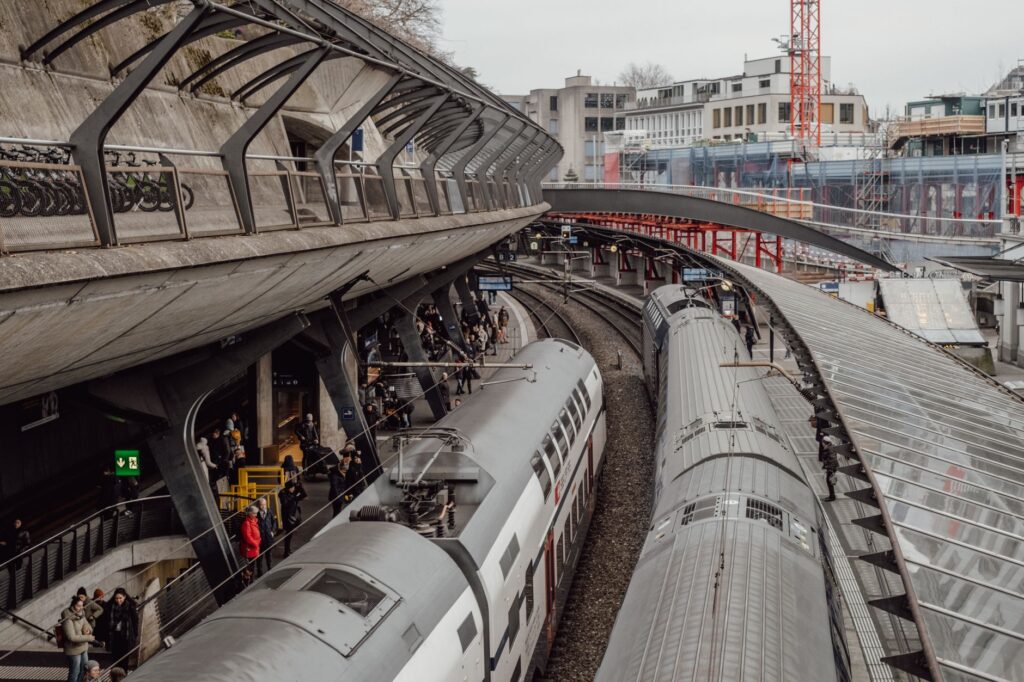
A good starting point is the area near Zurich Hardbrücke station, where the railway network and new office buildings intersect with residential streets. Further west, in Altstetten, the landscape changes: active industrial estates, shopping centers and a more open urban fabric appear. And in Höngg, the district becomes almost rural, with vineyards and orchards that recall that until a few decades ago this was a transition zone between city and countryside.
What to look for in each sector
- Industriequartier: converted warehouses, design schools and cultural spaces in former workshops.
- Wipkingen: medium-scale housing, neighborhood shops and proximity to the Limmat river.
- Altstetten: active industrial estates, shopping centers and a mix of new and traditional housing.
- Höngg: vineyards, orchards and a transition toward the canton’s rural landscape.
Design that is not displayed, but used
In Zurich West, design is not behind museum glass but in street furniture, signage, public benches and the way building entrances are organized. The Swiss tradition of functionality and precision shows in small details: handrails, lighting, neighborhood maps and public transport signage.
There is also an active cultural scene that reinterprets that legacy. Ceramics workshops, printmaking studios, exhibition spaces in former shops and public art projects coexist with the neighborhood’s daily life. It is not a closed tourist circuit but a dispersed network that visitors discover by walking and reading the signs on facades.
The everyday design of Zurich West does not seek to impress: it seeks to work. And much of its cultural value lies in that discretion.
Everyday life: markets, schools and squares
District 10 has a neighborhood life organized around schools, weekly markets and squares. In Altstetten, for example, the fresh produce market and occasional fairs are a good place to observe the mix of residents: young families, industrial workers, students and older people who have lived there all their lives.
Food also reflects that diversity. Alongside traditional Swiss bakeries are Portuguese, Italian, Turkish and Balkan restaurants, a legacy of the labor migration that arrived in the district in the second half of the 20th century. It is not a neighborhood of fine dining but of honest food at reasonable prices, something visitors appreciate after a day of walking.

Industrial heritage: what is kept and why
The preservation of industrial heritage in Zurich West has not been automatic. For years, many warehouses were considered obsolete and came close to demolition. Neighborhood pressure, the interest of architects and the real estate market’s own evolution have allowed some structures to be kept and converted.
Today, buildings such as the former railway workshops or some factories turned into cultural spaces bear witness to an era when manual labor and industrial production defined the urban landscape. Their value lies not only in the architecture but in what they tell us about the city’s social history: who worked there, under what conditions and how that activity transformed the territory.
How to visit without harming the neighborhood
Zurich West is not a mass destination, and that is part of its charm. For visitors, the best way to explore it is on foot or by bicycle, using public transport for longer trips. It is advisable to avoid peak hours at stations and to respect residential spaces, which are not a tourist stage.
It is also worth checking local cultural events before traveling, as many workshops and art spaces open only on specific dates. And, as in any neighborhood in transformation, curiosity should be accompanied by respect for the daily life of those who live there.

A possible one-day route
- Morning: walk through Industriequartier and the Hardbrücke area, with stops at open cultural spaces.
- Midday: lunch at a neighborhood restaurant in Altstetten or Wipkingen.
- Afternoon: walk toward Höngg to see the transition to the rural landscape and vineyards.
- End: return by tram or train from one of the district’s stations.
Practical guide
Getting there: District 10 is well connected by train (Hardbrücke and Altstetten stations) and by several tram and bus lines linking it to central Zurich. Swiss public transport is punctual and allows combining trips without depending on a car.
When to go: spring and autumn are good seasons for walking, with mild temperatures and fewer tourists. Summer offers terraces and outdoor events, while winter is quieter but requires appropriate clothing.
What to bring: comfortable shoes, a reusable water bottle and a district map or guide. In Switzerland, card payment is common, but it is worth carrying some cash for small shops.
Where to eat: neighborhood restaurants in Altstetten and Wipkingen offer varied cuisine at more affordable prices than in the center. It is advisable to book at smaller places on weekends.
A respectful tip: many converted buildings are private homes or workspaces. Before entering or taking photos, check whether access is public and avoid disturbing residents.
A neighborhood you read by walking
Zurich West offers no single postcard or iconic monument. Its appeal lies in the accumulation of layers: the factory that became a school, the workshop that is now a design studio, the square where generations and accents cross. It is a place best understood on foot, with time and without the urgency of a must-see list.
For travelers interested in culture and design, District 10 is a lesson in how a city can transform its heritage without erasing its memory. It is not a perfect example or a model free of tensions, but it is a place where local identity is still being written, brick by brick, in western Zurich.