
A runway between water and hillside
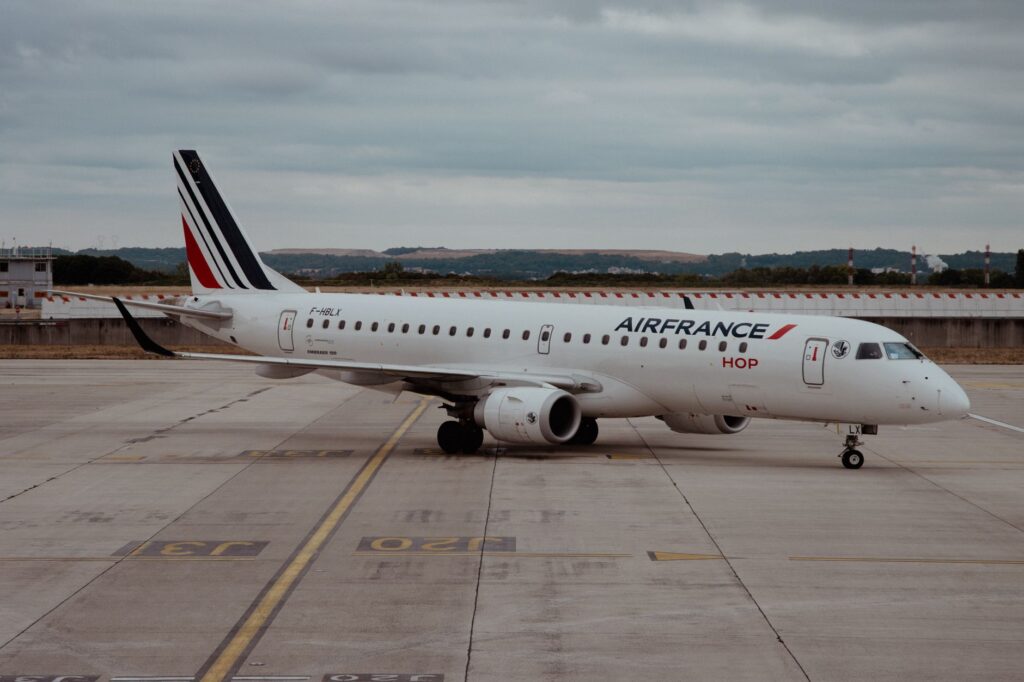
Toulon-Hyères Airport occupies a strip of land carved out of the coastal landscape of the Var, in southeastern France. A few kilometres from the centre of Toulon, the terminal presents itself as a discreet, compact infrastructure that nonetheless fulfils a precise function: connecting this part of Provence with the rest of Europe without turning the journey into a mass experience.
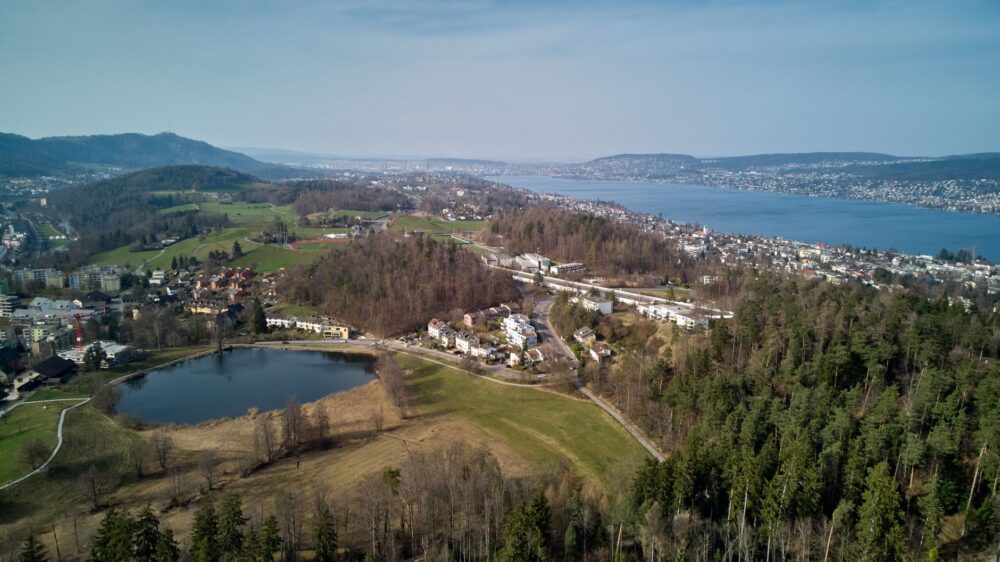
Arriving by air reveals an airport that does not compete with the large hubs of Nice or Marseille. Its scale is different. The runway, surrounded by Mediterranean vegetation and close to the coastline, imposes a direct relationship with the territory: the traveller lands and, within minutes, is on a road leading to Hyères, Toulon or the beaches of the Giens peninsula.
The terminal does not aspire to be a destination in itself; its value lies in minimal friction with the city and the landscape around it.
That restraint has practical consequences. Waiting times are short, internal movements are straightforward, and signage retains the clarity typical of French regional airports. For travellers who value efficiency over spectacle, Toulon-Hyères offers a lesson in sobriety.
The architecture of a human-scale terminal
The main building follows the conventions of late twentieth-century European airport architecture: low volumes, light roofs and a layout that prioritises natural light. There are no grand atriums or endless corridors. The plan is organised around a central hall from which check-in, security controls and boarding lounges are accessed.
This simplicity is not a flaw but a decision consistent with traffic volume. The airport mainly handles short- and medium-haul flights, with marked seasonality: summer concentrates the highest activity, while winter reduces operations and restores an almost domestic rhythm to the building.

Materials and climate
The materials — concrete, glass, metal structures — age with dignity under Mediterranean light. Waiting areas seek the outdoors through large windows that frame the sky and vegetation. On clear days, the passenger experience incorporates an element that other airports lose: awareness of the landscape.
The terminal does not hide the place where it stands. That transparency, more sensory than technological, defines much of its character.
Toulon, a city of sea and navy
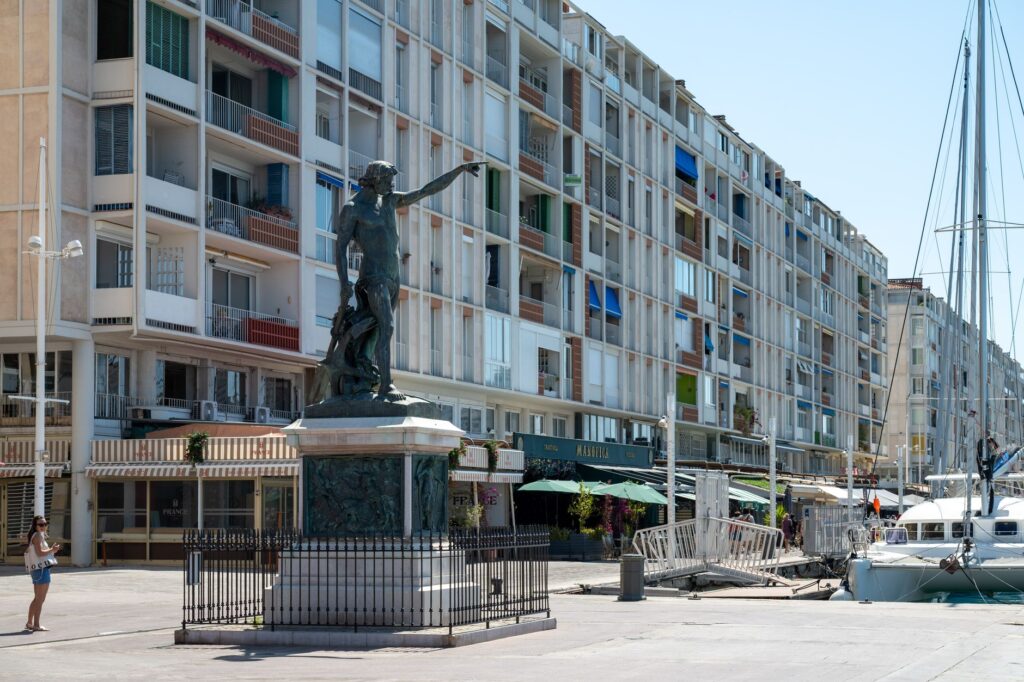
To understand the airport, one must look at the city it serves. Toulon is one of France’s main naval bases, home to the Mediterranean fleet, and its urban history is marked by that military condition. The port, the harbour and the shipyards have shaped the city’s economy and physiognomy for centuries.
The historic centre, partly rebuilt after the bombings of the Second World War, retains a layout of narrow streets, Provençal markets and a daily life that does not revolve around tourism. Visitors arriving via the airport discover a working city, with popular neighbourhoods and an intense relationship with the sea.
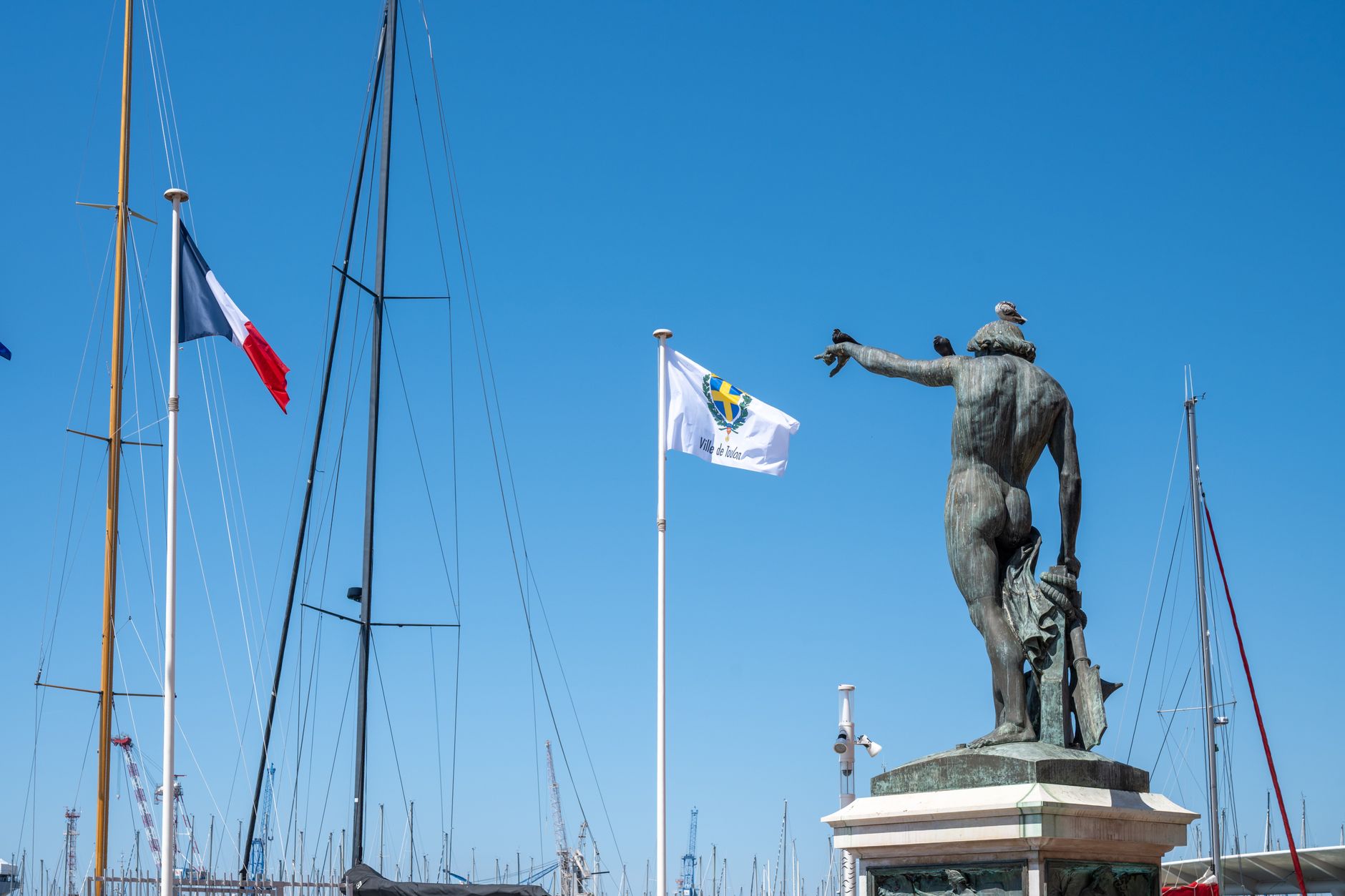
Toulon does not offer itself as a postcard; it offers itself as a city that keeps functioning every day of the year.
That authenticity has growing value in the context of Mediterranean tourism, saturated elsewhere along the coast. The airport, by maintaining a moderate scale, helps prevent that pressure from overflowing.
The link with the territory: Hyères, Giens and the islands
The airport takes its name from Hyères, a neighbouring municipality with its own identity. Hyères is one of the gateways to the Giens peninsula, an arm of land reaching into the Mediterranean from which the islands of Porquerolles, Port-Cros and Le Levant are accessed.
The connection between the airport and these destinations is one of the practical reasons for its existence. Travellers seeking nature, hiking and less crowded beaches find in this area a balance difficult to find on the more publicised Côte d’Azur.
- Porquerolles: the largest island in the archipelago, with trails and regulated-access beaches.
- Port-Cros: a marine national park with strict conservation rules.
- Le Levant: an island with military and natural history, more restricted for visits.
The airport thus acts as a gateway to a territory combining heritage, landscape and maritime activity. Its function is not only to transport; it also orders the arrival of visitors to a fragile space.
The passenger experience: simplicity and seasonal rhythm
Those who frequently travel through European regional airports recognise a pattern: the experience improves when the infrastructure does not try to imitate large hubs. Toulon-Hyères follows that pattern. Security is quick, distances are short, and boarding is organised without the endless queues of metropolitan terminals.
In high season, the airport adapts to increased flights with operational reinforcements but maintains its human-scale logic. In winter, the building recovers its calm, and travellers can perceive the surrounding landscape more clearly.
What to expect by season
Summer concentrates most connections with northern Europe and other French regions. Spring and autumn offer an interesting balance: pleasant weather, fewer visitors and a city operating at full capacity. Winter is quiet, with fewer flights and a more local atmosphere.
Seasonality is not a defect of the airport; it is part of its identity and its relationship with the territory.
Getting there and moving around: ground transport
The connection between the airport and Toulon is mainly resolved by road. Bus services and taxi options cover the journey in a reasonable time, although exact duration depends on traffic and time of day. Car rental is a common alternative for those planning to explore the Giens peninsula or the villages of the Var.
For travellers without a vehicle, it is advisable to plan arrival in advance and check the schedules of available transport services, as offerings may vary by season. The city of Toulon also has a railway station and an urban bus network that allows movement through the centre and neighbourhoods.
Moving around Toulon
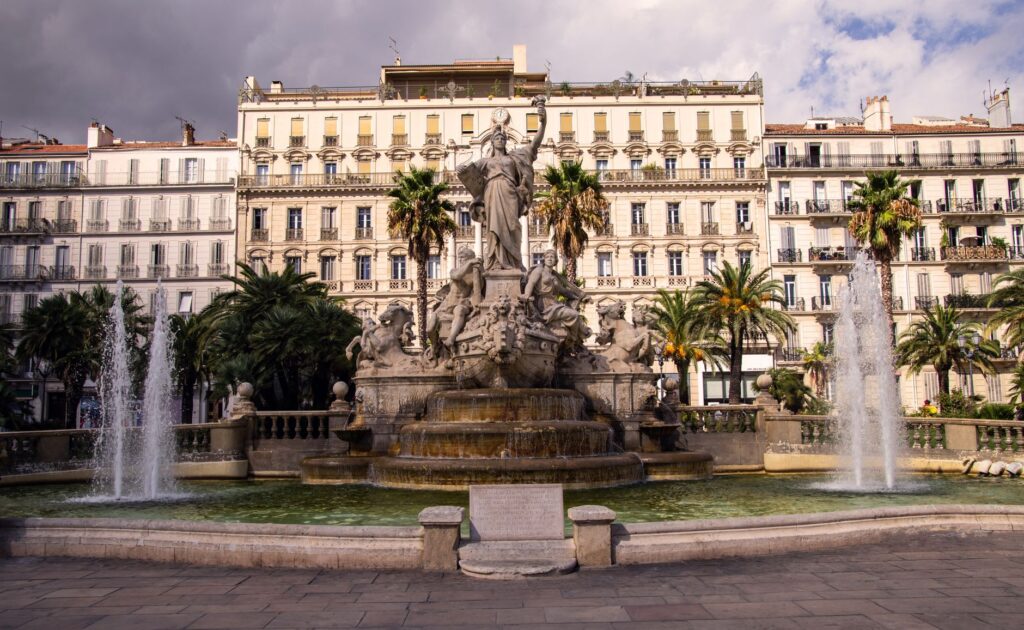
The centre of Toulon is walkable, although slopes and topography require calculating distances. The Faron cable car offers a broad view of the harbour and port, and functions as an attraction for both residents and visitors. The Cours Lafayette market is another reference point for understanding the city’s daily life.
Heritage and context: a city explained by its port
Toulon’s history is tied to the sea. Its status as a naval port has determined its architecture, economy and even the shape of its neighbourhoods. Visiting the city reveals that relationship: the arsenal, the fortifications and the National Maritime Museum are among the stops that explain the character of the place.
The airport, though modern, forms part of that same logic: an infrastructure serving a territory with its own identity, which does not need grand architectural gestures to fulfil its function.
Toulon’s air connection does not seek to compete with neighbouring large airports; it seeks to solve a specific need with precision.
Practical guide
Before travelling, it is advisable to verify flight availability and the operating season, as offerings may vary throughout the year. Toulon-Hyères Airport is a short distance from the city, but the journey should be planned according to the chosen means of transport.

- Documentation: for European travellers, a valid identity card or passport according to applicable rules; for travellers from outside the European Union, check entry requirements for France.
- Luggage: consult airline conditions and current security restrictions.
- Ground transport: check bus schedules and availability of taxis or car rental before arrival.
- Accommodation: book in advance in high season, especially if planning to visit the Giens peninsula or the islands.
- Climate: summer is hot and busy; spring and autumn offer milder conditions.
For those visiting the islands, it is advisable to learn about conservation rules and access restrictions, especially on Port-Cros. Prior planning improves the experience and respects the environment.
A stopover that invites you to look at the landscape
At the end of the journey, Toulon-Hyères Airport returns the passenger to a recognisable scale. There are no grand corridors or excessive distances; there is a terminal crossed in a few minutes and an exit leading directly to the Mediterranean landscape.
That simplicity, which in other contexts might seem a limitation, here becomes a form of discreet hospitality. Travellers arriving or departing from Toulon do not face the machinery of a large hub but an infrastructure that seems to remember that the journey begins and ends in a specific place, with its light, its climate and its history.
Toulon’s true connection lies not in the number of routes but in the coherence between what the airport offers and what the territory needs.