
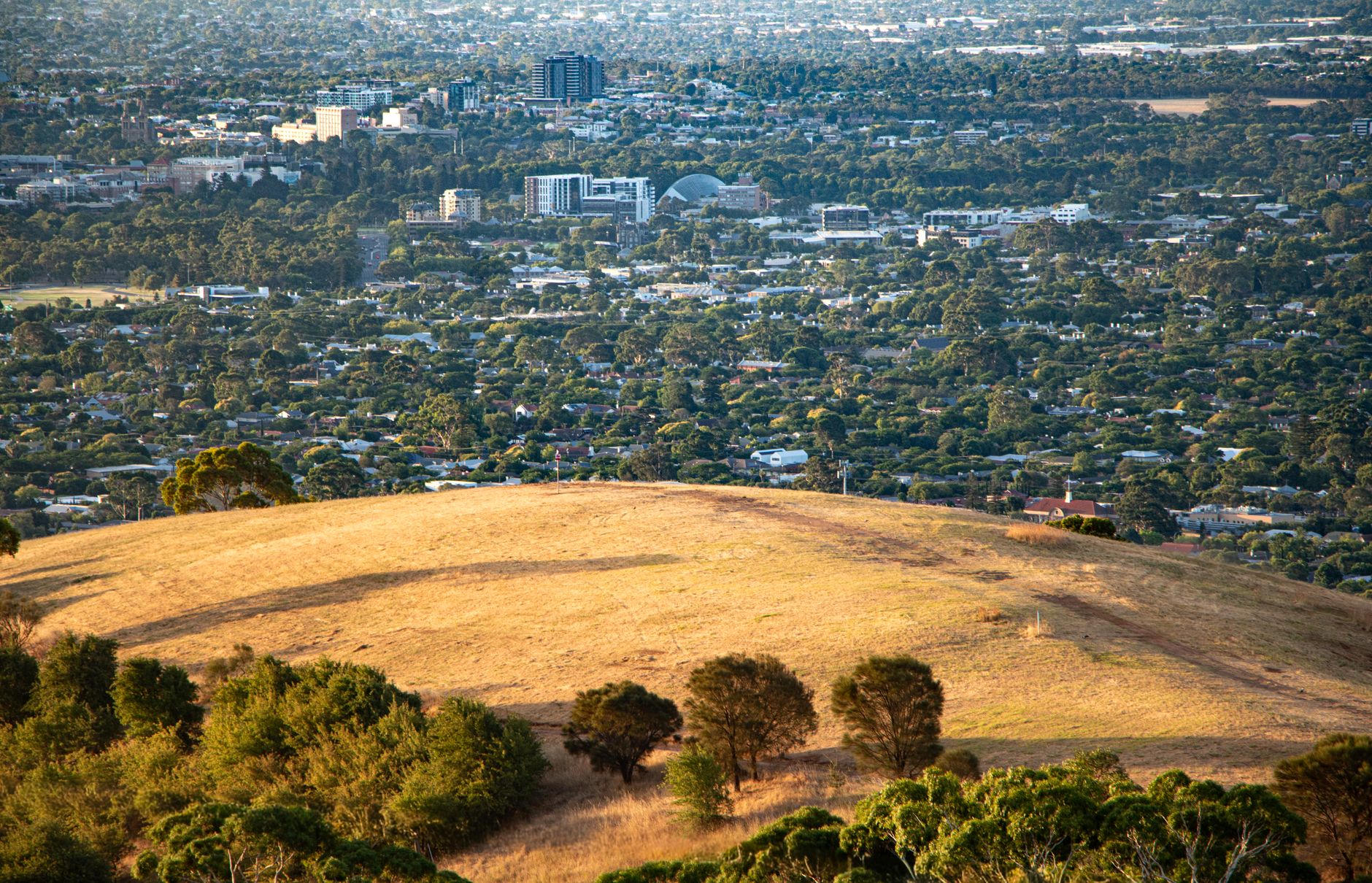

Adelaide, the capital of South Australia, occupies a gentle plain between the Gulf of St Vincent and the first foothills of the Mount Lofty Ranges. With roughly one and a half million people in its metropolitan area, the city is organised around a rectangular centre encircled by a ring of parklands and crossed by the River Torrens. That geometry is not accidental: the founding plan of 1836, designed by Colonel William Light, left a mark that still shapes the way the city is walked, lived and understood.
For the visitor, Adelaide does not present itself as a sequence of isolated monuments but as a legible city: a place where heritage, everyday life and the responsible choices of the traveller intersect over short distances. This report proposes to explore it with care, without haste and with attention to what the city says about itself.
A plan that still explains the city
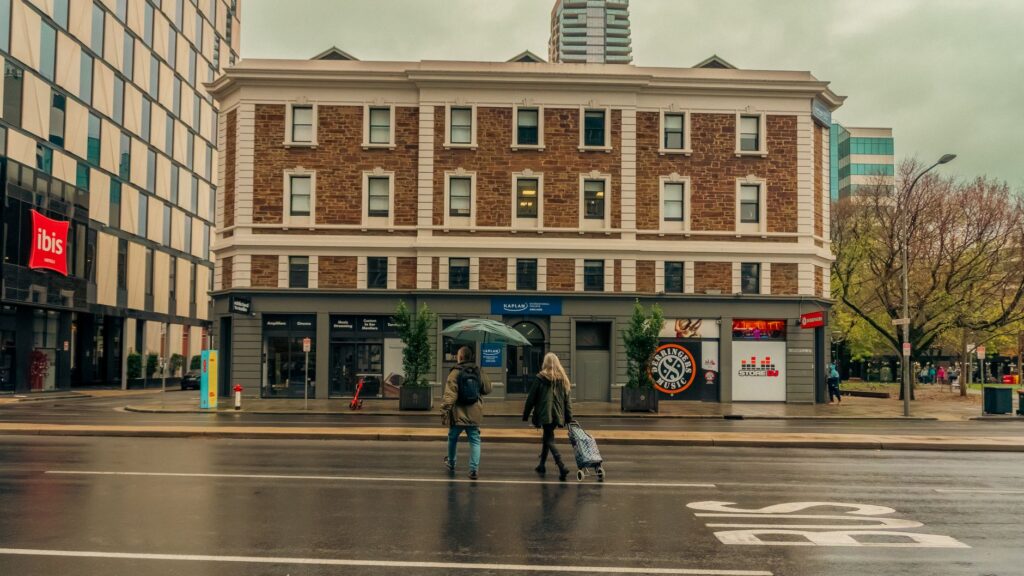
Central Adelaide is laid out on a grid of wide streets, divided by four squares and separated from the outer neighbourhoods by a belt of parklands. That nineteenth-century design still has practical consequences: walking distances are reasonable, the gaps between points of interest are short and public green space is not decoration but an infrastructure that accompanies daily life.
Walking along North Terrace, the avenue that concentrates cultural institutions, allows that logic to be read in a few minutes. The state library, the museum and the university share a pavement with administrative buildings and with the river, which opens at the end of the route. No exhaustive itinerary is needed to sense that the city was planned so that knowledge and leisure would occupy a visible place in the common space.
The grid also has a less obvious effect on the visitor’s experience: it makes orientation easy without erasing detail. Because the main axes are long and straight, side streets become invitations rather than detours, and a short walk can move from a busy commercial frontage to a quiet terrace of stone houses in a matter of minutes. That contrast, repeated across the centre, is one of the reasons the city rewards slow movement over checklist tourism.

Adelaide’s grid is not just an urbanistic fact: it is a way of distributing the time and attention of those who walk it.
Squares, statues and the public vocabulary
The four central squares and the smaller reserves scattered through the grid give the city a particular texture. They function as pauses, meeting points and shaded corners, and they carry a layer of civic memory in their monuments, plaques and planting. Reading them requires no specialist knowledge, only the habit of stopping.
Many of these spaces are modest in scale, which is precisely their value: they belong to the street rather than to the postcard. A bench under a mature tree, a fountain that marks an old boundary, a memorial that records a chapter of local history — these elements form a public vocabulary that residents pass every day and visitors can learn to recognise.
It is worth remembering that these are working public spaces, not exhibits. Picnics, games, lunch breaks and quiet reading are part of their purpose, and the traveller who uses them in the same spirit understands the city better than one who photographs them from a distance.
The central market and food as routine
The Adelaide Central Market, in the heart of the centre, has operated since the nineteenth century and remains a place of everyday shopping rather than a visitor attraction. Its aisles bring together stalls of fruit, vegetables, meat, cheese, spices and bakeries, with a mix of traditions that reflects the city’s migration history.
For the traveller, the advice is simple: arrive in the morning, when the market is at full working rhythm, and walk it without a fixed list. Buying something to eat on the spot, watching how goods are served and listening to exchanges between vendors and regular customers offers a more accurate reading of the city than any guided route. Food here is a form of daily life, not a spectacle.
The market also illustrates how migration has shaped South Australian food culture: produce, recipes and shopkeeping traditions arrived with successive communities and were absorbed into ordinary shopping habits. Approaching that history through the stalls themselves, rather than through a summary, keeps the focus on the people who keep the place running.
Parks, river and the scale of rest
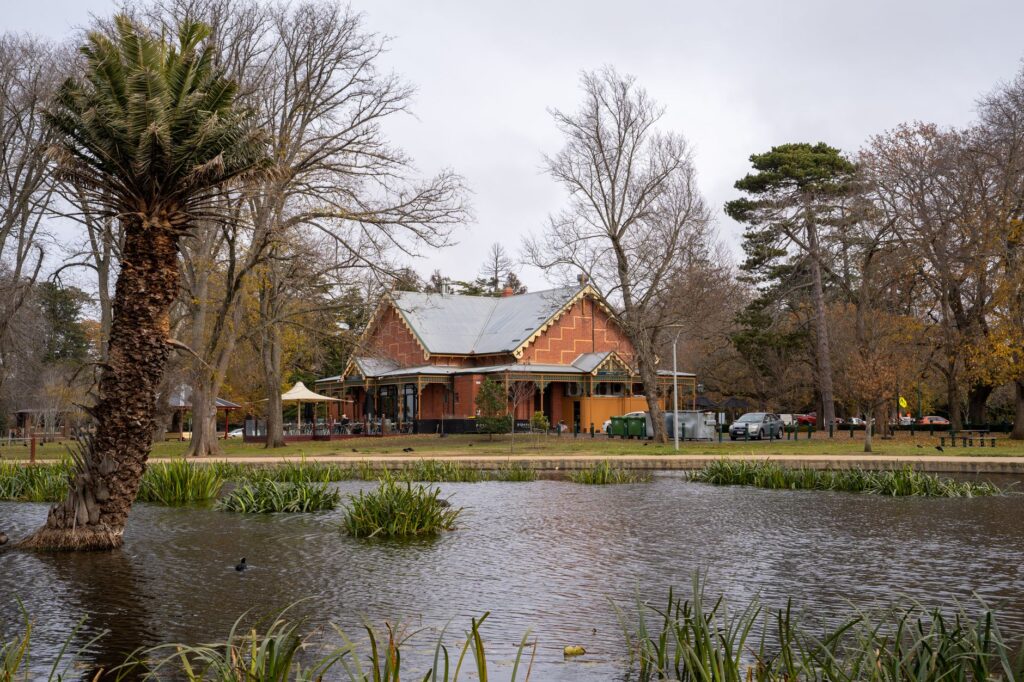
The belt of parklands around the centre is one of Adelaide’s most distinctive features. It extends as a continuous strip of green space separating the central grid from the residential neighbourhoods and offering places for shade, play and rest. The River Torrens crosses it and links a promenade that connects the zoo, the botanic gardens and the stadium.
The city has made that green edge a place of daily use: runners, families, students and office workers share the space without tourism displacing them. For the visitor, the best way to understand it is to walk or cycle through it, pause in the botanic gardens and accept that the local rhythm does not demand a strict schedule of visits.
The river itself is a useful reference point for orientation. Following it on foot reveals how the parklands stitch together institutions, sports grounds and quiet banks, and how the green belt works as a shared corridor rather than a boundary. Early morning and late afternoon are especially revealing: the parklands fill with ordinary activity, and the city’s relationship with open space becomes visible without any explanation.
Heritage without a display case: the houses and streets of the east
East of the centre, neighbourhoods such as North Adelaide and Kent Town retain stone houses, Victorian terraces and tree-lined streets that show how the city grew beyond the founding plan. They are not museum districts: they are places where people live, and that condition calls for a respectful gaze.
Walking them without intruding on residents’ privacy, looking at façades, front gardens and small local shops allows the domestic scale of heritage to be understood. The value of these streets lies not in an explanatory sign but in the continuity of a way of living.

This kind of heritage is easy to overlook because it does not announce itself. It appears in the proportion of a veranda, the material of a wall, the way a street tree shades a footpath. Visitors who slow down and keep their distance — no peering through windows, no entering private gardens — can read the city’s growth in these details without turning homes into attractions.
A cultural identity that is handed down
Adelaide has a dense cultural life for its size: festivals, theatres, concert halls and a food scene grounded in the produce of South Australia. That vitality is not concentrated only in major events but in a network of small venues and continuous programming that sustains the everyday.
Visitors can approach that scene through bookshops, cafés and independent venues in the centre and nearby neighbourhoods. The advice is to check what is on at the time and choose one or two activities rather than trying to cover the whole offer. The city is best enjoyed when it is accepted that not everything needs to be seen.
There is also a quieter dimension to this cultural life: libraries, community halls and small galleries that serve residents throughout the year. These places are not designed around visitors, and that is precisely why they offer an honest view of how the city spends its time. A brief, respectful stop — checking opening hours in advance — can be more illuminating than a rushed circuit of headline venues.
First Nations context and the public conversation
South Australia’s public life includes an ongoing conversation about the history and presence of First Nations peoples, including the Kaurna people, whose country includes the Adelaide plains. The city’s place names, interpretive material and cultural institutions reflect that conversation in different ways, and travellers benefit from approaching it with attention rather than assumption.
No visit can substitute for the knowledge held by the communities themselves, and it is not the traveller’s role to summarise it. What a visitor can do is read the material that institutions provide, listen carefully, and treat cultural sites and artworks with the respect they are due. Recognising whose country one is walking on is a basic form of attention.
Getting around the city and beyond
Central Adelaide is reasonably walkable, and public transport connects the grid with the neighbourhoods and the coast. For longer trips, it is worth checking available services and planning ahead, especially if the hills or the Fleurieu Peninsula are on the agenda.
- Check up-to-date maps and timetables before setting out.
- Book in advance any activity that requires a ticket or guide.
- Choose comfortable footwear: the city invites walking.
- Carry water and sun protection, even on cloudy days.
Distances within the centre are short enough that walking often beats any other option, and the parklands make pleasant routes between areas that might otherwise seem far apart. For anything beyond the grid, planning the return journey in advance avoids the common mistake of leaving transport to the end of a long day.
Responsible choices for visitors
Adelaide is a city where tourism can integrate without displacing local life if a few simple decisions are made. Shopping in markets and neighbourhood businesses, respecting residential areas, using public transport where possible and avoiding concentrating visits in the same time slots all help to maintain the balance.
It is also worth learning about the cultural and environmental context of South Australia before travelling: water management, relations with First Nations peoples and the protection of natural spaces are present in public conversation. Travelling with attention to those debates is a way of respecting the place being visited.
Responsibility here is mostly a matter of ordinary courtesy: not blocking footpaths, keeping noise low in residential streets, following signage in parks and conservation areas, and accepting that some places are not open to the public. These habits cost nothing and make the visitor’s presence easier to absorb.

A legible city is not the one seen quickly, but the one understood when walked with attention.
Practical guide
The best time to visit Adelaide depends on tolerance for heat and on the cultural calendar. The centre can be walked in a day, but time should be set aside for the parklands, the market and a neighbourhood in the east. For longer distances, public transport and bicycle hire are common options; availability and timetables should be checked at the time.
- Carry water and sun protection throughout the year.
- Check the cultural programme before fixing dates.
- Book in advance any visit that requires it.
- Respect residential neighbourhoods and natural spaces.
- Learn about local access and conservation rules.
It also helps to plan by area rather than by list: group the centre, the parklands and one eastern neighbourhood into separate half-days, and leave room for unplanned stops. Because the city is compact, this approach reduces travel time and increases the chance of noticing details that no itinerary can schedule.
A closing between trees and sky
At the end of the day, the parklands offer a different perspective on the city: the skyline appears behind the trees, the river reflects the light and the noise of the centre fades. It is a place to stop, look and understand that Adelaide was built on the idea that public green space was an essential part of urban life.
That idea, formulated more than a century ago, still holds. Those who visit with attention take away less a list of places seen than a way of looking: that of a city that recognises itself in its parks, its markets and the continuity of a daily life that does not need to be displayed to be valuable.


