
There is a way of arriving somewhere that consists of passing through without touching it. You get off the plane, you walk the historic centre, you photograph what you already knew had to be photographed, and you return home with the feeling of having ticked a box. But there is another way, older and more difficult: to arrive slowly, to stay a little longer than planned and to let the place change your pace. It is that difference we want to write about today.
Haste as a Form of Blindness
Speed is not a flaw in itself. It allows us to cross distances that would have been unthinkable a century ago and brings us closer to people and landscapes that would otherwise remain far away. The problem arises when speed becomes the only measure of a journey, when the number of places visited replaces the depth of what is lived.
When everything is measured by what accumulates, the world becomes a list. And a list, however complete, leaves no room for surprise. Walking slowly is, first of all, a form of resistance to that logic: recovering time as the substance of travel and not merely as the interval between two points.
Walking as a Reading of the Land
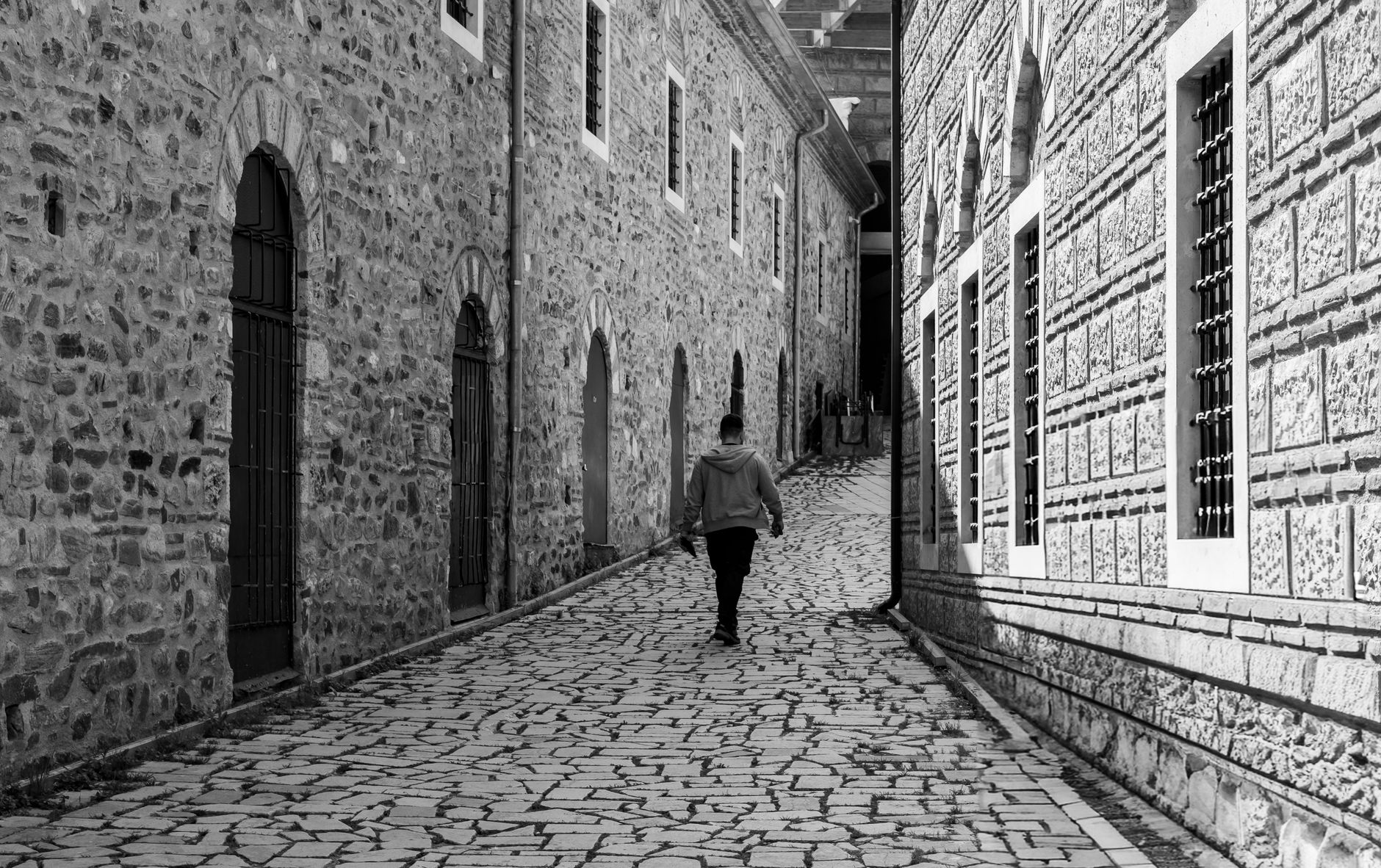
A city is read with the feet. The uneven pavements, the open doorways, the smell of a bakery in mid-morning, the shade of a tree someone planted decades ago: all of this composes a text that no guidebook can summarise. Walking slowly is learning to read it without skipping paragraphs.
The attentive walker discovers that every neighbourhood has its own rhythm and that this rhythm says more about those who inhabit it than any monument. Architecture can be explained; everyday life, by contrast, is observed. And observing requires stopping, looking twice, accepting that not everything is understood at once.
Conversation as Hospitality
Travelling slowly is also a form of conversation. A well-posed question opens doors that no key can guarantee. Asking about the name of a street, the origin of a dish, the history of a façade, is to acknowledge that the place does not belong to us and that those who inhabit it have something to teach us.
Hospitality, in this sense, is not only what is received but also what is practised: to arrive with respect, to listen without interrupting, to give thanks for what is offered. It is a courtesy that needs no protocol, only attention. And that attention turns a journey into an encounter.
The Landscape as Responsibility
Stopping also has an ethical dimension. Those who walk slowly see what the hurried traveller does not: the river running with less water, the path that has eroded, the square that has lost its trees. To see is the first step towards caring, and caring is the most elementary way of giving thanks for what a territory gives us.
It is not a question of turning every walk into a moral lesson. It is, rather, a matter of accepting that travel leaves a mark and that this mark can be lighter if we choose carefully where we tread, what we consume and whom we listen to. The traveller’s responsibility lies not in grand gestures but in small, repeated decisions.
The Memory of the Road
In time, journeys arrange themselves in memory in a strange way. We do not remember lists of monuments but details: a conversation on a terrace, the sound of a bell, the taste of something we could not name. Those fragments are what remain, and they are what teach us something about ourselves.
Walking slowly is also a way of making that memory with care. It is not about collecting recollections but about letting them form without forcing them. A journey well lived is not remembered as a succession of stages but as a state of mind that returns from time to time and reminds us that the world is wider and kinder than we think.
Travelling slowly is not renouncing the world: it is accepting that the world deserves to be looked at with time.
Against the temptation to measure everything, we propose a different measure: that of the step that stops, the gaze that lingers, the word that is exchanged. It is not a recipe or a slogan. It is, simply, a way of being in the world that seems to us fairer to places and to those who inhabit them. And perhaps, too, more generous with ourselves.