
In the town of Talavera, in Mexico’s Puebla state, the air smells of damp earth and firewood. It is not a perfume for tourists but the everyday trace of a craft passed down through generations. Here, glazed ceramics are not a museum memory: they are kneaded, thrown, painted and fired every day in workshops that preserve an artisanal process rooted in the 16th century. In 2019, UNESCO inscribed the processes of making the artisanal talavera of Puebla and Tlaxcala, Mexico, and the ceramics of Talavera de la Reina and El Puente del Arzobispo, Spain, on the Representative List of the Intangible Cultural Heritage of Humanity. That distinction does not freeze the craft: it places it in a global conversation about transmission, identity and sustainability.
This report proposes a thoughtful visit to the workshops of Talavera, Puebla. It is not a shopping trail or a hunt for unique pieces, but an attempt to understand how a craft that demands patience, a trained eye and skilled hands is learned. The guiding question is simple: how is knowledge transmitted today when, for centuries, it passed by word of mouth within the family and the workshop?
A clay with a shared history
Mexican and Spanish talavera share a name, techniques and a history of exchange. According to UNESCO documentation, the artisanal processes of making, enameling and decorating retain the same pattern as in the 16th century, even though electric potter’s wheels are used today. That continuity is no small detail: it speaks of a chain of knowledge that has withstood technological change, economic crises and shifting tastes.
In Talavera, Puebla, ceramics have domestic, decorative and architectural uses. They are not only display objects: they appear on facades, in kitchen utensils and in ceremonial pieces. That versatility has been key to keeping the craft alive. Ceramists do not produce solely for the tourist market; they also fulfill local commissions, restore old pieces and experiment with contemporary forms.
Talavera is not inherited like a surname: it is inherited like a skill that must be earned with your hands.
The workshop as a school
Knowledge transmission in talavera happens mostly in the workshop. UNESCO notes that knowledge related to raw material extraction, material processing, decoration and firing techniques is carried mainly by master earthenware artisans and ceramists, who pass it to the next generations through oral transmission in artisanal workshops or in the family setting.
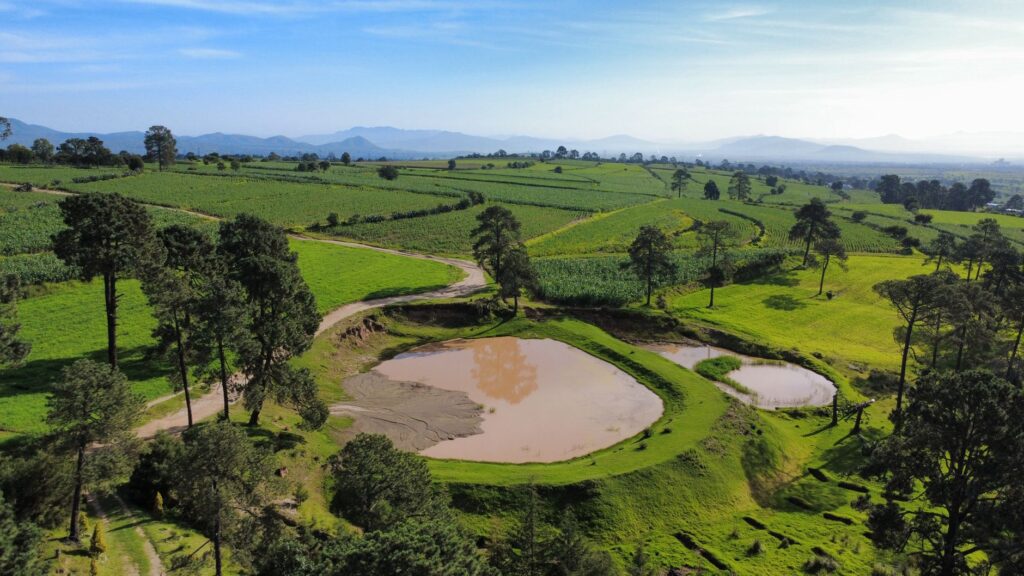
That means there is no single academy or definitive manual. Every workshop has its own identity, reflected in the detail of shapes, decorations, colors and enamels. Some ceramists carry out the whole process; others specialize in specific tasks: preparing clay, throwing, decorating, preparing enamels and pigments, or managing the kiln. That division of labor does not eliminate the global vision: to decorate well, you must understand how clay responds to heat.
Preparing the clay, understanding time
The process begins long before the piece touches the wheel. Clay must rest, lose moisture, gain plasticity. It is a time that cannot be rushed without consequences. Experienced ceramists read the texture with their hands: if it is too wet, it deforms; if it is too dry, it cracks.
Then comes throwing or casting. Precision matters, but so does intuition. A piece may look perfect and later fail in the kiln because of an air bubble or a temperature variation. That is why masters insist that ceramics teaches humility: not everything depends on human will.
Painting with oxides: the pulse of decoration
Decoration is the most visible moment of the craft. Pigments and enamels are prepared with metal oxides that, after firing, reveal intense colors. Cobalt blue is the most recognizable, but not the only one. The palette includes greens, yellows, oranges and blacks combined in geometric and floral patterns.
Painting a talavera piece requires a steady hand and visual memory. Motifs repeat, but they are not identical: each artisan imprints their character. UNESCO highlights that ceramic production remains a key identity symbol in both communities, Mexican and Spanish. That identity is not static: it is negotiated in each generation.
The kiln does not forgive haste. The piece that comes out wrong teaches more than the one that comes out right.
The kiln: where everything is decided
Firing is the most critical step. Managing the kiln requires great expertise: temperature, timing and atmosphere must be controlled. A sudden change can ruin weeks of work. That is why many workshops keep wood or gas kilns with firing curves learned through observation and repetition.
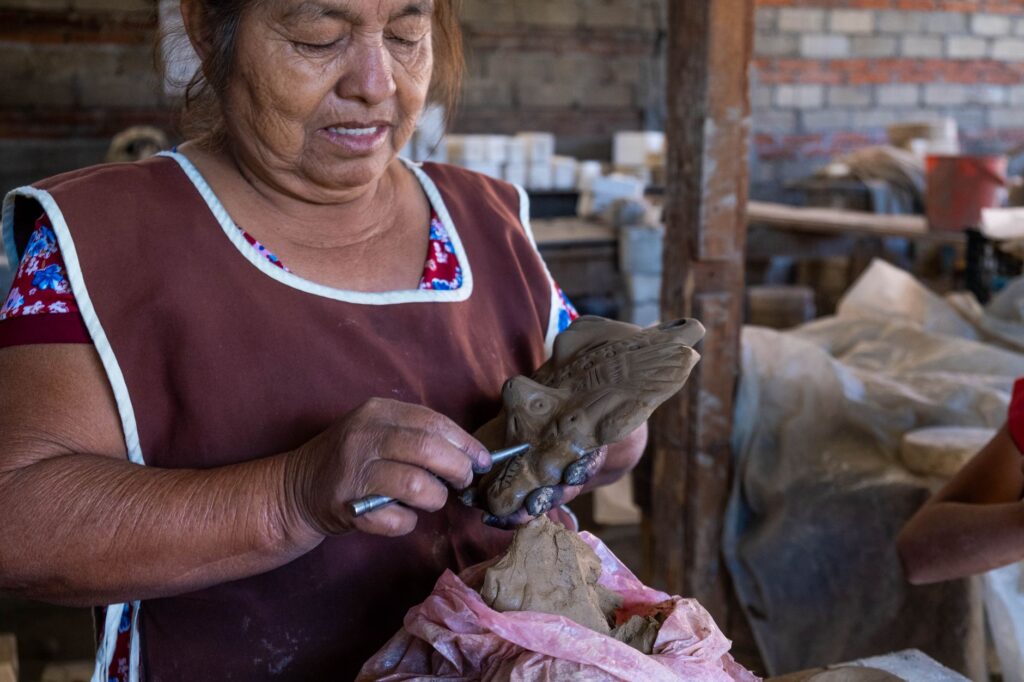
Electricity has transformed the craft: electric potter’s wheels are now common, reducing physical effort and allowing greater uniformity. But the essence of the process, according to UNESCO, remains: clay preparation, enameling and decoration keep the 16th-century pattern.
Accessibility and preparing your visit
Visiting talavera workshops in Talavera, Puebla, requires preparation. Not all spaces are permanently open to the public or have visitor infrastructure. Some receive by appointment; others function as workspaces where production, not tourism, is the priority.
For a respectful visit, it is best to make contact in advance, ask about schedules and conditions, and accept that the visit may be limited to certain areas. Physical accessibility varies: some workshops have steps, narrow corridors or dirt courtyards. People with reduced mobility should inquire before traveling.
It is also important to understand that ceramics are fragile and heavy. If you buy a piece, plan for packing and transport. And if you take photographs, ask permission: some artisans prefer to protect their designs from indiscriminate copying.
Transmission: the challenge of new generations
The greatest challenge of the craft is not technical but human. Oral and family transmission works, but it depends on there being a successor. UNESCO links this heritage to the Sustainable Development Goals, including quality education, gender equality, decent work and economic growth, and responsible consumption and production. These are not decorative labels: they point to real conditions for keeping the craft alive.

In Talavera, Puebla, as in other ceramic communities, women have played a central role in decoration and workshop management. Recognizing that contribution is part of a contemporary view of heritage. So is valuing artisanal work over industrial production, which can imitate shapes but does not reproduce the process.
What to look at and what to ask
A visit to a talavera workshop is not a passive experience. There are questions that open valuable conversations: How is the enamel prepared? How long does the clay rest? How is kiln temperature controlled? Which pieces are the hardest to achieve? Artisans tend to answer generously when they perceive genuine interest.
Pay attention to details: the uniformity of the enamel, the sharpness of the line, the coherence of the design. But also to what is not seen: the order of the workshop, the state of the tools, the presence of apprentices. There you can read the health of the craft.
Practical guide
- When to go: Puebla’s rainy season runs from May to October and can affect visits and outdoor firing. The dry season, from November to April, is usually more comfortable for walking.
- Getting around: Talavera is located in Puebla state. Access is usually by road from Puebla city. Check routes and times with local operators.
- What to bring: comfortable shoes, water, sunscreen and cash for small purchases. If you buy pieces, plan for packing.
- Etiquette: ask before photographing, do not touch pieces without permission and respect the workshop’s pace.
- Accessibility: ask in advance about steps, corridors and adapted bathrooms. Not all workshops have accessible infrastructure.
- Language: Spanish is the main language; some workshops may have staff with basic English, but it is not guaranteed.
A closing with hands in the earth
At the end of the visit, one image remains that cannot be bought or photographed: the ceramist’s hands turning the clay, correcting a curve, deciding when to stop. It is a gesture repeated for centuries, yet never identical. Talavera in Talavera, Puebla, is not just a beautiful object: it is a living archive of knowledge passed from hand to hand. Visiting with respect, asking with curiosity and buying with awareness are concrete ways to keep that archive open.