In Quebec, the capital of the Canadian province of the same name, winter is not a season to endure. It is a season to organise around. For much of the year, sub-zero temperatures and accumulated snow shape every movement. The city’s response was not only technical. It was urban. Beneath the streets of the centre runs a network of passages, galleries and indoor plazas connecting office buildings, hotels, shops, universities and transit stations. It is known as the underground pedestrian network, and it functions as a second city, parallel to the one above.
Walking it is neither a tourist curiosity nor an emergency shelter. It is a way of understanding how a northern community has chosen to live. The network does not erase winter. It domesticates it. And it does so without hiding the heritage of one of the best-preserved fortified colonial cities in North America, whose historic district was inscribed on UNESCO’s World Heritage List in 1985.
A city that folds beneath the surface
Quebec’s underground system was not born from a single master plan. It grew by aggregation. In the 1960s, the construction of large office and hotel complexes in the upper part of the centre began to include indoor commercial galleries. Over time, those galleries were linked to one another through passages, escalators and tunnels. Today they form a network of several kilometres that allows people to walk long stretches without stepping outside.
The logic is simple: if the climate keeps people indoors, the city offers a continuous indoors. But the result is not a mere shopping tunnel. It is an alternative urban fabric, with its own schedules, its own flows and its own hierarchies. Some sections are bright and busy; others are quieter, almost domestic, where foot traffic becomes sporadic.
The underground network does not compete with the city above. It complements it. It allows daily life to continue when the surface turns hostile.
For visitors, the first consequence is practical. A trip that on the surface would require full winter gear, proper footwear and tolerance for wind can be completed under cover. The second consequence is subtler: it forces you to read the city in two layers, to understand that the historic centre and the functional centre do not always coincide, and that contemporary Quebec rests on a discreet infrastructure few guidebooks mention.
From colonial fort to administrative centre
Quebec’s history explains why the city is organised the way it is. It was founded by the French explorer Samuel de Champlain in the early 17th century and became the capital of New France. After the change of sovereignty in the 18th century, it became the capital of the new British colony. That double heritage remains visible in the layout, the architecture and the way the city thinks of itself.
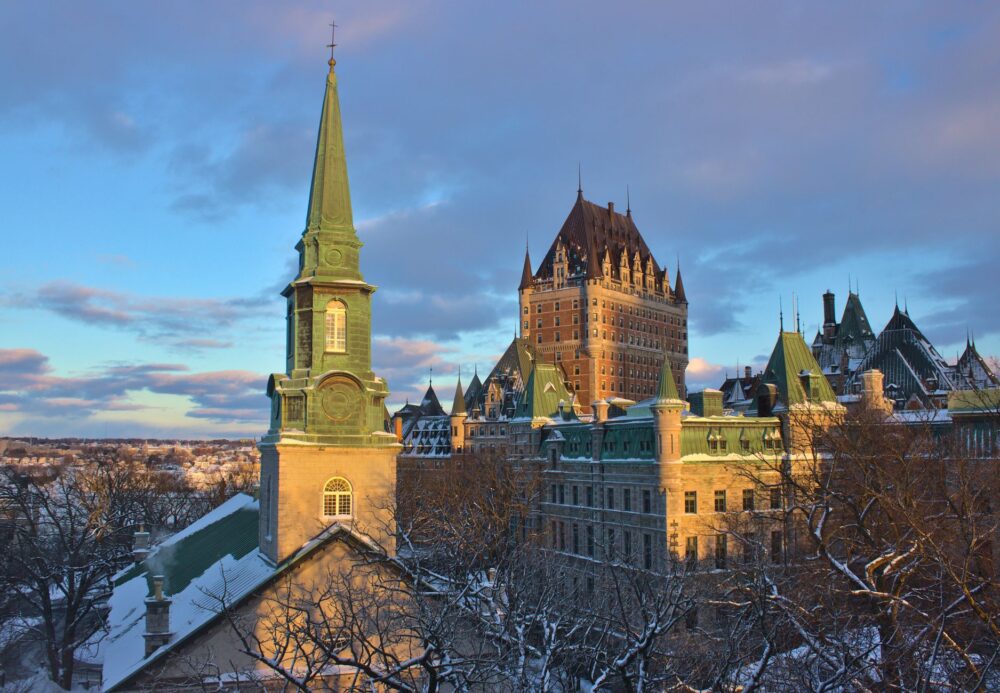
The Upper Town, built on the Cap Diamant cliff, retains its religious and administrative role. Its churches, convents and monuments include the Dauphine Redoubt, the Citadel and the Château Frontenac. The Lower Town, by contrast, grew around Place Royale and the old harbour. Together they form an urban ensemble that UNESCO describes as one of the finest examples of a fortified colonial city north of Mexico.
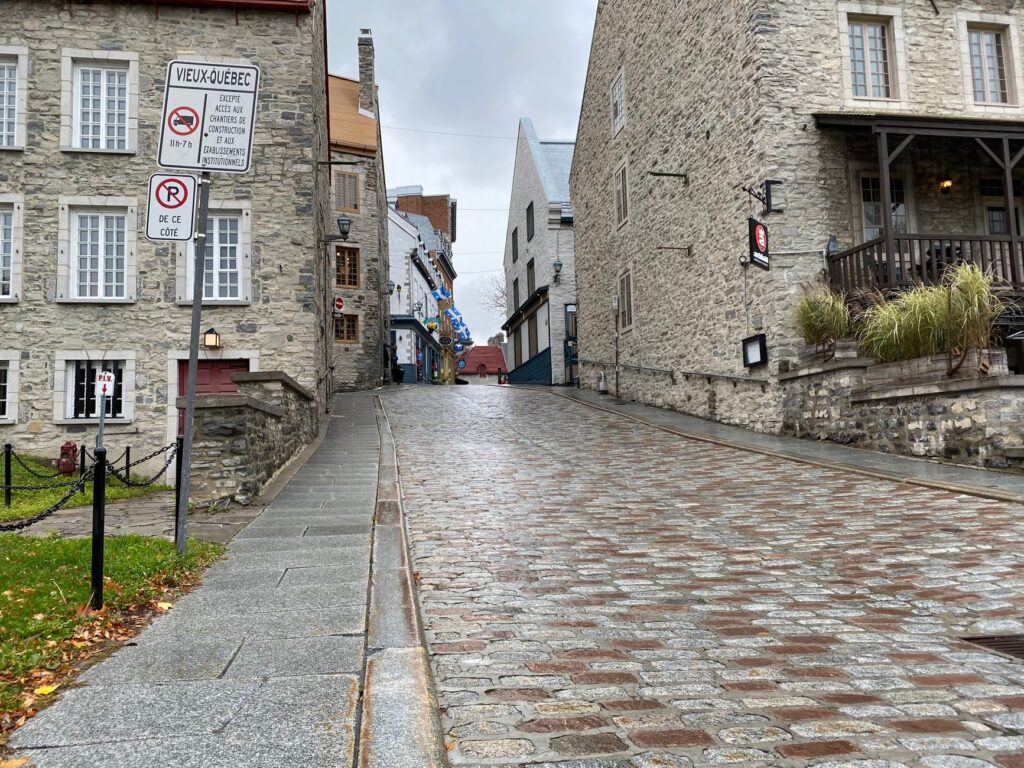
That walled condition is not a picturesque detail. It is the reason the historic centre keeps a compact scale, with narrow streets and stone buildings that do not allow for large interventions. That same compactness, paradoxically, made the underground connection easier: the buildings are close enough to be linked below ground without destroying the surface fabric.
Winter as infrastructure
In Quebec, winter is not improvised. Snow is cleared with machinery, pavements are covered with sand or salt, and buildings are designed with double vestibules that act as thermal locks. The underground network is the most elaborate expression of that technical culture. It is not just about comfort: it is about keeping the centre’s economy active during months when the outdoors discourages any stroll.
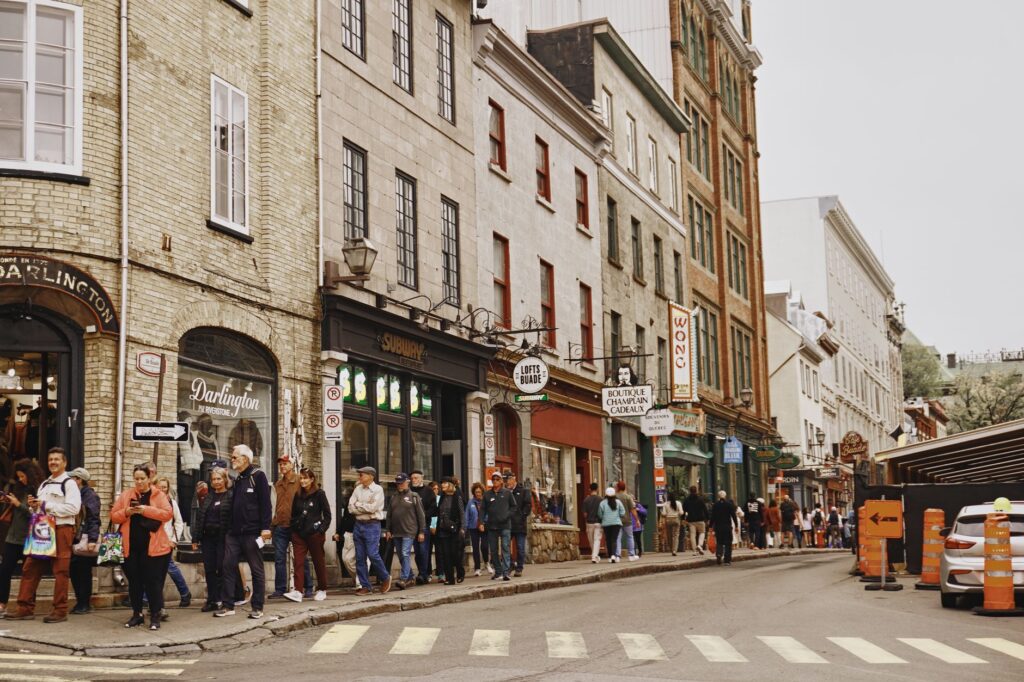
That infrastructure has a social effect that is rarely noticed. In winter, the underground becomes a real meeting space. Students heading to class, workers crossing between offices, residents doing everyday shopping and visitors trying to orient themselves share the same corridors. The mix is not forced: it results from a system that connects different functions, not just shops.
For those arriving from elsewhere, the advice is simple: do not treat the underground as a separate attraction, but as a tool. Use it to arrive, to shelter or to cross the city when the surface becomes difficult. The experience changes completely once you understand it is not a shopping mall but a functional extension of public space.
The city above and the city below
The relationship between Upper and Lower Town still shapes the urban experience. The difference in elevation is considerable, and stairs, ramps and lifts play a daily role. In winter, when snow and ice complicate the slopes, the underground network and covered passages offer alternatives that do not depend on the weather.
That duality is also reflected in land use. The Upper Town concentrates institutions, offices and hotels. The Lower Town, more touristic and heritage-oriented, keeps cobbled streets, small squares and a more intimate scale. A visitor who only walks one of the two misses half the story. The interesting part is precisely the transit between them, the way the city changes tone as you go up or down.
Quebec cannot be understood from its walls alone. It is understood from the way its inhabitants have learned to move between levels, seasons and temperatures.
That learning is collective. It is part of the local identity as much as the language, the food or the winter festivities. The city has developed a familiarity with cold that is not resignation but active adaptation.
Heritage that is used, not merely admired
One of Quebec’s most interesting traits is that its heritage is not museified. Historic buildings are used: they house offices, schools, shops and homes. That continuity of use is what has allowed the ensemble to be preserved without turning it into a stage set. UNESCO explicitly recognises the integrity of the historic district and its authenticity in terms of form, materials and setting.

Legal protection is strict. The Vieux-Québec heritage site is covered by provincial cultural property legislation, and any construction, renovation or signage work requires prior authorisation. A concertation committee between levels of government coordinates actions. That administrative web may seem slow, but it has prevented the aggressive transformations that erase a city’s memory.
For travellers, that combination of protection and daily use explains why Quebec feels inhabited rather than staged. You do not have to look for the monuments: they appear in the daily route, between a bus stop and a bakery.
What to look at while walking
The city rewards slow observation. In the Upper Town, pay attention to the relationship between religious buildings and administrative space, to the way institutions have settled into old structures without destroying them. In the Lower Town, the interest lies in scale: narrow streets, stone facades, squares that work as small urban refuges.
Street furniture and signage also deserve attention. In a bilingual city, signs tell a political and cultural story that goes beyond translation. And in winter, the infrastructure itself —handrails, ramps, covered passages— becomes an object of observation: it reveals priorities, decisions and a concrete idea of what it means to live in the north.

Local food, meanwhile, follows the same logic of adaptation. Traditional dishes respond to a harsh climate and a history of limited supply. There is no need to seek fine dining: markets, bakeries and small neighbourhood restaurants offer an honest reading of everyday life.
A destination for every season
Quebec is not only a winter city, although winter defines it. Spring and autumn offer milder temperatures and a different light on the stone. Summer, with long days and open terraces, shows another version of the same city. But it is in the cold months that you best understand why the underground network exists and why residents use it so naturally.
That marked seasonality forces planning. It is not a city to explore spontaneously in January. It requires thinking about footwear, layers, travel times and shelter points. In return, it offers something rare: the chance to see a city running at full capacity in conditions that would paralyse public life elsewhere.
Practical guide
When to go
The city has four clearly distinct seasons. Winter is harsh but it is also when its infrastructure is easiest to understand. Spring and autumn are milder and allow unhurried walking. Summer brings more visitors and more street activity.
Getting around
The historic centre is walkable, but the elevation between Upper and Lower Town demands proper footwear. In winter, use the underground network and covered passages for longer trips. Public transport connects the centre well with the rest of the city.

What to bring
In winter, layers, waterproof footwear and gloves. In summer, sun protection and water. In any season, comfortable clothing for walking on cobblestones and slopes.
Language
French is the predominant language. English is understood in tourist areas, but a greeting in French improves any interaction.
Respect and coexistence
Quebec is an inhabited city, not a theme park. Respect neighbourhood schedules, do not block access and treat heritage as what it is: living infrastructure.
At the end of the day, when the light retreats early and the cold tightens, the city keeps working. Underground, the lights stay on and people continue on their way. That image —a community that does not stop because the weather demands it— sums up better than any monument what Quebec has chosen to be.