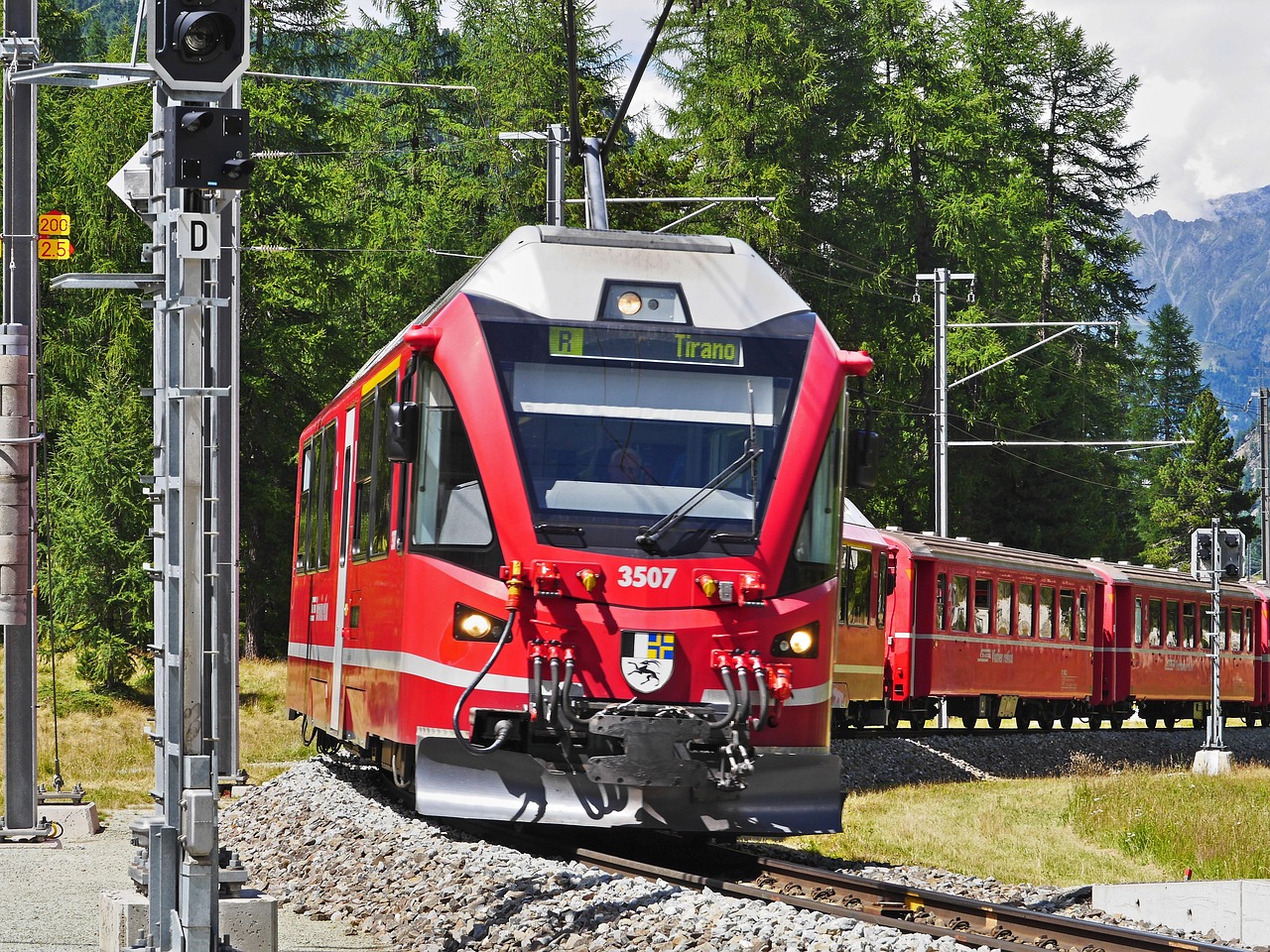

The whistle of a locomotive cuts through the cold air of Graubünden. It is not a nostalgic sound: it announces that a train is about to enter one of the 42 tunnels and covered galleries that pierce the rock of the Albula line in southeastern Switzerland. There, among high meadows and stone villages, the Rhaetian Railway (Rhätische Bahn) has spent more than a century linking valleys that would otherwise remain isolated. Since 2008, the Albula and Bernina landscapes have been listed as a UNESCO World Heritage Site, a recognition that honours not only the audacity of its engineers but also the way these tracks have blended into the environment without disfiguring it.
This report explores what makes this railway unique, how its route was conceived, what remains of its legacy and why it is still essential to understanding Alpine Switzerland. It is not a conventional travel guide or a hymn to speed: it is a measured look at a railway system that, even today, sets the rhythm of mountain life.
A railway born to break isolation
At the beginning of the 20th century, the Albula and Bernina valleys in the canton of Graubünden depended on mule tracks and mountain roads that snow blocked for months. The arrival of the railway changed that reality. The Albula line, opened in 1904, was the first to prove that a train could cross the central Alps at high altitude without relying on rack-and-pinion systems along its entire route. Its 67-kilometre route required 42 tunnels and covered galleries and 144 viaducts and bridges, a figure that conveys the difficulty of the terrain.
The Bernina line, opened in 1910, completed the ensemble with 61 additional kilometres, 13 tunnels and galleries, and 52 viaducts and bridges. Together they form a transalpine corridor linking northern Graubünden with the Italian border, passing through landscapes that range from larch forests to glaciers. UNESCO highlights that this railway was an example of how trains helped open up mountain settlements and generate a lasting socio-economic impact.
“The Rhaetian Railway in the Albula/Bernina landscapes constitutes an outstanding technical, architectural and environmental ensemble,” states the UNESCO declaration.
That impact was not only economic. The arrival of the train allowed scattered communities to access services, trade and education, and laid the foundations for mountain tourism that still sustains the region today. But it also posed a challenge: how to build modern infrastructure without destroying the landscape that made it possible. The answer, to a large extent, was respect for scale and local materials.
Engineering that blends into the mountain
To travel the Albula line is to attend a lesson in adapting to the terrain. Limestone viaducts, such as the famous Landwasser, rest on arches that seem to sprout from the cliffs. Tunnels, often short and curved, avoid the most unstable slopes and maintain gentle gradients. Nothing is gratuitous: every curve, every bridge and every tunnel responds to a precise calculation so that the train can climb and descend without excessive effort.
The result is a route that reads like an engineering text but also like a landscape. The harmony between human construction and the environment is one of the criteria that led UNESCO to inscribe the site. This is not a straight, fast line but a winding journey that forces you to look out the window. In that sense, the Rhaetian Railway is a contemplation machine: it moves slowly, stops at small stations and allows you to see how light changes over the mountains.
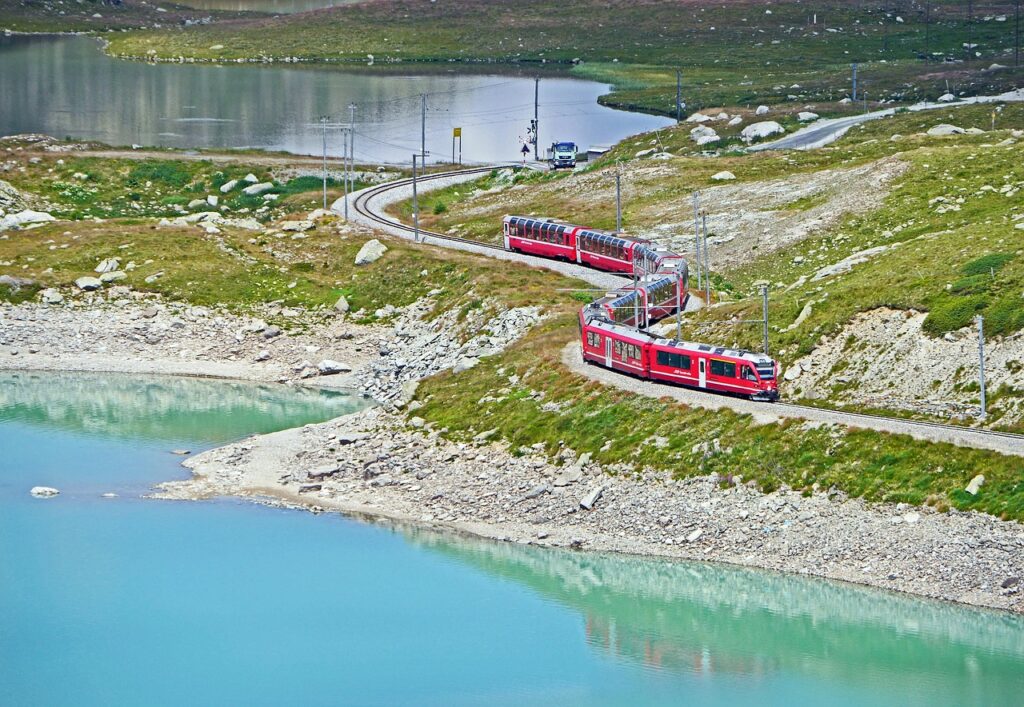
The Bernina line adds a different nuance. Its highest point, at Ospizio Bernina station, exceeds 2,200 metres, making it one of the highest railway routes in Europe. There, the landscape becomes mineral, with glacial lakes and snow that persists well into spring. The train, however, does not renounce its function: it remains a daily means of transport for local inhabitants, not just an attraction for visitors.
Stations with memory: from St. Moritz to Tirano
The stations of the Rhaetian Railway are not mere stopping points. Many retain early 20th-century buildings with pitched roofs, stone walls and platforms that seem frozen in time. St. Moritz, on the Albula line, is perhaps the best known, but not the only one. Filisur, Bergün and Preda maintain that air of functional yet careful architecture, designed to withstand the climate and to receive travellers with a certain dignity.
On the Bernina side, Alp Grüm station offers one of the most spectacular views: a natural balcony over the Poschiavo valley, with the Palü glacier in the background. There are no large hotels or luxury shops, just a small refuge and a platform. It is a reminder that this railway was born to connect communities, not to feed a theme park.
The journey culminates in Tirano, already in Italy, where the line meets the Italian railway network. That link, which seems minor, was for decades one of the main gateways for goods and people between Switzerland and Italy. Today, the train still crosses the border with the same naturalness with which it passes through a tunnel.
The landscape as heritage: beyond the tracks
UNESCO does not protect only the tunnels and viaducts. The site includes the landscapes surrounding the lines, from the Engadin and Albula valleys to the slopes of the Bernina. It is a strip of territory where mountain agriculture, forests and Alpine villages form a mosaic that the railway has helped preserve. Without the train, many of those villages would have lost population and activity; with it, they have found a balance between tradition and modernity.

That balance is not without tensions. Railway tourism has grown, and with it pressure on infrastructure and services. Swiss authorities and the railway company work to manage flows, maintain frequencies and preserve the character of the route. The key, according to site managers, is not to turn the railway into a spectacle but to keep it as a quality public service.
“The railway infrastructures of the Albula and Bernina lines form an authentic ensemble of great integrity,” UNESCO stresses in its assessment.
That authenticity is visible in details such as signalling systems, which combine modern technology with historical elements, or in the conservation of locomotives and carriages still used on special services. It is not an open-air museum but a living system that adapts without losing its identity.
What this railway can teach us today
At a time when many regions seek alternatives to road transport, the Rhaetian Railway offers valuable lessons. The first is that mountain railway infrastructure can be sustainable if designed with the landscape, not against it. The second is that a slow, well-integrated train can be more useful to local communities than a high-speed service poorly adapted to the territory. The third is that industrial heritage need not clash with modernity: it can be updated without losing its essence.

The Albula and Bernina line also shows that railways can be a cultural engine. Throughout the year, themed journeys, station exhibitions and educational activities bring the history of the train closer to new audiences. That pedagogical dimension is important: without knowledge, heritage becomes mere scenery.
For the traveller, the experience is simple: board a train, sit by the window and let yourself be carried. No complex plan is needed. The route itself sets the pace. In winter, snow covers the roofs and carriages become warm refuges; in summer, meadows fill with flowers and the train seems to glide over a green tapestry.
A present that looks to the future
The Rhaetian Railway has not remained anchored in 1904. The company has renewed rolling stock, improved accessibility at some stations and introduced more modern passenger information systems. But it has done so cautiously, aware that its main asset is precisely what has not changed: the relationship between the track and the landscape.
That continuity is also a challenge. Maintaining century-old tunnels, viaducts and stations requires constant investment and specialised staff. Snow, frost and rockfalls are permanent risks. Site management, according to UNESCO, is satisfactory, although it recommends strengthening the public presentation of the heritage values that sustain it.
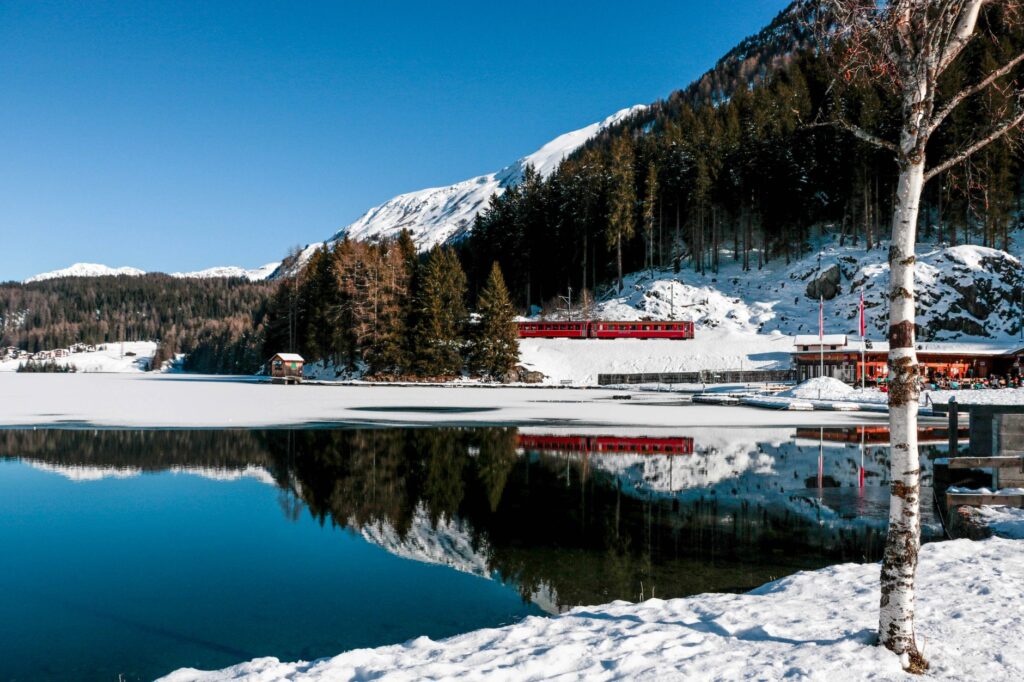
In a world that tends to homogenise travel, the Rhaetian Railway retains a quality that is difficult to replicate: the sense that every kilometre has a story. It is not just a means to reach a destination; it is the destination itself. And that, in times of haste, is a luxury within reach of anyone who steps on board.
Practical guide
For those wishing to discover the Rhaetian Railway in the Albula and Bernina landscapes, advance planning is advisable. The network is part of the Swiss public transport system and can be travelled with national or regional rail passes. Trains run throughout the year, although some high-altitude sections may be affected by adverse weather conditions in winter.
- Best time: June to September for green landscapes and long days; December to March for the winter experience, with snow and a festive atmosphere.
- Recommended routes: the section between Thusis and St. Moritz on the Albula line, and the journey from St. Moritz to Tirano on the Bernina line. Both can be combined in a multi-day trip.
- Reservations: in high season, especially in summer and on key dates, it is advisable to reserve a seat on panoramic trains. Regional services do not always require reservation.
- Luggage: warm clothing and suitable footwear for the mountains, even in summer. High-altitude stations can be cold and windy.
- Accessibility: many stations have improved accessibility, but it is worth checking in advance if travelling with reduced mobility.
- Official information: the Rhätische Bahn website and Switzerland Tourism offer timetables, maps and itinerary suggestions.
This is not a route to be rushed. The Rhaetian Railway rewards those who take their time, look out the window and accept that the journey is as important as the arrival. In the Swiss Alps, the train remains a way of inhabiting the landscape.