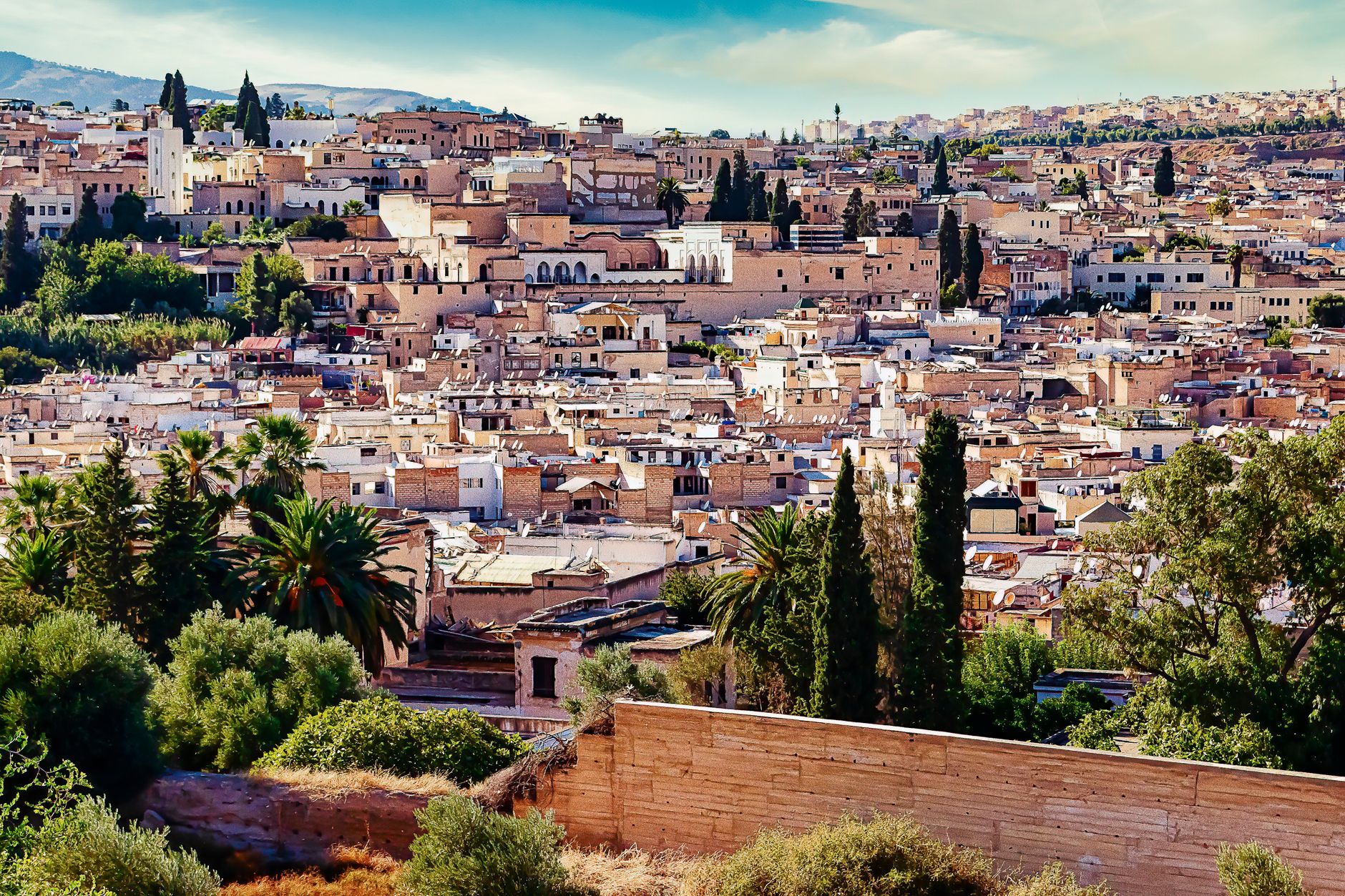

In the medina of Fez, a UNESCO World Heritage site since 1981, there is a sound that does not fade with nightfall: the strike of metal against anvil. It is not an accidental noise. It is the rhythm of a trade that, since the Marinid era, when the city served as the kingdom’s capital between the 13th and 14th centuries, has organised work, space, and neighbourhood life. The medina, with its 280 hectares and more than nine thousand alleys, preserves an exceptional monumental density: madrasas, fondouks, mosques, and fountains dating from that period. But it also preserves something less visible and more fragile: an ecosystem of urban crafts that sustains the daily life of tens of thousands of people.
This report does not stem from a recent visit or on-the-ground interviews. It draws on documentary sources, UNESCO reports on the state of conservation of the property, and available ethnographic literature on the artisan guilds of Fez. There are no invented characters or fabricated testimonies. The guiding question is concrete: how does a trade like blacksmithing survive in a medina that must simultaneously preserve its architectural authenticity and adapt to the pressures of tourism and modernity?
A neighbourhood that rings with metal
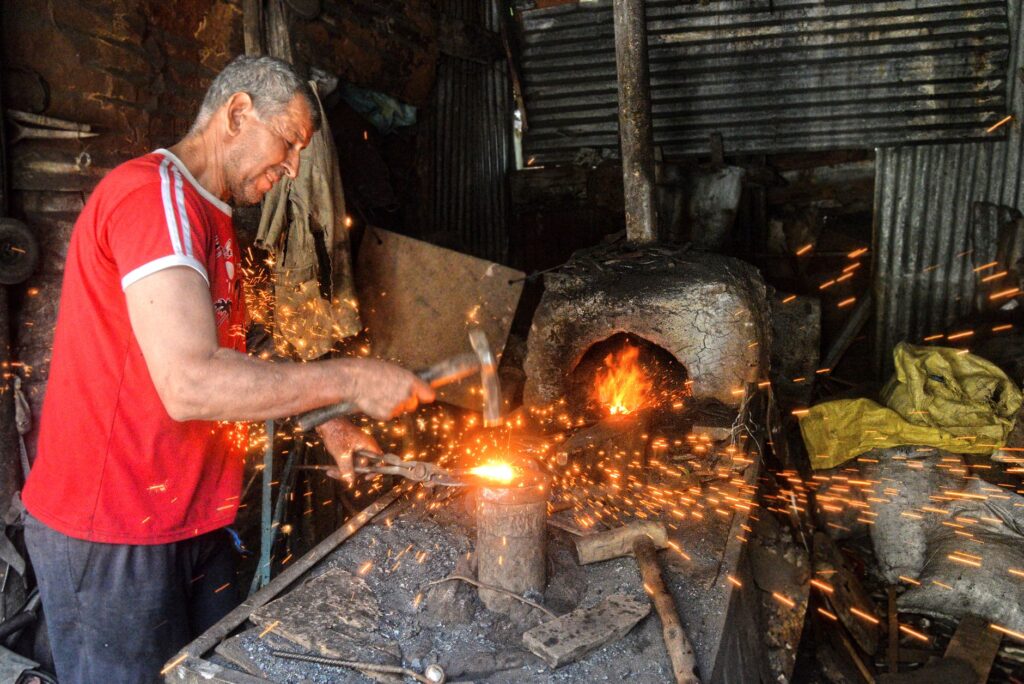
The blacksmiths’ quarter in Fez el-Bali is not a museum. It is an open-air workshop where hammering blends with the smell of coal and the steam of water cooling freshly forged pieces. UNESCO documentation on the medina notes that the urban fabric retains most of its original functions and that traditional crafts, especially those linked to construction and architectural decoration, continue to be passed down from generation to generation. That detail is key: this is not a re-enactment for visitors, but a real economic activity supplying carpenters, masons, locksmiths, and restorers.
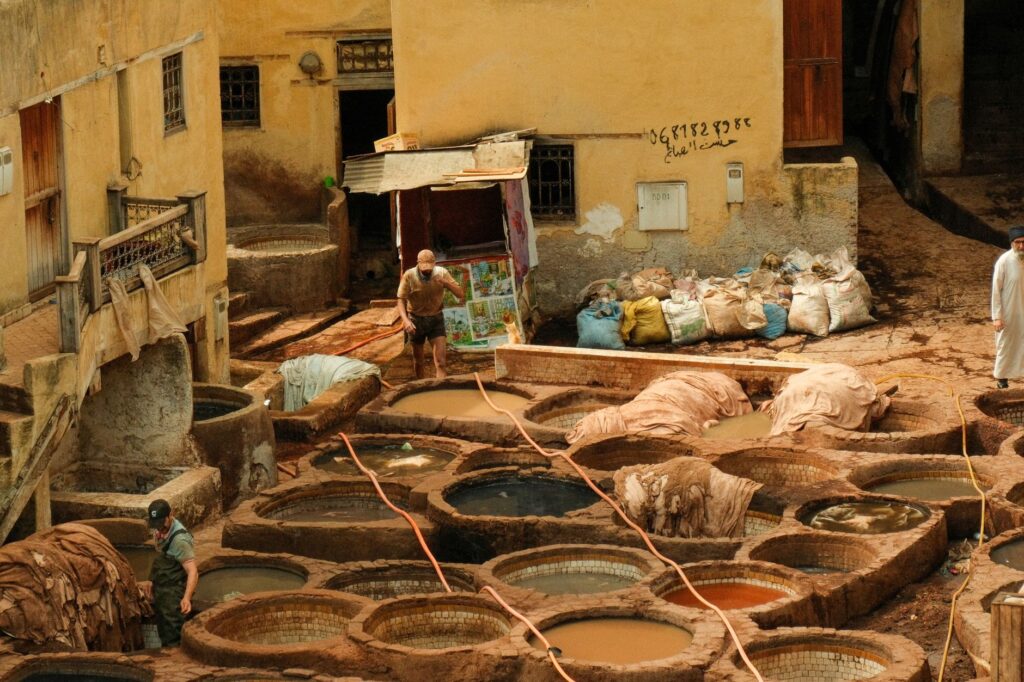
The blacksmiths’ guild occupies a precise place in the hierarchy of trades. Its product is neither decorative nor ornamental: it is tool, reinforcement, grille, nail, hinge. Without its work, the conservation of the historic centre itself would be more difficult, because many restoration interventions require custom-made metal pieces, using techniques not found in an industrial catalogue.
The medina of Fez not only represents an outstanding architectural heritage: it transmits a way of life, skills, and a culture that persist and are renewed despite the effects of modern societies.
Forge as a service trade
It is worth discarding a romantic notion: the blacksmith of the medina does not work for tourists. He works for his neighbour. His client is the carpenter who needs a reinforced hinge, the mason replacing a grille, the restorer commissioning a piece identical to the original. That mutual dependence is what has kept the trade alive for centuries. UNESCO, in assessing the authenticity of the property, stresses that the survival of traditional technical knowledge, especially in construction and decoration crafts, is a major advantage for maintaining the site’s values.
The process begins with the selection of metal, often recovered from old pieces. Then comes heating in the forge, striking on the anvil, cooling, and sometimes tempering. Each step demands a precision that cannot be learned from a manual: it is transmitted in the workshop, through the body, the eye, and the ear. The result is an object that does not seek industrial perfection, but durable functionality.
A neighbourhood economy under strain
The medina of Fez faces structural problems that directly affect the crafts. UNESCO reports mention building deterioration and overcrowding as the main challenges. Added to this is the pressure of tourism, which can distort demand and push some workshops to produce souvenirs instead of tools. The Agency for the De-densification and Rehabilitation of the Medina of Fez, created under the 2001 development plan, has among its functions to rationalise and organise the necessary urban interventions.
The balance is delicate. If tourism replaces the local client, the trade loses its social function and becomes a spectacle. If conservation freezes the neighbourhood, workshops cannot adapt to new needs. The key, according to management documents, lies in maintaining functional mix: housing, commerce, crafts, and services within the same fabric.
The Medina Development Plan, reassessed every ten years, incorporates specific provisions for the ancient district and seeks to rationalise urban interventions.
Noise as intangible heritage
There is a dimension of the trade that appears neither on maps nor in inventory sheets: sound. The hammering of blacksmiths is, for many residents, a sign of normality. When it stops, the neighbourhood sickens. This perception is documented in ethnographic studies of the medina, which describe the soundscape as part of local identity. It is not mere nostalgia: the noise indicates that there is work, that there are orders, that the neighbourhood economy is functioning.
UNESCO, in describing the property, insists that the medina retains most of its original functions and attributes. That includes not only buildings but also the activities that occupy them. The challenge is to prevent that continuity from breaking through the displacement of traditional crafts to the periphery, a phenomenon already observed in other historic cities.
The fondouks: forgotten infrastructure
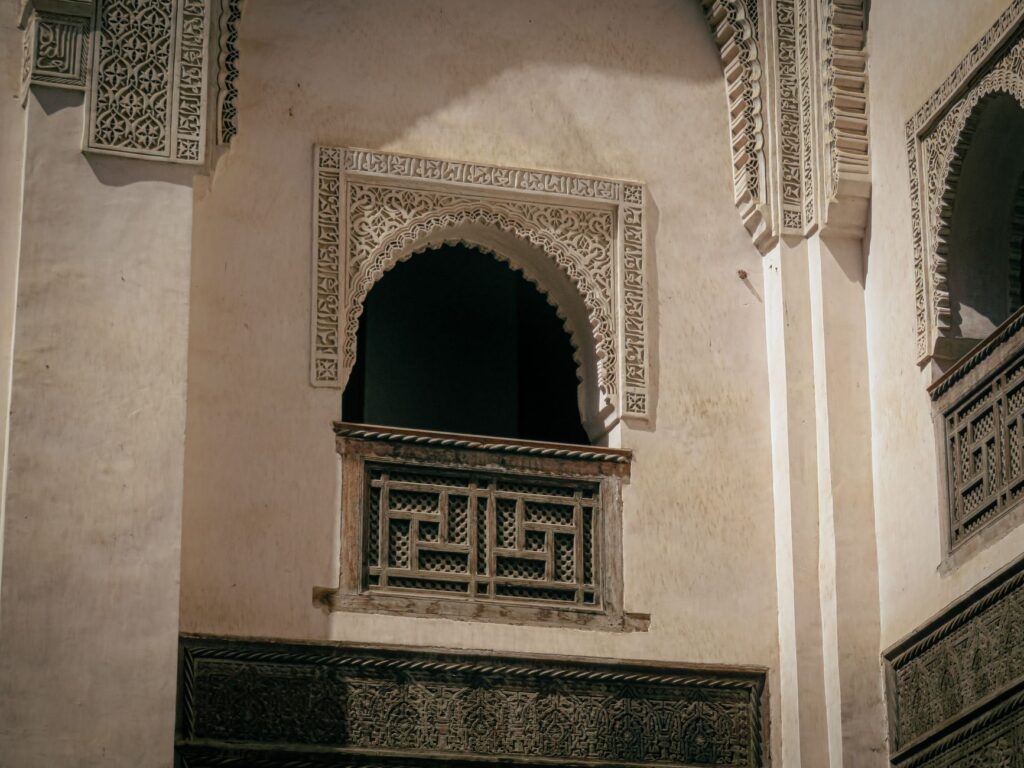
The fondouks, those lodging and storage structures mostly dating from the Marinid era, were for centuries the material support of the guilds. Raw materials were stored there, deals were negotiated, and sometimes work was carried out. Today many have been rehabilitated as shops or tourist accommodation, but their original function as productive infrastructure has faded. Recovering that dimension, without turning them into theme parks, is one of the open debates in heritage management.
For the blacksmiths’ guild, the loss of fondouks as storage and wholesale spaces has been an added difficulty. Without those nodes, the supply chain fragments and the workshop becomes more isolated. Rehabilitation policies, according to UNESCO documents, must consider not only the architectural value of these buildings but also their role in the urban economy.
Training and generational succession
Generational succession is the most fragile point. Training a blacksmith requires years of apprenticeship, and the economic return is not always attractive compared to other jobs. Reports on the state of conservation of the property mention the need to support the transmission of traditional knowledge. However, there are no updated public data on the exact number of active workshops or the average age of artisans. Any figure given would be speculative.
What can be stated, based on available documentation, is that the continuity of the trade depends on local demand. If the restoration of the historic centre continues to require custom-made pieces, the blacksmith will have work. If, on the contrary, the logic of industrial replacement prevails, the trade will lose its raison d’être.
Accessibility and preparing the visit
For travellers wishing to understand this trade without falling into superficial consumption, preparation is essential. The medina of Fez is a dense space with narrow streets and uneven ground. It is not a route accessible to everyone: many alleys are not adapted for wheelchairs or for those with reduced mobility. Orientation within the medina is difficult, and although apps and maps exist, signage is limited.
Comfortable shoes, water, and patience are recommended. The best time to observe the blacksmiths’ work is in the morning, when the heat is not yet oppressive and workshops are in full activity. One should not interrupt work or take photographs without permission. Respect for the workspace is the first rule of any visit.

Practical guide
- When to go: Spring and autumn are the mildest seasons. Summer can be very hot, and Ramadan alters workshop hours.
- Getting around: The medina is explored on foot. Taxis and vehicles do not enter. Hiring a licensed local guide can facilitate orientation and respectful access to workshops.
- What to bring: Closed, comfortable shoes, water, sunscreen, and a discreet attitude. For photographs, always ask permission.
- Accessibility: The terrain is uneven and the streets are narrow. People with reduced mobility will find serious difficulties. It is advisable to consult specialised tour operators in advance.
- Cultural respect: The medina is an inhabited neighbourhood, not a theme park. Avoid loudspeakers, do not block the way, and do not enter private spaces without invitation.
- Shopping: If purchasing a forged piece, ask about its use and origin. The value of the object lies in its function, not only in its appearance.
The future of the hammer
The future of the blacksmiths’ guild of Fez is not written. It depends on decisions taken far from the anvil: rehabilitation policies, tax incentives, vocational training, and above all, the demand of a city that still needs handmade objects. The medina, with its World Heritage status, has the opportunity to keep that chain alive. But it also faces the risk of turning it into a stage set.
At the end of the day, as the sun sets over the rooftops of Fez el-Bali, the hammering becomes more spaced. It does not disappear. It remains as a faint pulse, a sign that the trade is still there, resisting. It is not a spectacle for tourists: it is the life of a neighbourhood that refuses to fall silent.