


Some cities are visited under open sky; others are visited under cover. Bologna belongs to the second kind. In the capital of Emilia-Romagna, in northern Italy, walking beneath the porticoes is not an aesthetic choice or a rainy-day fallback: it is how residents move, shop, talk and wait. The city preserves the world’s largest portico system, roughly 62 kilometres of covered routes, and since 2021 twelve representative ensembles from that network have been inscribed on UNESCO’s World Heritage List.
Understanding Bologna means accepting a legal and cultural paradox that defines it: the porticoes are private property for public use. They belong to whoever owns the building, yet passage and lingering are guaranteed to everyone. That formula, fixed by the municipal statute of 1288, has survived nine centuries of urban change and still governs the relationship between house and street.
A medieval rule that still holds the city together
The 1288 statute was not an isolated gesture but the codification of an existing practice: anyone building in the city had to leave a covered space beneath their building for public passage. The measure answered concrete needs — housing artisans, organising commerce, protecting pedestrians — and also an ambition for prestige: the porticoed façade became a calling card for families, guilds and religious orders.
From that decision came a model that was never interrupted. UNESCO stresses the chronological continuity of the system, from the 12th century to the present, and the variety of typologies, materials and functions it accumulated. Wood, stone, brick and, by the 20th century, reinforced concrete: each era left its mark without abandoning the shared principle of covered passage.
The Bolognese portico is not a monument to be admired but an infrastructure to be used: a place where the city negotiates daily between the private and the collective.
Twelve ensembles, one shared principle
The nomination recognised by UNESCO does not cover the full 62 kilometres but twelve components selected for their representative value. The choice responds to criteria of integrity and authenticity: the aim was to find ensembles that retained their original features and had suffered less damage during the Second World War, when Bologna was one of the most heavily bombed Italian cities.
Those twelve sections do not form a closed tourist route or a signposted circuit from start to finish. They work more like samples of a continuous fabric extending through the historic centre and into peripheral neighbourhoods. Each illustrates a different phase, material or social use, and together they allow the city’s evolution to be read like a book of layers.
From the historic centre to the outskirts
In the urban core, the porticoes accompany narrow streets and main squares, with brick arcades, barrel vaults and stone columns. To the north and east, the system stretches along wider avenues, where the portico becomes a commercial passage and a link between neighbourhoods. The continuity is not only physical: it is also one of habits. The portico follows Bolognese residents from their front door to the bus stop, the grocery shop or the university.
Beneath the arcade: commerce, study and neighbourliness
Commercial use is one of the features UNESCO highlights most insistently. For centuries the porticoes have been privileged places for mercantile activity, and that function remains alive: bakeries, bookshops, cafés, workshops and local shops occupy the ground floors of porticoed buildings. The arcade works as a continuous shopfront and as a space of slow transit, where passers-by can pause without feeling out of place.
To that commercial life is added a student dimension. Bologna is home to one of Europe’s oldest universities, and the presence of students sets the rhythm of many porticoes: bicycles leaning against columns, clusters of people by the doors, coffees taken standing. The portico is, in that sense, a place of integration where residents, students and visitors coexist.
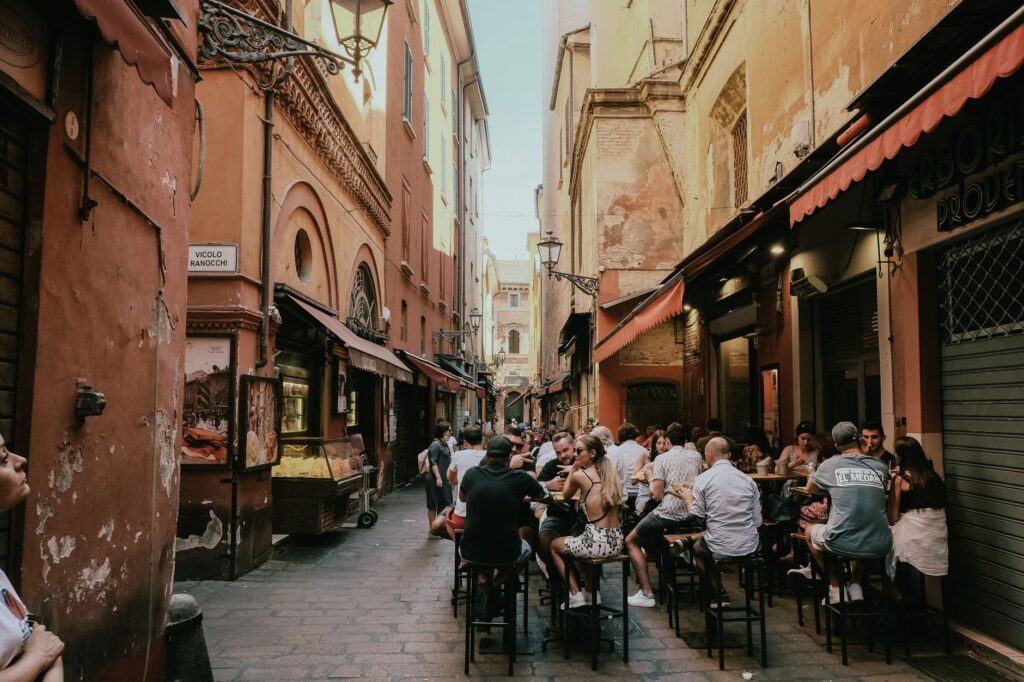
- Climate shelter: it protects from rain, summer sun and winter cold, encouraging pedestrian use all year round.
- Meeting place: it replaces the square as a setting for everyday conversation in bad weather.
- Commercial showcase: it sustains local activity and gives visual continuity to the streets.
- Identity marker: the community recognises the portico as a feature of the city, not merely a historical remnant.
La Barca and the 20th-century portico
One of the most interesting contributions of the UNESCO dossier is its attention to the 20th century. In the La Barca district, the use of reinforced concrete allowed the traditional vaulted arcades to be replaced by new structural solutions and a different architectural language. The aim was not to imitate the past but to continue a tradition with contemporary tools.
That episode shows that the portico system is not a medieval fossil but an urban practice capable of adaptation. The city kept building porticoes even when they were no longer mandatory, using materials and forms of its own time. Continuity, therefore, lies not only in the stone but in the collective decision to maintain a particular way of inhabiting the street.
Walking as a method of reading
Exploring Bologna beneath the porticoes requires abandoning haste and accepting a different rhythm. The eye grows used to looking up: vaults, wooden beams, capitals, inscriptions, lamps and painted ceilings that go unnoticed from the roadway. Also to the sides: doors, shop windows, inner courtyards glimpsed beyond entrance halls.
The itinerary needs no rigid order. It is enough to choose a direction and let the arcade lead, crossing squares and streets until the portico breaks off and forces you to look for the next one. That apparent discontinuity is, in fact, an invitation to discover the city in fragments, like reading an unnumbered text.

The best way to understand Bologna is not to look at it from a viewpoint but to walk it in the shade of its arcades, at the pace of someone buying bread.
Materials that tell a story
The variety of materials is one of the ensemble’s attractions. Wooden porticoes, now less common, recall the earliest phases. Stone and brick dominate the historic centre and have shown exceptional resistance to the passage of time. Reinforced concrete, arriving later, brings lightness and new structural possibilities.
That diversity is not a disordered catalogue but the result of a coherent evolution. Each material responds to an era, an available technique and an aesthetic intention, yet all share the same function: to cover the passage and order the façade. The city has managed to integrate the old and the modern without renouncing its character.
A heritage kept in use
The conservation of the porticoes does not depend on administrations alone. The legal system governing them assigns owners responsibility for maintenance, while the municipality sets the rules for construction, access and decoration. That shared responsibility has preserved the urban quality and collective usability of the spaces.
The city council has also drawn up guidelines for the care and use of the porticoes’ accessory elements, in order to maintain their visual integrity. Management is coordinated through a committee bringing together the main parties involved in protecting and enhancing the property.

What to look at without getting lost in detail
For first-time visitors to Bologna, it is worth remembering that the portico is not just a roof: it is a sequence. The experience is enriched by paying attention to the transition between sections, changes in height, differences in rhythm between columns and the way light enters from the street. Each variation indicates a different stage of construction.
The relationship between the portico and the building it belongs to also deserves attention. UNESCO insists that porticoes are architectural elements relating both to the surrounding public space and to the construction they are part of. They are not independent additions but pieces of a whole.
- Look at the ceilings: vaults, beams and decorations vary from one section to another.
- Notice the materials: wood, stone, brick and concrete coexist in the same city.
- Listen to the use: footsteps, conversations and bicycles are part of the heritage.
- Respect the space: it is a place of passage and neighbourhood life, not a stage for tourists.
Practical guide
The best way to discover Bologna’s porticoes is on foot. The historic centre is compact and walkable, and the network of porticoes allows movement between points of interest without exposure to the weather. Comfortable shoes are advisable, and time should be set aside to pause, because the interest lies not only in the great monuments but in the continuity of the route.
To orient yourself, it can help to identify the twelve ensembles recognised by UNESCO and choose a few according to the time available. Completing all of them is not necessary: the experience is better enjoyed at a leisurely pace and with a willingness to stray into side streets. The porticoes function all year round, though spring and autumn offer more pleasant temperatures for walking.
It is advisable to learn about the context before visiting, since many details — inscriptions, changes of material, renovations — go unnoticed without minimal preparation. Likewise, remember that this is a living space: respect the movement of residents, access to shops and homes, and municipal rules of use.

When to go and how to move
Bologna has a railway station well connected to the main Italian cities and to the rest of Europe. Within the city, public transport and bicycles are efficient alternatives, but the portico invites walking. Routes can be adapted to different durations, from a one-hour stroll to a full day.
The visit can be combined with other attractions, such as its squares, markets and food scene, but the main axis remains the same: letting the arcade lead and observing how an urban solution from nine centuries ago continues to organise everyday life.
A closing in the shade
At the end of the day, when light filters between the columns and shops begin to close, the porticoes recover their most intimate character. They are no longer a tourist itinerary but the space where residents return home, where students discuss the day and where the city prepares for night. That moment, without spectacle or grandiosity, explains better than any guide why Bologna still walks under cover.


