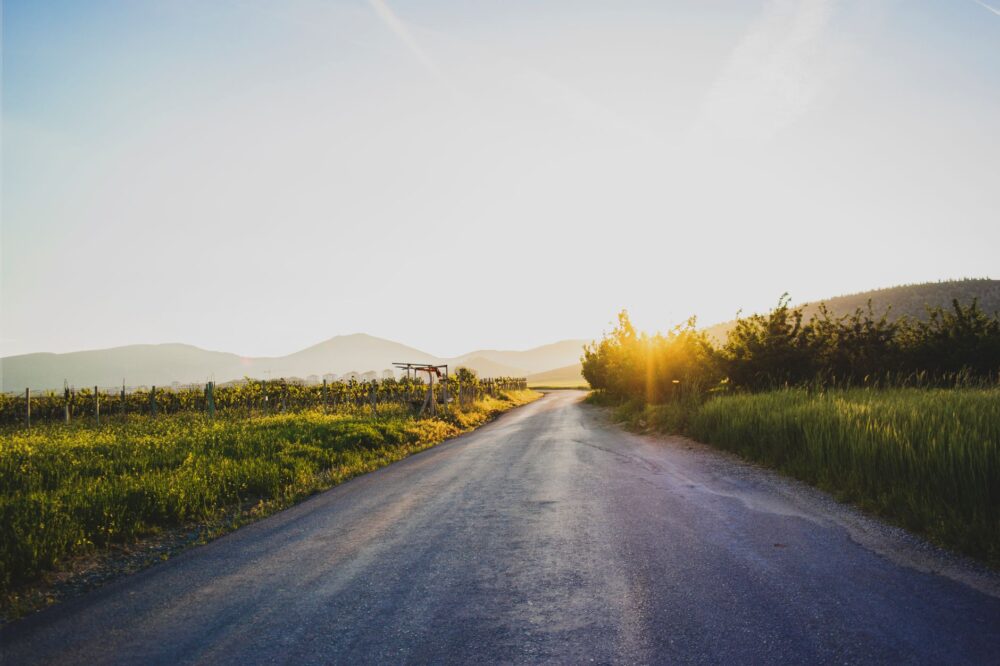

There is an idea of travel that exhausts itself in the postcard: the perfect landscape, the exotic food, the anecdote told upon return. But true travel is something else. It is a way of looking, of being, of letting the world speak to us without imposing our noise. At Atlas Lume we believe that travel is, above all, a school of attention. And in times of haste and noise, attention has become a scarce good, almost a luxury.
Distance as a teacher
Distance does not always separate. Sometimes it brings closer. When we leave the known, small things take on unexpected relief: the gesture of someone pointing out a path, the smell of a foreign kitchen, the shade of a tree we had not seen before. Distance makes us more sensitive to the essential. Not because the faraway is better, but because the faraway strips us of habit. And habit is a fog that makes everything the same.
To travel is to accept that we do not control the script. That the map is not the territory. That the best route is sometimes the one we had not foreseen. That acceptance is a form of humility, and also a form of freedom.
Hospitality as language
There is a moment in every journey when we stop being tourists and begin to be guests. That moment is not marked by the border or the passport, but by the gaze of those who receive us. Hospitality is an ancient language, older than languages. It is spoken with gestures, with timing, with silences. And it is learned when one accepts that one is not at home and that, precisely for that reason, one must listen more and presume less.
Hospitality is not a service: it is a gift. And like every gift, it obliges. Not with debts, but with gratitude. The traveler who understands this stops measuring the world by what he receives and begins to measure it by what he cares for.
The territory is not a stage
We often speak of the territory as if it were a backdrop. A background for our photos, a stage for our stories. But the territory has memory, it has wounds, it has owners who are not always visible. The landscapes we admire have been worked, cared for, or abandoned by generations. Behind every path there is a human decision, an effort, sometimes a renunciation.
Recognizing this changes the way we travel. It is no longer about conquering peaks or collecting places, but about understanding that we are part of a chain of presences. The responsible traveler does not leave only footprints: he leaves respect. And respect is not photographed, but it is noticed.
The shared table
There are few places where travel becomes as tangible as at a table. Gastronomy is not an ornament of travel: it is one of its deepest grammars. What we eat tells of where we come from, of what we celebrate, of what we fear. Sitting at another’s table is accepting a code of trust. One does not need to understand all the ingredients to understand the gesture.
At the table, the traveler stops being an observer and becomes a participant. And that participation is one of the purest forms of knowledge. No discourse can replace shared bread.
The memory of the road
Journeys do not end when we return. They continue happening in memory, in conversations, in the way we look at our own home after having been away. Travel returns us to the everyday with new eyes. And that is, perhaps, the greatest gift: not the memory of the exotic, but the renewed capacity to be amazed by the near.
That is why we believe that travel is a form of conservation. It conserves curiosity, it conserves empathy, it conserves the awareness that the world is larger and more fragile than it seems. And it conserves, above all, the idea that we are not alone.
An ethic of the gaze
Not everyone can travel, and it is not necessary. The traveler’s ethic does not depend on kilometers, but on the gaze. One can travel in one’s own city, in one’s own neighborhood, in one’s own home. The essential thing is the willingness to look attentively, to ask without invading, to give thanks without expecting anything in return.
In a time when everything accelerates, we reclaim slowness as a form of respect. Slowness is not laziness: it is the speed of wonder. And wonder is the raw material of every true journey.
To travel is not to go far, but to return with eyes more open. And perhaps with a heart more quiet, more attentive, more grateful.
That is how we understand it at Atlas Lume. Not as an invitation to escape, but to be. To be in the world with the curiosity of a child and the responsibility of an adult. Because the territory we tread does not belong to us: it welcomes us. And welcoming is an art that is only learned when one accepts that one is not the center.