
On the outskirts of Bhubaneswar, the capital of Odisha, India, the sound of hammer on brass is not a metaphor: it is a coordinate. In workshops open to the courtyard, where the heat of the furnace mingles with the smell of rice cooking next door, several generations of the same family strike, temper, and polish metal discs until they become drums, gongs, and bells that will later travel to the temples of Puri and to neighboring villages. There is no spectacle for tourists, no signs announcing the visit. There is work.
This report approaches that craft without inventing voices or scenes: it describes what is visible in the public space, what the artisans themselves explain when asked with respect, and what local ethnography has documented for decades. The underlying question is simple: what sustains a ritual craft when industrial metal, fuel prices, and youth migration press from all sides?
A state where metal has a sacred function
Odisha, on India’s eastern coast, is one of those places where daily life and the religious calendar overlap without friction. The state is home to the great Jagannath complex in Puri, one of the country’s busiest pilgrimage centers, and a network of smaller temples spread across districts such as Khordha, Cuttack, and Ganjam. In that ecosystem, metal is not decoration: it is a vehicle. Brass drums set the rhythm of processions; gongs announce the hours of worship; small bells hang on the carts that carry the images during festivities.
Demand is neither constant nor massive, but it is stable. Each ritual season activates orders that reach the workshops weeks in advance. The artisans know by heart what size, alloy, and sound each temple or brotherhood expects. That technical memory is passed on in the courtyard, not in school.

The workshop as a domestic and economic unit
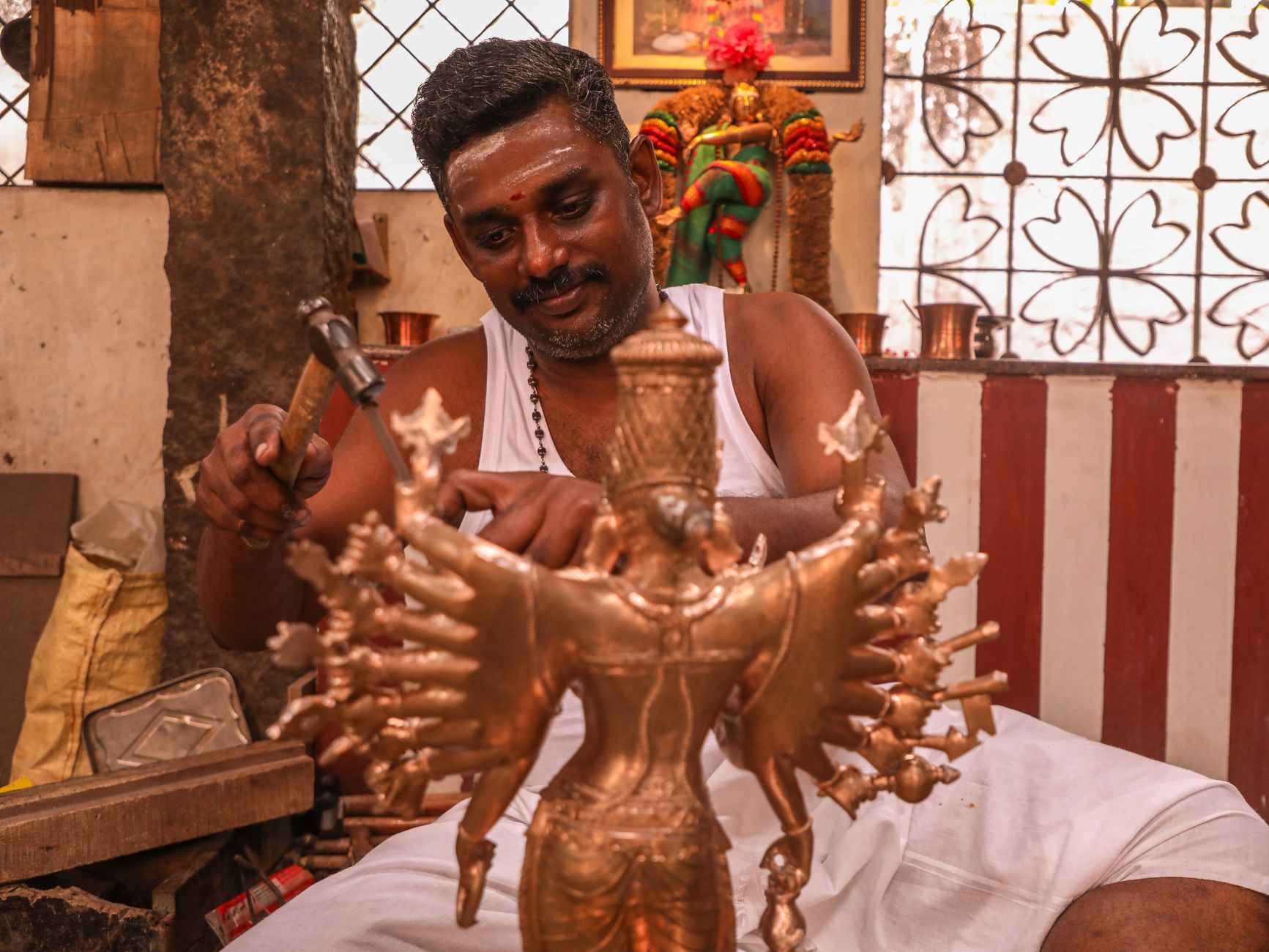
The first thing that strikes a visitor is that there is no clear separation between home and workshop. The furnace may be on one side of the courtyard; tools hang from a nail on the wall; children do their homework at a table while their father hammers. Production is organized by commissions and seasons, not by an industrial chain.
In many cases, the entire family participates in some phase: the father or uncle forges; the mother or a sister polishes the edges; a young cousin runs errands and handles the charcoal. There is no formal hierarchy, but there is a practical division of labor learned by watching. When I asked a middle-aged artisan how he had learned, his answer was as brief as it was eloquent: «Here you don’t study, you watch.» That phrase, gathered in informal conversations in the courtyard, sums up a pedagogy that does not go through the classroom.
The craft is not taught with manuals: it is learned in the courtyard, amid the noise of the hammer and the smell of hot metal.
Raw material: brass, copper, and the rising price
Brass is the most common alloy in these workshops, although copper and, to a lesser extent, bronze are also worked. Raw material arrives in ingots or selected scrap that is melted in small furnaces, fueled by coal or, increasingly, gas. The cost of metal has risen in recent years, forcing artisans to be more efficient: less waste, more reuse.
There are no official figures that precisely measure the impact of this pressure on family workshops, but the artisans themselves describe it as a constant adjustment. When the price of brass rises, some orders are delayed or reduced. When it falls, they stock up. It is a subsistence economy, not one of accumulation.
Sound as a proof of quality
In a workshop of ritual instruments, the ear is the most important quality-control tool. The artisan strikes the freshly tempered piece and listens. If the sound is clean and sustained, the piece passes. If it sounds dull or with an irregular hum, it goes back to the anvil. This test cannot be delegated to a machine: it requires years of exposure to the craft.

Drums, in particular, are tuned by tightening the skin over the metal rim. It is a manual process that demands patience and is often done in groups, with several hands holding and stretching. The result is not a uniform product, but a piece with character, slightly different from the others. That variation is part of its value.
A possible route through the workshops of Khordha and Cuttack
For travelers interested in learning about this craft without invading private spaces, the recommendation is to move through the districts of Khordha and Cuttack, where many of these family workshops are concentrated. There is no formal tourist circuit, and that is precisely what allows for a more authentic approach, provided it is done with permission and without interrupting the work.
The best way to get there is to hire a car with a driver in Bhubaneswar and dedicate a morning or an afternoon to touring nearby villages. It is advisable to ask at your accommodation or to local guides if they know of a workshop willing to receive visits. In many cases, the answer will depend on the day and the workload. There are no fixed hours or tickets: this is a visit to a productive space, not a museum.
What to bring and how to behave
- Comfortable clothing and closed shoes: the courtyard floor may have shavings and splinters.
- Sun protection and water: many villages are exposed to the sun for hours.
- Absolute respect for the space: do not touch tools or pieces without permission.
- Ask before photographing: some families prefer not to appear in images.
- If you wish to buy, do so directly from the artisan and without aggressive haggling.
Generational succession, the real test
The question hovering over every workshop is who will keep hammering when the current artisans retire. Young people in the villages now have access to formal education and urban jobs that did not exist thirty years ago. Many choose the city, not out of disdain for the craft, but in search of more stable income.

Some workshops have begun to diversify: in addition to ritual instruments, they produce decorative pieces for an urban market and, occasionally, for export. That adaptation keeps the furnace burning, but it also raises a deeper question: can a ritual craft be preserved when it is produced for a market that does not use it ritually? There is no single answer. Each family negotiates its own continuity.
The continuity of the craft depends not only on talent: it depends on someone wanting to stay.
Women in the workshop: a barely visible but essential role
Although forging and hammering are usually associated with men, in many workshops women take on fundamental tasks: polishing, quality control, order management, and household accounting. Their work is not always mentioned in descriptions of the craft, but without it production would not move forward.
In some cases, women have begun to organize in cooperatives to market small pieces, such as bells or keychains, sold at fairs and urban markets. It is a slow but visible change. Local ethnography has documented this transition in several villages in Odisha, although exact figures vary and should not be generalized.
The ritual calendar as an economic engine
The artisan year in Odisha follows the rhythm of festivities. The most important is the Jagannath procession in Puri, which mobilizes thousands of people and requires instruments in good condition. Before that date, workshops work at full speed. Afterward comes a period of lower activity, used to repair tools, stock up on raw material, or accept smaller orders.

That calendar is not only economic: it is also emotional. The artisans know that their work will be part of a collective ritual, and that gives a meaning that is hard to find in mass production. That symbolic dimension is, perhaps, the most valuable asset of the craft.
Practical guide
How to get there
Bhubaneswar airport (Biju Patnaik) connects with major Indian cities. From there, you can hire a car with a driver to tour the districts of Khordha and Cuttack. Journeys between villages are usually short, but roads can be in poor condition during the rainy season.
When to go
The best time to visit Odisha is between November and February, when the climate is drier and temperatures are moderate. Avoid the monsoon months (June to September) if you plan to travel by road.
Where to stay
Bhubaneswar offers a wide range of hotels, from budget to luxury. There are also options in Puri, especially for those who want to combine the workshop visit with the city’s ritual context.
What to buy
Ritual instruments are unique pieces, not industrial souvenirs. If you buy directly from the artisan, you contribute to the local economy. It is advisable to ask about the specific use of each piece and its maintenance.

Accessibility and preparation
Many workshops are not adapted for wheelchairs, and courtyards can be uneven. Comfortable shoes are recommended, and be prepared to walk on dusty surfaces. There are no formal tourist services in most villages, so bring water and sun protection.
Cultural respect
These are workspaces and, in many cases, also domestic spaces. Asking permission before entering, not interrupting a task in progress, and not photographing without consent are basic rules. If you offer a tip, do so discreetly and without turning it into a transaction.
A closing with the sound of the hammer
At the end of the afternoon, when the sun sets over the village rooftops, the sound of the hammer becomes more spaced out. The artisans put away their tools, review the day’s pieces, and sit in the courtyard to talk. There is no grand conclusion, but a fragile and tenacious continuity. The craft remains alive because someone, somewhere in Odisha, keeps striking metal so that the gods have rhythm. And that, in a world that tends to forget slow gestures, is a form of resistance.