
On Singapore’s eastern edge, separated from the city centre by an expressway and several metro stops, Changi Airport does not look like most airports in the world. It is not a single building with endless corridors but a constellation of terminals, gardens, hotels and an adjoining complex called Jewel that functions almost like a neighbourhood of its own. For the transit passenger, that layover can be a simple wait or an experience that demands decisions: which terminal, which internal train, how much time to set aside, whether to leave or stay.
The question guiding this report is not what to see at Changi but how to organise yourself inside it. Because the airport, with its internal transport network, green areas and dining options, poses a very Singaporean everyday problem: how to move efficiently through a dense space without giving up calm.
An airport you read in layers
Changi consists of four main terminals —T1, T2, T3 and T4— plus the Jewel complex, opened in 2019 and directly connected to T1, T2 and T3. Internal trains, the Skytrain, run between them, allowing passengers to move without going through security again if they remain in the transit area. That network is the first layer worth understanding: not all terminals are connected in the same way, and some routes require more walking than the map suggests.
The second layer is time. A three-hour layover and an eight-hour layover are not organised the same way. In the first, the margin is consumed by arrival, screening and boarding; in the second, there is room to sleep, eat slowly or even leave the airport. The third layer is emotional: a tired traveller tends to underestimate distances and overestimate their own energy.

At Changi, a layover is not improvised: it is managed the way you manage a morning in an unfamiliar city, with clear priorities and room for the unexpected.
Terminals, trains and the logic of transit
The Skytrain connects T1, T2 and T3 in a few minutes and runs for most of the day. To reach T4, however, the system is different: an internal bus from T2 is used. That asymmetry matters because many travellers assume all terminals are linked by the same train. They are not, and confusing this can cost time.
Inside the transit area, signage is clear and bilingual in English and Chinese, with other languages at key points. Even so, it is worth checking the panels that indicate estimated walking times between gates, because Changi is large and some connections require twenty minutes or more on foot.
- The Skytrain runs between T1, T2 and T3 and is the fastest way to move among them.
- To reach T4, an internal bus from T2 is used; there is no direct train.
- Jewel connects on foot to T1, T2 and T3 via covered walkways.
- Security checks at Changi are normally carried out at the boarding gate, not at a central filter.
Jewel and the layover that becomes a stroll
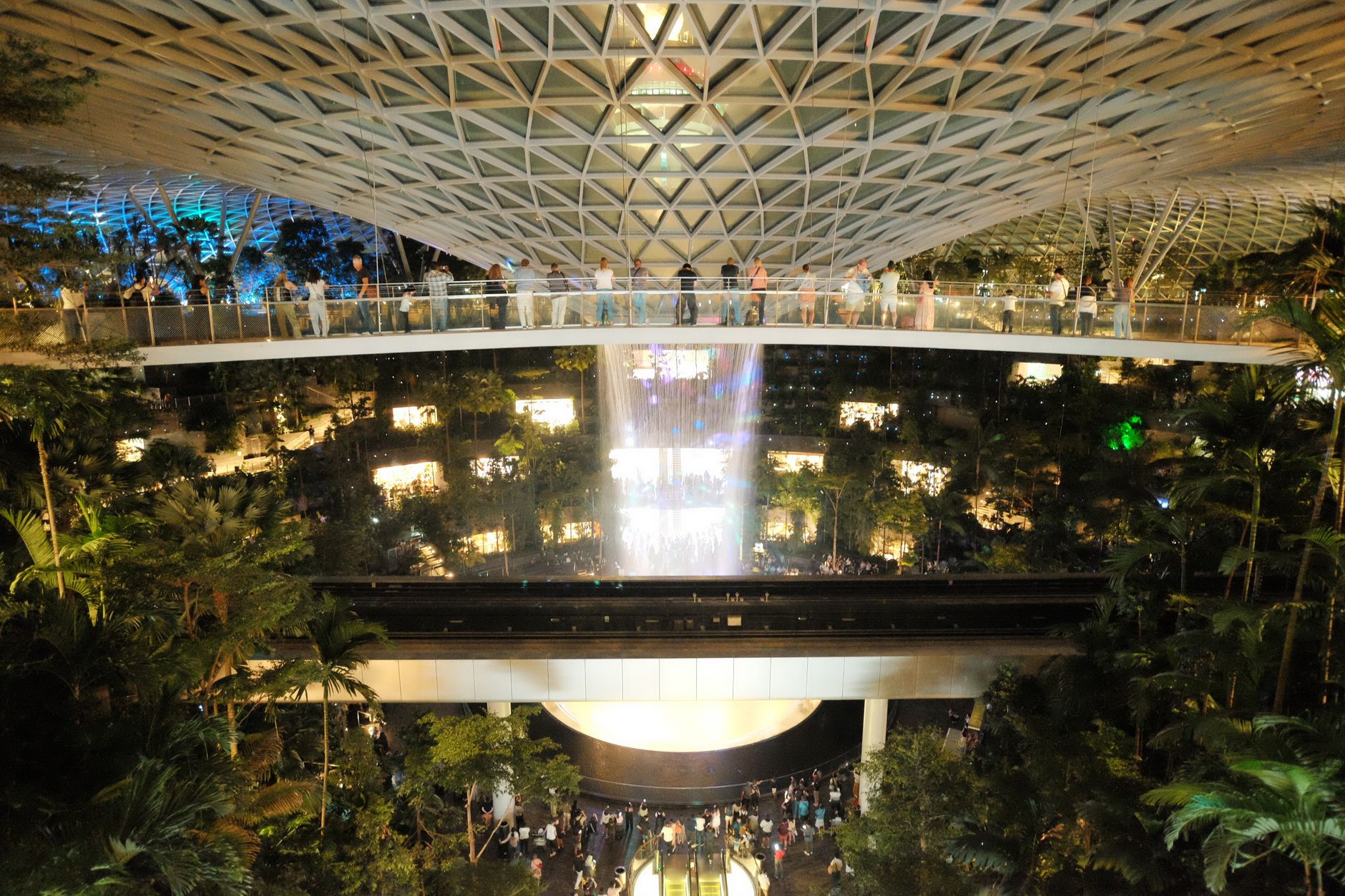
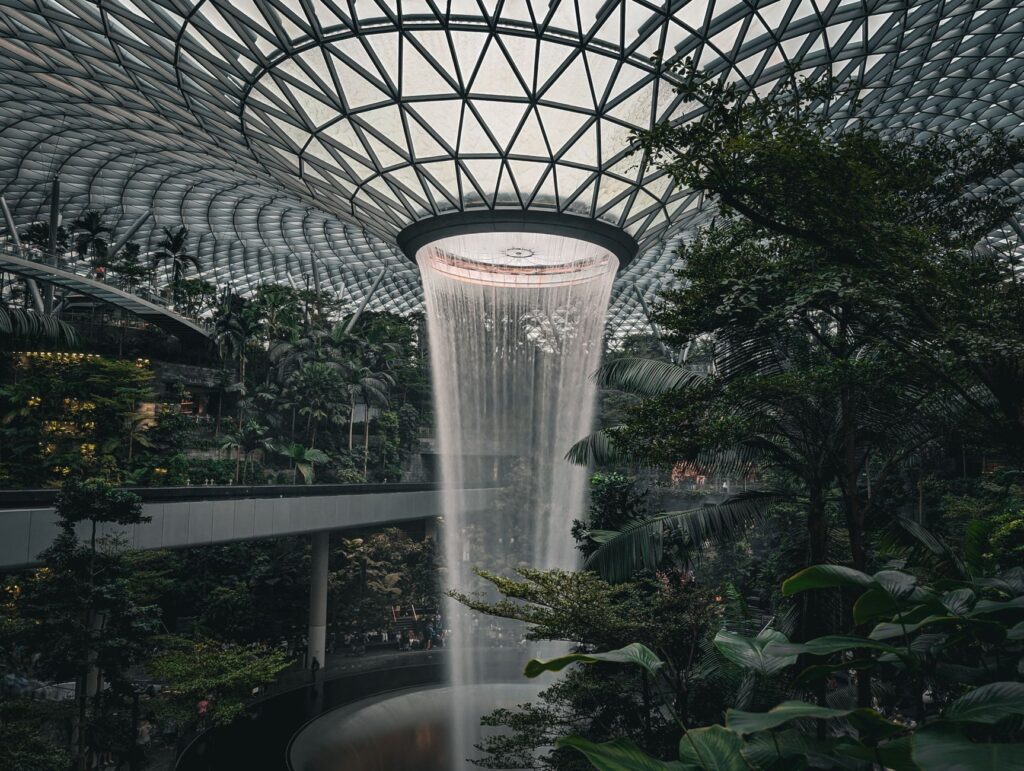
Jewel is an adjoining complex combining a shopping centre, an indoor garden and the famous covered waterfall known as the Rain Vortex. It is not a terminal, but it is integrated into the airport and can be reached from T1, T2 and T3 without taking transport. For travellers with several hours ahead, Jewel offers a circular walk among tropical vegetation, terraces and viewpoints that breaks the monotony of waiting lounges.

However, it is worth remembering that Jewel lies outside the transit area for connecting passengers. That means if a traveller is not entitled to enter the country or prefers not to pass through immigration, they will not be able to access it. The decision to leave and re-enter depends on nationality, visa type and available time, and should always be verified with the airline or Singapore immigration authorities before attempting it.
Eating, resting and working at the airport
Changi’s dining offer is broad and reflects Singapore’s diversity: Chinese, Malay, Indian, Japanese, Western and fusion cuisine. There are budget stalls in public areas and table-service restaurants in Jewel. For transit passengers, the key is distinguishing between areas accessible without passing immigration and those that require entering the country.
Rest also requires planning. There are hotels inside the terminals, such as Aerotel in T1 or Yotelair in Jewel, plus free rest areas and armchairs scattered through the lounges. On overnight layovers, many travellers choose to book a few hours of a room to sleep properly rather than trying to rest in a chair. It is a practical decision that improves the rest of the journey.
The difference between an exhausting layover and a manageable one often comes down to a single decision: booking a place to sleep, even for a few hours.
Singapore beyond the airport: when leaving is worth it
Singapore is a small, well-connected city-state. From Changi, the MRT metro can reach the centre in roughly half an hour, depending on the destination. For layovers of six hours or more, some travellers consider going out to see the city. It is possible, but requires careful calculation: immigration time, transfer, route and return with margin for boarding.

The relationship between landscape and everyday life in Singapore appears quickly: vertical gardens, trees planted between buildings, hawker centres where you eat well for little money and a public transport network that runs with precision. Changi is, in a way, a synthesis of that way of organising space: dense, green and efficient.
Luggage and the details that slow you down
One of the most common mistakes on long layovers is carrying all hand luggage around. Changi has left-luggage and storage services in some terminals, allowing travellers to move freely if they decide to explore. There are also assistance services for people with reduced mobility, prayer rooms, nursing areas and spaces for children.
Another practical detail is connectivity: the airport offers free wifi, but it is worth downloading maps, boarding passes and documents in advance in case the signal fails at a given moment. Phone battery is a critical resource on any long layover, and Changi has charging points distributed through the terminals.

A layover designed for different kinds of travellers
Not all travellers need the same thing. Business travellers look for silence, a plug and a table. Those travelling with children need spaces to burn energy. First-time visitors to Asia may want to glimpse a tropical garden without leaving the airport. Changi tries to cover those profiles with themed gardens, children’s areas, VIP lounges and workspaces.
The key is to choose one goal for the layover and not try to do everything. A traveller who decides to walk through Jewel, eat calmly and sleep for two hours will probably end up better than one who rushes from terminal to terminal without direction. A layover, in the end, is a fragment of a journey with rules of its own.
Practical guide
Before travelling, check the official Changi Airport website and your airline for updated information on terminals, connections and entry requirements for Singapore. Information changes, and no guide can replace direct consultation.
- Terminals: T1, T2, T3 and T4, plus Jewel as an adjoining complex.
- Internal transport: Skytrain between T1, T2 and T3; bus from T2 to T4.
- Transit: security checks are usually at the boarding gate.
- Leaving the airport: requires passing immigration; verify visa and available time.
- Metro: Changi Airport station connects to Singapore’s MRT network.
- Rest: hotels inside terminals and free rest areas.
- Luggage: left-luggage services in some terminals.
- Connectivity: free wifi and charging points throughout.
The most useful recommendation is simple: calculate the real time available, subtract screening and boarding margins, and decide with that number in hand. Changi rewards the organised traveller, but also the one who knows when to stop.
A closing between gardens and screens
In the end, what sets Changi apart is not only its size or commercial offer but the way it integrates nature and movement. A traveller can move from a butterfly garden to a boarding gate in minutes, or contemplate an indoor waterfall before boarding a plane. That coexistence of the green and the technical sums up something of Singapore: efficiency need not clash with care for space.
For those who lay over there, the lesson is modest but useful. An airport is not just a place of passage; it is also a territory with its own rules, rhythms and landscapes. Learning to read it turns the wait into another part of the journey, not an empty parenthesis.