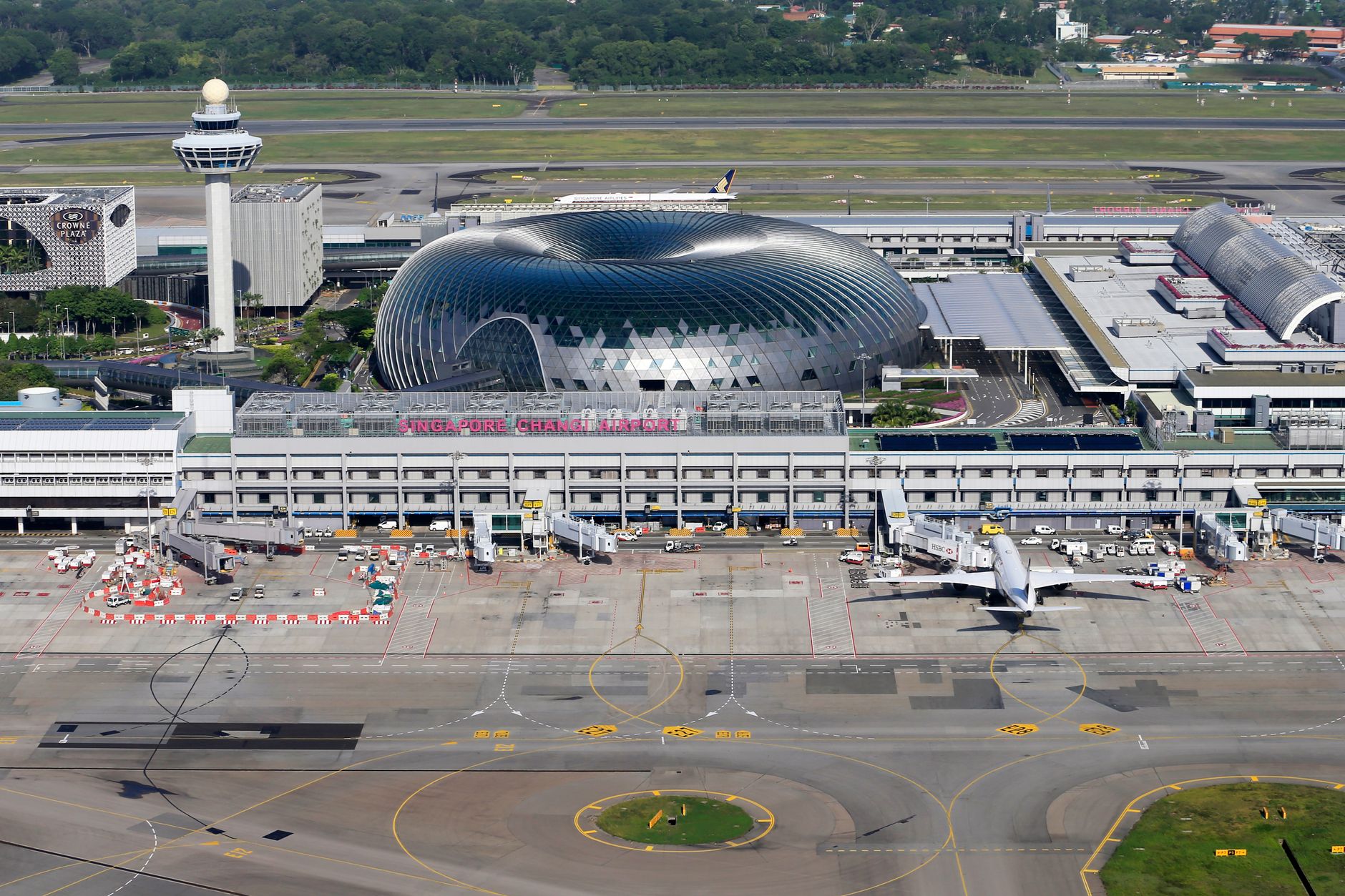

Some airports are crossed; others are inhabited. On Singapore’s eastern edge, on land reclaimed from the sea, Changi Airport belongs to the second category: a place where waiting has become a programme and where thousands of travellers arrive with hours to spare not out of caution, but out of interest. The city-state, long a mandatory stop between Europe, Asia and Oceania, has turned that condition into its signature.
The question behind this report is not how many flights leave Changi, but how a trip is organised when the airport stops being a formality and becomes the first chapter of the itinerary. Answering it means looking at its terminals, its architecture, its relationship with the sea and with Singapore’s memory, and the way it links connections without making travellers feel they have left the city behind.
An airport you read like a neighbourhood
Changi works with the logic of a district rather than that of a facility. Its terminals are linked by an internal transport system that lets people move between them without stepping outside, and each has its own character: Terminal 1 keeps the air of a first modern airport, Terminal 2 combines indoor gardens with commercial areas, Terminal 3 handles much of the long-haul traffic and Terminal 4 runs on a more automated model.
Added to that network is Jewel Changi Airport, a complex opened in 2019 that is not strictly a terminal but a destination in itself: a glass-and-steel building organised around an indoor waterfall and a multi-level garden. For many transit passengers, Jewel is their first image of Singapore, even before they set foot in the city.

Changi does not compete to be the largest airport, but the most habitable: a place where a layover becomes a visit.
Terminal by terminal: how to find your way
The first decision for any traveller at Changi is to understand which terminal they are in and which one they need to reach. Internal links allow transfers between terminals, and the internal train that runs through some of them works like a small elevated metro line. For those in transit, signage is abundant and designed for passengers who do not share a language.
- Terminal 1: one of the most recognisable for its architecture and its proximity to Jewel.
- Terminal 2: combines indoor nature and commerce, with gardens built into the building.
- Terminal 3: a reference point for long-haul flights and connections to Asia and Oceania.
- Terminal 4: bets on automated processes and a more technological experience.
Beyond the labels, what matters is that the whole works as a system: a traveller can arrive at one terminal and leave from another without the journey feeling fragmented.
Jewel and the waterfall that changed the layover
Jewel Changi Airport introduced a simple idea that is hard to execute: that an airport can have an emotional centre of gravity. Its indoor waterfall, surrounded by vegetation, has become the meeting point par excellence and the most repeated postcard of the complex. Around it are gardens, viewpoints and commercial spaces that invite a slow walk.
The building does not replace the terminals; it complements them. For transit passengers, it offers a reason to leave the boarding area and explore a space that feels more like a covered park than a shopping centre. For those arriving or departing, it works as a threshold: the first or last image of Singapore.
Green heritage and the memory of the place
Singapore has built much of its contemporary identity on the idea of a garden city, and Changi is one of its most visible expressions. The indoor gardens, ponds and green areas are not decoration: they respond to an urban policy that treats nature as infrastructure. In a complex designed for fast transit, that plant presence introduces a human scale that slows the pace.
There is memory in the name too. Changi designates an area of eastern Singapore with a history of its own, marked by its military past and its later transformation into a residential and airport zone. The airport does not float in a void: it rests on a territory with layers that curious travellers can trace beyond the boarding gates.
Connections: the art of chaining flights
Changi’s main function remains connecting. Its position in Southeast Asia makes it a hub between European, Australian, East Asian and South Asian routes. For travellers, that means many long-haul routes pass through Singapore and that the layover can become a short stay if planned with judgement.
The key is to distinguish between a connection and a visit. A connection requires controlling times and access; a visit requires margin and a clear idea of what you want to see. Changi allows both, but it does not mix them on its own: it is the traveller who decides whether their stop in Singapore will be a formality or a chapter.
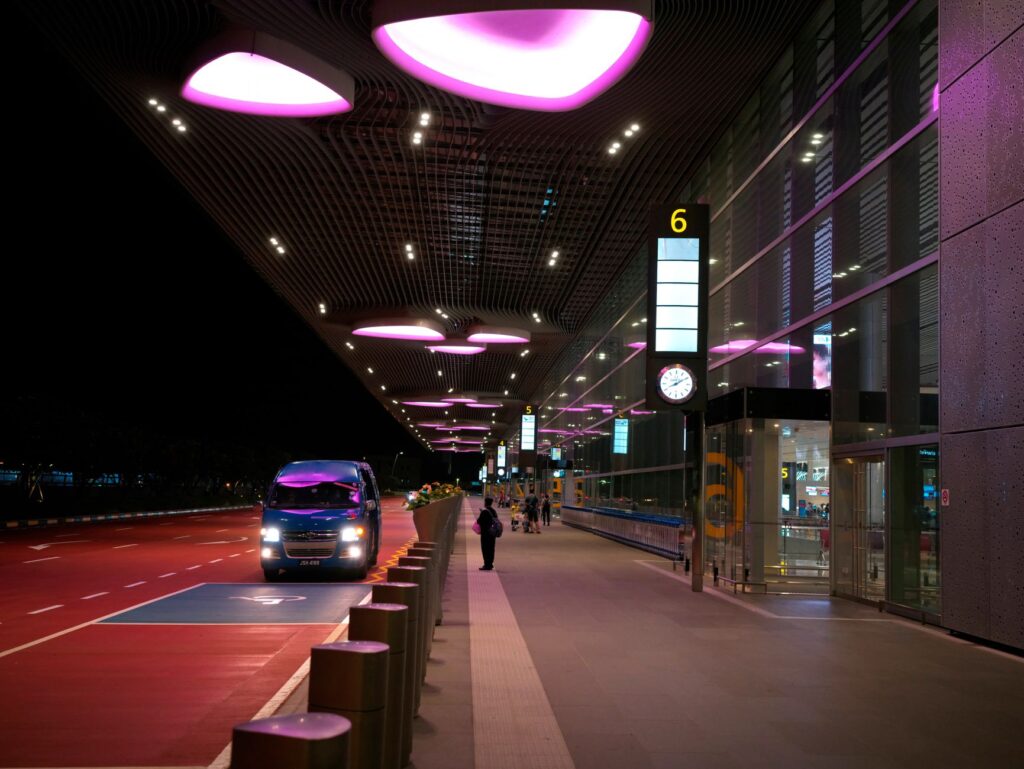
At Changi, the layover stops being dead time and becomes a decision: stay inside or step out into Singapore.
What to do if the journey stops here
For those with several hours, the complex offers enough stimuli to make leaving unnecessary. The gardens, Jewel’s waterfall, rest areas and dining options allow for a reasonable stay without crossing the airport boundary. For those who prefer to glimpse the city, the link to central Singapore is direct and well signposted.
The general advice is simple: decide before landing what kind of layover you want. If the goal is rest, look for quiet areas and avoid the busiest corridors. If the goal is exploring, set aside enough time for the journey and the return, without relying on improvisation.
Transit food, city cooking
Changi’s dining offer reflects Singapore’s diversity: Chinese, Malay, Indian and fusion cooking coexist in the same complex. For travellers, that means the last meal before the flight can also be an introduction to local cuisine. Dining spaces range from quick stalls to slower venues, and their distribution lets you choose according to the time available.

It is not only about eating: it is about understanding that Singapore is defined, in part, by its table. A bowl of noodles, a curry or a local tea can work as the first lesson of a country that is also travelled with the palate.
Architecture for movement
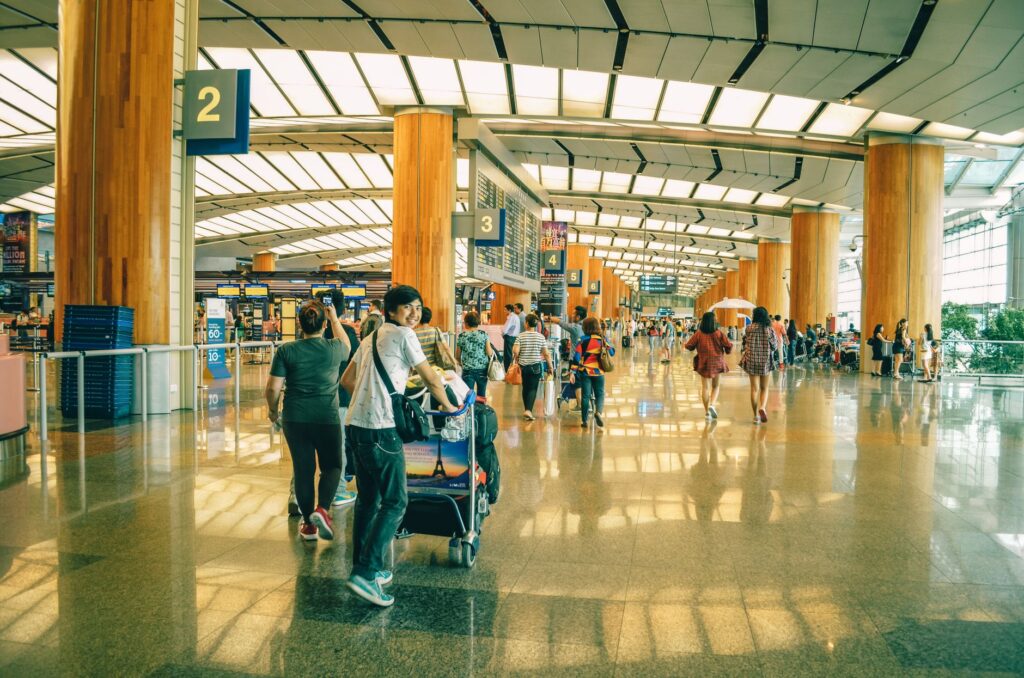
Changi’s design answers a difficult question: how to organise the movement of thousands of people without the space turning hostile. The answer combines high ceilings, natural light, clear signage and a careful separation of flows. Jewel adds a different layer: that of a building meant to be looked at, not just crossed.
The result is a complex remembered for its form, not only its function. In a category where efficiency is usually enough, Changi bets on experience and turns architecture into part of the journey.
Practical guide
Before travelling, check the airport’s official information to confirm arrival and departure terminals, available services and transit conditions. Changi publishes passenger guides for arrival, departure and transit, along with maps and descriptions of each terminal.

- Documentation: verify entry and transit requirements according to your nationality and route.
- Terminals: identify your terminal and check whether you need to move between them.
- Transit: if you do not leave the complex, review the rules and access applicable to connecting passengers.
- Time: allow enough margin if you plan to visit Jewel or go out into the city.
- Services: check rest, dining and assistance options before you arrive.
Information changes over time and with routes, so the reliable source is always the official one. This report offers context and organisational criteria, not real-time operational data.
An airport you remember
In the end, what sets Changi apart is not a figure or an award, but the feeling that the journey began before take-off. In a world where airports tend towards uniformity, Singapore has built a place with character: green, luminous, diverse and designed so that travellers do not feel they are waiting, but travelling.
For those crossing the world with stopovers, Changi proposes a different idea of transit: not as an obligatory pause, but as a legitimate part of the itinerary. And that, perhaps, is the most useful lesson anyone passing through Singapore on the way elsewhere can take away.