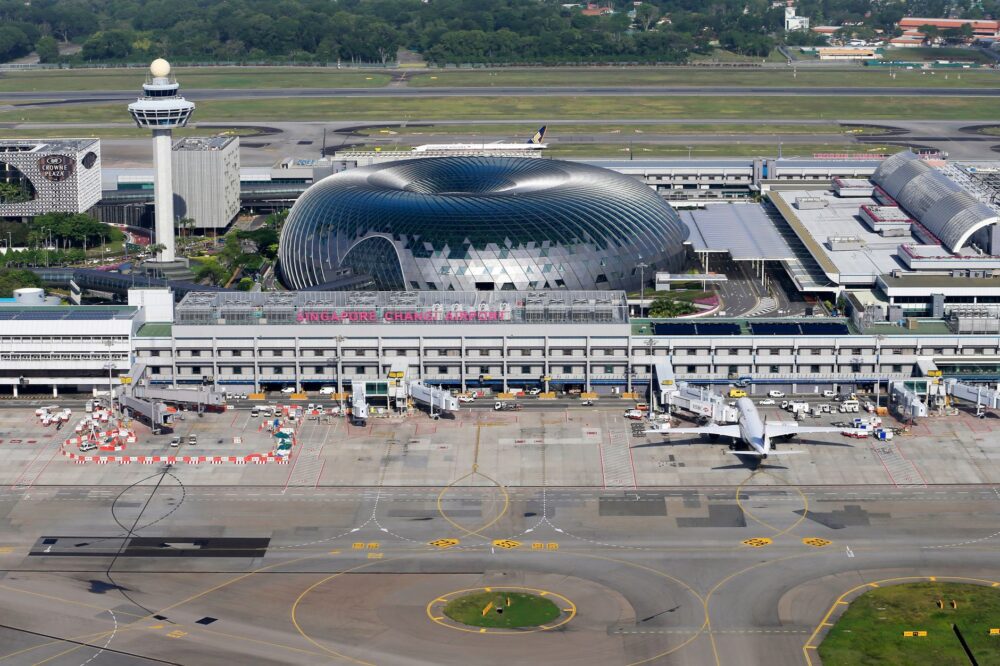

On the eastern edge of Singapore, Changi Airport stretches out like a parallel city. It is not just transport infrastructure: it is an ecosystem where nature, technology, and hospitality combine to turn waiting into discovery. For the traveler on a layover, Changi offers more than shops and boarding gates; it proposes a lesson in urbanity.
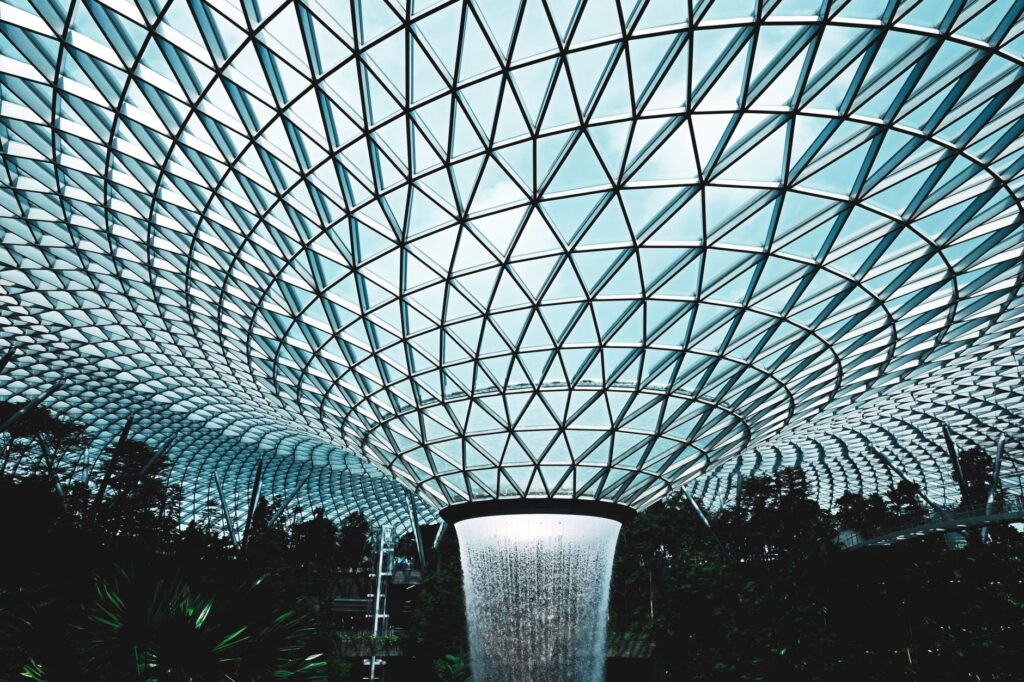
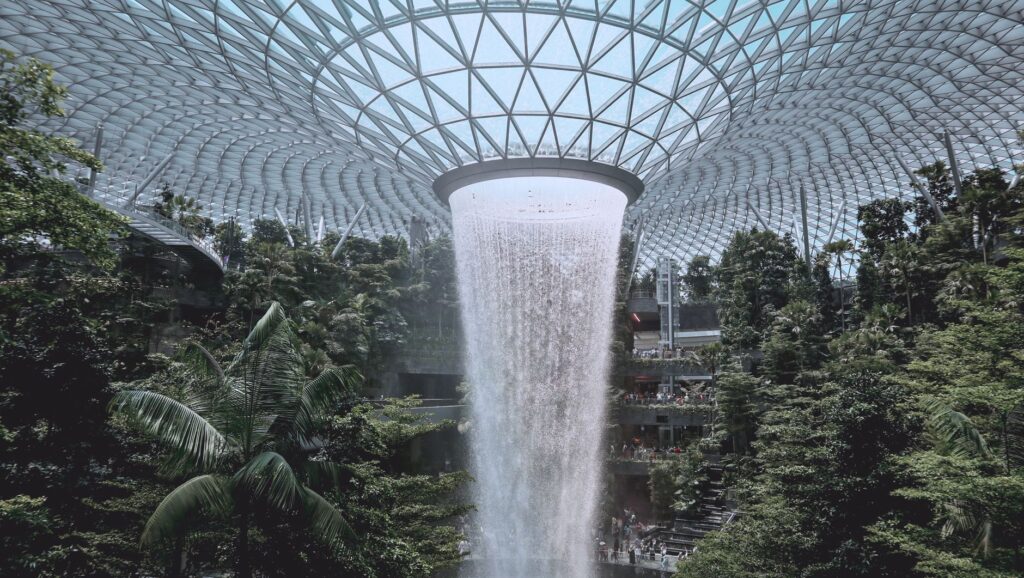
Since opening in 1981, Changi has grown into one of the world’s most awarded airports. Its design incorporates indoor gardens, a forty-meter waterfall at Jewel, and automated transport systems that connect terminals with precision. But beyond the numbers, what sets Changi apart is its ability to anticipate passenger needs and turn transit into a pleasant experience.
An airport that breathes nature
The visitor landing at Changi immediately senses a different atmosphere. The gardens are not a decorative addition but a structural part of the complex. The Butterfly Garden in Terminal 3, the Cactus Garden in Terminal 1, and the Sunflower Garden in Terminal 2 offer calm spaces where travelers can disconnect before their flight. These gardens not only beautify; they also help regulate temperature and improve air quality.
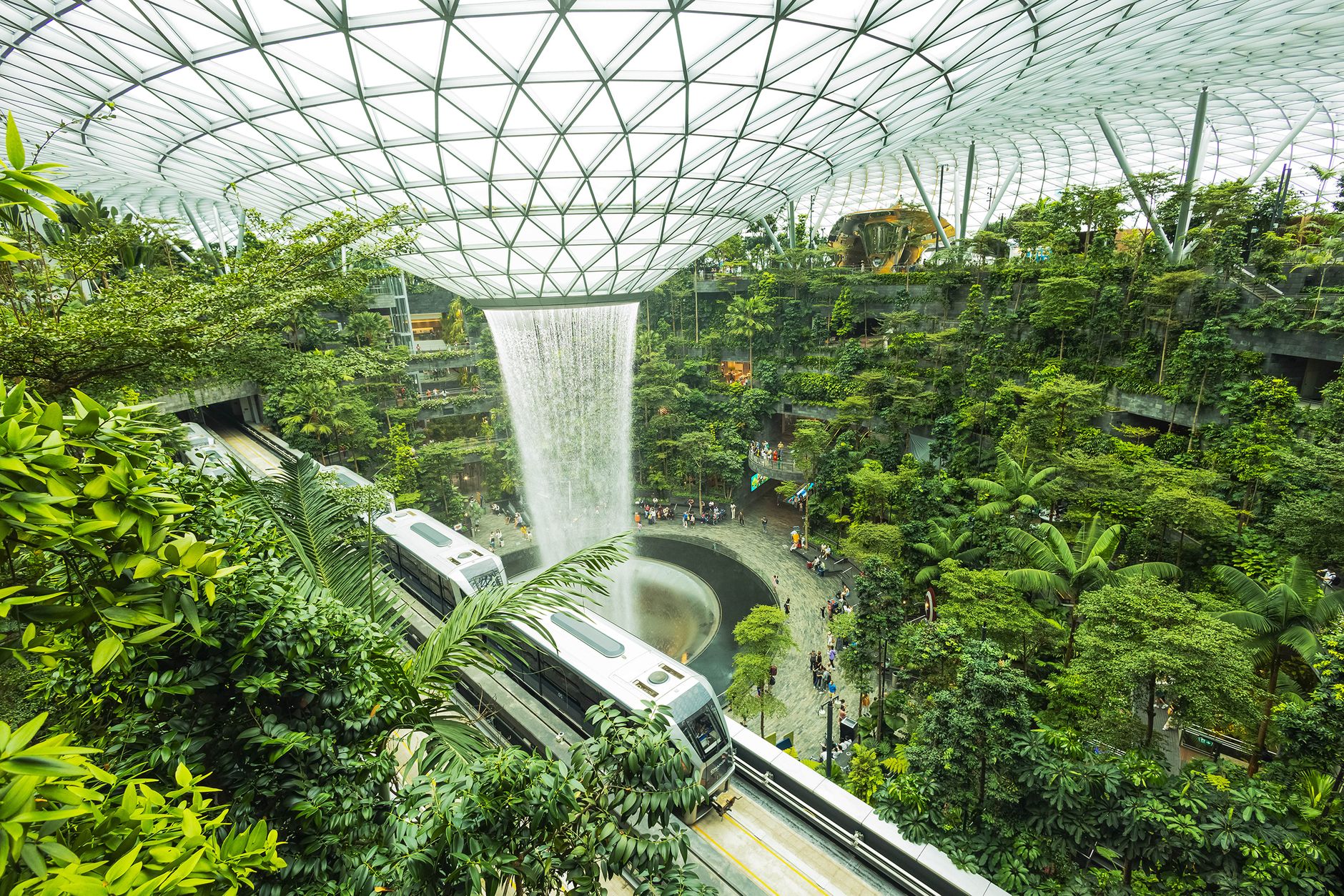
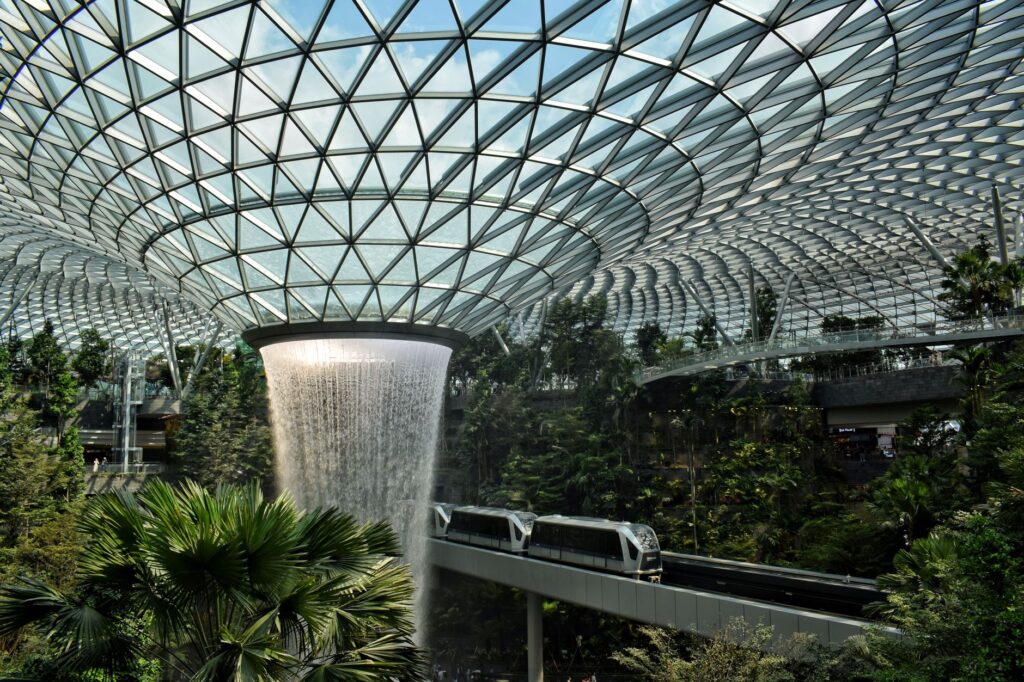
Jewel Changi, opened in 2019, took this philosophy to another level. Its glass and steel dome houses the world’s tallest indoor waterfall, surrounded by the Shiseido Forest Valley, a four-level forest with more than two thousand trees and plants. The ensemble is a masterpiece of engineering and landscape design that invites walking, observing, and above all, breathing.

«Changi is not an airport with gardens; it is a garden with airplanes,» summarizes a principle that has guided its architecture for decades.
Organization as a form of hospitality
Efficiency at Changi is not a slogan. Internal transport systems, such as the Skytrain, connect terminals every few minutes, and information desks, signed in multiple languages, make orientation easy. For first-time transit passengers, the clarity of flows—arrivals, departures, connections—reduces the anxiety that often accompanies long layovers.
Terminal 4, opened in 2017, incorporates facial recognition technology and automated scanners that speed up controls. But even in the oldest terminal, the experience is carefully curated: rest areas with loungers, free cinemas, a pool in Terminal 1, and a transit hotel for those who need to sleep between flights. Every detail seems designed so passengers do not feel they are wasting time.
This organizational clarity extends to the smallest details. Signage follows a consistent visual language across all four terminals, and staff are trained to assist travelers in multiple languages. For those unfamiliar with airport procedures, the predictability of the layout becomes a form of reassurance. Rather than feeling lost in a vast complex, passengers can move with confidence, guided by an environment that anticipates their questions before they are asked.
A shopping center that does not compete with the city
Unlike other airports where shops occupy the central space, at Changi commerce integrates without dominating. Luxury brands coexist with local offerings, and prices are not always higher than in downtown Singapore. Jewel adds a varied dining scene, from fine dining to hawker food stalls, that culinary heritage of the city-state.

For travelers with several hours to spare, Changi even offers the possibility of leaving and exploring Singapore. Free tour services, available to those with layovers over five hours who meet entry requirements, allow visits to places like Gardens by the Bay or Chinatown. It is a way to turn a layover into a brief but meaningful contact with the country.
The commercial areas are not merely transactional spaces. They function as extensions of the city’s social life, where travelers can sample local flavors, purchase regional products, or simply observe the rhythm of a place that never fully stops. This integration of commerce with culture reflects a broader philosophy: the airport is not a barrier between Singapore and the world but a threshold that introduces visitors to the country’s character.
Architecture that dialogues with the climate
Singapore is a tropical city, with high temperatures and constant humidity. Changi responds to that context with bioclimatic solutions: high ceilings, cross ventilation, heat-reflecting materials, and carefully dosed natural lighting. The result is a cool, luminous interior where air conditioning is not the only comfort strategy.
Terminal 3, designed by SOM, features a roof with skylights that filter light and reduce the need for artificial illumination during the day. Vertical gardens and fountains contribute to a sense of well-being. It is an architecture that does not fight the climate but learns from it.
This approach extends to the materials used throughout the complex. Stone, wood, and glass are combined in ways that evoke the natural landscape of the region while maintaining the durability required for a high-traffic facility. The result is an environment that feels both modern and rooted, a space where the tropical setting is acknowledged rather than suppressed.
Heritage and culture in transit
Changi also serves as a showcase of Singaporean culture. Its corridors display contemporary artworks, installations that pay homage to the country’s multicultural heritage, and spaces dedicated to the airport’s history. The permanent exhibition in Terminal 2, for example, traces Changi’s evolution from construction to the present, with photographs and objects documenting its transformation.
For those traveling with children, the airport offers themed play areas, such as the nature-inspired space in Terminal 3 or the children’s playground in Terminal 1. These spaces not only entertain; they also allow families to share a moment of rest before their flight.
Cultural programming at Changi goes beyond static displays. Rotating exhibitions and installations ensure that repeat visitors encounter something new, while thematic events tied to local festivals bring a sense of seasonal rhythm to the terminals. These initiatives transform the airport from a neutral transit zone into a place with a distinct identity, one that reflects the diversity and dynamism of Singapore itself.
The experience of connection
Changi is, above all, a hub of connections. More than a hundred airlines operate in its terminals, linking Singapore with destinations in Asia, Europe, the Americas, and Oceania. For travelers using the airport as a layover, the experience is designed to be seamless: transfer desks, security controls, and boarding gates are organized to minimize movement.
The Changi mobile app allows users to check flight status, gate locations, and available services in real time. It is a useful tool, though not essential, because physical signage is abundant and clear. In a world where airports are often a source of stress, Changi bets on calm.
«Changi’s true innovation is not in its technology but in its ability to make travelers feel cared for,» notes a principle felt in every corner.
For passengers with tight connections, the airport’s design prioritizes efficiency without sacrificing comfort. Dedicated transfer routes and clearly marked pathways help reduce the stress of navigating an unfamiliar space. Even during peak periods, the layout allows for a steady flow of movement, ensuring that the journey from one gate to another remains manageable.
Practical guide
To make the most of a layover at Changi, keep some practical aspects in mind. The airport has four terminals connected by the Skytrain, which operates free of charge. Transfers between terminals are quick, though there can be some waiting during peak hours. If connection time is tight, it is advisable to head directly to the boarding gate and consult the information panels.
For longer stays, Jewel Changi offers an ideal space to rest, eat, or simply walk. Entry to the waterfall and forest has a cost, but access to commercial and dining areas is free. Travelers with more than five and a half hours of layover can sign up for the free tour program, provided they meet Singapore’s immigration requirements.
- The airport has rest areas, showers, and transit hotels in several terminals.
- Most establishments accept credit cards and mobile payments.
- There are luggage storage facilities in all terminals.
- Customer service is available in several languages.
- For those traveling with babies, there are nursing rooms and changing tables.
It is also worth noting that the airport’s layout rewards a bit of planning. Checking the terminal map in advance, noting the location of key amenities, and allowing buffer time between connections can make the experience smoother. For travelers with accessibility needs, the airport provides assistance services and clearly marked routes, ensuring that the journey through Changi remains comfortable for everyone.
A closing with a garden view
At the end of the journey, travelers who pause for a few minutes in front of the Shiseido Forest Valley at Jewel understand that Changi is not a simple place of transit. It is a space where nature and architecture meet to offer a pause amid the bustle of travel. The waterfall falls with a constant murmur, the trees filter the light, and time seems to stand still. In that instant, the layover ceases to be a wait and becomes a small journey within the journey.
Changi, in Singapore, demonstrates that airport planning can also be a form of hospitality. It is not just about moving passengers but about creating an environment where each person finds a moment of calm, a space to discover, or simply a place to breathe before continuing on their way.