
In the Chiloé archipelago, off the coast of southern Chile, wood is not just a building material: it is a language. The churches that dot its islands and coastlines are the finest expression of a tradition that began in the 17th century and still defines the landscape and the lives of its inhabitants. These constructions, declared a UNESCO World Heritage Site in 2000, represent a unique example in Latin America of wooden religious architecture.
To travel through Chiloé is to enter a territory where rain, wind, and sea have shaped not only the geography but also the way of building and living. The churches, with their wooden towers and colorful facades, stand as beacons visible from the water, fulfilling a practical and symbolic function that transcends the religious.
An archipelago of temples visible from the sea
The location of the churches is no accident. They were built on hills and elevated sites so that sailors could see them from the sea and to prevent flooding. This decision, repeated throughout the archipelago, created a visual reference system that guided fishermen and travelers for centuries. The esplanades that precede them, often turned into plazas, remain the scene of religious festivals and community gatherings.
The tradition began with the circular mission of the Jesuits, who toured the islands annually to evangelize their inhabitants. With the expulsion of the order in 1767, the Franciscans continued and enriched this work during the 19th century. The result was a successful fusion of indigenous and European techniques, giving rise to what is known as the Chilota School of architecture.
The Jesuits arrived in the archipelago in 1608 and organized a system of circulating missions: religious groups made annual tours around the islands, staying for a few days in locations where churches were erected jointly with the communities of believers. For the rest of the year, a specially trained layperson attended to the spiritual needs of the inhabitants. This model explains both the number of temples and their distribution across the territory, as well as the deep roots they acquired among the island population.
The mark of the boat builders
The knowledge of local carpenters was fundamental. Accustomed to working in shipbuilding, they applied naval techniques to the construction of the churches. The joints and fittings of the towers and roofs recall those of boats, and the wood used—mainly larch, cypress, and mañío—came from nearby forests. This artisanal skill reached its highest expression in these temples, where precision and resistance were essential to withstand the harsh climate.
Wood, worked with naval wisdom, became the soul of an architecture that defied time and the elements.
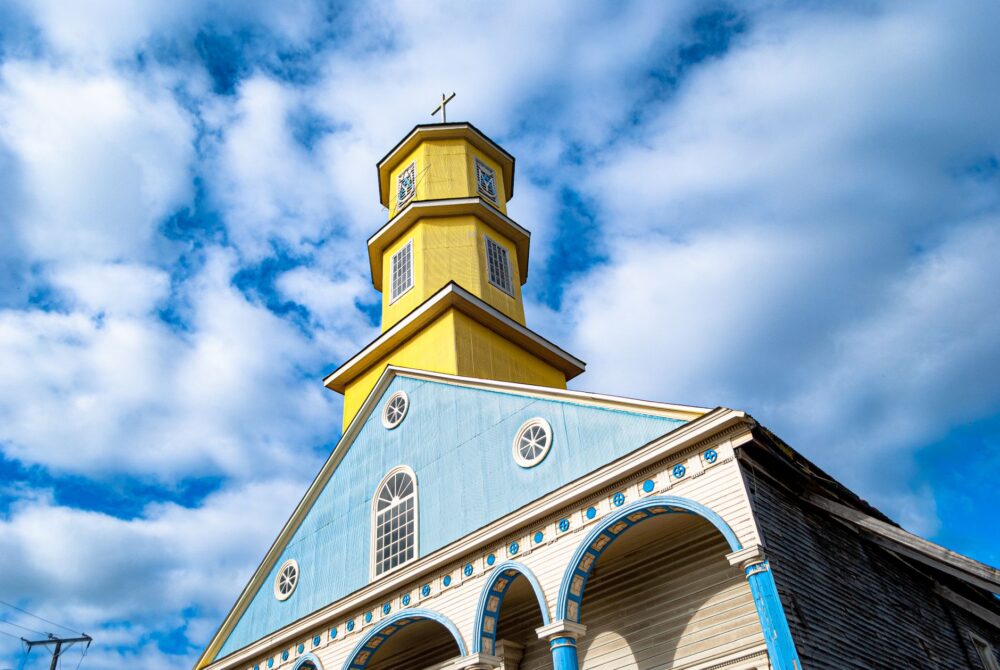
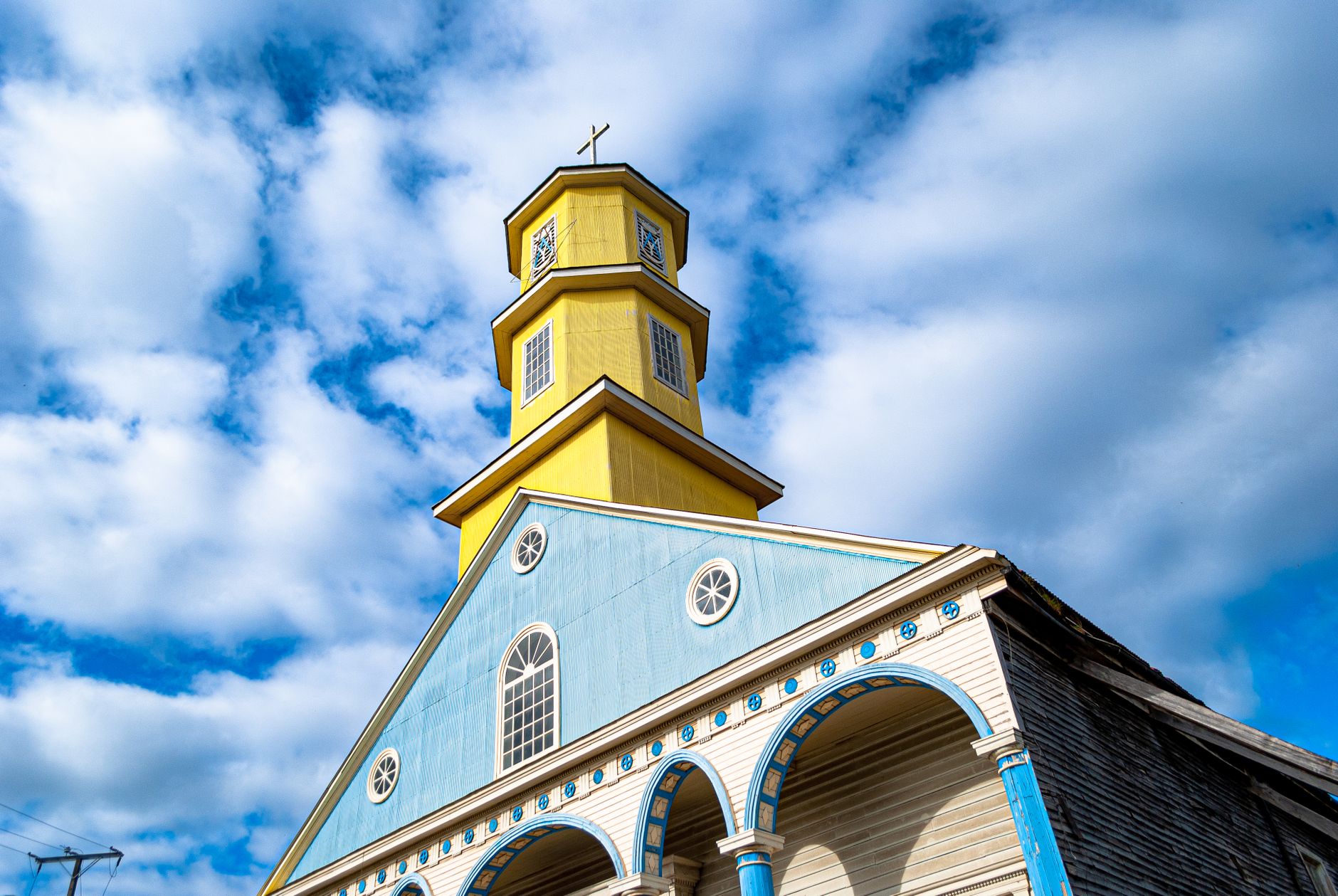
The churches have a basilican layout, with a central nave and side chapels, and a vaulted ceiling. The main facade is usually dominated by a tower, which can be square or polygonal, and stands as a distinctive element. Inside, traditional colors and religious images complete an ensemble that has been preserved without substantial changes over time.
The builders were farmers, fishermen, and sailors who demonstrated great expertise in handling the most abundant material in their environment. Their skills, transmitted from generation to generation, allowed the development of a vernacular tradition supported by a great quantity and variety of testimonies that remain in use. The orientation and location of the churches were deliberate: constructed according to the demands of the sea, they were arranged on hills to be seen by navigators and to prevent flooding.
A living heritage in constant care
Sixteen of these churches were inscribed on the World Heritage List: Achao, Quinchao, Castro, Rilán, Nercón, Aldachildo, Ichuac, Detif, Vilupulli, Chonchi, Tenaún, Colo, San Juan, Dalcahue, Chellín, and Caguach. All of them are part of the Diocese of Ancud and are administered by the Friends of the Churches of Chiloé Foundation, created for their conservation and enhancement.
The challenge of maintaining these structures is constant. The nature of the material and environmental conditions demand permanent conservation work. The community has historically taken on this task, but phenomena associated with modernization and globalization have increased their vulnerability. The shortage of fine woods and the protection of the species that provide them are current challenges that have led to exploring the use of alternative woods.
The churches were declared a National Monument of Chile under Law No. 17.288 of 1970, and their supervision and protection are carried out by the Government of Chile through the National Monuments Council. The property covers a serial area of just under 14 hectares, distributed among the sixteen temples, which underlines the importance of the surrounding areas and the need to regulate them to preserve the integrity of the ensemble.
The minga: collective work that sustains heritage
One of the pillars of conservation is the minga, a form of unpaid community work that has been key to the maintenance of the churches. This practice, deeply rooted in Chilote culture, reflects the intangible value these constructions hold for their communities. Religious festivals and group support activities are essential components of this relationship.
Without the active participation of the islanders, the conservation of the churches would be an impossible task; their collective effort is the true foundation of this heritage.
The transmission of ancestral knowledge from carpenters to new generations is fundamental. Research, recording, and teaching of construction techniques, as well as the study of wood properties and treatments to mitigate the effects of climate, are ongoing lines of work. Recent restorations have prompted a substantive reflection on the role of intangible heritage and on the need to keep alive the traditions, techniques, and management systems that have sustained these buildings for centuries.
Architecture that dialogues with the landscape
The integration of the churches into their environment is total. They do not compete with the landscape; they are part of it. The colors of the facades, often white, blue, or yellow, contrast with the green of the forests and the gray of the sky, creating postcards that have become a symbol of Chiloé. The orientation of the temples, always seeking visibility from the sea, reinforces this dialogue with the geography.
The subsoil of some churches could reveal information about their relationship with pre-Hispanic indigenous ritual sites, a field of study yet to be explored. This connection with the deep past of the archipelago adds another layer of meaning to these constructions.
Interventions have preserved the richness of the typologies of connections, joints, and fittings; period technology has been recovered and applied, and exceptional combinations of connections of a deeply local and singular character have been discovered. This attention to detail explains why the churches retain a high degree of authenticity in their forms, designs, materials, and settings.
Threats and lessons from the past
The vulnerability of these buildings became evident when the tower of the church of Chonchi collapsed as the result of a storm in March 2002. This event highlighted that the state of conservation and the fragility of the churches were worse than previously assessed, particularly at the time of nomination. Since then, a large-scale program supported by the Inter-American Development Bank has managed to reverse serious damage, especially in the tower facades.
The churches require constant conservation efforts; the nature of the building material and the environmental characteristics make continual maintenance an imperative. The communities have always assured their conservation, but current phenomena associated with modernization and globalization have increased their vulnerability. The unified and selfless participation of the community in the conservation and preservation of the wisdom, expertise, and ancestral knowledge of the carpenters is essential in this regard.
The challenge of respectful tourism
Growing tourist interest in Chiloé presents both opportunities and risks. The key is to find formulas that allow tourism to generate tangible benefits for the communities and churches, avoiding excessive commercialization or trivialization. The sustainability of conservation is a major challenge, as the churches are at the center of their communities’ development.
Authorities and local organizations are working on the protection and regulation of surrounding areas, as well as on risk preparedness and environmental protection of the temples. The goal is to maintain the delicate balance between the social, environmental, physical, and spiritual factors that make these churches an exceptional heritage.
It is also necessary to advance in the investigation of the properties of different woods and in the treatments that mitigate the effects of weathering and attacks by xylophages. The search for alternative woods that share the exceptional properties of larch and cypress is part of this effort, as is the environmental protection of the areas where these species grow.
Practical guide
To visit the churches of Chiloé, the most recommended starting point is Castro, the provincial capital, which offers accommodation and transport services. From there, many of the churches can be reached by land routes and ferries. Other islands, such as Quinchao, are connected by regular ferry services.
- Best time to travel: The austral summer months (December to March) offer milder temperatures and longer days, although rain can be present at any time. Spring and autumn are also viable, with fewer visitors.
- What to bring: Waterproof clothing, appropriate footwear for uneven terrain, and wind protection. A detailed map or offline navigation app is useful, as signal can be limited in some areas.
- Respect and schedules: The churches are active places of worship. It is advisable to check opening hours, which may vary, and behave respectfully during ceremonies. Some churches may be closed outside of religious services.
- Transport: Renting a vehicle offers the greatest flexibility to tour the main island and access the ferries. There are also local bus services connecting the main towns.
- Gastronomy: Chilote cuisine is an attraction in itself. Be sure to try curanto, a traditional dish cooked in a hole in the ground with hot stones, and the fresh seafood of the area.
A closing by the sea
At sunset, when the golden light bathes the wooden towers and the sound of the wind mingles with that of the waves, the churches of Chiloé reveal their true dimension. They are not just historical monuments; they are the beating heart of a culture that has known how to adapt and resist. Every board, every joint, every color tells a story of faith, community, and respect for a challenging environment. To visit Chiloé is to understand that heritage is not something static, but a collective construction renewed day by day with the effort of its inhabitants.