The Coral Dream of a Visionary
Far from the frenetic bustle that defines the financial skyline of the metropolis today, the urban origins of this region stem from a meticulous, almost quixotic design. In the early 1920s, developer George Merrick conceived a garden city over the subtropical wetlands that would emulate the architectural grandeur of southern Europe. The goal was not merely to erect residential buildings, but to sculpt a comprehensive aesthetic narrative where every facade engaged in dialogue with classical history, Spanish baroque, and Italian Renaissance styles.
To materialize this vision, Merrick recruited renowned architects such as Phineas Paist and landscape designers of the stature of Clemente von Franckenberg. Together, they devised an urban canvas where coral stone, extracted directly from the local quarry and characterized by its porous texture and ochre hue, would become the vertebral material. This geological substrate not only granted an indelible, rugged texture to the walls, but also rooted the structures firmly in the marshy territory they sought to tame and embellish.
Stone, Lime, and Colonial Memory
A journey through this foundational district reveals a visual grammar dominated by tribute towers, interior courtyards paved with terracotta tiles, and noble hardwood lattices. Gabled roofs, covered with handmade or imported terracotta tiles designed to replicate the Andalusian tone, crown residences that seem lifted straight from a Sevillian tale. The evening light, filtered through leafy avenues flanked by centennial banyans, bathes the white stucco walls in a chiaroscuro of profound Mediterranean lineage.
Unlike the functionalist grid that would dominate much of subsequent American urban planning, this layout prioritized monumental perspectives and visual terminals. Garden rotundas, adorned with baroque-inspired fountains and classical sculptures brought from Italy, interrupted the travel rhythm to offer pauses for contemplation. In these spaces, native vegetation—ferns, royal palms, and bougainvillea—intertwined with imported elements, creating a living botanical garden where architecture served as a frame and backdrop for the subtropical nature.
The city was not built against the climate, but through a constant negotiation with its humidity, blinding light, and Atlantic breezes via shaded galleries and ventilated courtyards.
The Palace of Water and Carved Stone
Among the monumental landmarks of this enclave stands the Venetian Pool, a masterpiece of playful and architectural engineering inaugurated in 1924. Excavated from an ancient coral rock quarry from which thousands of tons of material were extracted for neighboring constructions, this monumental public swimming pool transformed into an aquatic amphitheater surrounded by Venetian bridges, Italian Gothic-inspired watchtowers, and grottos carved into the stone.
The complex served not only a recreational function but operated as the social salon of a community in full effervescence. Wealthy families, artists, and investors gathered beneath arched porches to debate the region’s urban future. The crystal-clear water, sourced from subterranean springs and constantly renewed, reflected the filigree of arches and balustrades, turning bathing into an aesthetic ritual where liquid architecture merged with stony solidity.
The Railway Milestone and the Portal of Entry
The physical and symbolic access to this utopian city demanded infrastructure matching its aesthetic pretensions. The former railway station, designed with a volumetric display reminiscent of Californian missions and Spanish Renaissance palaces, functioned as the threshold where travelers from the industrialized north crossed the border into a subtropical eden. Round arches and bell towers welcomed visitors with the promise of sun-drenched repose.
This railway portal also articulated the commercial and cultural flow feeding the area’s growth. Construction materials, mahogany furniture, and European works of art arrived via its tracks, connecting the marshy periphery with the nation’s core hubs. Today, although the station’s original function has evolved, its structure remains a testament to the blind faith its founders placed in transportation as a catalyst for urban development.
The Refuge of Tropical Avant-Garde
As the urban project matured, it attracted a colony of creators, writers, and architects seeking to escape the winter rigidity of the northeast without compromising aesthetic rigor. The private residences built in subsequent years experimented with the integration of indoor and outdoor spaces, anticipating the principles of modern tropical architecture. Deep porches, locally known as breeze porches, made it possible to inhabit the outdoors even during the hottest summer days.
These transitional spaces became informal laboratories where human habitat in extreme climates was rethought. Large windows protected by wooden lattices allowed diffuse light to pass while blocking radiant heat, proving that formal beauty and climatic efficiency could go hand in hand. The influence of this movement quickly spread throughout the southern peninsula, laying the groundwork for a distinct visual identity that rejected the simplistic imitation of Anglo-Saxon models.
The Deco Persistence in the Neighboring Peninsula
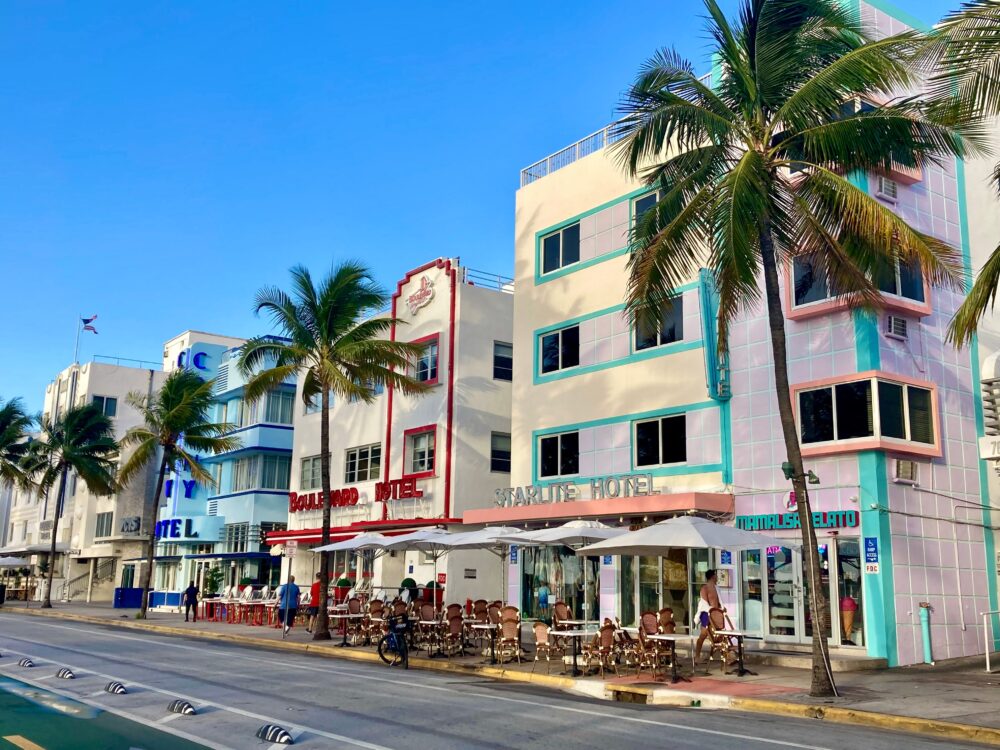
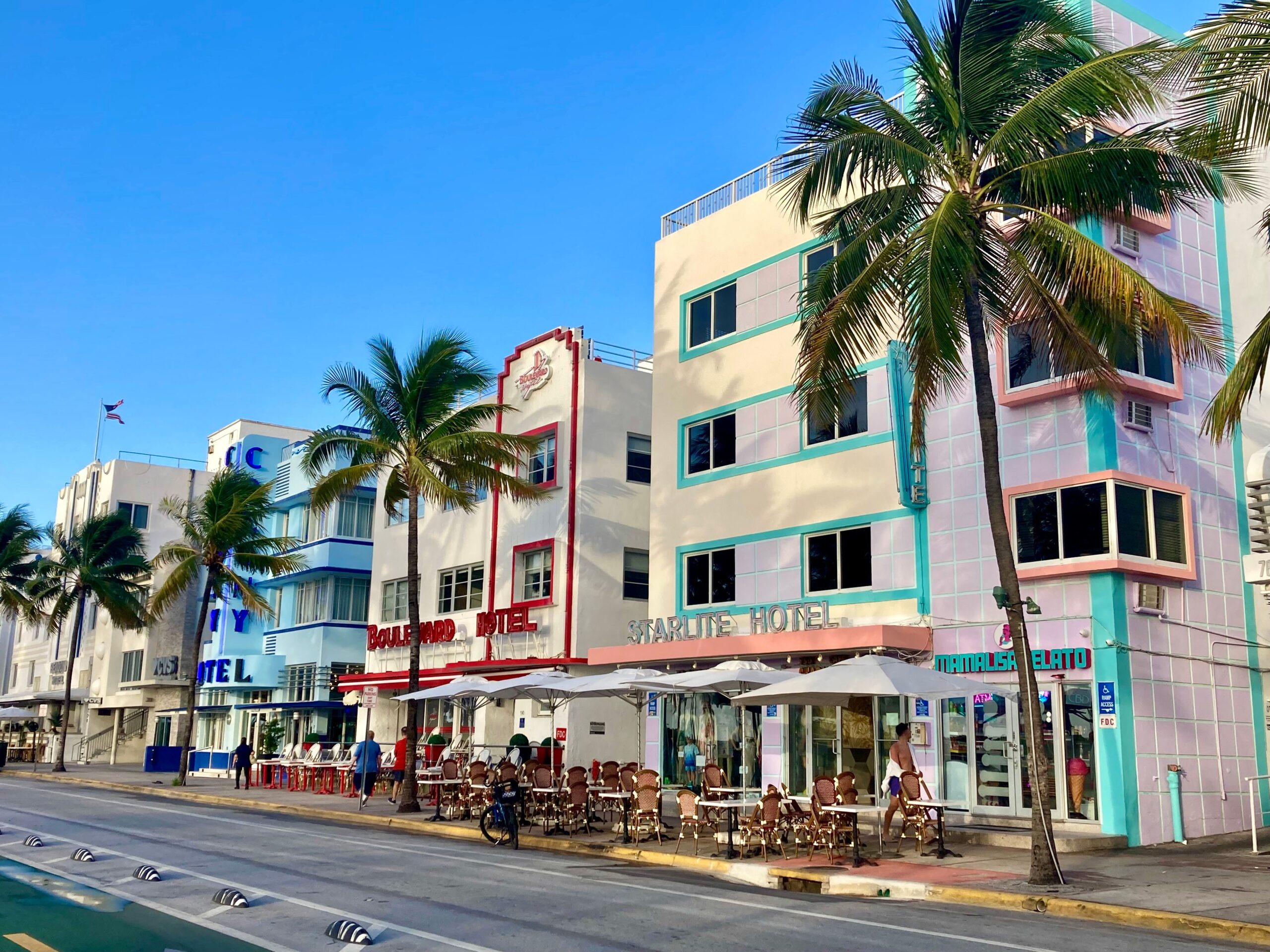
If Coral Gables represented nostalgia for the Old World, the coastal strip of Miami Beach responded to a completely opposite impulse: the celebration of mechanical the future and speed. A few kilometers away from the coral courtyards, the Art Deco district emerged after the devastating hurricane of 1926 as a collective exercise in optimistic reconstruction. Here, pure lines, nautical motifs—portholes, ocean liner railings—and geometric reliefs replaced colonial arches.
The hotels and apartments of South Beach, initially painted in pastel shades and off-whites to reflect the relentless sunlight, transformed the maritime facade into a cinematic set. Architects like Henry Hohauser and Albert Anis introduced the Streamline Moderne style, characterized by rounded corners and horizontal bands suggesting constant movement. This architecture did not look back at historical precedent, but toward the era of commercial airliners and luxury cruise ships.
The contrast between the rustic stone of the interior and the streamlined stucco of the coast draws the mental map of a city built upon stylistic clashes.
The Persistence of the Past Beneath Neon
Today, exploring both enclaves allows one to understand that the metropolis’s identity is not a homogeneous monolith, but the result of overlapping layers of human aspirations. While the glass towers of the financial district permanently rewrite the skyline with global codes, the historic neighborhoods endure as three-dimensional archives of the dreams that birthed them. The preservation of these architectural heritages proves that a destination’s value lies as much in its capacity to innovate as in its firmness to preserve material memory.
Residents and visitors who walk today through the tree-lined avenues of Coral Gables or observe the marine frizes of Ocean Drive participate in an uninterrupted dialogue between utopia and reality. The coral traces, Venetian oculi, and restored neon signs form an urban fabric where each building acts as a mute witness to a collective ambition to transform the swamp into a legendary territory.
Practical guide
How to get there: Miami International Airport (MIA) is located less than fifteen minutes by taxi or rental car from the historic districts of Coral Gables and Miami Beach.
When to go: The months from November to April offer milder temperatures and lower humidity, ideal for exploring the routes on foot or by bicycle.
Where to stay: The historic Biltmore Hotel in Coral Gables offers a complete immersion into the architecture of the 1920s, featuring its iconic tower inspired by Seville’s Giralda. For the coastal ambiance, restored boutique hotels in the Art Deco Historic District combine period design with contemporary comfort.
Must-see highlights: The Venetian Pool is open from Tuesday to Sunday (advance booking recommended); Vizcaya Museum and Gardens, an Italian Renaissance-style mansion on the shores of Biscayne Bay.
Getting around: Coral Gables’ complimentary trolley system connects the most relevant heritage points of interest without needing a private vehicle.
Local gastronomy: Area cafes blend Cuban culinary tradition with Mediterranean-influenced haute cuisine in interior courtyards sheltered by tropical vegetation.
Cultural tip: It is advisable to take guided architectural walking tours in the morning to avoid peak sun hours and appreciate ornamental details in natural light.
Epilogue of Shadow and Coral
As night falls, when the heat of the asphalt yields to the sea breeze drifting in from the bay, the porous stone facades seem to exhale the coolness accumulated throughout the day. Under the twilight of centennial ficuses, the lines drawn nearly a century ago by dreamers and builders recover their original splendor, reminding the traveler that true architecture transcends the mere function of shelter to become the most enduring testament of an era.
Source: Condé Nast Traveler Spain (La arquitectura de Miami que explica su historia).