
The Persistence of a Metallic Sky Above the Wupper River
The Wupper River valley, nestled in the industrial heartland of North Rhine-Westphalia, has hosted one of the most daring and enduring public transport solutions on the planet for over a century. Wuppertal’s suspended monorail, known locally as the Wuppertaler Schwebebahn, is not merely a daily commuting tool, but an engineering artifact that defied the urban planning conventions of its era to merge seamlessly with river topography. Officially opened in 1901 after years of complex calculations, this suspended artesa system demonstrated that the spatial limitations of constricted valleys could be resolved not by demolishing the city, but by inhabiting its atmosphere.
Spanning over thirteen kilometers, the infrastructure snakes at a constant height above the riverbed and the flanking roadways. Far from being a mere technical eccentricity, the monorail responds to a rigorous geographical necessity: the industrial region of Barmen, Elberfeld, and Vohwinkel grew linearly and compressed between steep slopes, making the construction of a conventional tramway or underground metropolitan railway impossible due to water tables and dense built environments. The civil engineering of the project demanded an alloy of forged iron and high-strength steel, calculated to withstand not only the dynamic weight of moving trains but also the extreme thermal fluctuations of Central European winters and the humid summers of the valley.
The Anatomy of the Pendulum: Mechanical Principles and Kinematics
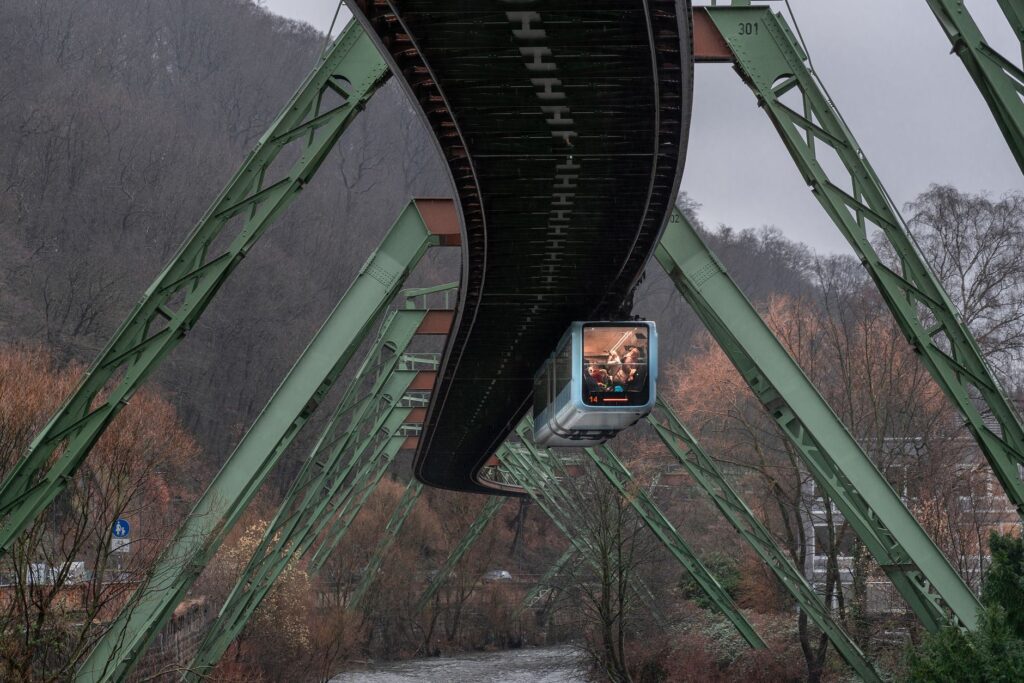
The operating principle of the Schwebebahn relies on gravity suspension. Unlike conventional trains resting on parallel pairs of rails, the Wuppertal carriages hang from a single support girder integrated into a robust metallic lattice structure. This trough design grants the system a unique stability: when a convoy navigates a curve, centrifugal force induces a natural oscillation of the carriages acting as a giant pendulum, dissipating kinetic energy and ensuring a sense of buoyancy for passengers. Every load-bearing structure is calculated to minimize material fatigue, a monumental challenge considering the system has operated almost uninterrupted through wars, economic crises, and deep urban transformations.
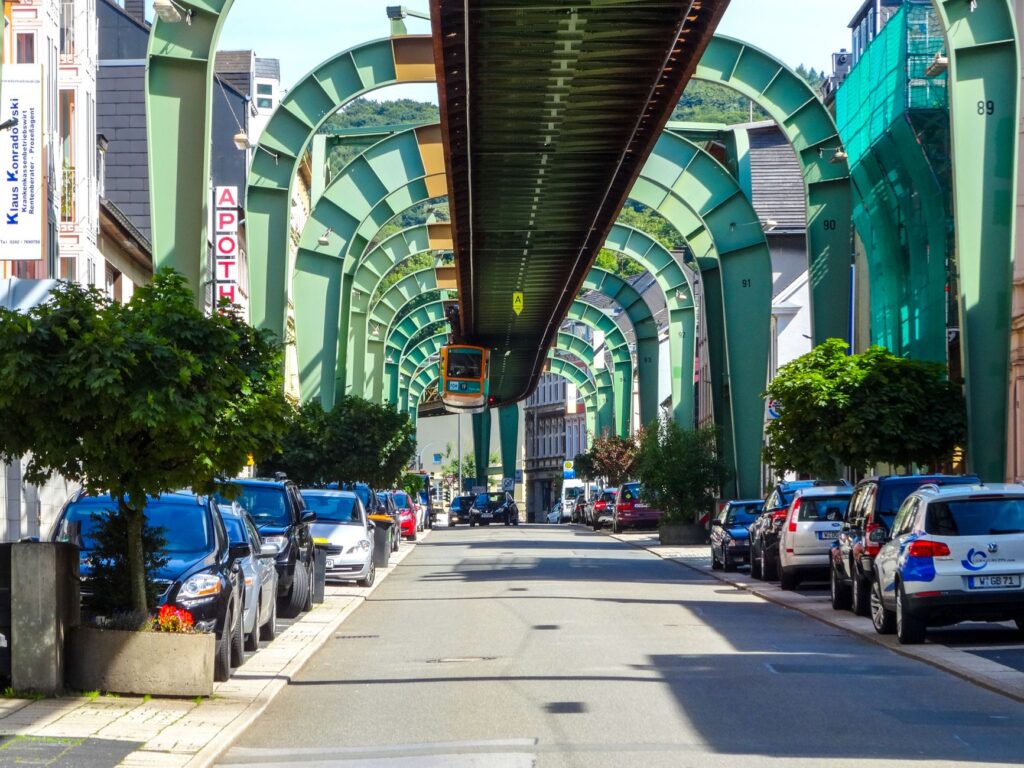
The original electrical supply, established at 600 volts direct current, has been gradually modernized to adapt to contemporary energy efficiency standards, yet the fundamental kinematic scheme remains unaltered. Motor bogies, equipped with hardened steel wheels, travel along the main beam protected by metallic covers that prevent ice accumulation or interference from external elements. This relative isolation from urban road traffic grants the monorail enviable punctuality, establishing it as the backbone of urban mobility in a city exceeding 350,000 residents. The synchronization between modern signaling systems and nineteenth-century infrastructure represents a living testament of industrial archaeology in active service.
Urban Integration and the Amphibious Memory of the Valley
The relationship between the monorail and Wuppertal’s urban fabric is an exercise in architectural symbiosis. The stations, many restored under strict heritage criteria, function as visual landmarks articulating the various neighborhoods hanging over the river. The gray iron structure, drawing a kilometer-long lattice over the water, acts as a protective canopy and an aesthetic threshold defining the collective identity of the city. The local population has integrated the constant passage of suspended convoys as the rhythmic heartbeat of daily life, a mechanical pulse marking rush hours, school openings, and the commercial vigor of the valley.
This amphibious character, where the railway infrastructure seems to float between the fluvial medium and urban airspace, forced planners to pioneer solutions for nighttime maintenance and accessibility. The Vohwinkel car sheds, where trains undergo exhaustive reviews of structural components and braking systems, operate like precision mechanical operating rooms. In these century-old workshops, workers combine traditional manual adjustment techniques with advanced digital diagnostics, ensuring metal fatigue never compromises strict German safety standards. Preserving this moving heritage proves technological obsolescence can be averted through consistent critical component renewal policies.
Logistical Challenges and Modernization in the Twenty-First Century
Maintaining a century-old infrastructure with such unique features poses monumental logistical challenges. Throughout the 2010s, the Wuppertal network underwent comprehensive renovation ranging from the complete replacement of support beam kilometers to acquiring a new vehicle fleet, dubbed Generation 15. These modern trains, manufactured from lighter composite materials and equipped with silent traction systems, drastically reduced acoustic pollution in sections running mere meters from residential facades. Daily traffic management demands millimeter-level coordination between automated control centers and maintenance brigades, capable of working at height during brief nighttime closures.
Furthermore, tariff integration with the North Rhine-Westphalia regional system has consolidated the monorail not only as a top-tier tourist attraction, but as an efficient intermodal hub connecting with the S-Bahn commuter rail network and urban bus lines. Stations feature panoramic elevators and platforms adapted for passengers with reduced mobility, resolving accessibility challenges imposed by the original 1901 architecture. This balance between historic heritage preservation and metropolitan functionality makes Wuppertal an international benchmark for sustainable urban mobility in complex geographical areas.
Iron Architecture and Urban Silence
The visual presence of the Schwebebahn redefines the human scale of the valley. While lower roadways bear the bustle of private vehicle and freight traffic, the upper plane offers an almost domestic perspective of urban space, where passengers gaze from heights at nineteenth-century attic roofs and river parks. This spatial bifurcation effectively reduces road congestion on the surface, freeing public space for bike lanes, pedestrian zones, and the naturalization of Wupper riverbanks. Monorail engineering proves urban density does not necessarily require landscape destruction via large asphalt highways, but can be solved through intelligent optimization of available airspace.
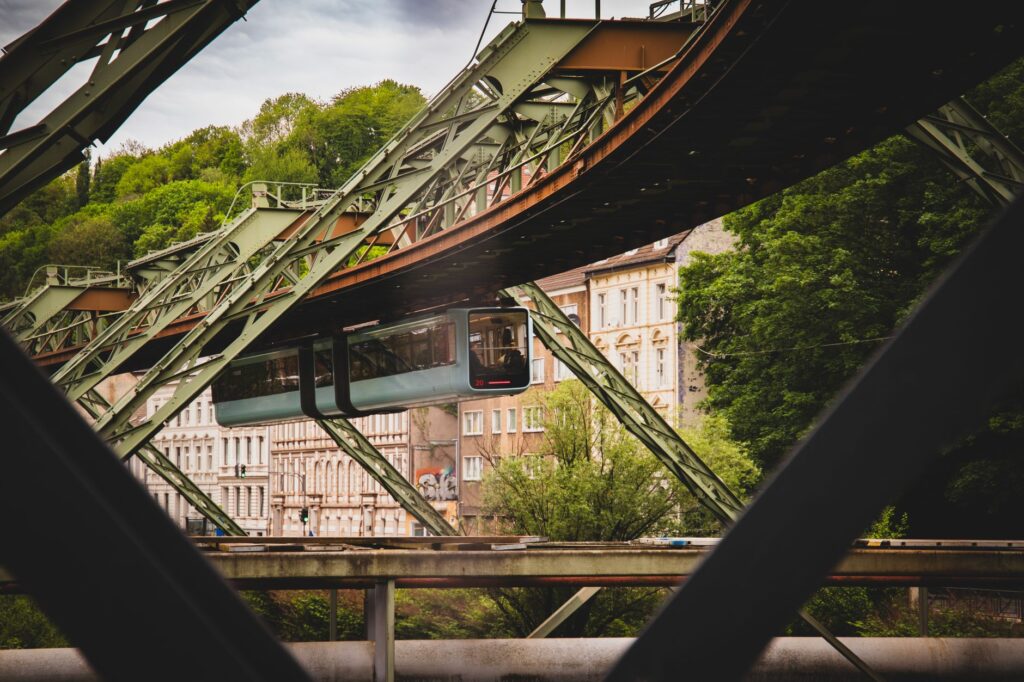
Wuppertal’s suspended monorail proves that nineteenth-century technical audacity, when combined with rigorous maintenance and profound landscape integration, can successfully overcome contemporary metropolitan mobility challenges.
Acoustic impact, historically a critical point raised by nearby residents, has exponentially decreased thanks to elastomeric vibration dampers installed at beam joints and aerodynamic bogies redesign. These technical advancements progressively silence traditional metallic rumbling, transforming train passage into a muffled murmur blending with the river’s constant water rush. Thus, the machine mimics its ecological environment, adopting a low environmental impact profile contrasting with its imposing visual presence.
Practical guide
How to get there: Wuppertal is fully integrated into the North Rhine-Westphalia railway network. The central station (Wuppertal Hauptbahnhof) receives high-speed ICE trains and frequent regional services from Düsseldorf, Cologne, and Dortmund. Travel time from Düsseldorf is approximately 25 minutes.
Monorail operation: The Schwebebahn operates daily from 5:00 AM to 11:00 PM (with slightly extended weekend hours). Frequency during rush hours is every 3 to 5 minutes, guaranteeing high transport capacity without strict timetable consultation.
Tickets and fares: The system is part of the VRR (Verkehrsverbund Rhein-Ruhr) integrated transport association fare structure. Single tickets, 24-hour passes (EinzelTicket or 24StundenTicket), or regional tourist cards including unlimited access to buses, trams, and the monorail can be purchased.
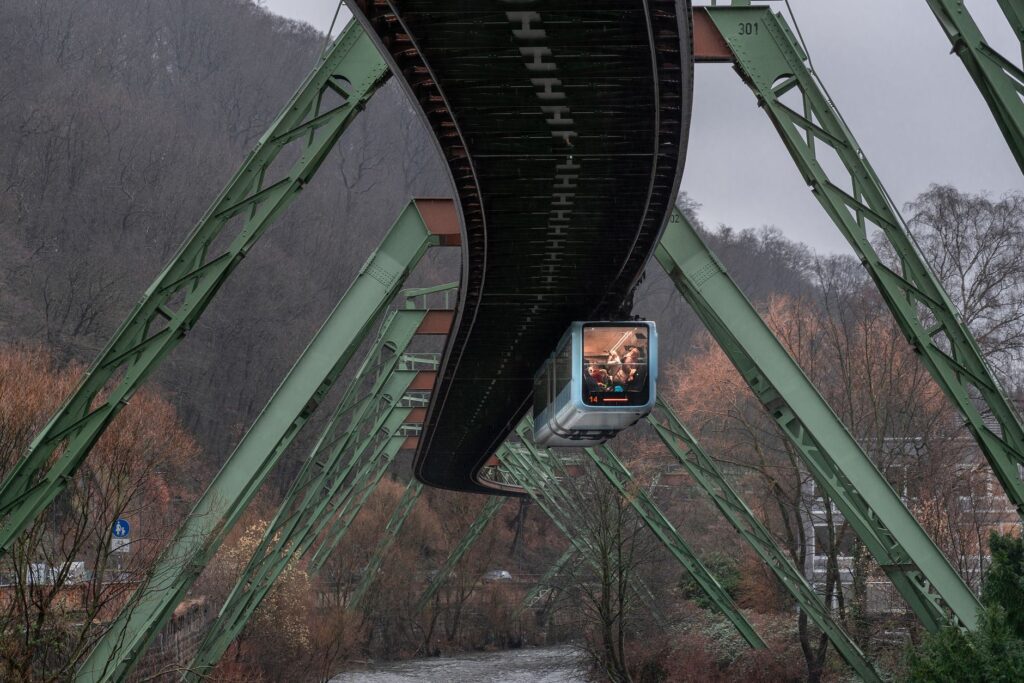
Photographic and technical highlights: The most spectacular stretch is over the Wupper River, especially between Robert-Daum-Platz and Landgericht stations, where the metal structure draws a sharp curve over water. The historic Vohwinkel terminal and central workshops also preserve original early 20th-century industrial atmosphere.
Planning your visit: Dedicating at least a full day to traverse the complete line from end to end (Vohwinkel – Oberbarmen) is recommended, stopping at unique stations and exploring recently recovered linear riverbank parks.
Visual Epilogue on the Suspended River
As evening falls over the Wupper valley and stormy sky reflections fracture on the dark river surface, the monorail continues its silent march silhouetted against the industrial skyline. In windows misted by dusk humidity, the faces of workers and students momentarily dissolve as they merge with the forged iron lattice supporting their daily commutes. At this exact intersection between nineteenth-century engineering tenacity and modern unceasing pulse, Wuppertal’s suspended train transcends mere transport to become a moving sanctuary, tangible proof that cities can defy geographical limits and literally rise above their own difficulties.