
The global horizon of contemporary tourism is redefined each year under the scrutiny of analysts, editors, and seasoned travelers seeking to separate commercial noise from true geographical essence. When the influential international guide Lonely Planet publishes its annual selection, the entire sector holds its breath to examine which coordinates will set the tone for cultural exploration. In the Best in Travel 2027 edition, the global map of travel priorities has shifted once again, placing a Spanish destination at the center of international conversation that has successfully shielded its identity against the tide of mass tourism.
This report examines the keys to a selection that rewards neither the easy postcard nor superficial attractions, but rather heritage resilience, historical depth, and a territory’s capacity to offer an experience that dialogues with the present time. Through a meticulous journey into the reasons that led experts to highlight this corner of the peninsula, we analyze how travel in the immediate future demands looking beyond conventional circuits to embrace unadorned authenticity.
The geopolitics of conscious tourism on the global horizon
The map of great journeys is no longer measured solely by passenger flows but calibrated according to the sustainability of local resources. The inclusion of a Spanish destination on the 2027 global podium responds to a paradigmatic shift in how major travel publications understand territorial value. It is no longer about accumulating showcase attractions, but about preserving fragile cultural ecosystems where the daily life of local communities continues to mark the rhythm of the seasons.
Lonely Planet’s selection committees have critically valued those enclaves capable of resisting the temptation of runaway growth. In the case of the selected Spanish representative, the strategy has consisted of safeguarding rural landscapes and traditional historic centers through active protection regulations that prioritize residents over disposable visitors. This containment strategy has not only preserved the place’s scenic value but has elevated its qualitative standing among the cultured traveler.
Architecture of silence and stone memory in the landscape
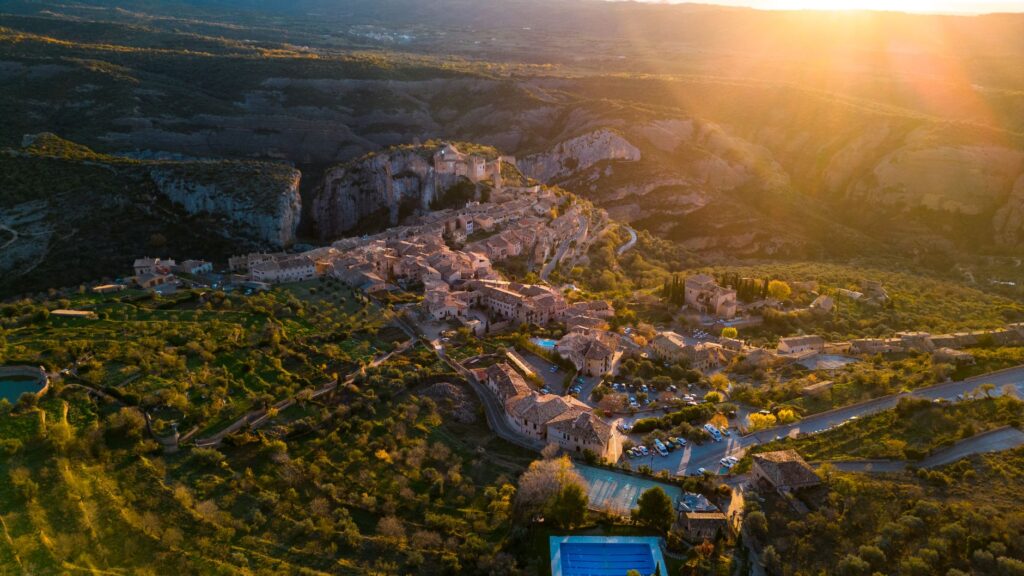
Exploring this territory consecrated by the international guide involves delving into a geography where ancient stone dialogues with urban planning respectful of the original topography. Unlike hyper-connected urban destinations that prioritize speed, here time seems to slow down in cobbled alleys and arcaded squares that preserve their medieval layout almost intact. Vernacular architecture, built with local materials and secular techniques, functions as a three-dimensional archive of peninsular history.
The conservation of this architectural heritage is not a matter of chance, but of a continuous effort by local architects, art historians, and administrations who have understood that a place’s beauty lies in its formal coherence. Every public building, every ancestral manor house, and every isolated hermitage on the rural horizon maintains a harmonious relationship with the natural surroundings, avoiding visual pollution and embracing landscape integration as an unshakeable rule of coexistence.
The human factor: communities defending their narrative
Behind any international recognition of this magnitude always beats the invisible effort of a community that refuses to become a mere tourist backdrop. The inhabitants of this Spanish enclave have demonstrated a remarkable capacity for self-organization to manage their heritage and keep alive the artisanal, agricultural, and festive traditions that give meaning to their collective identity. Hospitality here is not commercialized; it is offered as a code of mutual respect between host and visitor.
The voices of local artisans, farmers maintaining endangered crops, and small business owners occupying the same secular storefronts are the true guardians of the experience. Conversing with them reveals a clear awareness of the risks of mass tourism and a firm determination to keep the reins of their own economic and cultural future, proving that modernity and tradition can coexist without devouring one another.
True exploration no longer consists of being the first to step on an unknown territory, but in knowing how to look with respect and depth at a landscape that has guarded its secrets for centuries.
Proximity routes and sustainable mobility within the territory
Exploring the awarded destination in 2027 requires adopting a mindset of slow and conscious travel. The territory’s transportation infrastructures have undergone a profound transformation aimed at discouraging private vehicle use in sensitive cores and empowering a network of pedestrian trails, greenways, and public transit connections tailored to the real needs of residents and respectful visitors.
This commitment to soft mobility allows travelers to discover landscape details that would go unnoticed from a car window. Ancient bridle paths, recovered and marked with scientific rigor, connect villages, natural viewpoints, and geological sites, allowing the traveler to intuitively understand the historical relationship between human settlements and land orrography.
Rooted gastronomy: flavor as a historical document
The cuisine of this territory selected by Lonely Planet does not seek flashy avant-garde or globalized hybridization, but maximum fidelity to seasonal produce and recipes passed down from generation to generation. In local markets and modest eateries, traditional recipes function as an authentic treatise of cultural anthropology, where each dish explains a secular adaptation to climate, scarcity, or seasonal abundance.
Products with protected designation of origin, extra virgin olive oils from centennial olive trees, raw milk artisanal cheeses, and wines produced in small family wineries are the true protagonists of a culinary offering that rejects mass distribution circuits. Eating here is an act of food sovereignty and a tribute to local producers who sustain the agrarian landscape with their daily toil.
The challenges of global recognition and future preservation
Being named one of the world’s best destinations for 2027 is a double-edged sword for this peninsular corner. On one hand, it consolidates its international prestige and attracts much-needed funding for heritage restoration; on the other, it exponentially increases the risk of overcrowding and speculative pressure on housing markets and local basic services.
Local authorities and citizen groups face the monumental challenge of managing this success without succumbing to the short-term temptation of quick financial gain. Implementing visitor caps in protected natural areas, strictly regulating short-term tourist rentals, and promoting awareness campaigns aimed at international travelers are some of the tools already being applied to guarantee the destination’s long-term viability.
Excellence in tourism is not measured by the number of visitors we manage to attract, but by the ability to keep the place intact when those visitors decide to leave.
Practical guide
How to get there: Main access is through the international airports of the peninsula’s central region, from where the use of regional rail networks or low-emission vehicle rentals is recommended to complete the final journeys to the protected territory.
When to go: Spring months (April to June) and autumn (September to November) offer optimal weather conditions and avoid summer heat peaks, while coinciding with the community’s most significant agricultural and festive cycles.
Where to stay: Prioritize establishments affiliated with sustainable rural tourism networks, small historic inns, and accommodations managed by local residents that guarantee the direct redistribution of economic benefits.
Rules of conduct: Strictly respect signage on natural trails, avoid collecting protected botanical species, consume exclusively in local shops, and maintain silence in rural and historical environments of high heritage sensitivity.

The intimate heartbeat of a destination resisting time
At dusk, when golden light bathes the slate roofs and surrounding fields, this peninsular corner recovers its ancestral silence. Sitting on a stone bench in any rural square and watching the slow coming and going of its neighbors is the best synthesis of what it means to travel with purpose in the 21st century. There are no strident notes or tourist artifices; only the dignity of a place that has understood its greatest wealth lies in being exactly what it is, without apologies or gallery concessions.
This radical commitment to authenticity is, ultimately, why Lonely Planet has placed it at the global peak of tourism for 2027. A luminous reminder that geographies still exist capable of resisting the vertigo of homogeneous modernity, offering the curious traveler a refuge of restful beauty, living memory, and sustainable future.
Source in English: El País, Best in Travel 2027: los mejores destinos para el año que viene (uno es español), según Lonely Planet (https://news.google.com/rss/articles/CBMi2gFBVV95cUxNZWZBXzB3ZjNnTzViZ1VhQzJUc0Z3TjRLZUtpRGtUUGNSMVIzS2dWbzNDQVMtMU84X2V3R2hmNzhFdEpfcTZpN1V0Rlg0SmtFZFlBRjhxaWR3Qzg5WkEwd1FsYjh2YXVvZm5wY0g3TjFPdUtCYjFHci1UNUUwV3hQSFVFT01GbmpLcGZkNHpISlZsaXJUR2NBa1NSSy1LbUtmSGFpZ2xMakpYOUQyRl93OHRIZmV4Zm1aTVRNVXZGdVpfZmQya0VpdUp0YkdacXZveHVWb1d5ZlJXQQ?oc=5)