
When the first puff of black smoke merges with the thick mist of the West Bengal mountains, time seems to freeze in a dimension where thermodynamics still dictates the pace of progress. The Darjeeling Himalayan Railway (DHR), known worldwide as the Toy Train, is not merely a vestige of the British colonial past; it is a feat of civil engineering that, since its inauguration in 1881, has maintained a vital connection between the plains of Siliguri and the heights of Darjeeling, ascending over two thousand meters in just eighty kilometers of track.
This report dives into the heart of an infrastructure that defies gravity and modern economic logic. Through its narrow-gauge rails (610 mm), the DHR tells the story of a region whose identity is inextricably linked to the aroma of tea and the whistle of Sharp, Stewart & Co. Class B steam locomotives. To explore this railway system is to understand how human tenacity transformed an impassable geographical barrier into a corridor of cultural and commercial exchange that today holds UNESCO World Heritage status.
The Genesis of a Narrow-Gauge Miracle
The history of the DHR began with a pressing logistical need. By the mid-19th century, Darjeeling had established itself as a crucial hill station for the British administration, both for its healthy climate and its tea plantation potential. However, transporting goods and passengers relied on bullock carts that took days to traverse the winding Hill Cart Road. It was Franklin Prestage, an agent for the Eastern Bengal Railway Company, who proposed building a narrow-gauge railway following the existing road’s alignment.
The choice of a two-foot (610 mm) gauge was not accidental. This measurement allowed for much tighter curves, essential for adapting to the mountain’s capricious contours without the need for expensive tunnels or massive viaducts. Construction, which began in 1879, was a display of local labor and technical vision that culminated in record time. In less than two years, the first train reached Darjeeling station, forever transforming the region’s economy and allowing tea from these slopes to reach the ports of Calcutta with unprecedented freshness and efficiency.
Unlike other European alpine railways that rely on rack-and-pinion systems, the DHR is a pure adhesion system. This means the locomotive’s wheels depend entirely on friction against the rail to move forward. To overcome gradients that in some sections reach a 1 in 18 slope, engineers had to devise creative solutions that are still studied in engineering faculties worldwide today.
«The Darjeeling Railway is to 19th-century engineering what Galileo’s telescope was to astronomy: a tool that changed our perspective on the limits of the possible.»
Loops and Z-Reverses: Defying Verticality
The greatest obstacle for the DHR was gaining altitude over very short horizontal distances. The solution was not brute force, but geometry. Two main techniques were implemented: loops and zigzags (reverses). The most famous loop, Batasia, is a spiral where the train crosses over its own lower track to gain height gradually, offering passengers a 360-degree panoramic view of Kanchenjunga, the world’s third-highest mountain.
On the other hand, zigzags are reversing maneuvers that allow the train to climb the hillside in a Z-shape. The train moves forward to a dead end, a pointsman manually changes the track direction, and the locomotive pushes the carriages backward to a higher level, repeating the process forward. This mechanical dance, requiring perfect coordination between the driver and ground staff, is one of the most fascinating sights for railway logistics enthusiasts.
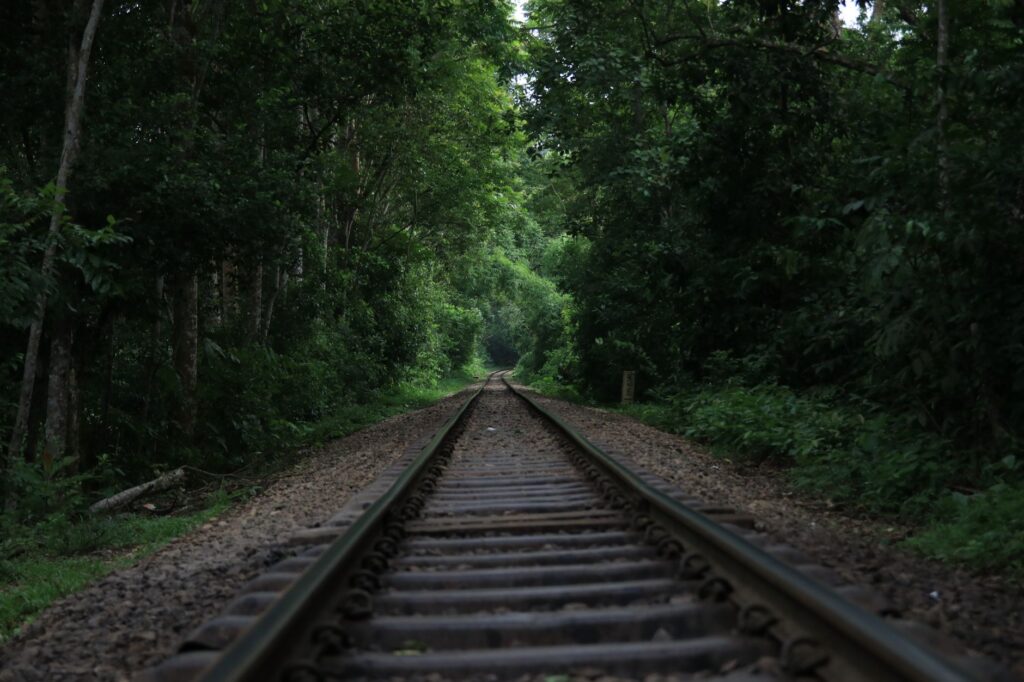
The current infrastructure features three operational loops and six zigzags. Each of these points represents a critical maintenance node. Due to the Himalayan geological instability, landslides are frequent during the monsoon, forcing maintenance crews to work almost non-stop to ensure the track—which often runs parallel to the road and through local markets—remains clear and safe.
Class B Locomotives: The Heart of Coal and Steel
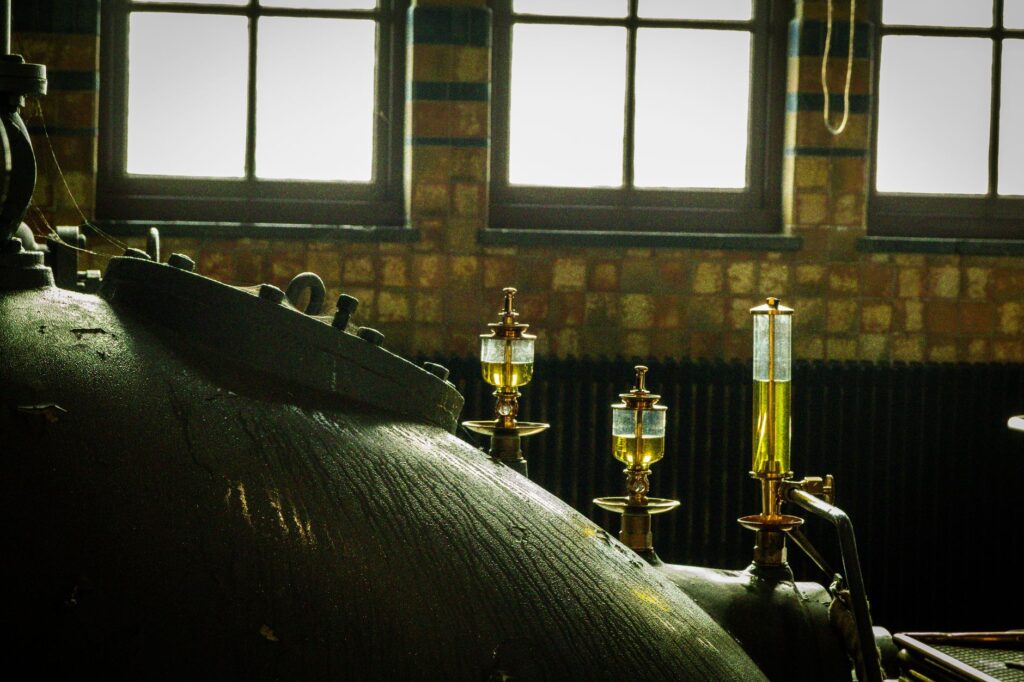
One cannot discuss the DHR without mentioning its mechanical protagonists: the Class B steam locomotives. Designed specifically for this line, these machines are a marvel of robustness and simplicity. With their characteristic saddle tanks and low center of gravity, they are perfectly balanced for sharp curves and steep grades. Remarkably, several units operating today are over a hundred years old.
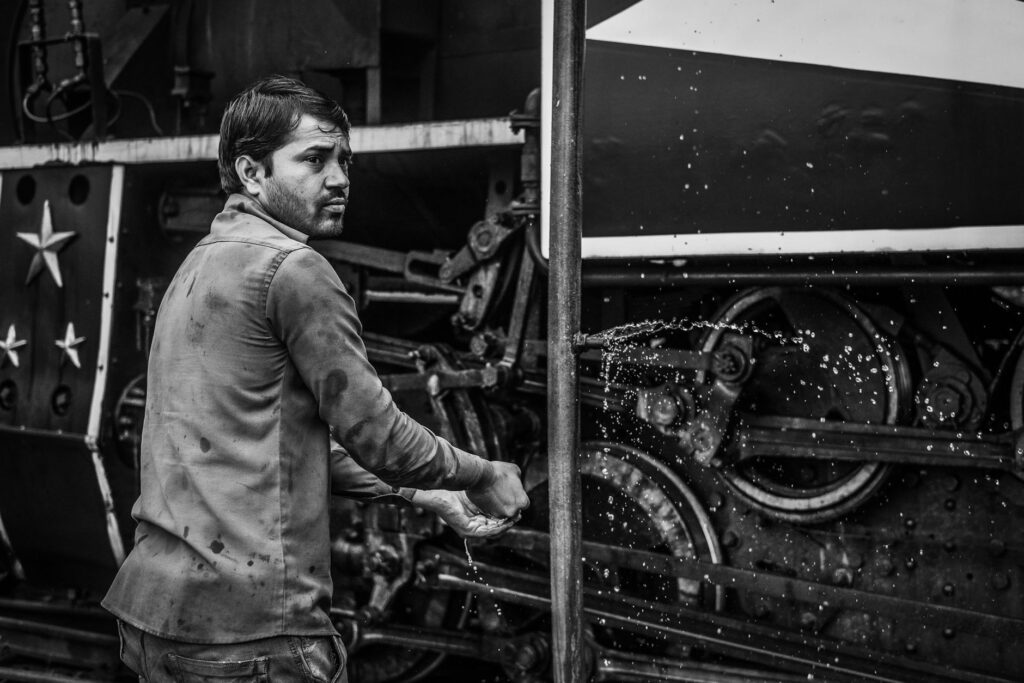
Maintaining these technological jewels is a craft performed at the Tindharia workshops. There, mechanics manufacture custom parts using techniques passed down through generations. There are no laser scanners or 3D printers; there are hammers, old lathes, and a deep understanding of how steel behaves under pressure. Each locomotive has its own personality, and veteran drivers claim they can «feel» the boiler’s condition through the vibrations in the cab floor.
The firing process for a Class B begins hours before departure. The fireman must feed the coal fire with surgical precision to reach the necessary steam pressure. During the journey, two operators ride on the front of the locomotive, standing on the footboards, manually throwing sand onto the rails to improve traction on wet sections. It is physical, exhausting, and profoundly human work that reminds us that behind the machinery, there is always a vital pulse.
Kurseong: The Urban Pulse on the Rails
Midway between Siliguri and Darjeeling lies Kurseong, the «Land of White Orchids.» Here, the railway stops being a tourist viewpoint and becomes an intrusive and fascinating urban element. The tracks run through the city center, passing inches away from shop windows and house doors. The train whistle is the alarm clock for merchants and a warning for pedestrians to momentarily step aside.
This extreme coexistence between the train and daily life is unique in the world. Children play near the tracks and street vendors spread their wares over the rails, picking them up only seconds before the locomotive passes. In Kurseong, the true social importance of the DHR is felt: it is not an isolated museum piece, but an artery pumping life into the mountain’s urban fabric.
Kurseong station also serves as an operational control point. Here, train crossings are managed on a line that is, for the most part, single track. Communication between stations still relies heavily on traditional systems, ensuring that safety is not compromised by failures in digital networks, which tend to be erratic at these altitudes.
The Tea Landscape: An Economic Symbiosis
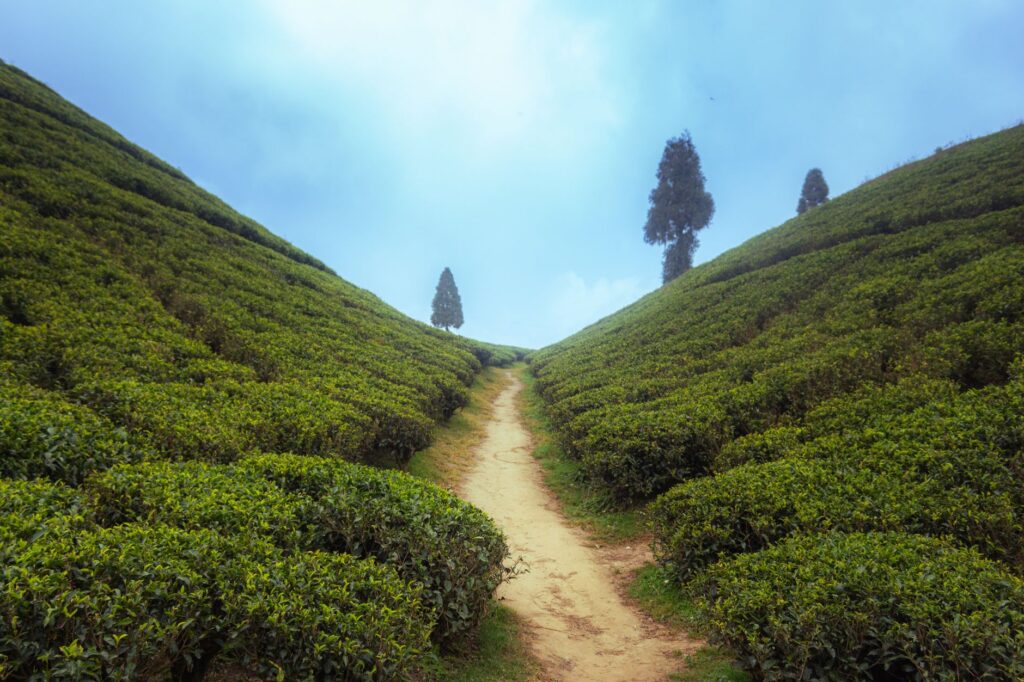
The Darjeeling skyline is dominated by the green carpets of tea plantations. The DHR was the catalyst that allowed this product to reach global markets. Legendary estates like Makaibari or Castle Hill owe part of their history to the ease of transport the train provided. Although much of the tea is transported by truck today, the train’s symbolic value remains an invaluable marketing asset for the Darjeeling tea industry.
The relationship is bidirectional. The landscape tourists see from the wooden carriage windows is the result of centuries of meticulous cultivation. The train passes through some of the world’s most fertile slopes, where the Himalayan microclimate and mineral-rich soil produce tea with muscatel notes, nicknamed the «Champagne of Teas.»
During harvest season, it is common to see pluckers with their wicker baskets working just meters from the track. The contrast between the stillness of the tea field and the metallic roar of the train creates a cinematic atmosphere. It is a symbiosis where industry and agriculture have learned to coexist in a fragile but lasting balance.
«Darjeeling tea tastes of mist and altitude, but it also tastes of the iron of its rails and the effort of those who keep the track alive.»
Ghum and the Shadow of Kanchenjunga
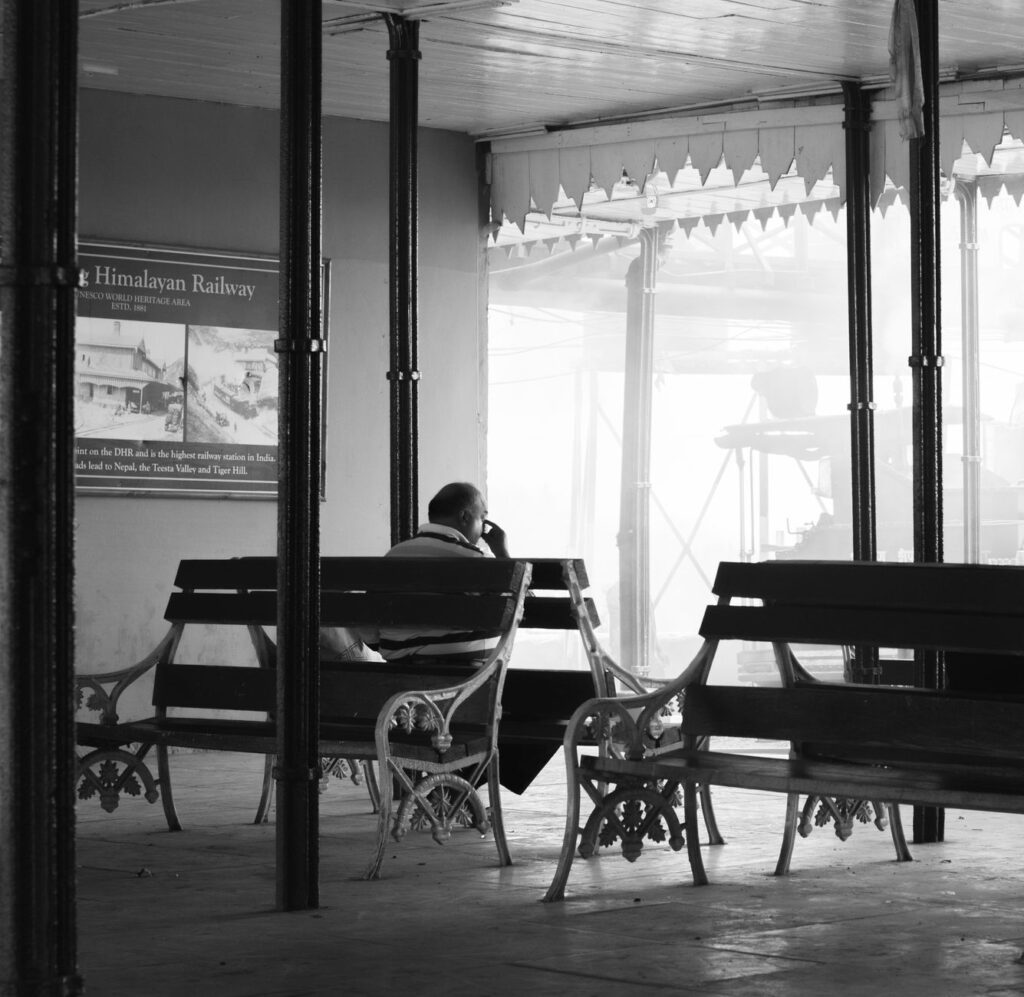
The journey’s climax is the arrival at Ghum, India’s highest railway station, situated at 2,258 meters above sea level. Ghum is a place shrouded in mystique. Its small railway museum houses the «Baby Sivok» locomotive, the oldest in the fleet, and offers a detailed look at Victorian-era logistical challenges. But beyond history, Ghum is a spiritual viewpoint.
From here, if the weather permits, the Kanchenjunga massif reveals itself in all its magnitude. The sight of snow-capped peaks illuminated by the morning sun, while the locomotive’s steam floats in the cold air, is one of the most powerful aesthetic experiences a traveler can have in Asia. It is the moment one understands why this train was declared a World Heritage site: not just for its technique, but for its ability to integrate human endeavor into a breathtaking natural environment.
The descent from Ghum toward Darjeeling is a short but meaningful trek. The train skirts the Ghum Monastery, where the sound of Buddhist bells mingles with the rhythm of metal on rail. It is the final transition toward the tea capital, the end of a journey that is, in essence, an ascent toward serenity.
The Challenge of Preservation in the 21st Century
Maintaining a 140-year-old steam railway in one of the most geologically active regions on the planet is a Herculean task. The DHR faces constant threats: soil erosion, competition from faster road transport, and budget cuts. UNESCO has repeatedly expressed concern over the state of conservation of certain sections and stations, prompting a renewed effort by Indian Railways to protect this legacy.
Modernization is a double-edged sword. While diesel locomotives have been introduced for regular passenger services to reduce costs and pollution, the essence of the DHR lies in steam. The current challenge is to find a sustainable tourism model that funds the expensive maintenance of coal-fired machines without turning the railway into a soulless theme park.
Local community involvement is key. The DHR cannot survive solely as an attraction for foreigners; it must remain useful to the mountain people. Heritage education programs and integrating the train into local logistics are necessary steps to ensure the Class B whistle continues to echo through the valleys for another century.
Practical Guide
For those determined to experience the Darjeeling Himalayan Railway, meticulous planning is essential, as mountain logistics can be unpredictable.
- Routes and Services: The main service is the «New Jalpaiguri – Darjeeling Passenger,» which covers the full line in about 7-8 hours. However, the most popular options are the «Joy Rides» operating between Darjeeling and Ghum (round trip), ideal for experiencing steam and the Batasia Loop in just two hours.
- Best Time to Travel: October to December (clear skies and Himalayan views) and March to May. Avoid the monsoon season (June to September), when landslides often interrupt the service.
- Bookings: It is essential to book in advance through the official Indian Railways website (IRCTC). Tickets for steam locomotives are more expensive than diesel ones, but the experience is worth it.
- Seating: For the best views of Kanchenjunga on the uphill journey, try to sit on the right side of the carriage.
- Clothing: Even in summer, temperatures in Darjeeling and Ghum can be low. Bring layers of clothing and a light raincoat.
At the end of the day, when the last locomotive returns to the Darjeeling shed and the steam dissipates under the stars, one is left with the feeling of having witnessed a heroic resistance. In a world obsessed with speed and algorithmic efficiency, the Toy Train teaches us that there is profound beauty in slowness, in the creaking gear, and in the path that, though difficult, is traveled with the dignity of ancient iron. It is, ultimately, a monument to patience and a reminder that sometimes, to touch the sky, all you need is a little coal, water, and an unbreakable will.