
The Symphony of Iron and Stone in the Heart of the Douro
The journey does not begin on the first rail, but in the dim light of Porto’s São Bento station. Here, more than twenty thousand azulejo tiles by Jorge Colaço narrate the history of Portugal, enveloping the traveler in a reverential silence before the train whistle announces the departure eastward. The Linha do Douro is not merely a transport infrastructure; it is an umbilical cord connecting Atlantic modernity with a landscape that seems frozen in a geological era of human effort and stone. As the convoy moves away from the coast, the landscape narrows and the Douro River emerges as the absolute protagonist, flanked by one of the world’s most astonishing works of agricultural engineering: the schist terraces.
This railway route, construction of which began in 1875, was conceived to break the isolation of the Alto Douro wine regions. What we perceive today as a journey of pleasure and contemplation was, in its origin, a titanic challenge against the topography. Engineers of the time had to pierce through granite and schist, erecting bridges that defy gravity and tunnels that seem to swallow the riverbed. It is in this balance between the raw force of the machine and the fragility of the ecosystem where the true essence of the journey lies. The introduction to this experience is the recognition that we are facing a cultural landscape that is a World Heritage site, not for its virgin nature, but for the profound transformation that man has operated upon it over two millennia.
The Origin of a Wound in the Rock: 19th-Century Engineering
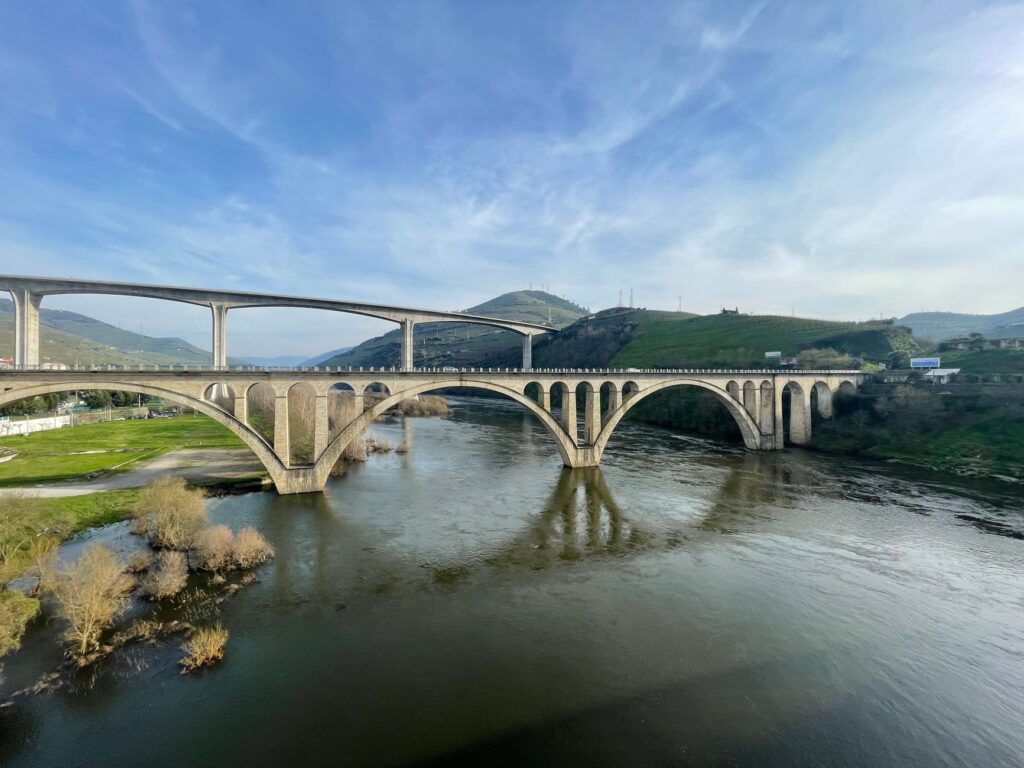
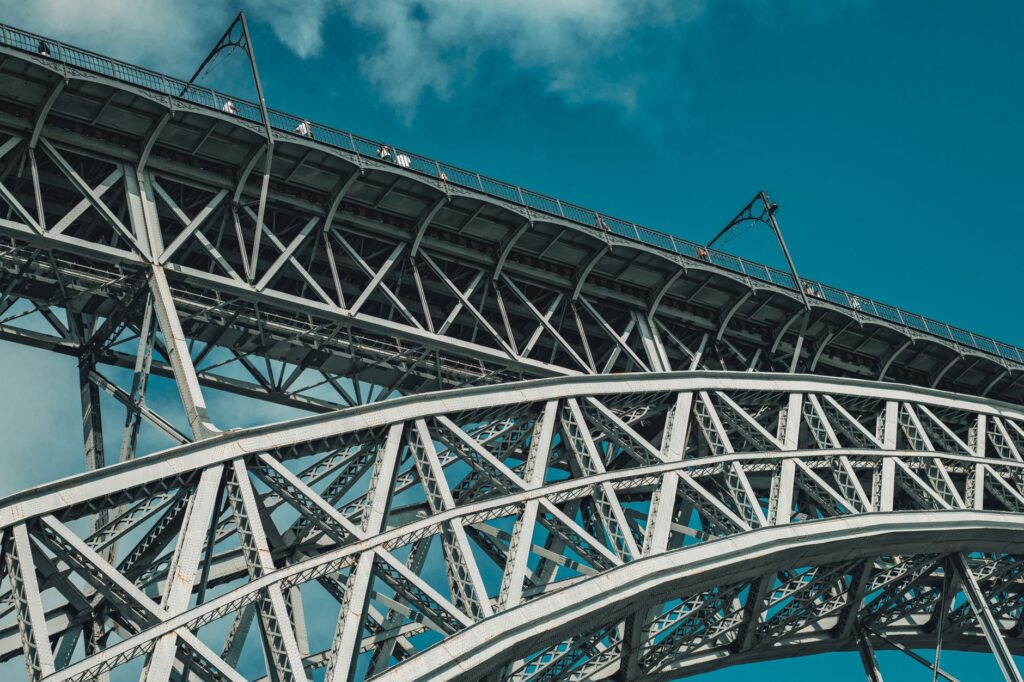
The construction of the Linha do Douro was a milestone in Portuguese civil engineering. The stretch we travel today with such fluidity was the result of decades of manual labor, dynamite, and a strategic vision aimed at transporting Port wine from the most remote quintas to the docks of Vila Nova de Gaia. The line once reached 200 kilometers in length, although today the operational passenger section stops at Pocinho. During the journey, the train passes through 26 tunnels and crosses 30 bridges, many designed under the influence of Gustave Eiffel’s school, whose aesthetic presence is unmistakable in the iron structures that span the river’s tributaries.
The track design follows the right bank of the river almost obsessively, allowing constant visibility of the water. This proximity is not accidental; the valley’s geography, with steep slopes of up to 70 degrees, left no choice but to hug the shore. Observing the viaducts, one perceives a functional elegance: the riveted iron blends with the ochre color of the rocks, creating a visual harmony that time has only reinforced. The maintenance of these structures remains a technical challenge, especially in areas where fluvial erosion and the thermal fluctuations of the Mediterranean-continental climate test the elasticity of 19th-century materials.
“The railway in the Douro was not an imposition of progress, but a necessary conversation between human ambition and the unwavering resistance of the mountain.”
Schist Architecture: Walls that Hold Time
What visually defines the Douro Valley are its terraces or socalcos. They are not simple cultivation steps; they are structures of hydraulic and geological engineering. Unlike other wine regions, the soil here is predominantly schist, a metamorphic rock that laminates easily. Generations of viticulturists learned to break this rock to create dry-stone walls that retain the scarce soil and, most importantly, regulate the temperature of the vine roots. During the day, the schist absorbs solar heat; at night, it releases it slowly, allowing for a steady ripening that is the secret behind the vigor of the region’s wines.
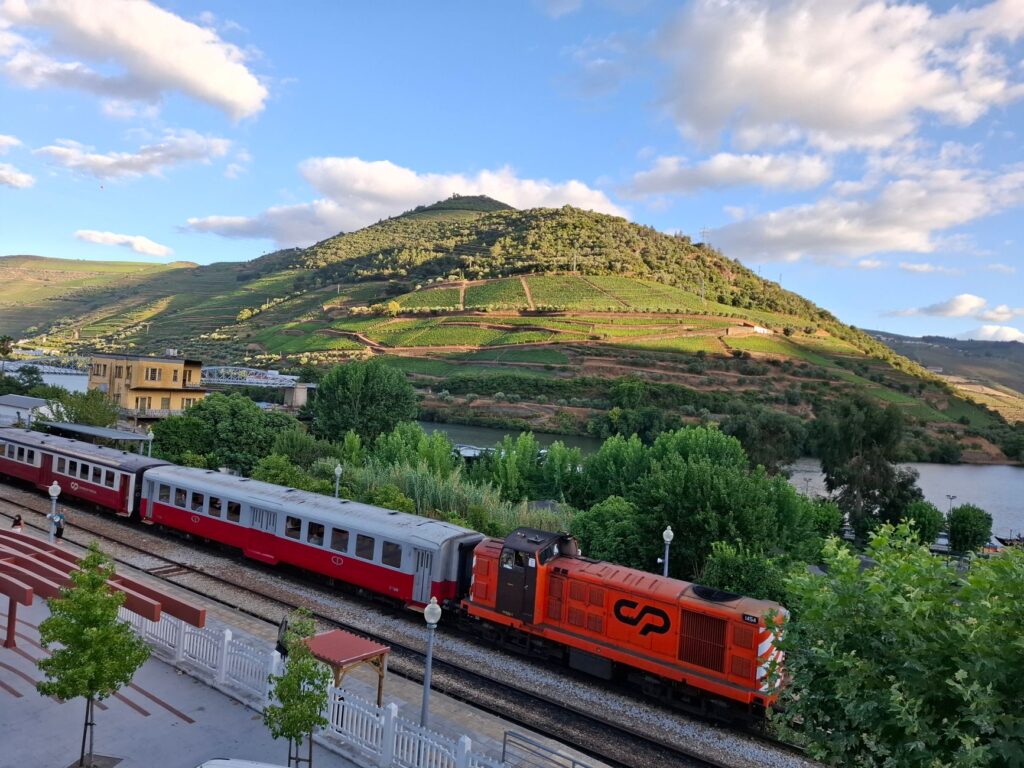
There are three types of vineyard architecture visible from the train window. The oldest are the dry-stone walls, built by hand before the arrival of phylloxera. Then there are the patamares, wider terraces built in the 70s and 80s to allow for small machinery. Finally, one observes the vinhateiro planting, where vines are planted following the line of maximum slope. This architectural evolution tells the story of the region’s economic adaptation, moving from artisanal production to a competitive industry without losing the aesthetic that makes it unique. Each wall is a scar of effort holding tons of liquid history.
Pinhão: The Tile Museum at Track Level
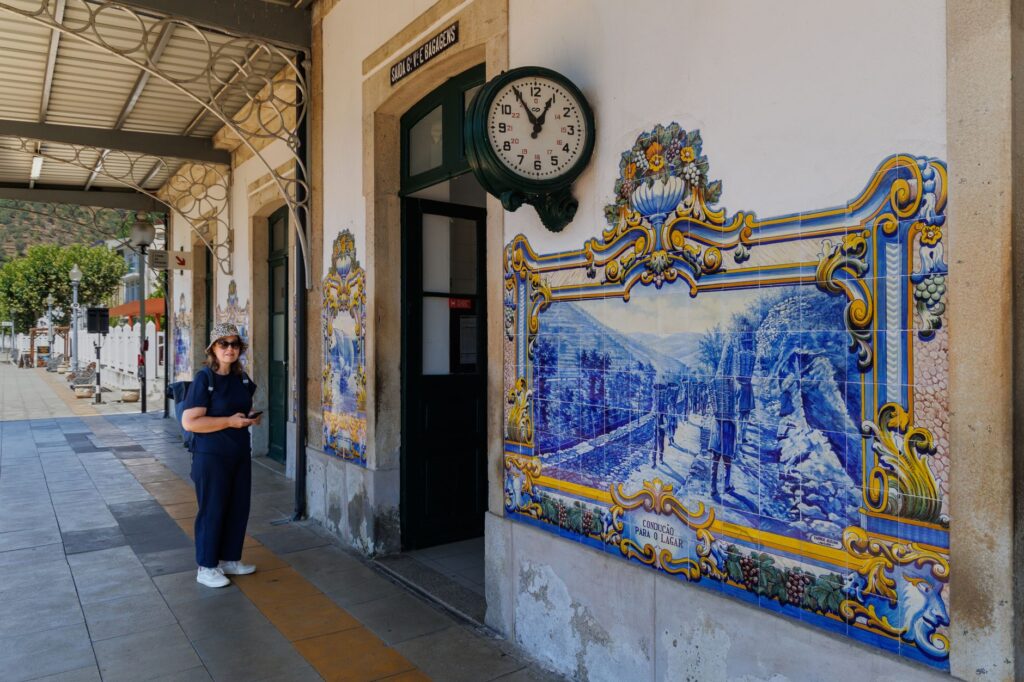
If there is one mandatory stop on this route, it is Pinhão station. Located in the geographical heart of the demarcated Douro region, the station is a work of art in itself. Its walls are decorated with 24 azulejo panels depicting the complete cycle of wine production: from the harvest on the slopes to the transport of the must in rabelo boats. These panels, dating back to 1937, offer a lesson in visual ethnography, showing traditional clothing, farming tools, and the importance of the river as a commercial highway before the railway arrived.
Pinhão station acts as a cultural lighthouse. Upon stepping off the train, the air changes; the damp smell of the river mixes with the aroma of oak wood from nearby cellars. The station’s architecture, with its wooden ceilings and local stone structure, serves as a perfect transition between the railway world and the agricultural world. It is here that the traveler understands that the Douro is not just a destination, but a process. The quintas surrounding the village, such as Quinta das Carvalhas or Quinta do Bomfim, are examples of manor architecture that combine the functionality of wine production with the elegance of the summer residences of the Porto bourgeoisie.
Water Engineering: The River Turned Staircase
Although the train is the protagonist, its layout cannot be understood without observing the river. The Douro we see today is not the wild and dangerous river navigated by the rabelos. Starting in the 1960s, a series of dams transformed the riverbed into a succession of calm lakes. From the window, one can see the navigation locks, such as Valeira or Bagauste, authentic works of hydraulic engineering that allow ships to clear elevation differences of over 30 meters. This domestication of the water allowed the railway line to gain stability, although it also submerged ancient passages and rapids that are part of local legend.
The Wellness of Slow Movement: A Visual Therapy
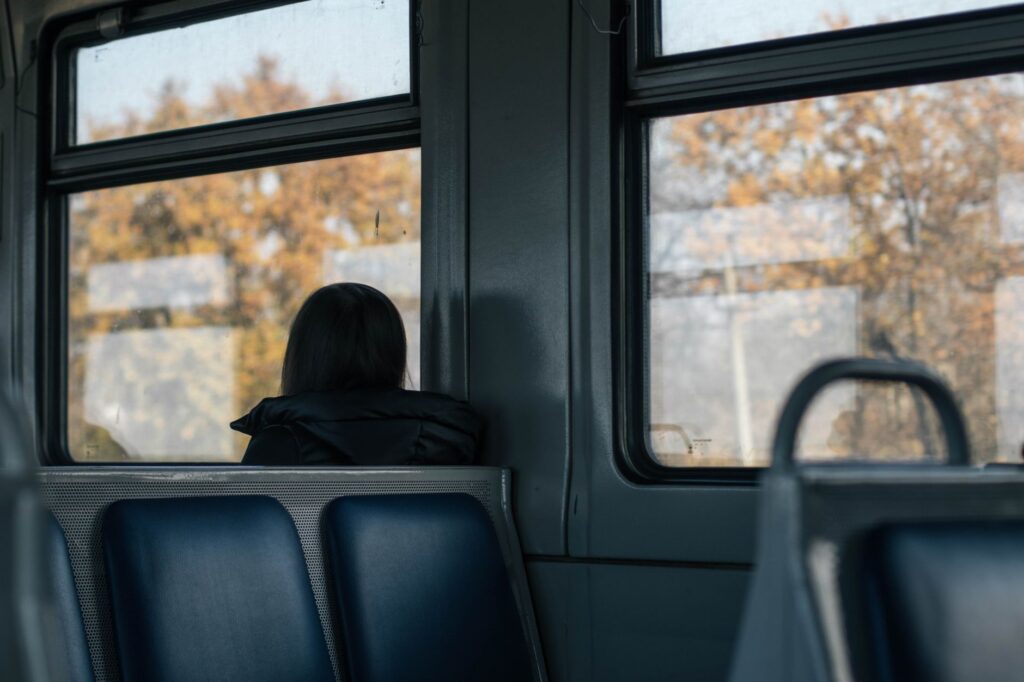
Traveling on the Linha do Douro is an exercise in slow travel in its purest state. In a world obsessed with speed, the rhythmic clatter of the train over the broad-gauge tracks invites deep disconnection. No Wi-Fi connection can compete with the spectacle of light filtering through vine leaves in autumn, when the valley turns ochre, red, and gold. Environmental psychologists suggest that constant lateral movement through natural landscapes reduces cortisol levels, and the Douro offers one of the best visual therapies in Europe.
Wellness here does not come from a luxury spa, but from the contemplation of geometry. The repetition of the terraces creates a fractal pattern that hypnotizes the observer. Furthermore, the acoustic isolation of certain stretches, where only the train engine and the wind in the gorge are heard, allows for an introspection that air or highway travel has eliminated. It is a sensory journey: the touch of the vintage velvet seats (if opting for the historical train), the sound of metal, the sight of the broken horizon, and, of course, the taste, anticipated at every station by the names of the world’s most famous quintas.
“The true wealth of the Douro is not in its barrels, but in its landscape’s ability to silence the noise of the outside world.”
From Régua to Pocinho: Where Silence Rules
As the train moves eastward, leaving Peso da Régua behind, the landscape becomes more arid and wild. We enter the Douro Superior. Here, population density drops drastically and nature reclaims its ground. Vineyards share space with olive and almond trees. This is the most spectacular stretch of the line, where the tracks cling to the rock in an almost implausible way. The river narrows and the canyon walls become more vertical. It is in this sector that one perceives the solitude of the 19th-century track builder, working in extreme conditions of heat in summer and freezing cold in winter.
The end of the line at Pocinho is a reminder of finitude. Formerly, the track continued into Spain, connecting with the La Fregeneda line in Salamanca, but that section was closed in 1985. Today, Pocinho is a mental border, a space of absolute calm where time seems to have stopped. The station’s architecture, simple and functional, marks the limit of a railway adventure that is, above all, a tribute to human persistence against the most indomitable geography.
Practical Guide
- Getting there: Trains depart daily from Porto-São Bento and Porto-Campanhã stations. Regional or Interregional trains are recommended for the best views.
- Best time: Autumn (September and October) to witness the harvest and the changing leaf colors, or spring (March and April) to see the almond trees in bloom.
- Historical Train: During summer and early autumn, a steam train with 19th-century wooden carriages operates between Régua and Tua.
- Key Stations: Do not miss stopping at Pinhão to admire the tiles and at Régua to visit the Museu do Douro.
- Logistics: Tickets can be purchased on the CP (Comboios de Portugal) website or directly at station ticket offices.
- Recommendation: Always sit on the right side of the train when traveling towards Pocinho for the best river views.
The Echo of the Final Whistle
Returning towards Porto, as the sun dips behind the hills and casts long shadows over the terraces, one realizes that the Douro Valley is a living organism. The train is its pulse, a constant vibration that keeps the villages, the wineries, and the people connected. This journey is not just a geographical shift, but a lesson in architectural humility. In every hand-placed stone in a schist wall and in every rivet of the iron bridges, there is a statement of intent: the will to remain, to cultivate, and to transform difficulty into beauty. The Douro teaches us that the most beautiful landscape is the one that tells a story of effort, and that the best way to read it is through the glass of a train that refuses to hurry.