
Conquering the White Abyss
The alpine territory has historically demanded a truce from those attempting to cross its crests. In southeastern Switzerland, the canton of the Grisons represents one of Central Europe’s most complex geographical settings, where vertical drops and masses of granite once seemed to veto any attempt at consistent mechanized transit. However, at the dawn of the twentieth century, civil engineering demonstrated that rock could be challenged without radically disrupting the natural order of the landscape. The result of that technical ambition is today one of the most fascinating railway arteries on the planet.
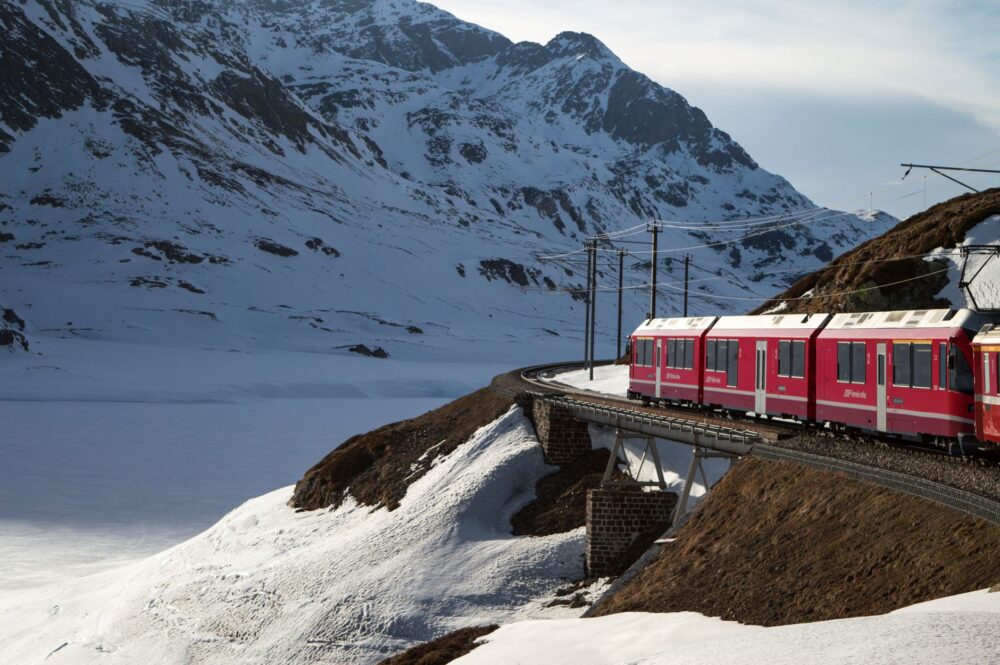
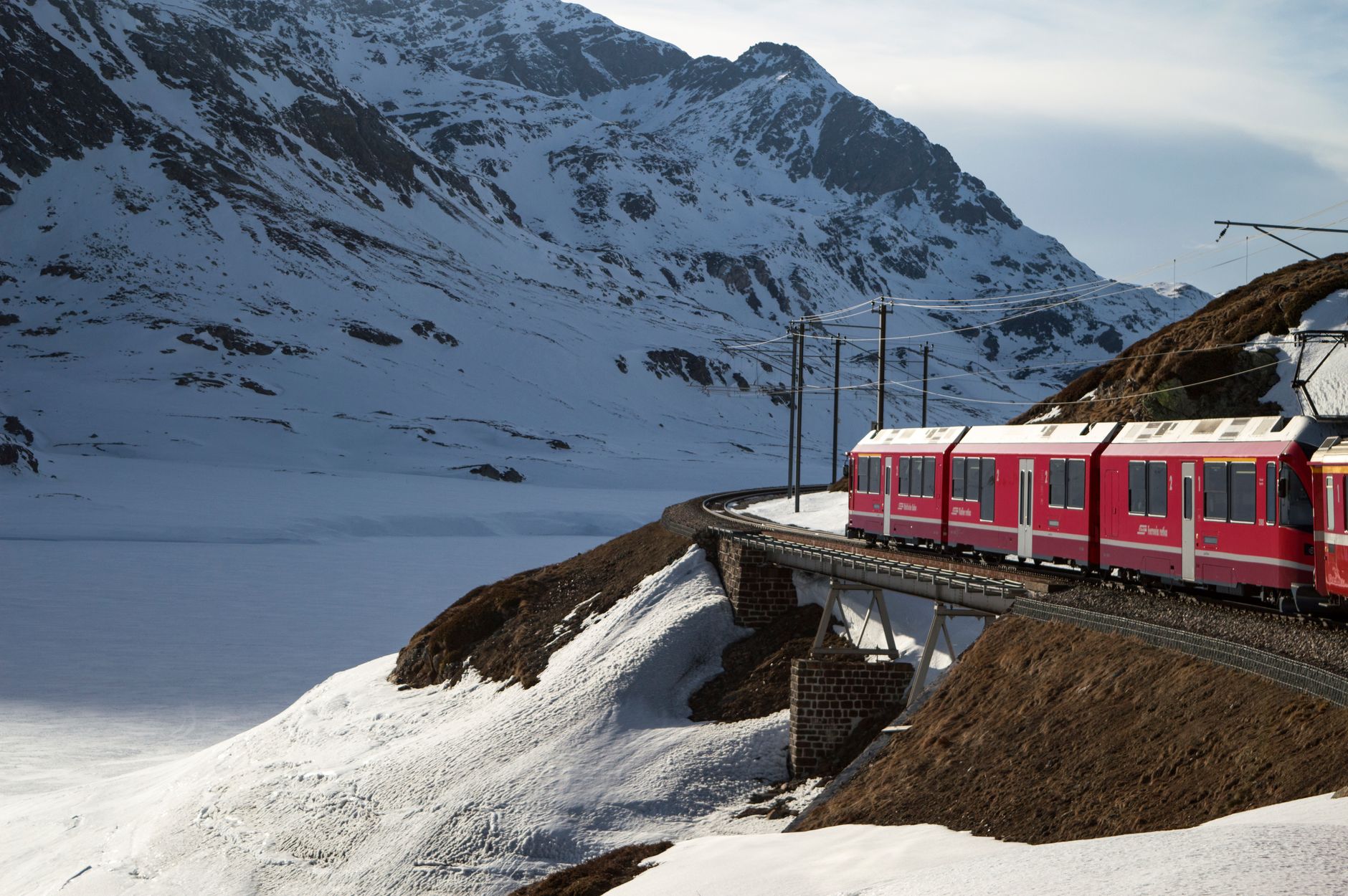
Along its route, the Bernina Express functions not merely as an efficient means of transport, but as a mobile observation structure connecting the northern alpine valleys with the Mediterranean slope of Italian Lombardy. Panoramic carriages with large glass surfaces allow for a continuous reading of geological transformation. From high-mountain alpine meadows to glacial lakes accumulating seasonal meltwater, every kilometer of track embodies an exercise in micrometric calculation and topographical adaptation.
The Architecture of Extreme Slopes
Overcoming a gradient of more than two thousand meters without resorting to the massive construction of base tunnels demanded truly unique architectural solutions. The most eloquent example of this constructive ingenuity is found in the celebrated helical viaduct at Brusio. This limestone structure allows the convoy to gain altitude gradually in a perfect circle, avoiding gradients that would be unacceptable for the adhesion of steel wheels on rails. Built entirely with local stone materials in early 1908, the work integrates harmoniously into the valley floor, mimicking agricultural terraces and conifer forests.
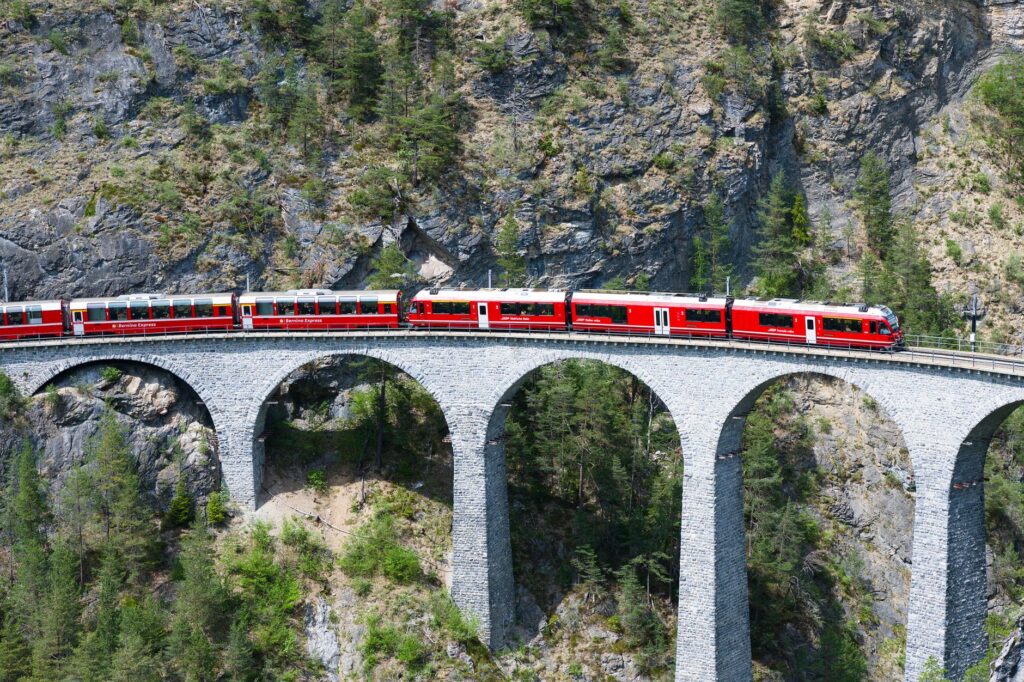
Further up, as the track approaches the Bernina mountain pass, the railway infrastructure dialogues directly with the harshest climatic elements. Snow avalanches and hurricane-force winds forced Swiss engineers to erect kilometers of protective galleries and granite retaining walls that resist the seasonal pressure of ice. This technical display demonstrates that the durability of public works in high mountains depends as much on the solidity of their foundations as on their ability to deflect the destructive forces of nature without offering sterile resistance.
Water as Witness and Frontier
The railway journey is permanently accompanied by the sculptural presence of water in its multiple physical states. In the vicinity of the Ospizio Bernina station, the highest point of the route at 2,253 meters above altitude, waters divide naturally. Lake White, with its characteristic milky hue due to rock flour eroded by glaciers, diverts its flow toward the Black Sea, while neighboring Lake Nero feeds the Adriatic basins. This hydrographic divide underscores the frontier and symbolic condition of the alpine pass.
During the summer months, snowmelt feeds a capillary network of streams descending with unusual force down the slopes, carving deep gorges beneath iron bridges. Passengers observing the landscape from panoramic seats perceive this constant flow not only as an aesthetic spectacle, but as the ecological engine sustaining the valleys’ biodiversity. Local communities have managed this resource over centuries, constructing traditional irrigation canals that harness gravity to supply sloping hay meadows.
Climatic Transition in the Snowfields
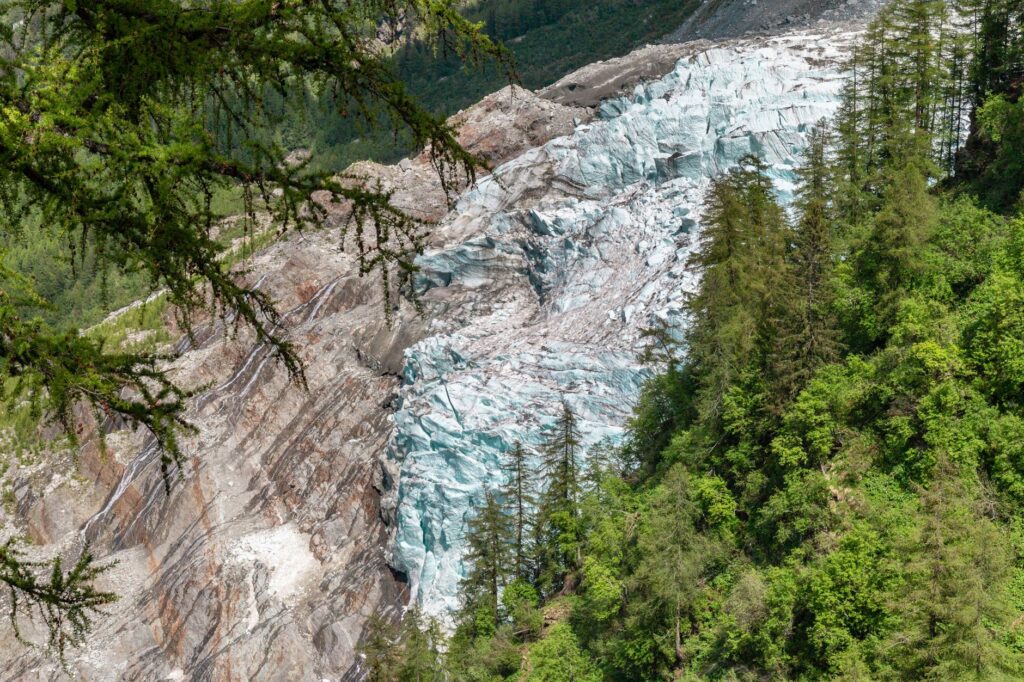
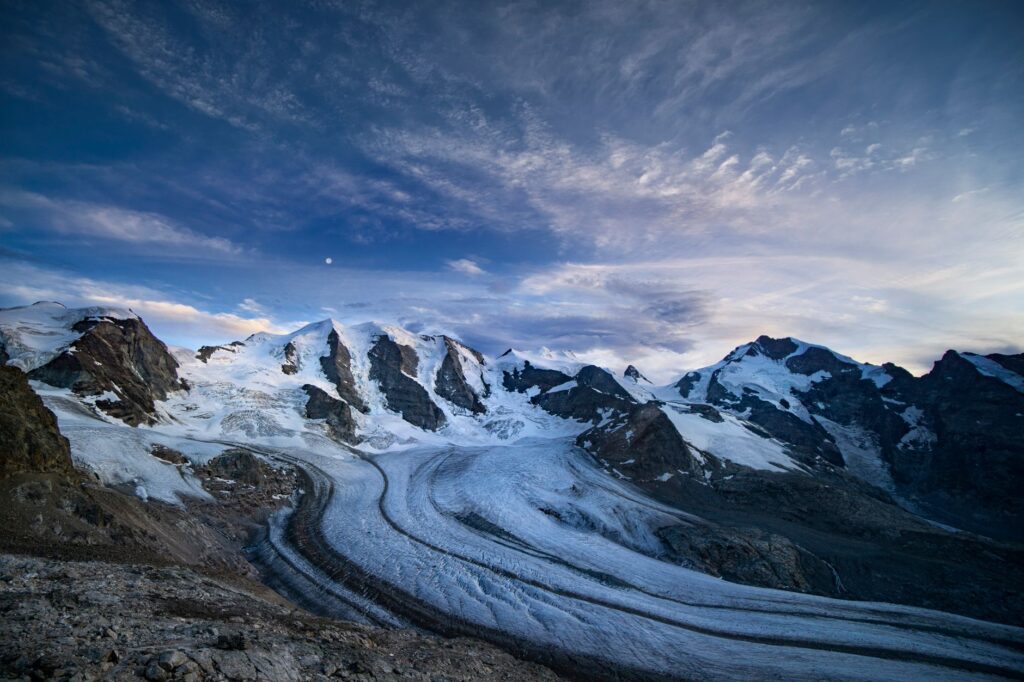
The stretch running alongside the Morteratsch Glacier offers one of the most sober lessons on contemporary climate reality. From the train windows, markers placed by glaciologists over recent decades relentlessly chart the retreat of the ice tongue. This visual record turns the journey into a reflective experience, where the comfort of the carriage contrasts with the evident fragility of the alpine ecosystem. Local guides and informative panels at intermediate stations remind travelers of the urgency of understanding the climatic cycles regulating the continent’s equilibrium.
Despite this retreat, the environment retains an imposing severity. Surrounding peaks, such as Piz Bernina with its altitude exceeding four thousand meters, dominate the horizon with their perennial mantles of snow and sharp ridges. The interaction between railway technology and the immensity of these massifs generates a scale that few transport modes manage to convey. The traveler understands they are in a territory where human intervention is a subtle line barely touching the surface of monumental geography.
Life in High-Altitude Stations
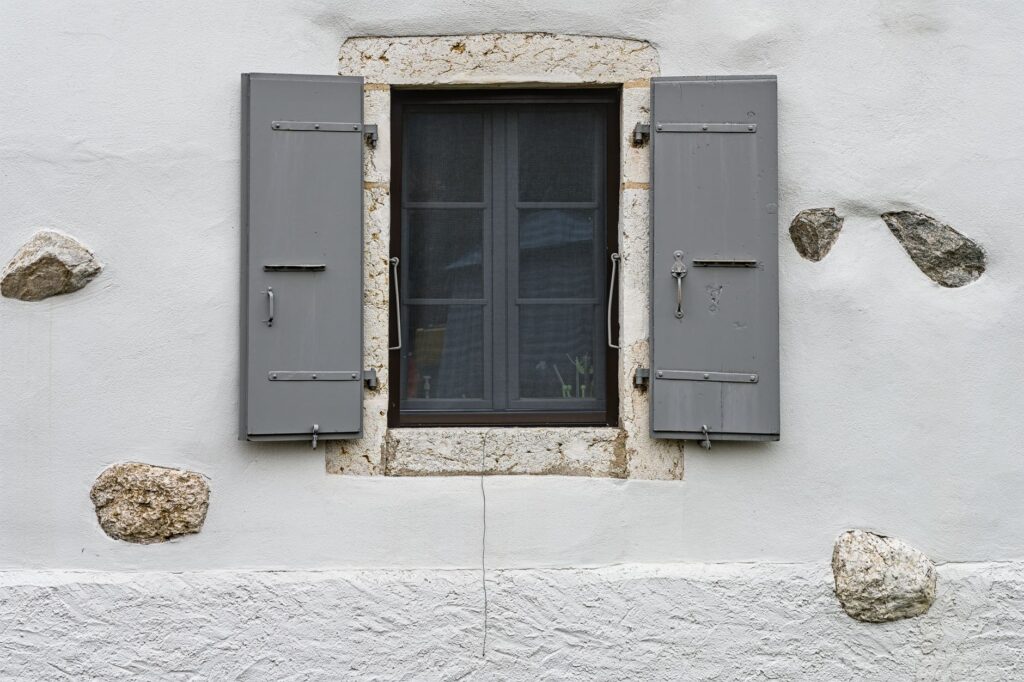
The small intermediate stations along the route act as nodes of cultural and social resistance for the inhabitants of the Grisons valleys and the Val Poschiavo region. Places like Pontresina or Le Prese maintain vernacular architecture characterized by facades decorated with the sgraffito technique, where geometric and floral motifs are carved onto superimposed layers of fresh stucco. These minor urban centers preserve the active use of local Romance languages, such as Romansh and Italian, resisting global cultural homogenization.
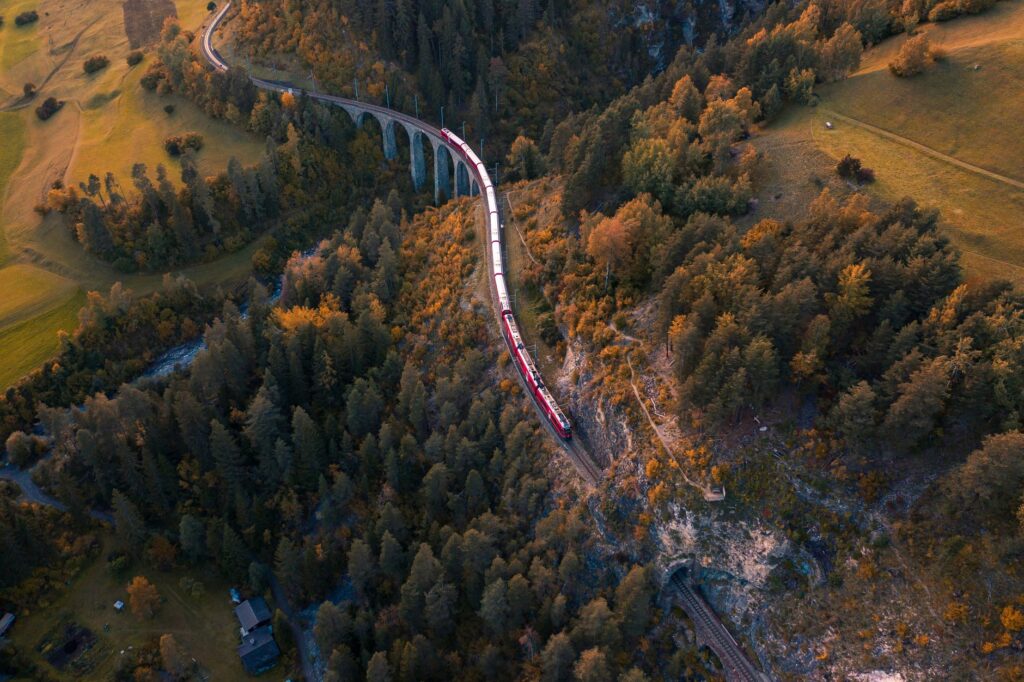
The passing train marks the daily rhythm of these communities. For local farmers and merchants, the railway line is not a tourist attraction, but the guarantee of connectivity during winter months when high-mountain roads remain blocked by snow. This dual functionality—essential public transport and international heritage route—endows the infrastructure with a social authenticity perceived at every stop, where local residents share the platform with international travelers.
The Descent Toward the Mediterranean Palate
After crowning the snow-capped summits and clearing the mountain pass, the Bernina Express begins a dizzying landscape transformation. Within a few kilometers, the train descends into the Poschiavo valley and subsequently crosses the Italian border to end its journey in Tirano. The transition is abrupt and fascinating: fir forests and alpine grasslands gradually give way to terraced vineyards, apple orchards, and Lombard Renaissance-influenced architecture.
This climatic and cultural contrast synthesizes the geopolitical singularity of the journey. In less than four hours, the traveler experiences the transition from Central European rigor to southern luminosity without changing trains. Palms and olive trees bordering the tracks near the Italian terminal immediately contrast with the glaciers left behind a few hours earlier, closing the visual cycle of a journey conceived to understand geography through its most extreme contrasts.
Practical guide
How to get there: The most common northern starting point is Chur station, directly connected to the Swiss rail network from Zurich. The southern terminus is located in Tirano, Italy.
Route planning: The Bernina Express operates year-round with multiple daily frequencies. Seat reservations are strictly mandatory in advance, especially during the peak summer season and the winter ski months.
Fares and tickets: The standard line ticket includes access to the journey, but requires an additional seat reservation supplement for panoramic carriages. Swiss Travel Pass holders enjoy free travel on the base route, paying only the reservation supplement.
Recommended accommodation: For a complete immersion in Grisons architecture, overnight stays in historic small hotels in Pontresina or rehabilitated rural houses in the Val Poschiavo valley are recommended.
Suggested equipment: Due to sudden altitude and temperature changes, traveling with layered clothing, adequate high-mountain sun protection, and grip-soled footwear is essential if planning descents at intermediate stations.
The Last Sigh of the Ice Giants
When the convoy finally halts at the sun-drenched platform in Tirano, the traveler’s memory remains inhabited by the white silence of the peaks and the rhythmic sound of steel over millennial rock. This is not simply about completing a transport route, but about having been a silent witness to an engineering feat that scrupulously respects the limits of the land it crosses. In an era marked by artificial speed and the isolation of air travel, this alpine journey restores to travel its most human, unhurried, and reflective dimension, reminding us that the world’s beauty lies in the complex harmony between relentless nature and the measured ingenuity of those who learned to inhabit it with respect.