A Liquid Mirror Shared by Three Nations
Lake Constance, known locally as the Bodensee, is not merely a freshwater body nestled at the foot of the Alps, but a complex geopolitical and mobility ecosystem where Germany, Switzerland, and Austria converge. Spanning over five hundred square kilometers with a shoreline stretching 273 kilometers, this aquatic territory has historically demanded a transport infrastructure as sophisticated as it is decentralized. Unlike other alpine lakes where navigation serves exclusively tourist purposes, here boats, catamarans, and ferries function as authentic commuter arteries, allowing thousands of workers, students, and goods to cross invisible borders every dawn without touching congested highways.
The integration of this water space with continental land networks represents a fascinating case study in cross-border transport cooperation. Mobility management agencies from the German federal states of Baden-Württemberg and Bavaria, the Swiss cantons of Thurgau, St. Gallen, and Schaffhausen, and the Austrian state of Vorarlberg operate under a shared tariff and operational framework that defies traditional national barriers. This feature examines how the intermodal system of the Bodensee sustains the daily pulse of a densely populated region, where synchronization between the Romanshorn-Friedrichshafen car ferries and local rail services constitutes a Swiss, German, and Austrian machinery of precision.
The Historical Genesis of Continental Navigation
To grasp the magnitude of modern transport on Lake Constance, it is imperative to look back to the 19th century, when the introduction of steamships radically transformed the riparian economy. Before the advent of railways and mechanical navigation, trade depended on sailing barges at the mercy of capricious alpine winds, particularly the dreaded Föhn, a warm, descending wind capable of stirring up sudden, violent waves within minutes. The state shipping lines of Baden and the royal railway companies realized early on that the lake was not an insurmountable obstacle, but rather the most efficient link to unite Central European transport networks with alpine passes leading into Italy.
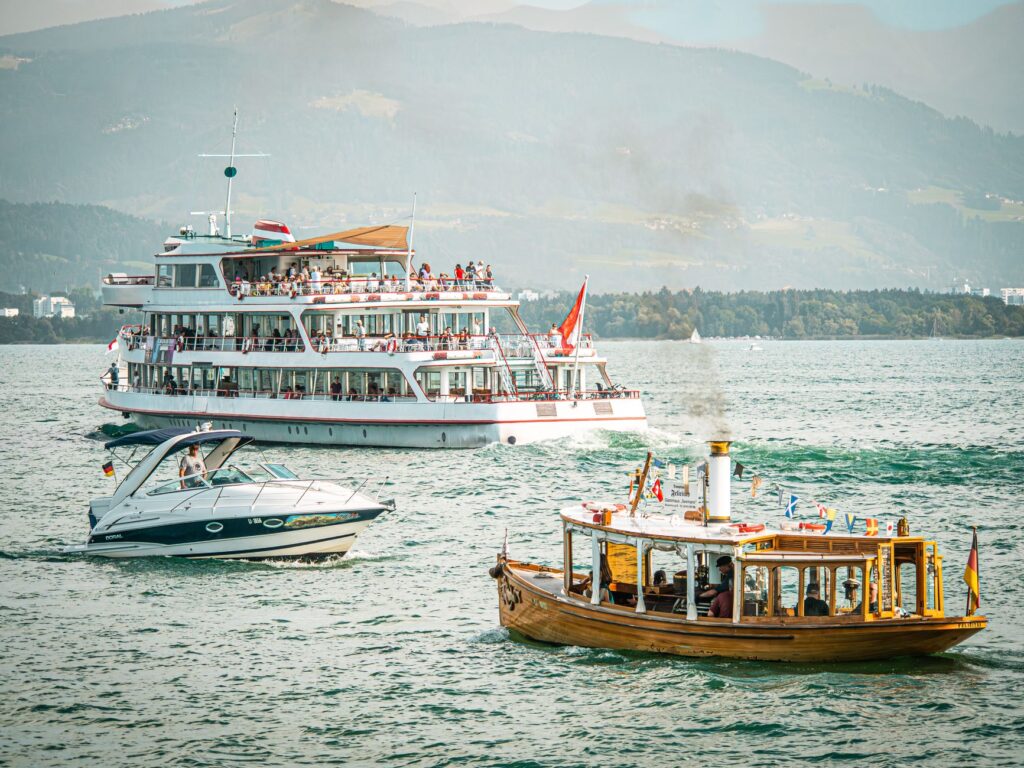
Historic fleets evolved from grand paddle steamers to modern passenger vessels that combine energy efficiency with the preservation of maritime heritage. Although much traditional heavy freight traffic has migrated to the highways encircling the shore, passenger and light vehicle transport over water has undergone a strategic renaissance. Local authorities have understood that the decarbonization of regional mobility inevitably requires diverting road traffic to lake routes, easing congestion on Upper Rhine bridges and reducing greenhouse gas emissions in one of Europe’s most sensitive ecological river basins.
High-Speed Catamarans Facing Alpine Swells
One of the most notable technological milestones in the recent history of Bodensee transport is the year-round catamaran line connecting Constance and Friedrichshafen. Inaugurated in the late 1990s to replace slow traditional ferries on that specific route, this high-speed service operates hourly in both directions, carrying over a million passengers annually. The vessels, specifically designed to minimize wakes and protect fragile littoral ecology, reliably withstand harsh winter weather when dense morning fog and freezing eastern winds test radar and satellite navigation systems.
The operational success of the catamarans lies in their seamless intermodality with the railway terminals of both cities. In Friedrichshafen, the pier sits just meters from the train station providing direct connections to Ulm and Stuttgart; in Constance, connections to regional trains toward Switzerland and Germany’s interior are immediate. This fluidity eliminates the need for private vehicles during daily commuting. However, maintaining these vessels demands complex technical protocols; dry docks in local shipyards perform thorough inspections of aluminum hulls and water-jet propulsion diesel engines during the weeks of lowest tourist influx in autumn.

The Floating Giant: The Romanshorn-Friedrichshafen Line
If catamarans represent speed and individual passenger transit, heavy vehicle and car ferries—known in German as Autofähren—embody the heavy logistical backbone of the lake. The route linking the Swiss town of Romanshorn with the German port of Friedrichshafen has operated uninterrupted for over a century, functioning as a floating bridge that avoids a terrestrial detour of more than a hundred kilometers through congested urban bottlenecks in Bregenz and Constance. These large double-ended vessels accommodate heavy trucks, buses, and hundreds of private cars on a crossing lasting approximately forty minutes.
Port logistics required to manage simultaneous vehicle loading and unloading on both shores is an exercise in time engineering. Hydraulic ramp systems on the docks constantly adapt to seasonal variations in lake water levels, which fluctuate notably due to spring alpine melting and summer droughts. During morning and evening peak traffic hours, operators coordinate departure schedules with customs and police authorities, given that the route crosses the outer Schengen border between Switzerland and the European Union, adding a layer of bureaucratic complexity resolved through mobile controls and bilateral cooperation agreements.
Railway Integration and the Promise of the Euregio
No analysis of Lake Constance transport would be complete without examining its integration with the surrounding rail network. The line known as the Seelinie, running largely along the Swiss shore between Schaffhausen and Rorschach, offers incomparable panoramic views while fulfilling an irreplaceable social and economic function for local communities. In parallel, continuous infrastructure improvements on the German shore, driven by electrification and modernized links toward Lindau and Munich, aim to reduce travel times and consolidate a single ticket valid across the entire Euroregion.

This integrated vision faces constant budgetary and political coordination challenges. While Switzerland invests steadily in densifying public transport schedules under the principle of the Taktfahrplan—fixed-cadence coordinated scheduling—neighboring German states must cope with federal funding constraints and single-track bottlenecks. Despite these administrative asymmetries, users enjoy a travel experience where transitions between trains, city buses, and ferries occur via unified apps and contactless cards, exemplifying a sustainable mobility model that inspires other lake regions across Europe.
Ecological Challenges and the Impact of Climate Change
The Lake Constance ecosystem is not immune to global climate transformations, and the transport sector sits on the front line of adaptation and mitigation. Increasingly warm winters have almost entirely eliminated episodes of surface freezing—the historic Seegfrörni, which allowed walking from shore to shore, has not been recorded since 1963. However, the opposite phenomenon, characterized by summers with prolonged droughts and dramatic drops in water levels, poses very real operational threats to commercial and passenger navigation.
Faced with this scenario, public and private shipping companies have initiated an ambitious energy transition process. Traditionally dependent on fossil fuels, new generations of vessels are incorporating hybrid and fully electric propulsion systems powered by certified solar and hydroelectric energy. The technical challenge lies in autonomy and power required to operate against lake currents and strong winds without compromising strict environmental protection standards governing the Bodensee biosphere reserve. Navigation restrictions in waterfowl nesting areas further compel captains to constantly adjust routes and permitted speeds.

Practical guide
How to get there: Zurich Airport is the primary international entry hub, directly connected to Constance via direct regional trains in approximately one hour. Access is also possible from Stuttgart and Munich airports using the German rail network, Deutsche Bahn.
When to travel: Spring months (May and June) and early autumn (September and October) offer stable weather conditions, lower tourist crowding, and full operation of all navigation services. In winter, ferry schedules remain active, but purely tourist boat frequencies drop sharply.
Tickets and fares: The fare system is partially integrated through regional associations like the Bodensee-Ticket, combining trains, buses, and ferries across border zones in Germany, Switzerland, and Austria. Multi-day passes are recommended for frequent lake crossings.

Logistical tips: Traveling with your own car on the Romanshorn-Friedrichshafen route during summer months requires advance booking or checking waiting-time displays at port access points to prevent unexpected delays from cross-border traffic.
The Human Pulse of a Shared Borderland
At dusk, as lights from riparian towns begin to mirror across the dark surface of the Bodensee, the rhythm of lake transport adopts a more intimate cadence. On the deck of the last catamaran departing for Constance, a group of workers exchanges remarks in Swiss German and High German while gazing at distant snow-capped alpine silhouettes. This steady flow of people crossing a water mirror to dine, work, or simply contemplate sunset proves that transport in this corner of Europe is much more than logistics or mechanical engineering.
It is, essentially, the connective tissue giving meaning to a transnational community built on peace, cooperation, and mutual respect. Barges, trains, and ferries do not merely transport bodies and goods across historically contested borders; they also carry the daily certainty that the shortest distance between two neighbors can be, quite simply, a quiet journey across the water.