
The High Frontier of Graubünden
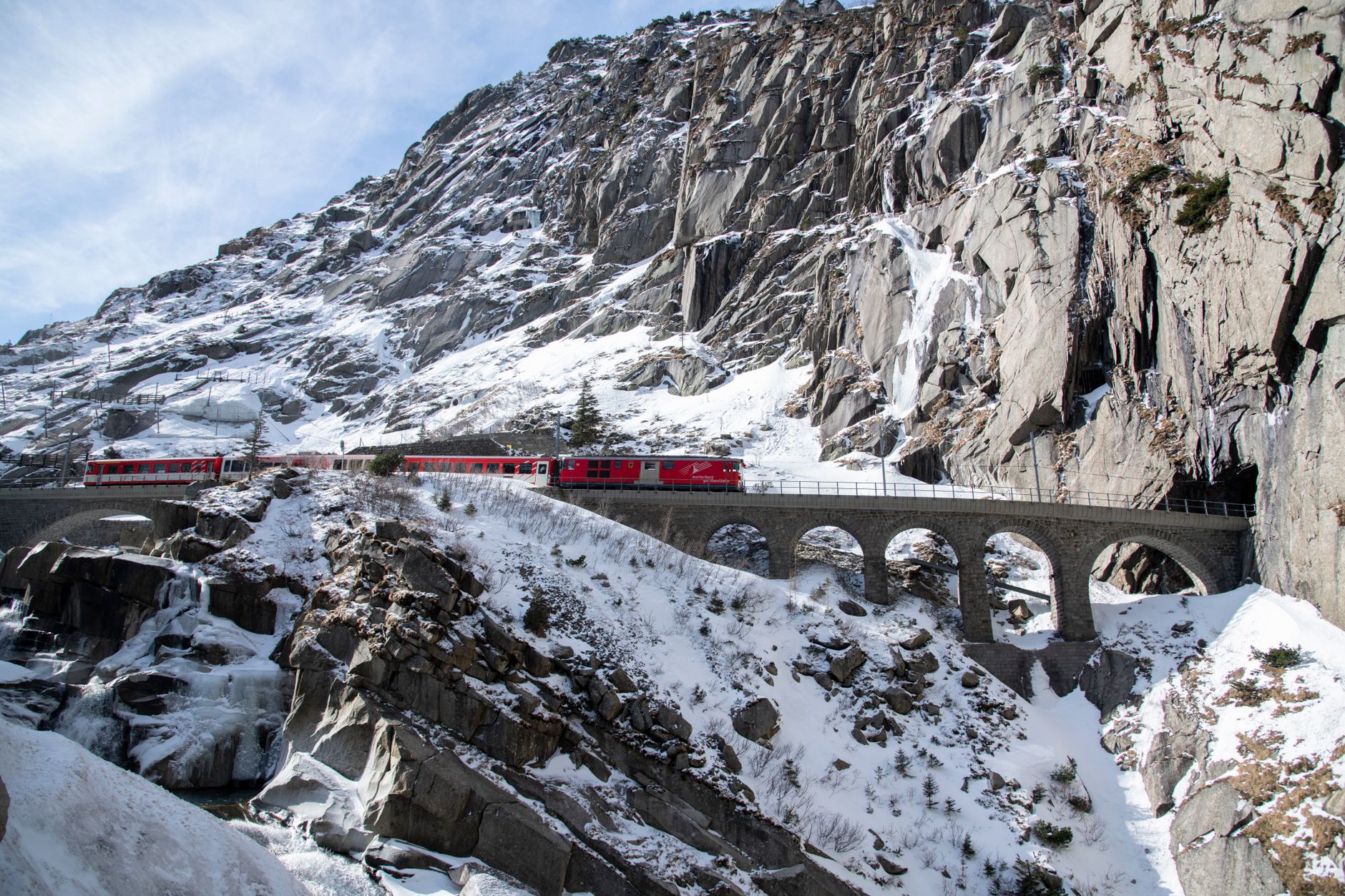
At over two thousand meters above sea level, where granite rock merges with perpetual snowfields, the whistle of a locomotive defies the traditional laws of railway physics. The Bernina Pass, located in the Swiss canton of Graubünden and extending down to the Italian border of Valtellina, represents one of the most audacious feats of civil engineering from the early twentieth century. Unlike other major alpine corridors that rely on colossal base tunnels to pierce the earth’s core, this railway chose to climb the mountain, traversing abysses and cols where nature once seemed to forbid human transit. The question underlying this route is not merely technical, but existential: how is a high-mountain infrastructure sustained in an era marked by climatic instability and the demand for constant modernization?
The answer requires looking beyond the tourist postcard promoting the iconic red train. Throughout the winter months and the melting transitions, the line operates as a vital umbilical cord for isolated mountain communities where secondary roads remain closed for weeks due to avalanche risks. This transportation system demonstrates that the survival of alpine villages depends on a delicate balance between mechanical robustness and the micrometric management of the territory. Every single wooden tie, overhead catenary line, and track switch responds to a twenty-four-hour maintenance protocol combating extreme temperatures, hurricane-force winds, and the relentless pressure of retreating glaciers.
The Audacity of Pure Adhesion
The Bernina railway alignment, operated by the Rhätische Bahn company, stands out in the history of locomotion for a fundamental characteristic: its absolute refusal to use rack-and-pinion systems. While most mountain railways with gradients exceeding four percent require metal teeth interlocked between the rails to prevent slipping, the Berninabahn ascends a maximum gradient of seven percent relying exclusively on natural adhesion between the steel wheel and the rail. This technical marvel was made possible by the early adoption of three-phase alternating current and subsequently single-phase AC traction, which endowed the convoys with constant, controlled power.
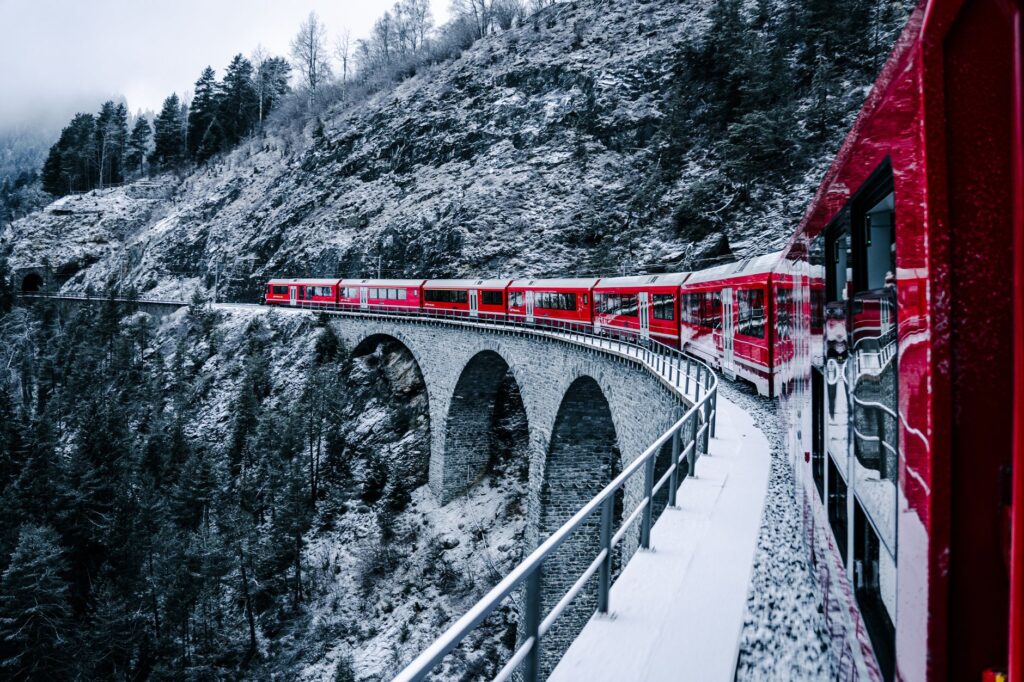
The engineers who designed the route in the early 1900s had to contend with a radically hostile topography. The result was a catalog of exceptional geometric solutions, most notably the famous Brusio helical viaduct. This three-hundred-and-sixty-degree closed-loop structure allows trains to gain or lose elevation in an extremely confined space without exceeding allowable incline limits. By tracing this perfect circle over the meadows of Valtellina, the convoy crosses its own path at different levels, offering a masterclass in how geometry can domesticate the most severe alpine verticality.
The Invisible Border from Tirano to St. Moritz
The journey through this cross-border corridor is not merely a change in altitude, but a cultural and landscape metamorphosis. The route begins in the Italian town of Tirano, situated some four hundred meters above sea level, where palm trees and Mediterranean vineyards coexist with Lombard architecture. As the train initiates its journey, the town’s main street transforms into a shared railway track where carriages pass within centimeters of house facades and café terraces—a striking reminder of the close coexistence between urban life and heavy transit.
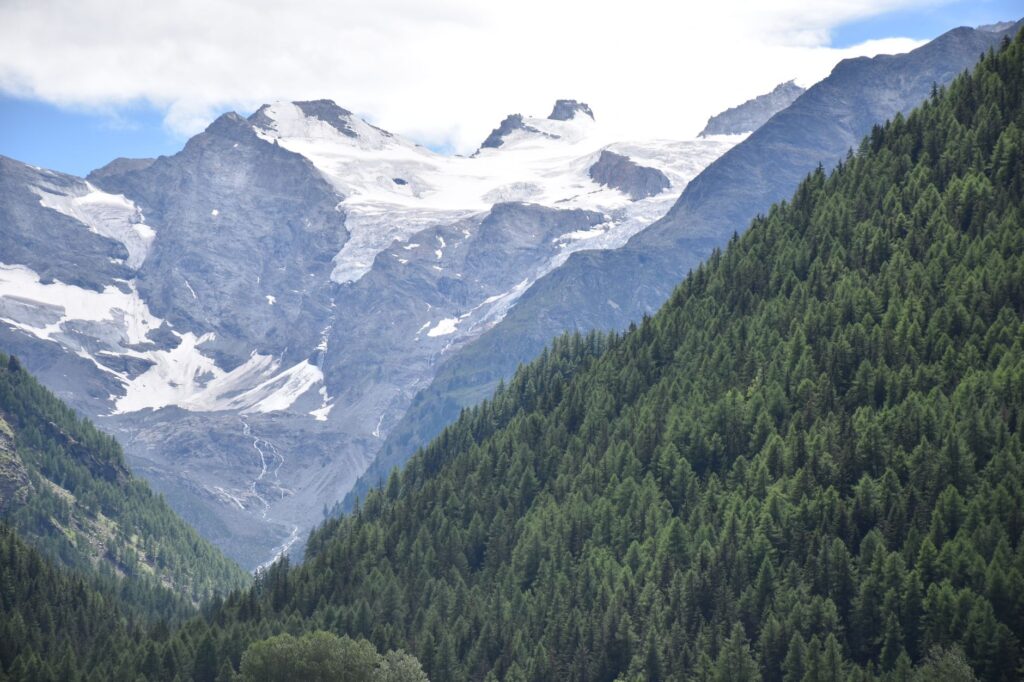
Within a few kilometers, the landscape shifts dramatically. Vineyards give way to spruce forests, which in turn vanish into alpine tundra as the stations of Poschiavo and Alp Grüm are surpassed. At this final viewpoint, hanging over a precipice overlooking the Valposchiavo valley and the Palü Glacier, the train halts for a few minutes. Passengers step down onto the platform to contemplate the absolute silence of the summits, broken only by the crackle of ice and the electrical hum of the motors. Here, the border between Switzerland and Italy blurs into a community of economic and social interests where cross-border commuters traverse the international line daily for work and education.
The alpine railway is not a nostalgic artifact destined for summer leisure, but the main artery guaranteeing the demographic sovereignty of entire valleys against rural abandonment.
The Battle Against Climate and Geology
Maintaining a railway line operational at over two thousand two hundred meters—specifically at the legendary Ospizio Bernina—entails a daily battle against the elements. Winter snowfalls can accumulate within hours to depths exceeding three meters, completely blocking switches and burying the tracks. To confront this threat, the railway company maintains a constantly alerted fleet of powerful locomotives equipped with massive rotary snowplow blades, some featuring auxiliary diesel engines capable of crushing compacted ice blocks and launching them dozens of meters away.
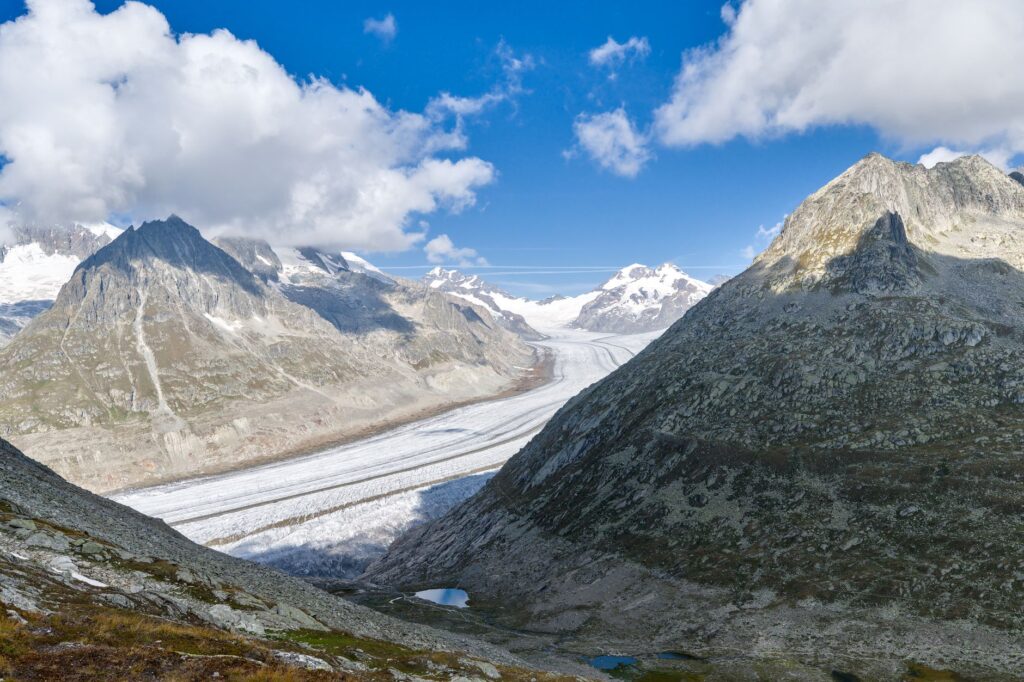
However, the greatest contemporary challenge does not stem from winter snow, but from the climate crisis and the accelerated retreat of surrounding glaciers. The thawing of the permafrost supporting high-mountain slopes has triggered a notable increase in slope instability, generating rockfalls and mudslides that threaten the infrastructure. Modern engineers employ dynamic containment nets, reinforced concrete walls anchored to bedrock, and sophisticated laser sensor systems that monitor in real time any millimetric displacement in the slopes adjacent to the tracks.
Intermodal Integration in the Heart of the Alps
The operational success of the Bernina cannot be explained in isolation, but rather as part of a highly integrated intermodal transport network connecting the deep valleys of Graubünden with the Swiss national railway system and postal bus networks. At strategic nodes such as Pontresina or Samedan, train schedules are coordinated with millimetric precision relative to bus lines penetrating secondary valleys like Val Roseg or Engadin, allowing residents and visitors to dispense with private vehicles for daily commutes.
This seamless connectivity is the result of public transport policies aimed at decarbonizing tourist regions. Integrated ticketing and strict clock-face scheduling ensure that a traveler can step off a regional train in St. Moritz and immediately connect with a bus heading toward the most remote villages of the Albula Valley. This model demonstrates that sustainable mobility in mountainous regions is viable provided there is strong political will to invest in public infrastructure and constant state subsidies compensating the high maintenance costs of these complex networks.
Investing in the modernization of mountain railways is the sole effective brake against the depopulation of alpine regions and the automobile congestion of their valleys.
Practical guide
Planning a journey through the Bernina railway corridor requires understanding the operational particularities of a high-mountain line where weather conditions can alter scheduled timetables.
How to get there: Access from the south is via the Italian railway network to Tirano station. From the north, connections originate in Zurich or Chur, linking at Samedan or St. Moritz with Rhätische Bahn regional trains.
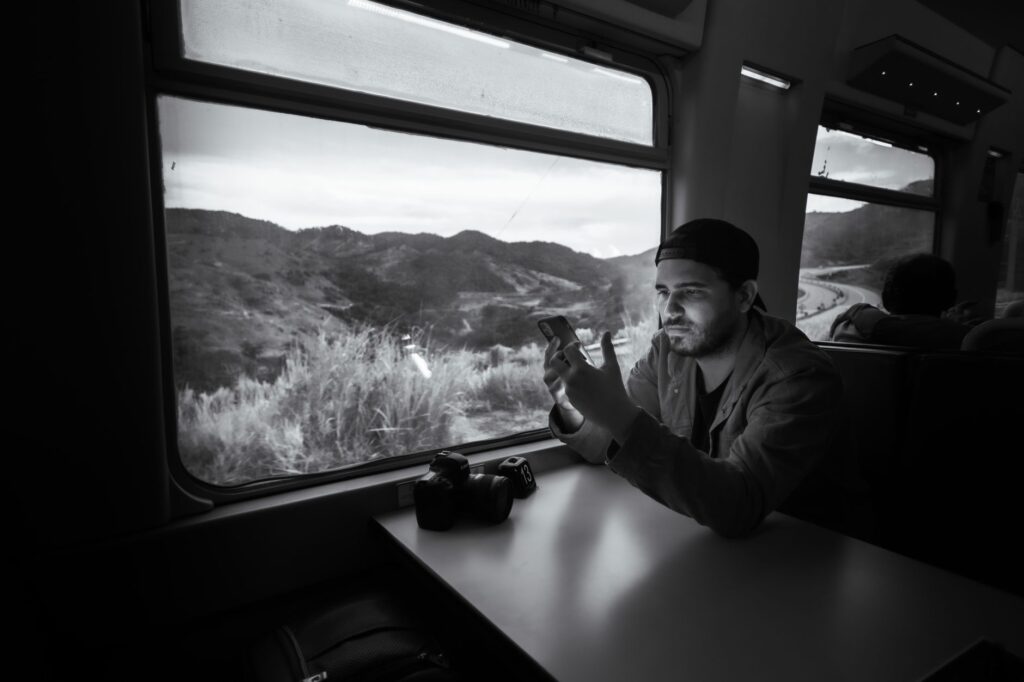
Service types: Two primary categories of trains operate. Panoramic trains (Bernina Express) require mandatory seat reservations and feature large wrap-around windows; standard regional trains cover the exact same route, permit opening windows for photography, and require no prior booking.
Recommended season: While service operates year-round, May and June offer a visual contrast between green meadows and snow-capped peaks, whereas January and February guarantee extreme winter landscapes.
Tickets and fares: The line is fully integrated into the Swiss tariff system and accepts the Swiss Travel Pass. Validating tickets prior to boarding at stations without automatic turnstiles is essential to avoid onboard fines.
Epilogue on Snowy Rails
As the final convoy of the day descends silently toward the Engadin Valley, leaving behind peaks enveloped in the bluish twilight of dusk, the Bernina reveals its true nature. It is not merely a tourist attraction recognized by UNESCO, but a masterpiece of engineering applied to human survival in extreme environments. At a time when global mobility tends toward the homogeneity of highways and mass air transport, this century-old route proves that calculated slowness, respect for natural topography, and the solidity of electric traction remain the most reliable pillars for connecting communities and preserving the dignity of the planet’s most rugged landscapes.