
When travel engineering intersects with the precision workshop
Some objects are born from the improbable intersection between extreme functionality and refined aesthetic caprice. In the universe of contemporary design, few alliances match such coherence in their pursuit of durability as the one just forged between German luggage maker RIMOWA and historic writing instrument manufacturer Faber-Castell. This is neither a simple cross-marketing exercise nor a limited edition destined for passive collector showcases; it is a radical reinterpretation of the portable workshop concept, conceived specifically for creators whose personal geography is constantly shifting.
The project starts with a premise as demanding as it is fascinating: how to translate the legendary robustness of aluminum suitcases into the delicate ecosystem of fine arts? The answer materializes in a case that adopts RIMOWA’s unmistakable visual language—its iconic grooved surface and high-resistance metal structure—to safeguard an monumental color selection signed by Faber-Castell within. A symbiosis that transcends mere material luxury to question new ways of inhabiting the creative space on the move.
The ritual of the stroke in the age of the digital nomad
In an era dominated by the intangibility of touchscreens and the dizzying obsolescence of digital files, the decision to invest industrial resources in a high-end pencil case constitutes a true declaration of principles. Contemporary creators—whether illustrators, architects, or visual journal writers—frequently claim the physicality of the analog medium as an anchor against digital noise. However, transporting delicate artistic materials has always been an Achilles’ heel: broken leads, scattered pigments, and cardboard cases weathered by the elements.
RIMOWA and Faber-Castell address this daily friction from the perspective of travel ergonomics. The case not only protects the material against the rigors of an airplane cargo hold or the bumps of a night train, but elevates the act of opening luggage to the category of an aesthetic ritual. Every element of the design responds to a functional need long studied by artisans and engineers, proving that formal beauty, when backed by rigorous utility, ceases to be a superfluous ornament and becomes an irreplaceable working tool.
Anatomy of a portable icon: the grooved exterior
To understand the magnitude of this piece, one must examine its shell. The anodized aluminum used by RIMOWA in its cabin suitcases is the material chosen to protect the contents. This metal, famous for its lightness and its ability to withstand severe impacts without compromising structural integrity, receives a specific surface treatment that minimizes signs of wear, allowing the patina of time to tell the story of the artist’s journeys.
The characteristic parallel grooves not only provide the torsional rigidity that has turned the brand’s luggage into a global standard since the mid-20th century, but also ensure a secure grip when handling the case on unstable surfaces, such as a train’s folding tray table or a traveler’s knees in the back seat of a taxi. Reinforced corners and precision latches ensure the case remains hermetically sealed against moisture, dust, and sudden changes in atmospheric pressure.
Noble wood interior and modular architecture
Upon releasing the latches, the tactile contrast is immediate and deeply satisfying. While the exterior communicates an industrial and unyielding modernity, the interior reveals the organic warmth of beech wood worked with micrometric precision. Faber-Castell has designed removable trays that fit with absolute perfection inside the aluminum structure, creating specific compartments for each element without leaving room for unwanted friction.
Each level of the case unfolds through a system of concealed hinges that allows access to the pencils in a tiered manner, facilitating a global view of the color palette in a matter of seconds. The interior layout is not a result of chance; it responds to the ergonomic principles demanded by professionals in Europe’s most demanding workshops, where every second of concentration counts and efficiency in color selection is decisive for the creative flow.
One hundred and twenty shades of legendary Polychromos pencils
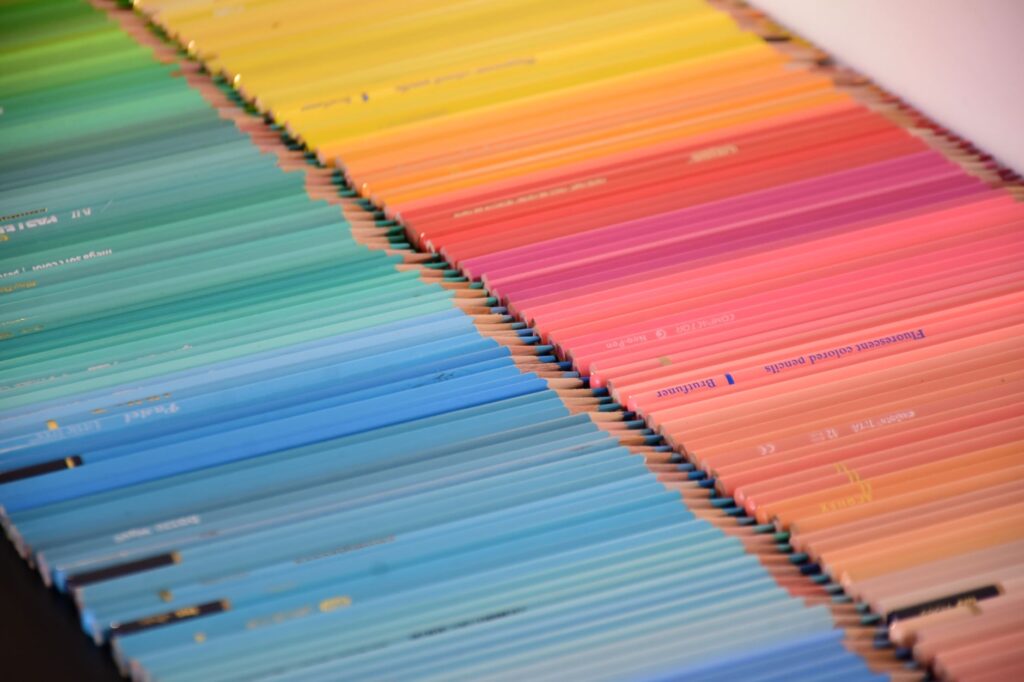
The true heart of this collaboration lies in its contents: a complete collection of 120 colored pencils from Faber-Castell’s Polychromos series. Considered by experts to be one of the global gold standards in artistic drawing, these pencils stand out for their oil-based, wax-free leads, which offer superior lightfastness and unmatched stroke smoothness on various paper weights.

The chromatic range selected for this special edition spans from the most subtle and deep earthy tones to the most vibrant and saturated pigments. The high concentration of pure pigments guarantees that colors retain their intensity intact for decades, free from the dreaded phenomenon of blooming. For the artist on the road, having this complete palette at hand in any corner of the planet eliminates the usual technical limitations of field work, allowing everything from quick sketches to museum-quality finished works.
Faber-Castell’s centuries-old tradition in the 21st century
Founded in 1761 in Stein, near Nuremberg, Faber-Castell represents the quintessence of German industrial excellence applied to writing and drawing. For over two and a half centuries, this family-owned company has successfully preserved traditional manufacturing techniques while incorporating the most advanced standards of sustainability and environmental stewardship in the management of its own forests.
The inclusion of Polychromos pencils in this aluminum case is no random choice. It represents the pinnacle of the brand’s mycological and chemical research, a product that has accompanied modern and contemporary art masters in their most intimate moments of inspiration. By joining forces with RIMOWA, the firm reaffirms its relevance in the 21st century, proving that classic top-quality manufacturing finds a natural ally in cutting-edge industrial design to conquer new territories of use.
The nomadic studio as a response to hypermobility
Traveling with purpose demands tools that converse with the environment without sacrificing professional demands. Current creators no longer look for airtight spaces to seclude themselves for months; they understand displacement as an inexhaustible source of stimuli that must be captured on paper with the same immediacy as they are recorded in visual memory.
This case responds directly to this shift in creative habits. Its balanced weight and compact dimensions allow it to be easily stored in any backpack or hand luggage, turning an airplane seat, a café terrace in Lisbon, or a hotel room in Tokyo into a fully operational studio. The work no longer depends on the fixed infrastructure of a traditional workshop, but on the artist’s ability to carry technical excellence to any latitude.
Practical guide
- Availability and distribution: The RIMOWA x Faber-Castell case is marketed in a strictly limited run through a very exclusive selection of flagship stores of both brands and authorized digital platforms.
- Priority access: Due to high international demand and the artisanal complexity of its manufacturing, prior registration in the firms’ interest registries is recommended to access allocation lists.
- Aluminum maintenance: To preserve the exterior finish, it is advised to clean the surface with a slightly damp microfiber cloth, avoiding abrasive products or chemical solvents.
- Care of Polychromos pencils: Professional high-precision pencil sharpeners are recommended to preserve the integrity of the oil lead and prevent internal fractures during sharpening on the road.
- Air transport: The case complies with international hand luggage regulations, though it is always advised to carry it in the cabin to avoid sudden temperature and pressure changes in the hold.
- Warranty and service: The piece is backed by the combined warranty of both brands for structural manufacturing defects in the metal case and technical support for the writing components.
The stroke that transcends the boundary of time
The true measure of a great travel object does not lie in the kilometers it covers, but in its ability to transform every destination into a blank page ready to be conquered by the observer’s sensitivity.
At dusk, when the golden light bathes the rooftops of the chosen city for the next stopover, the ritual of opening the aluminum case becomes an act of personal affirmation. It is not merely about drawing or writing marginal notes; it is the tangible manifestation that art, when endowed with the right instruments, is capable of defying the ephemerality of travel. Between the cold metallic touch of the exterior and the inexhaustible warmth of the one hundred and twenty pigments waiting inside, the wandering creator finally finds the certainty that their studio accompanies them, intact and available, at every step of the journey.
Source: Condé Nast Traveler Spain, RIMOWA x Faber-Castell: the artist’s suitcase, https://www.traveler.es/articulos/rimowa-faber-castell-estuche-artista