
The whisper of silica in the lagoon
The air in Murano does not breathe like the rest of Venice. It is a dense air, charged with a history written at temperatures exceeding 1,400 degrees Celsius. In the furnaces of this small island, tradition is not an exercise in nostalgia, but a daily battle against physics and time. While the world tilts toward mass production and automation, a new generation of master glassmakers has decided to look back to understand how fire can shape more than just objects: it can sculpt the memory of an entire culture.
The technique of glassblowing, which reached its zenith in the 15th century when masters were confined to the island to prevent their secrets from crossing the borders of the Serenissima, remains a mystery of precision. Every movement of the master, every turn of the blowpipe, is a choreography rehearsed over decades. The question that pulses behind this renaissance is clear: how does one keep an ancient craft alive when the global environment demands immediacy and standardized pricing?
Forging identity against industrial glass
Murano glass has been a victim of its own success. For years, the market was flooded with cheap imitations that, while visually similar, lacked the soul of hand-blown glass. This crisis forced historic workshops into a necessary introspection. Today’s masters, heirs to names like Seguso or Barovier, have understood that their value lies not in repetition, but in calculated imperfection—in that tiny bubble that betrays the human hand, and in the color achieved only through chemical formulas kept under lock and key.

The crisis of raw materials and energy costs has, ironically, served as a quality filter. The workshops that have survived are those that have committed to contemporary design without renouncing 16th-century techniques. Glass, once considered a purely decorative material, is being reinterpreted by artists who seek to explore transparency as an architectural concept, turning the furnaces into laboratories of experimentation where science merges with the purest art.
Glass is not a static material; it is a liquid in pause, a memory that fire keeps captive until the blower decides to give it form.
The choreography of the glass master
The process begins long before the glass touches the fire. The selection of sand, the control of temperature, and the preparation of the crucibles are acts of an almost religious liturgy. The master, surrounded by his assistants, works under a code of minimal gestures. In the workshop, the roar of the furnaces is deafening, but communication between the team is silent, almost telepathic. A nod is enough to know when the glass has reached the exact point of malleability.
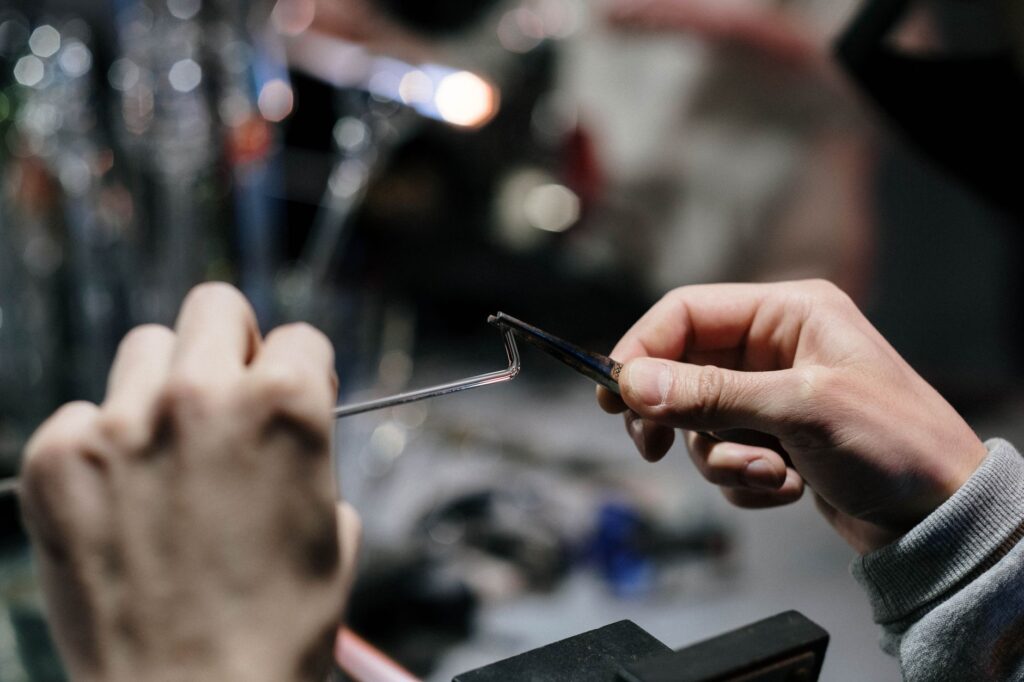
It is fascinating to observe how the glass transitions from an incandescent, rebellious, almost liquid mass into a piece of impossible geometry. Tension is constant. One second too long out of the furnace and the piece cracks; one second too short and the design is lost. It is on this edge that the art resides. Modern masters have incorporated blowing techniques that allow for volumes previously thought unreachable, defying gravity and the fragility of the material itself.
The architecture of the furnace and light
The architecture of the furnaces is, in itself, a heritage that deserves study. Many of these workshops are located in buildings that retain original structures, with tall chimneys dominating the island’s skyline. The light entering these spaces is unique, filtered by suspended dust and the reflection of hot glass. It is a setting that seems lifted from a Canaletto painting, yet with the urgency of contemporary production.
Preserving these spaces is fundamental to the local economy. It is not just about protecting the object, but the ecosystem surrounding it: the pigment suppliers, the steel tool manufacturers, and the artisans who polish the pieces once cooled. Without this artisanal supply chain, Murano glass would die within months. Sustainability, in this context, means keeping a network of interdependent trades alive.
The role of women in glassmaking
Traditionally, the glass workshop has been a male space, a bastion of physical strength and rigid hierarchies. However, in the last decade, a paradigm shift has occurred. Female artists and master glassmakers are occupying key positions in workshops, bringing a distinct sensitivity to the use of color and form. Their arrival has not been a rupture, but a natural evolution that has enriched the island’s color palette.
This phenomenon has revitalized interest in training. The glass schools in Murano, which for years suffered from a lack of interest, now see young people from all over the world arriving to learn the craft. The integration of the female perspective has allowed the technique to be applied to new media, from high-end jewelry to large art installations that now decorate museums in New York or Tokyo.
Sustainability in the face of energy challenges
One cannot speak of Murano glass without addressing the ecological impact. Keeping a furnace lit 24 hours a day is a luxury the planet can no longer afford without responsibility. The most advanced workshops have begun implementing heat recovery systems and high-efficiency electric furnaces that drastically reduce the carbon footprint.
This effort is not just ethical, but strategic. The current market demands transparency in the production chain. Customers want to know that the piece they are purchasing is not only beautiful, but has been manufactured with respect for the lagoon’s environment. This transition toward cleaner production is making Murano a global benchmark for how luxury craftsmanship can be compatible with 21st-century climate goals.
Collecting and the value of heritage
Murano glass has ceased to be a tourist souvenir to become a collector’s asset. International auction houses have focused on mid-20th-century pieces, but also on limited-edition contemporary creations. This change in status has given master glassmakers the confidence to raise their prices and, with that, the quality of their work.

Buying an original piece of Murano glass today is an act of patronage. It is recognizing that the price paid funds the training of an apprentice, the maintenance of a historic furnace, and the survival of a technique that would otherwise be lost to history books. The value of these pieces lies not in the weight of the material, but in the time condensed into every breath.
The true work of art in Murano is not the vase on display, but the knowledge passed from the master’s hands to the student’s hands.
Practical guide
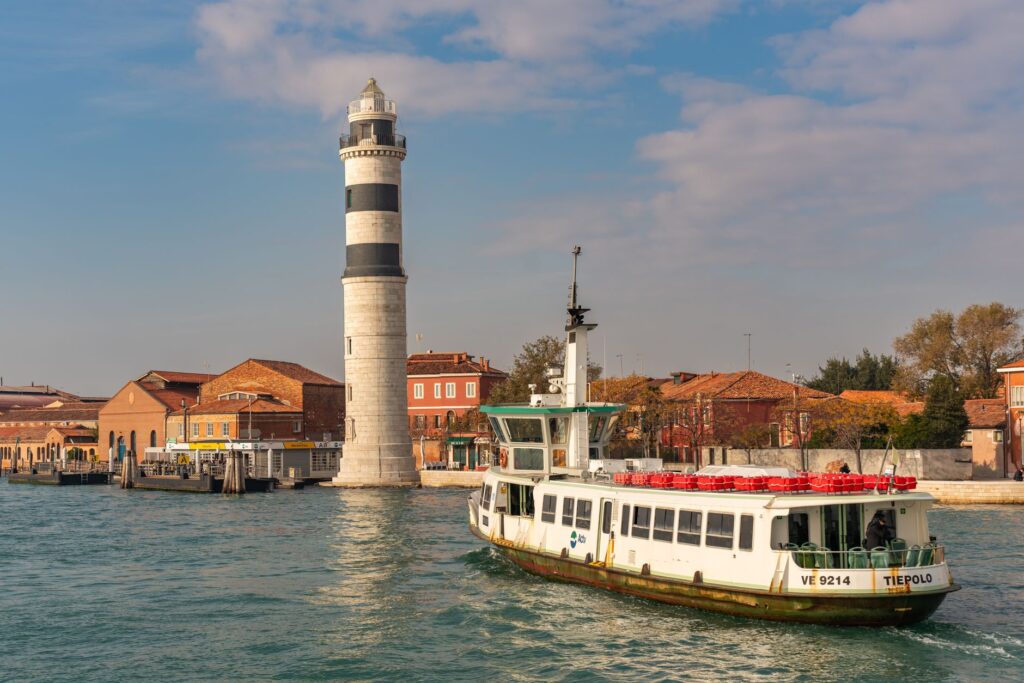
To visit Murano in depth, it is recommended to avoid organized tours that focus on souvenir shops. The ideal approach is to dedicate a full day to the island. Most historic workshops require prior appointments for technical visits. The Museo del Vetro is a mandatory stop to understand the historical evolution before entering the workshops. It is vital to verify that the workshop displays the ‘Vetro Artistico Murano’ seal of authenticity. For transport, use the Vaporetto line 4.1 or 4.2 from Fondamente Nove. The best time to visit is between October and March, when tourist flow decreases and it is possible to converse with the masters without the summer rush.
The closing: the final glow
At dusk, the light of the lagoon turns a cobalt blue that contrasts with the incandescent orange emanating from the furnaces. At that moment, when the last master turns off his blowpipe, the island seems to sigh. It is a collective relief, a pause before the fire wakes up again the next day. Watching a master clean his pipe at the end of the day is to see a man who has managed, once more, to master the most capricious material in the world. As long as there is someone willing to blow, the memory of Murano will remain, despite everything, transparent and eternal.