
Introduction to the Labyrinth of Granite and Open Sea
Northern Norway hides one of the most challenging and visually stunning environments on the planet for light marine navigation. The Lofoten archipelago, situated well above the Arctic Circle, rises from the Norwegian Sea like a wall of sharp granitic peaks plunging steeply into dark fjords and treacherous channels. For the sea kayaker, this territory is not merely a recreational destination, but a technical test of self-governance, physical endurance, and extreme meteorological reading. Here, the interaction between Atlantic currents, alpine topography, and shifting weather creates an environment where meticulous planning is not optional, but the sole guarantee of safety.
Throughout this report, we examine the logistical foundations, tidal dynamics, equipment selection, and indispensable survival strategies required to plot an autonomous route between the islands of Moskenesøy and Austvågøy. Far from the summer tourist postcard, the true essence of Lofoten is revealed only when the paddler understands the language of cold water, the behavior of katabatic winds descending from the peaks, and the absolute responsibility of camping in a nature as beautiful as it is relentless.
The Geography of Chaos: Alpine Peaks and Tidal Channels
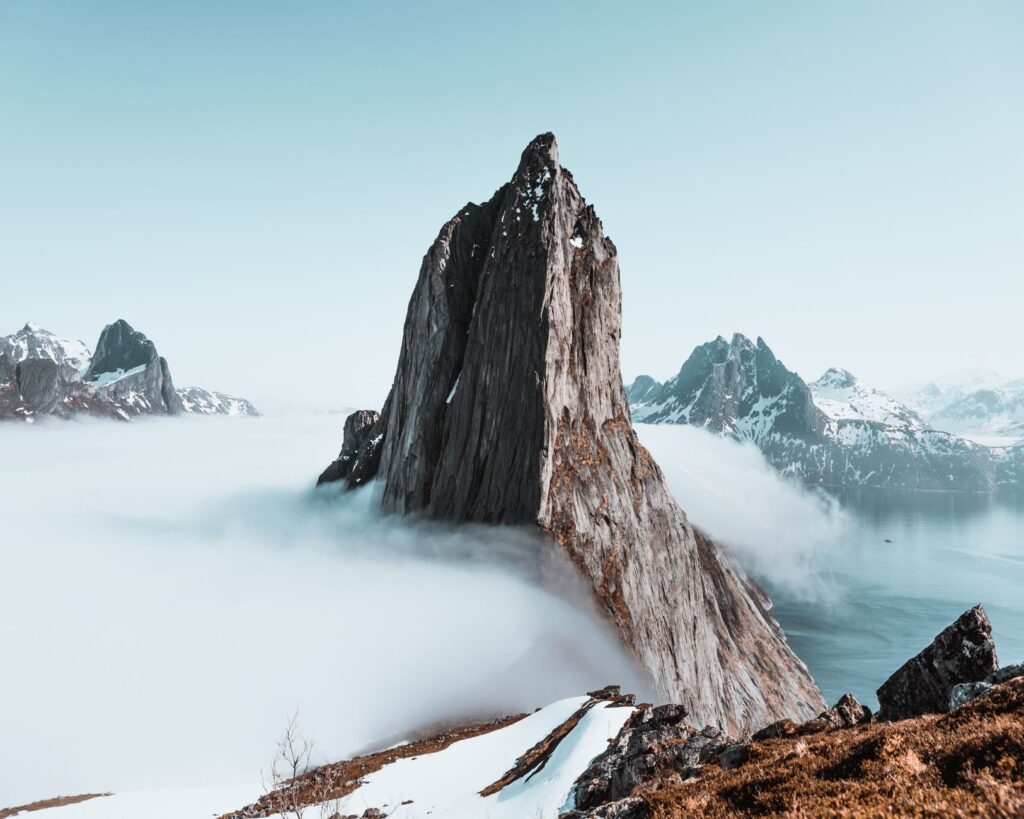
Understanding the submarine and terrestrial morphology of Lofoten is the critical first step before planning any kayak traverse. The islands are formed by Precambrian rocks sculpted by glacial erosion over millennia, creating narrow channels known as straumen. In these passages, water pushed by oceanic tides accelerates to speeds comparable to a fast mountain river. The most celebrated and feared passage is the Moskenstraumen, located between the islands of Mosken and Værøy, renowned for its powerful whirlpools capable of destabilizing larger vessels if not approached at exact slack water.
The navigator must rigorously study local tide tables and understand that high and low tides do not occur simultaneously within the fjords and on the open coast. Seabed friction and coastline complexity generate temporal offsets of up to two hours between neighboring channels. Ignoring these variables means becoming trapped in violent countercurrents that rapidly exhaust the physical resources of the team, forcing mid-route recalibration under reduced visibility or heavy cross-swell conditions.
Arctic Meteorology: The Art of Interpreting the Norwegian Sky
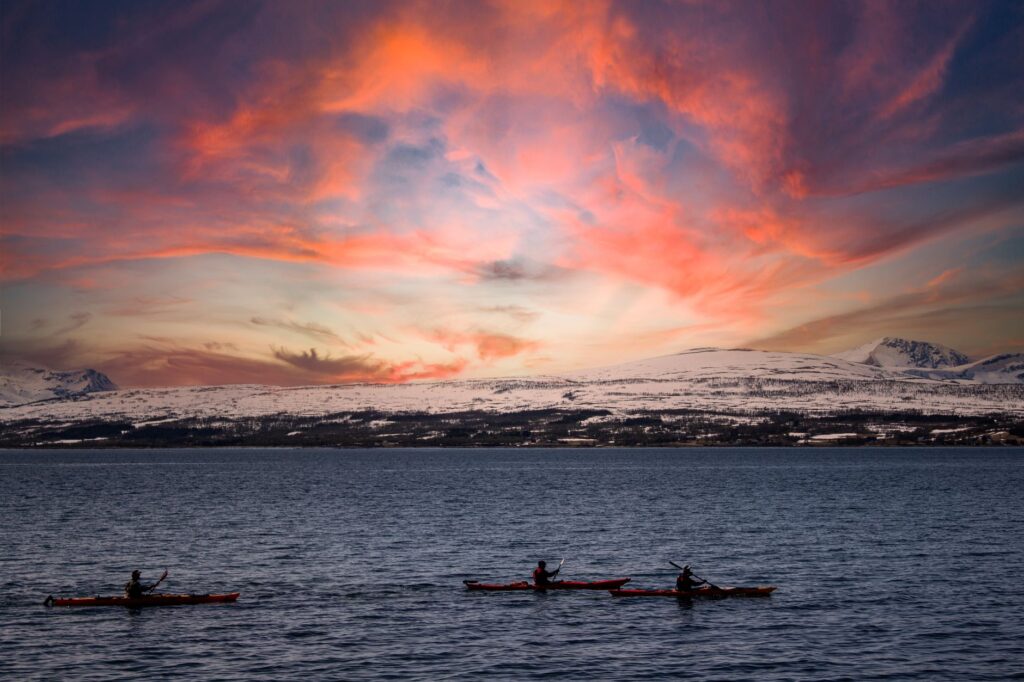
The climate in the Lofoten archipelago is governed by the Gulf Stream, which keeps waters ice-free despite their northern latitude, but also acts as an inexhaustible engine of atmospheric instability. Atlantic storms arrive with virtually no warning, transforming a morning of glassy calm and mirror reflections into a scenario of roaring northwest winds in a matter of minutes. Official weather reports issued by the Norwegian Meteorological Institute must be consulted obsessively, paying special attention to pressure gradients and local wind warnings.
A particularly dangerous phenomenon for the kayaker is the katabatic wind. When cold air accumulated on the high plateaus of the islands spills down cliff slopes toward the sea, it can generate extremely violent gusts that catch the paddler close to the shore. The golden rule in Lofoten is to maintain a prudent safety distance from vertical walls when the barometric pressure drops, always seeking alternative routes in the lee of minor islets or taking shelter in coves before the phenomenon reaches peak intensity.
Weight Logistics and Technical Equipment for Total Autonomy
Undertaking a multi-day traverse through Lofoten demands an implacable exercise in weight reduction and material selection. The sea kayak must be equipped with double watertight bulkheads, flawless perimeter deck lines, a robust deck bungees system, and an operational skeg or rudder to maintain heading in crosswinds. Every gram counts when the complete kit—including spare clothing in dry bags, a cooking system, dehydrated rations for a week, and camping gear—must be distributed meticulously to avoid altering the vessel’s center of gravity.
The true arctic expedition begins the moment the final kayak hatch is closed and one realizes there will be no outside assistance across the next fifty uninhabited kilometers of coastline.
Personal clothing is another critical pillar of safety. Any cotton garment must be discarded in favor of a layering system based on merino wool and technical fleeces, topped by a high-end dry suit with tight latex gaskets and integrated socks. Hypothermia in waters that rarely exceed eleven degrees Celsius in mid-summer is a real and latent risk; therefore, the ability to perform an efficient self-rescue using a roll or paddle float must be practiced and mastered before touching the Norwegian shore.
The Cardinal Route: From Reinefjorden to Trollfjord
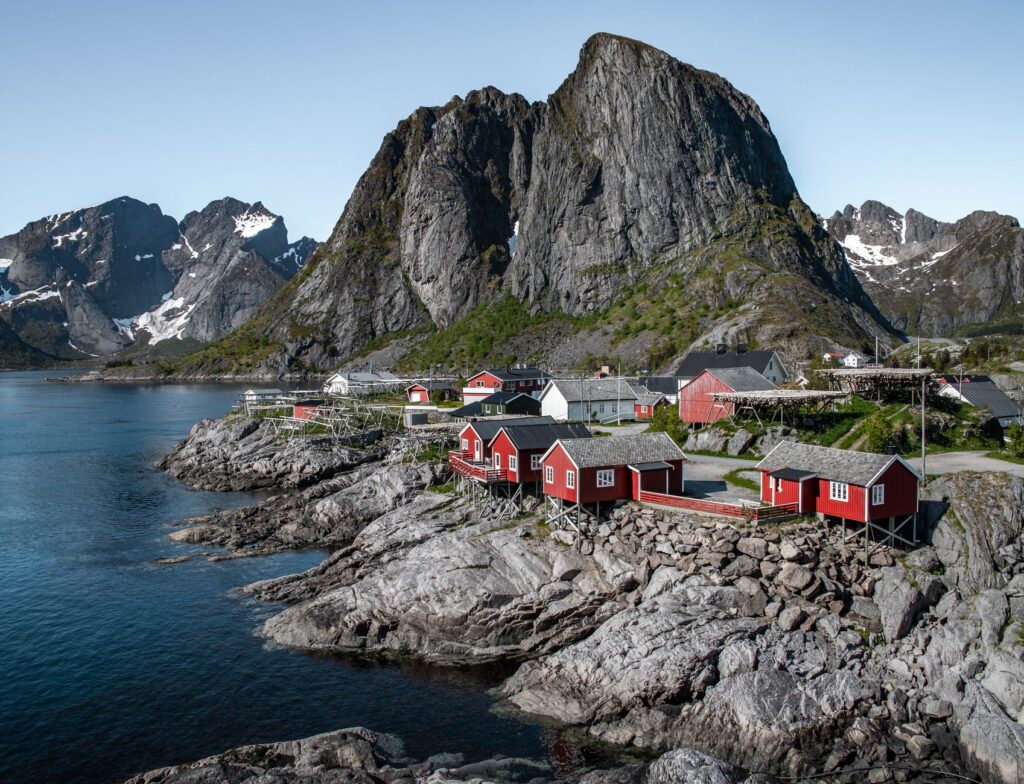
Designing a coherent itinerary involves connecting safe landing points separated by daily pushes of fifteen to twenty-five kilometers, depending on sea state. One of the most fascinating traverses starts in Reinefjorden, a natural amphitheater surrounded by peaks exceeding one thousand meters such as Reinebringen. Paddling through its secondary arms reveals the contrast between traditional red wooden fishing cabins, called rorbu, and the absolute solitude of granite walls carved by ancient ice.
From there, the route advances northward, crossing the Vestfjorden toward the island of Austvågøy, skirting labyrinths of rocky islets where gray seals and white-tailed eagles accompany the rhythm of the paddles. The culmination of the expedition is reached by entering the Trollfjord, a sea arm barely one hundred meters wide guarded by vertical precipices of dark rock. The sense of human insignificance when advancing in silence through this marine canyon, where echoes multiply the hiss of water breaking against the bow, defines the purest essence of arctic adventure in solitude.
Wild Camping and Environmental Management Along the Norwegian Coast
The right to public access in Norway, known as Allemannsretten, enshrines the right to roam and camp freely in nature, but this freedom entails strict environmental responsibility, especially in an ecosystem as fragile as Lofoten’s. Across the islands, flat areas suitable for pitching a tent are scarce and usually coincide with old pastures or fragile coastal meadows that easily erode under the continuous footfall of expeditions.
Expedition members must camp exclusively on rock or gravel surfaces whenever possible, respecting a minimum distance of one hundred and fifty meters from inhabited dwellings. All garbage generated, without exception, must be carried in the kayak’s own hatches until reaching the next urban center with waste management services. Likewise, human waste management requires small trowels for proper deep burial or, preferably, the use of portable containment systems when camping on rocky islets devoid of organic soil.
Practical guide
Planning a kayak expedition through Lofoten requires attention to essential operational data to ensure the success and safety of the journey.
Best time of year: The months of June, July, and August offer the longest daylight hours and moderate temperatures, although May stands out for greater atmospheric stability and lower commercial maritime traffic.
Permits and regulations: No special permits are required to navigate or camp under autonomy regulations, but registering route plans with local rescue centers is mandatory when undertaking open-sea crossings.
Equipment transport: Airlines allow checking folding kayaks or renting fiberglass expedition models at specialized bases located in Svolvær or Leknes.
Communication gear: Carrying a satellite phone, personal locator beacon (PLB), and marine VHF radio to monitor updated coastal weather forecasts is imperative.
Medical safety: International travel insurance explicitly covering rescue operations in high mountains and extreme marine environments is mandatory.
The Silence of Granite: Reflections at the Polar Sunset
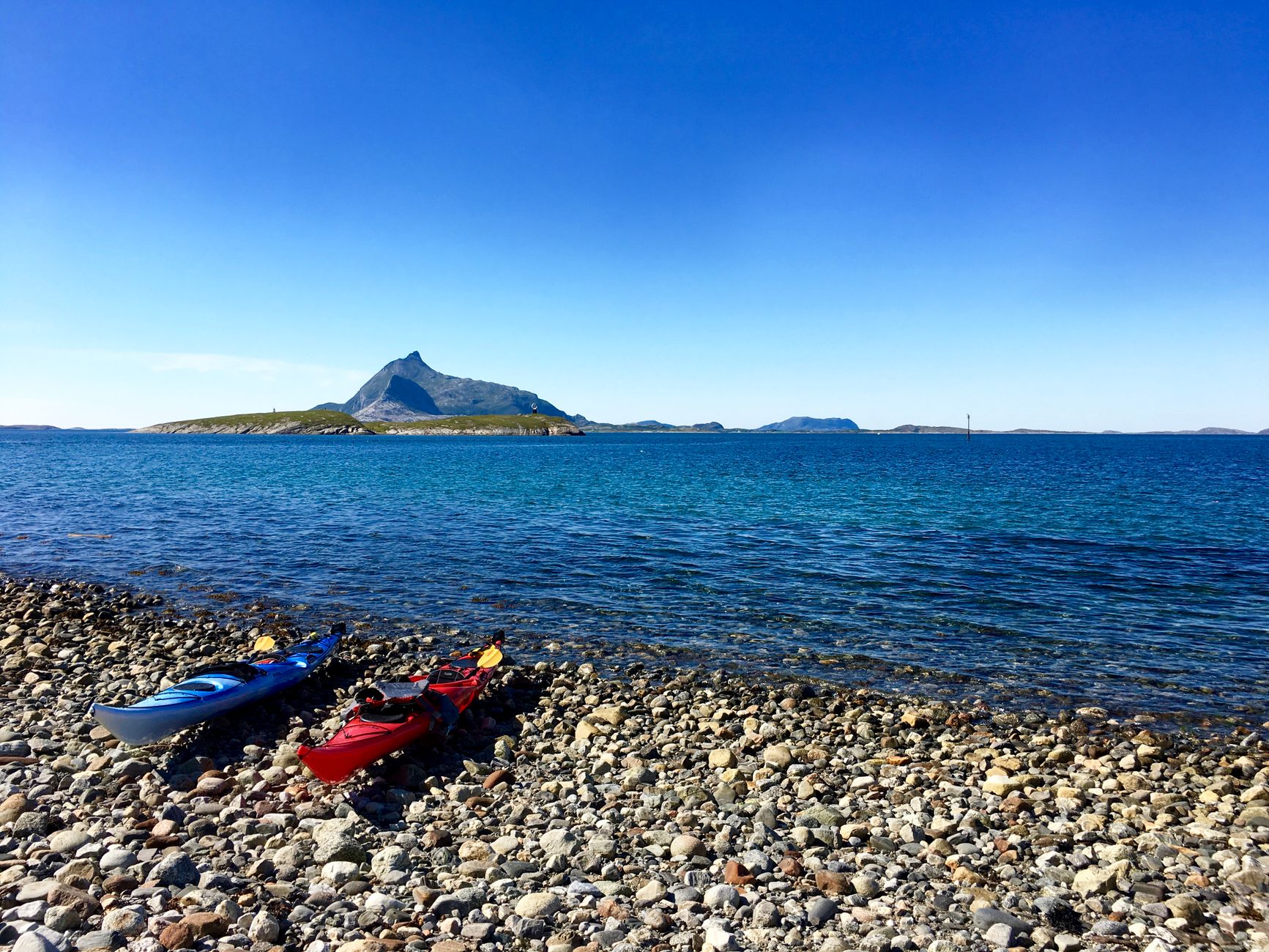
When the midnight sun skims the horizon line without setting, casting golden, oblique light over the peaks of Lofoten, the physical effort of the day dissolves into profound inner calm. Sitting by the tent on a white sand and pebble beach, the kayaker understands that the value of this journey lies not in the distance covered or the conquest of inaccessible summits, but in the harmony achieved with a wild environment that neither negotiates nor grants truces.
In the heart of the Arctic, the sea is not an obstacle to be conquered, but a stern teacher demanding undivided attention, humility, and unwavering respect for its invisible laws.
That silent communion between the paddler, their vessel, and the immensity of the seascape is the most valuable legacy one brings back to the civilized world. The waters of northern Norway will continue to carve their cliffs with the same indifferent force, holding in their liquid memory the ephemeral wakes of those who dared to traverse them with respect and autonomy.