
For centuries, the rhythm of Uzbekistan was dictated by the slow pace of camel caravans crossing the Kyzylkum Desert, carrying silk, spices, and ideas between East and West. Today, that same horizon of infinite steppes is pierced by a flash of white and blue: the Afrosiyob. This high-speed train, based on Spanish Talgo technology, has not only drastically reduced travel times between Tashkent, Samarkand, and Bukhara but has redefined the identity of a nation seeking to base its modern projection on its imperial past.
The integration of high-speed rail into the Central Asian landscape represents one of the region’s most ambitious engineering milestones. It is not merely a matter of laying tracks on sand; it involves adapting precision machinery to an environment of extreme thermal contrasts, where temperatures swing from forty-degree summer heat to freezing continental winters. In this report, we explore how the railway has become the new conductor of a route that, far from being an open-air museum, pulses with a renewed energy connecting the Soviet design of its capital with the time-defying turquoise-tiled minarets.
The Desert Metamorphosis: Spanish Engineering on Uzbek Soil
The deployment of the Afrosiyob system is a case study in global technology transfer. The choice of Talgo 250 trains was not accidental; their natural tilting system allows them to reach speeds of up to 250 km/h on tracks that are not always straight, optimizing existing infrastructure without the need to rebuild every kilometer of track. This technical versatility has been the key to Uzbekistan becoming the first country in the region to have an operational and efficient high-speed network.
From a technical perspective, the primary challenge lies in managing dust and sand. The convoys’ air filtration systems have been reinforced to prevent fine desert particles from compromising the sensitive electronics of the engines. The result is a journey of almost surreal smoothness: while the traveler watches sheep herds and mud-brick villages that seem frozen in time through the window, the train glides with a stability that belies the harshness of the exterior environment.
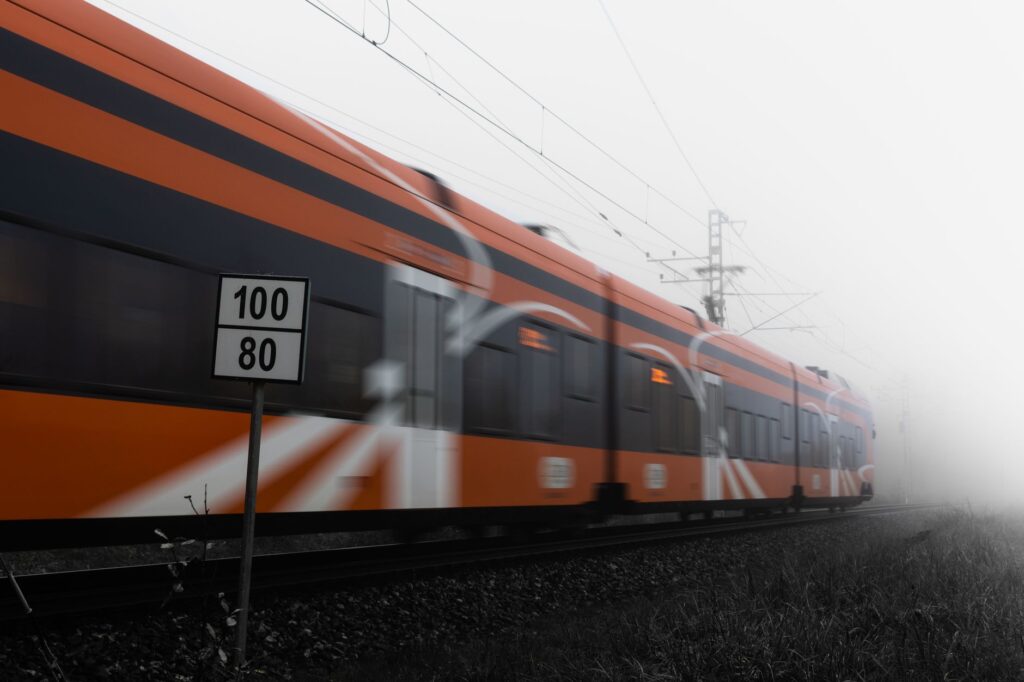
Railway modernization has had a collateral impact on heritage preservation. By facilitating massive and orderly access to historic cities, the government has been able to implement tourism management plans that relieve pressure on old town centers. The train does not just transport people; it carries the economic viability necessary for master artisans of ceramics and weaving to continue operating in their ancestral workshops.
«High-speed rail in Uzbekistan is not just a logistical advancement; it is the reclamation of the Silk Road spirit under a premise of contemporary efficiency.»
Tashkent: A Laboratory of Modernity and Artistic Underground
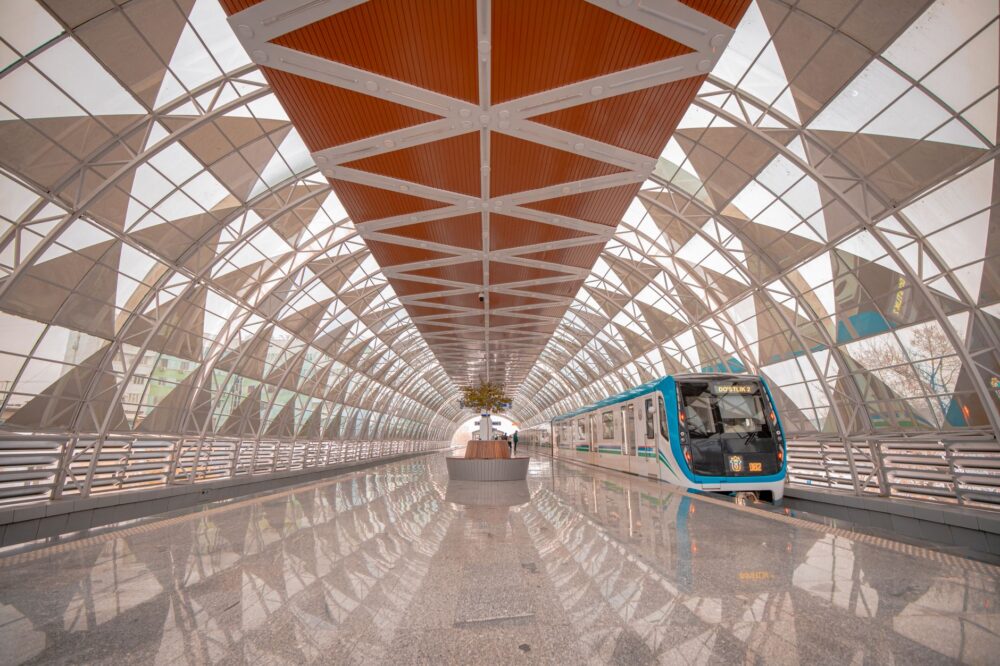
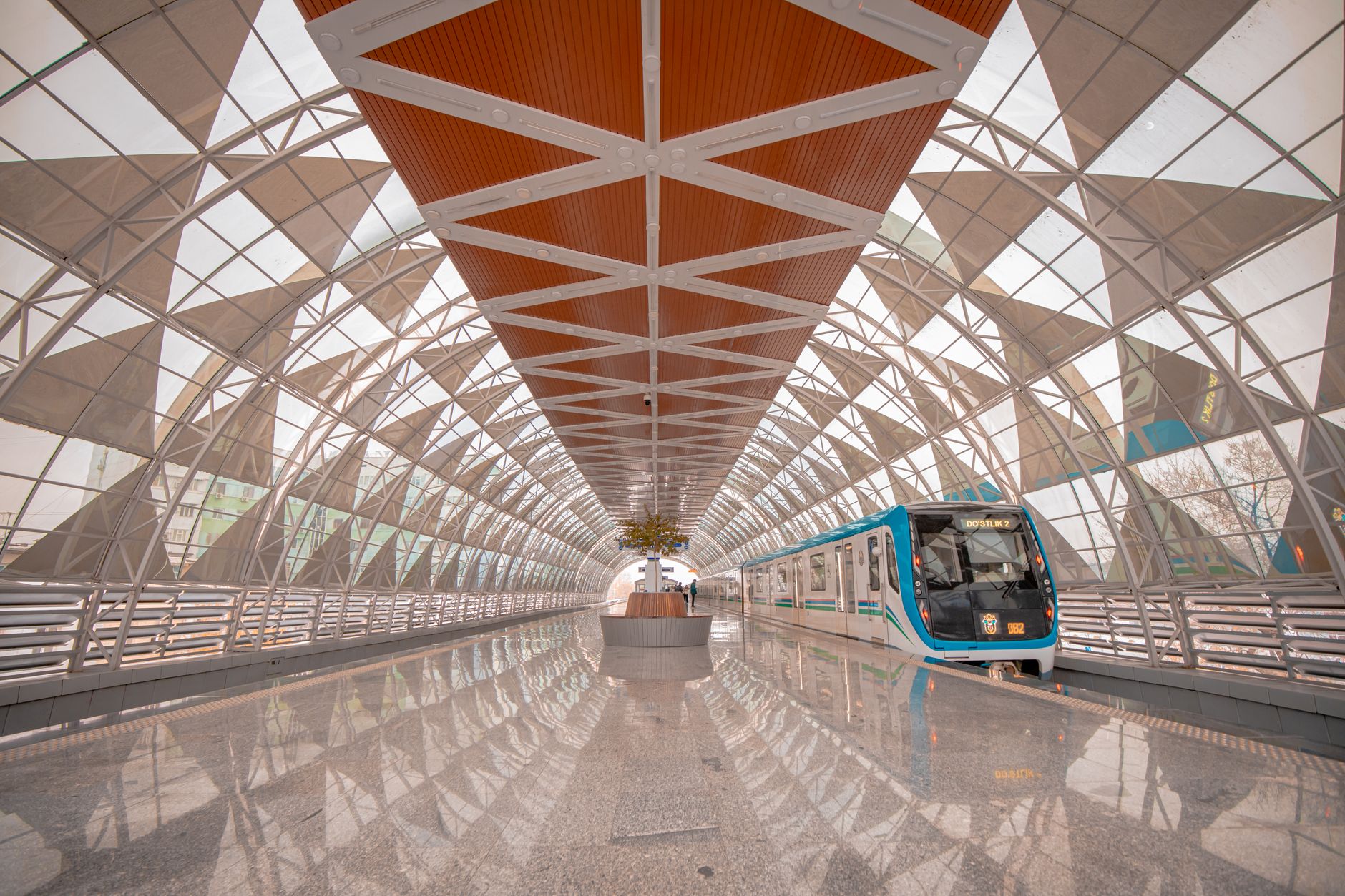
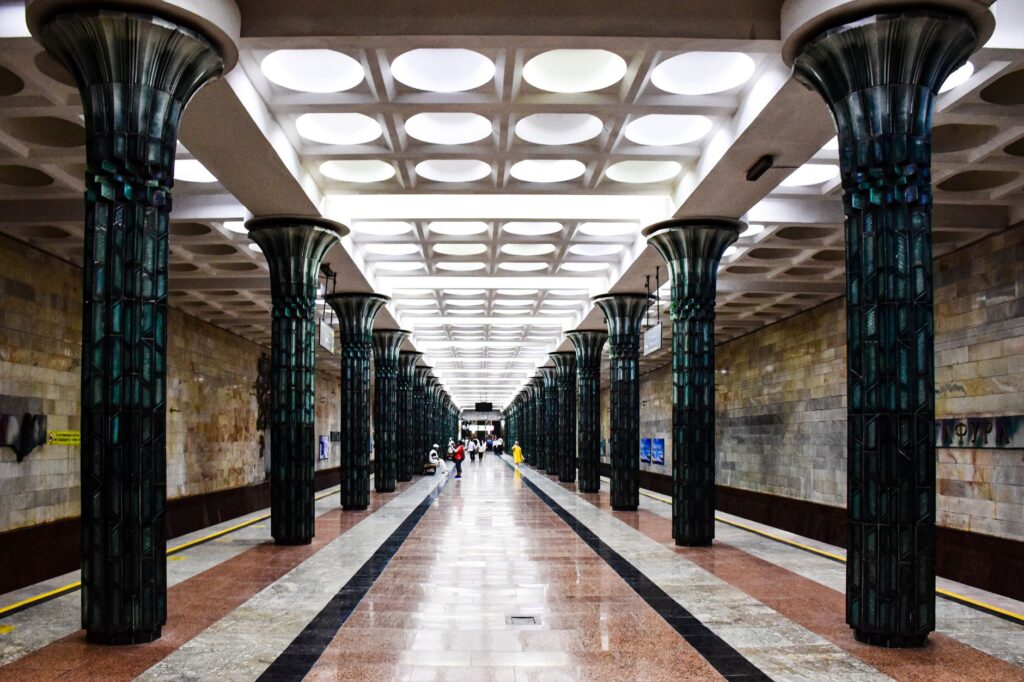
The journey inevitably begins in Tashkent, a metropolis that challenges visitor prejudices. Rebuilt almost entirely after the devastating 1966 earthquake, the capital is a display of monumental avenues and parks that function as green lungs. However, its true engineering treasure lies underground. The Tashkent Metro, the first in Central Asia, is an extension of the country’s railway philosophy: transportation as an aesthetic and cultural experience.
Each metro station is an art gallery. From Kosmonavtlar station, with its blue ceramic panels honoring the Soviet space race, to Alisher Navoi, with its domes evoking the mosques of Samarkand, the underground design prepares the traveler for what they will find on the surface. The brutalist architecture of government buildings coexists with new business centers, creating a visual contrast that narrates the transition from a socialist republic to an emerging commercial hub.
Tashkent railway station, the starting point for the Afrosiyob, is the nerve center of this transformation. With security checks reminiscent of an airport and VIP waiting rooms offering green tea and dried fruits, the passenger experience has been elevated to international standards. Here, punctuality is observed with almost military rigor, a legacy of the Soviet railway system that has merged with Uzbek hospitality.
Samarkand: The Geometry of Power and Eternal Blue
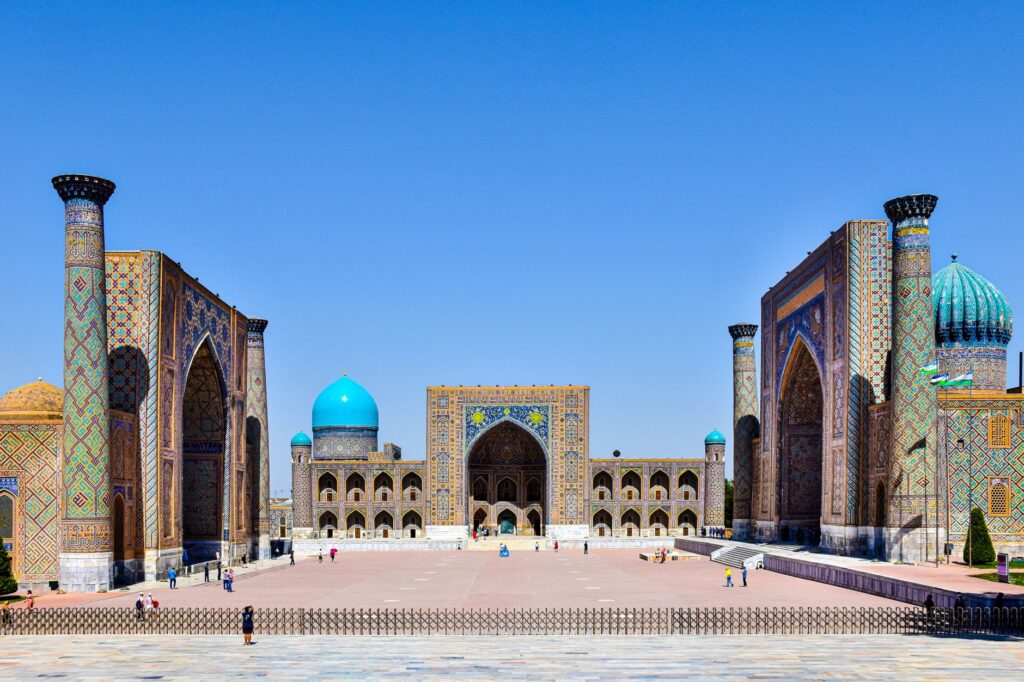
In just two hours, the train arrives in Samarkand, the city that during the reign of Tamerlane was the center of the known world. Arriving at Samarkand station is an immediate cultural shock. If Tashkent is order and spaciousness, Samarkand is a chromatic explosion. The Registan, the square flanked by three madrasas (Islamic schools), represents the zenith of Timurid architecture and a logistical challenge for contemporary restorers.
The engineering of these structures, which have survived centuries of seismic activity, fascinates modern architects. The use of double domes—an internal one for acoustics and an external one for monumental visibility—demonstrates an advanced knowledge of physics and aesthetics. The majolica and mosaic tiles, with their infinite geometric patterns, are not mere ornaments; they are a mathematical representation of the divine order that current artisans attempt to replicate using natural pigments like lapis lazuli and cobalt.
Near the Registan, the Ulugh Beg Observatory reminds us that Samarkand was not only a center of faith but of science. Ulugh Beg, Tamerlane’s grandson and an astronomer, calculated the duration of the stellar year with astonishing precision for the 15th century. This scientific tradition is what today’s infrastructure modernization seeks to emulate, understanding that technical progress is an intrinsic part of the city’s DNA.
«To contemplate the Registan at sunset is to understand that beauty, when supported by solid engineering, is capable of stopping time.»
Bukhara: The Adobe Oasis and Navigation Through Living History
The final stretch of the Afrosiyob to the west takes us to Bukhara, a city that feels more organic and less monumental than Samarkand. Here, the train stops at a station located on the outskirts, leaving the old town protected from the vibrations of modernity. Walking through Bukhara is like navigating a labyrinth of caravanserais and trading domes that have functioned uninterruptedly for a millennium.

The Po-i-Kalyan complex, with its minaret so impressive that even Genghis Khan ordered it not to be destroyed, is the axis upon which the city turns. The engineering of this minaret, with ten-meter-deep foundations designed to absorb ground movements, is a testament to the region’s constructive resilience. Unlike other cities that have been turned into museums, Bukhara maintains its vital pulse in the bazaars, where the trade of silk carpets and hand-forged knives follows the same bargaining rules as five centuries ago.
Water management in Bukhara is another fascinating aspect of its historical engineering. The hauz or ancient ponds were the heart of social life and the city’s natural cooling system. Although many were drained for sanitary reasons during the 20th century, Lyabi-Hauz remains the main meeting point, proving that intelligent urban design always prioritizes human well-being and heat mitigation.
The Gastronomy of the Road: The Ritual of Plov and Hospitality
The railway journey through Uzbekistan cannot be understood without mentioning the role of food as a social lubricant. In the Afrosiyob’s cafeteria car, or in the restaurants surrounding the stations, Plov is the absolute protagonist. This dish of rice, lamb, carrots, and spices, declared Intangible Cultural Heritage by UNESCO, varies according to the region the train passes through.
In Tashkent, plov tends to be darker and more robust; in Samarkand, it is cooked in layers and not mixed until served; in Bukhara, it is lighter and often includes raisins. Preparing plov in large iron cauldrons (kazans) is a culinary engineering spectacle requiring precise control of fire and proportions. Sharing a plate of plov is the necessary initiation rite for any traveler wishing to understand the country’s social cohesion.
Beyond plov, bread (non) is sacred. Each city has its own design and consistency. Samarkand bread is famous for its density and ability to stay fresh for weeks, making it the ideal food for long caravan journeys. Today, train travelers carry bags full of bread fresh from the clay oven (tandir), taking with them a piece of the land they have just crossed.
Challenges and Future of the Central Asian Rail Network
Despite the Afrosiyob’s success, the Uzbek railway system faces significant challenges. Expanding high-speed rail to Khiva, the country’s third jewel city further west, requires crossing even more hostile desert areas with lower population density. Full electrification of the tracks is a priority goal to reduce dependence on fossil fuels and improve tourism’s carbon footprint.
Furthermore, Uzbekistan is working on creating international railway corridors connecting China to Europe through Kyrgyzstan and the Caspian Sea. This ambitious project, known as the Middle Corridor, aims to position Uzbekistan not just as a tourist destination but as a global logistical hub. Railway engineering thus becomes a tool of diplomacy and economic development that transcends national borders.

Investment in human capital is equally critical. The Tashkent University of Railway Engineering trains thousands of engineers and technicians every year, ensuring that imported technology can be maintained and improved locally. This technological sovereignty is what will allow the heart of the Silk Road to continue beating strongly in the decades to come.
Practical guide
To travel through Uzbekistan by high-speed rail, advanced planning is essential. Afrosiyob tickets often sell out weeks in advance, especially in economy and business classes. It is recommended to purchase through the official Uzbekistan Railways (Uzrailways) app or authorized agencies.
- Documentation: Most citizens of the European Union and Latin America do not require a visa for short tourist stays (up to 30 days), but it is imperative to verify updated requirements before traveling.
- Climate and Packing: The best times to travel are spring (April-May) and autumn (September-October). The sun is very intense, so sun protection and constant hydration are essential. On the train, the air conditioning is powerful; keep a light garment handy.
- Connectivity: It is easy to purchase a local SIM card at Tashkent airport. Although stations have Wi-Fi, the connection can be unstable during deep desert stretches.
- Station Logistics: Arrive at least 45 minutes before train departure. Security checks are thorough (passport review and luggage scanning) before accessing the platforms.
Uzbekistan is a destination where safety is very high and hospitality toward foreigners is a cultural norm. Learning a few basic words in Uzbek or Russian will open many doors and smiles during railway journeys.
The journey concludes with the image of the sun setting over the steppe as the train accelerates toward the horizon. It is in that moment, between the comfort of the modern carriage and the silhouette of a distant minaret, that the true essence of this country is perceived: an unbreakable bridge between the glory of yesterday and the ambition of tomorrow.