The fascination with extreme geographies sooner or later leads to the planet’s great insular landmasses. Among them, Borneo occupies a singular place: the third-largest island in the world, shared by Indonesia, Malaysia, and the tiny sultanate of Brunei, holds some of the oldest and most complex ecosystems on the globe. Venturing into its jungle domains does not merely mean engaging in nature tourism; it is a direct confrontation with the primordial scale of Earth, where life cycles operate at a pace and intensity difficult to imagine from contemporary urban environments.
Our journey to this corner of Southeast Asia responded to a long-delayed desire to document firsthand one of the most threatened and fascinating tropical rainforests on the planet. Far from the sweetened postcard imagery often peddled by commercial brochures, the actual approach to Borneo requires accepting relentless humidity, logistical complexity, and above all, the urgency of an ecological reality marked by human pressure on the territory. This report addresses the geography, endemic fauna, botanical richness, and practical keys to touring the green heart of the island with a rigorous and respectful gaze.
Insular Geography: A Political and Natural Mosaic
With an area close to 748,000 square kilometers, Borneo is a miniature continent. Its territory is divided administratively into three states: Kalimantan, which occupies the largest surface area under Indonesian sovereignty; the Malaysian states of Sabah and Sarawak in the north; and the sovereign enclave of Brunei Darussalam. Each of these portions presents distinct reliefs, levels of development, and conservation policies, turning any cross-border journey into a comparative study on environmental management in the 21st century.

The insular relief is dominated by a mountainous backbone from which towering summits emerge, such as Mount Kinabalu, which at 4,095 meters of altitude in the Malaysian state of Sabah constitutes the highest point between the Himalayas and New Guinea. Raging rivers descend from these heights, historically functioning as the only possible communication arteries, cutting through an alluvial plain covered by dense marshes and mangrove forests before emptying into the South China Sea, the Sulu Sea, the Celebes Sea, and the Makassar Strait.
The Ancient Rainforest: Botany of Extremes
It is estimated that Borneo’s tropical rainforest is over 130 million years old, making it one of the oldest forest formations on Earth, predating the Amazonian jungles by a wide margin. This evolutionary longevity explains its astonishing plant biodiversity. More than 15,000 species of flowering plants have been cataloged, including over 3,000 varieties of timber trees, primarily from the dipterocarp family, whose specimens can exceed fifty meters in height and dominate the canopy.

Beneath that perpetual green vault, competition for sunlight is fierce and has fostered extraordinary biological adaptations. Some of the planet’s most enigmatic botanical wonders grow here, such as the Rafflesia arnoldii, famous for producing the world’s largest individual flower, which lacks visible leaves, roots, and stems, and emits a characteristic odor of decaying flesh to attract pollinating insects. Similarly, various species of carnivorous plants of the genus Nepenthes deploy their digestive pitchers in the acidic, nutrient-poor soils of the mountain ridges.
Endemic Fauna: Inhabitants of the Canopy and Rivers
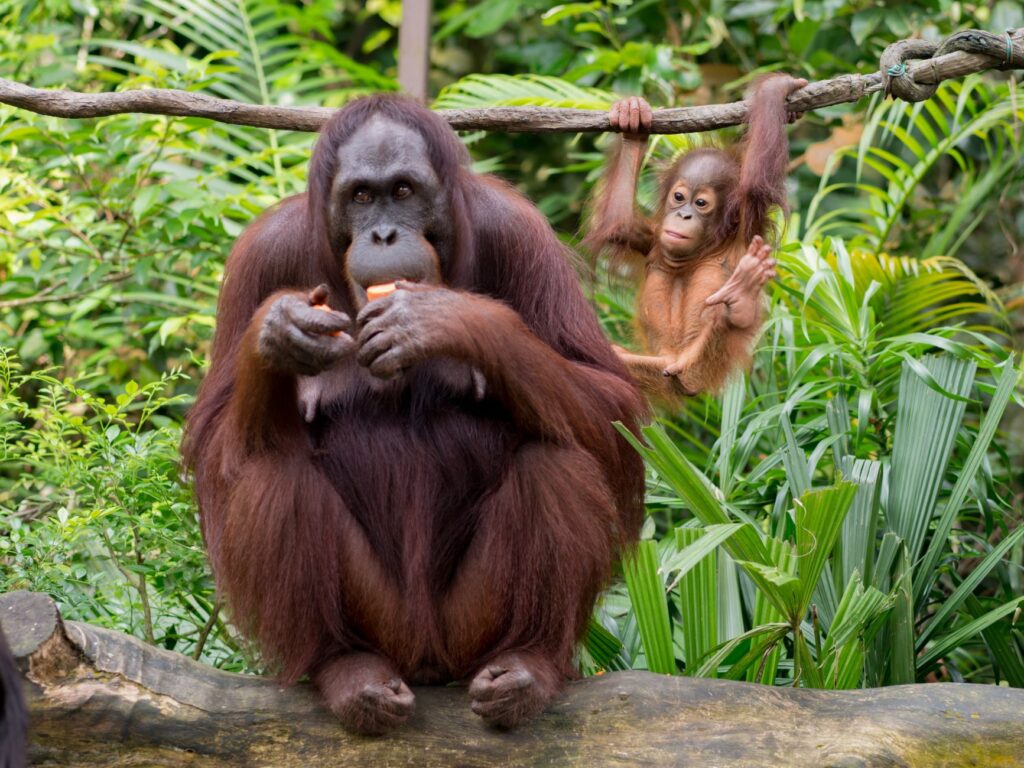
Borneo’s wildlife stands out for a very high degree of endemism, the result of prolonged geographic isolation during sea-level fluctuations in the ice ages. The island’s most iconic primate is undoubtedly the Bornean orangutan (Pongo pygmaeus), one of the three species of Asian great apes. Unlike their African relatives, orangutans lead a predominantly solitary and arboreal life, constructing daily nests with interwoven branches to sleep high above the ground.
Another unmistakable inhabitant of riverbanks and mangroves is the proboscis monkey (Nasalis larvatus), an endemic primate instantly recognized by the prominent, fleshy nose of adult males. These animals are exceptional swimmers, capable of crossing wide river channels to escape predators such as the saltwater crocodile or to search for food in flooded trees. The muddy banks also harbor populations of Borneo elephants, a subspecies differentiated by their smaller size and more docile temperament compared to the continental Asian elephant.
Anthropogenic Impact: From Virgin Jungle to Monoculture
The apparent lushness of Borneo contrasts dramatically with the environmental crisis it has suffered for decades. Uncontrolled timber industrialization beginning in the late 20th century and the subsequent massive expansion of commercial oil palm plantations (Elaeis guineensis) have radically transformed the insular landscape. Large extensions of primary forest have been logged and burned, fragmenting natural habitats and isolating wildlife populations in increasingly small pockets.
This habitat loss has pushed numerous species to the brink of functional extinction. In addition to the pressure on biodiversity, land-use conversion generates massive carbon emissions resulting from the destruction of peat soils, traditionally natural sinks for greenhouse gases. Various international and local organizations work on ecological corridors and reforestation programs, although the tension between regional economic development and long-term conservation remains one of the region’s most complex political and social debates.

Ecotourism and Community Conservation
Given the urgency of halting environmental degradation, well-managed ecotourism has established itself in certain areas of Sabah and Sarawak as an alternative economic tool for local communities. Initiatives based on community participation demonstrate that it is possible to generate income without resorting to clear-cutting or poaching. Low-impact accommodations, local naturalist guides, and scientific volunteering projects allow travelers to enter the jungle while understanding the intrinsic fragility of the environment.
However, experts warn against the risk of uncontrolled mass tourism in sensitive areas such as the Kinabatangan River or wildlife rehabilitation centers. The balance between educational outreach and the preservation of the natural behavior of species like the orangutan requires strict regulations, visitor limits, and rigorous oversight by competent authorities to prevent the habituation of animals to human presence.
Conserving the Borneo rainforest is not an act of landscape romanticism, but a geophysical necessity to maintain the climatic balance and evolutionary memory of the planet.
Practical guide
Planning a trip to the island of Borneo requires meticulous logistical preparation due to the diversity of jurisdictions and adverse tropical weather conditions.

- When to go: The driest season spans from April to October, with lower rainfall although always possible due to the equatorial nature of the climate.
- How to get there: The main entry airports are Kota Kinabalu (Sabah) and Kuching (Sarawak) in the Malaysian part, accessible via international flights connecting through Kuala Lumpur or Singapore. For Kalimantan, access is usually via Jakarta to Pontianak or Balikpapan.
- Documentation and visas: Requirements vary according to nationality and the territory to be visited; European Union citizens enjoy visa-free entry facilities for short tourist stays in Malaysia, while Indonesia has specific visa-on-arrival regulations.
- Health and vaccinations: It is essential to consult with a travel medicine center before departure. Vaccinations against hepatitis A and B, typhoid fever, and tetanus are recommended, in addition to evaluating malaria prophylaxis depending on the areas to be explored.
- Recommended luggage: Lightweight quick-dry clothing, hiking footwear with good grip, high anti-leech socks, a quality waterproof raincoat, and a sealed protection system for electronic equipment against high environmental humidity.
Final Reflection: Earth’s Hidden Pulse
Standing in silence along the bank of a tributary in the Kinabatangan River basin, as the morning mist slowly dissipates over the crowns of centuries-old trees, grants a unique perspective on our position on the planet. The Borneo rainforest is not a mere exotic backdrop intended for the visual consumption of the contemporary traveler; it is a living archive of Earth’s biological history, a complex network of interdependencies where each organism fulfills an irreplaceable function. Preserving this territory requires abandoning an extractive gaze and assuming shared responsibility, understanding that the health of these ancient rainforests directly impacts the global balance of the biosphere.
Source in EN: Vivir Viajando con Inteligencia Viajera