The Rhythm of Autumn on the Norman Coast
When summer fades in northern France, the light acquires a cinematic quality. The fields of the Normandy region trade their golden summer hues for a palette of deep ochres and damp greens, while the Atlantic crashes with renewed force against the towering white chalk cliffs. Against this backdrop, road cycling ceases to be a mere physical exercise and becomes a form of cultural and sensory immersion. Traversing the distance that separates the port of Dieppe from the historic city of Bayeux by bicycle offers an intimate perspective of a territory shaped by centuries, tides and traditional agriculture.
The journey does not demand the grueling physical exertion of the Alps or the speed of professional pelotons. With a continuously improving cycling infrastructure and low-traffic secondary roads, the region invites travelers to pedal at a contemplative pace. The sea breeze mingles with the aroma of ripe apples and wood smoke, signaling the arrival of a season where local life returns to its authentic rhythm. Here, every conquered hill rewards the traveler with an unexpected panorama: a medieval castle shrouded in mist, a meadow where Norman cattle graze, or a small family-run distillery.
From Dieppe to Varengeville: Cliffs Above the Channel
The journey begins in Dieppe, the historic port city that for centuries served as the principal gateway from England. After leaving behind the bustle of the docks and the castle that surveys the bay from above, the route climbs steadily toward the cliffs of the Alabaster Coast. The legs, still cold, find warmth in the initial inclines leading to Varengeville-sur-Mer, a haven for artists, poets and gardeners that once captivated figures like Claude Monet and Georges Braque.
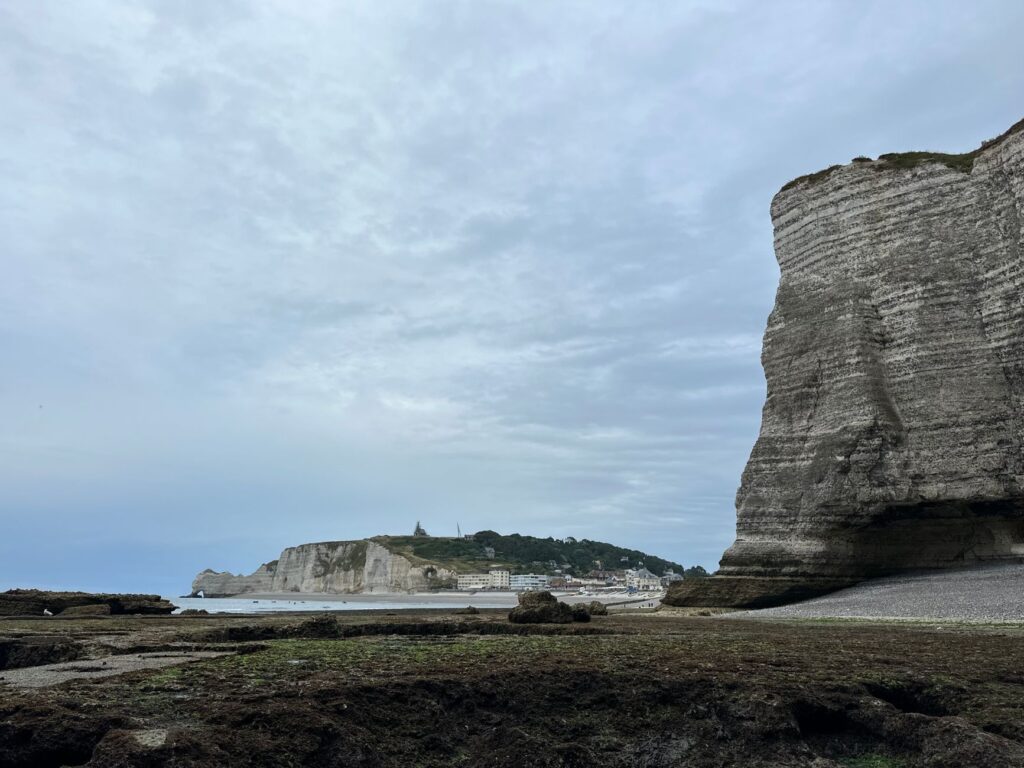
Pedaling along this upper stretch means advancing along the edge of the abyss, with the emptiness of the sea dropping abruptly to the left and hardwood forests shielding the road to the right. In Varengeville, a mandatory stop is the marine cemetery perched on the cliffside, where Braque’s remains rest beside a small sandstone and flint church. The silence is broken only by the cries of gulls and the dull echo of waves crashing against the rock base hundreds of feet below.
Water and Stone Architecture in the Pays de Caux
Leaving the coast temporarily, the route turns inland across the Pays de Caux, an agricultural plateau characterized by its vast open fields and traditional walled farmsteads known as censes. Here, rural architecture responds to a logic of survival against oceanic winds: timber-framed houses, brickwork and carefully trimmed thatched roofs clustered around central courtyards.
The rolling terrain demands consistent pedaling, but the effort is rewarded when passing through small hamlets where time seems to have stopped. Agricultural sheds store the seasonal harvest, and wild blackberries and apple trees hang over the shoulders of secondary roads. It is a utilitarian landscape of undeniable beauty, where every element serves both an economic and aesthetic function.

The Midday Ritual: Markets and Local Larder
Around midday, the journey pauses to intersect with village life. In towns like Saint-Valery-en-Caux or Fécamp — though the latter requires a slight coastal detour — local markets display Normandy’s gastronomic wealth. Market stalls overflow with protected designation of origin cheeses: the creamy Camembert, the pungent Pont-l’Évêque and the delicate Livarot, each bearing its own distinct character and monastic origin.
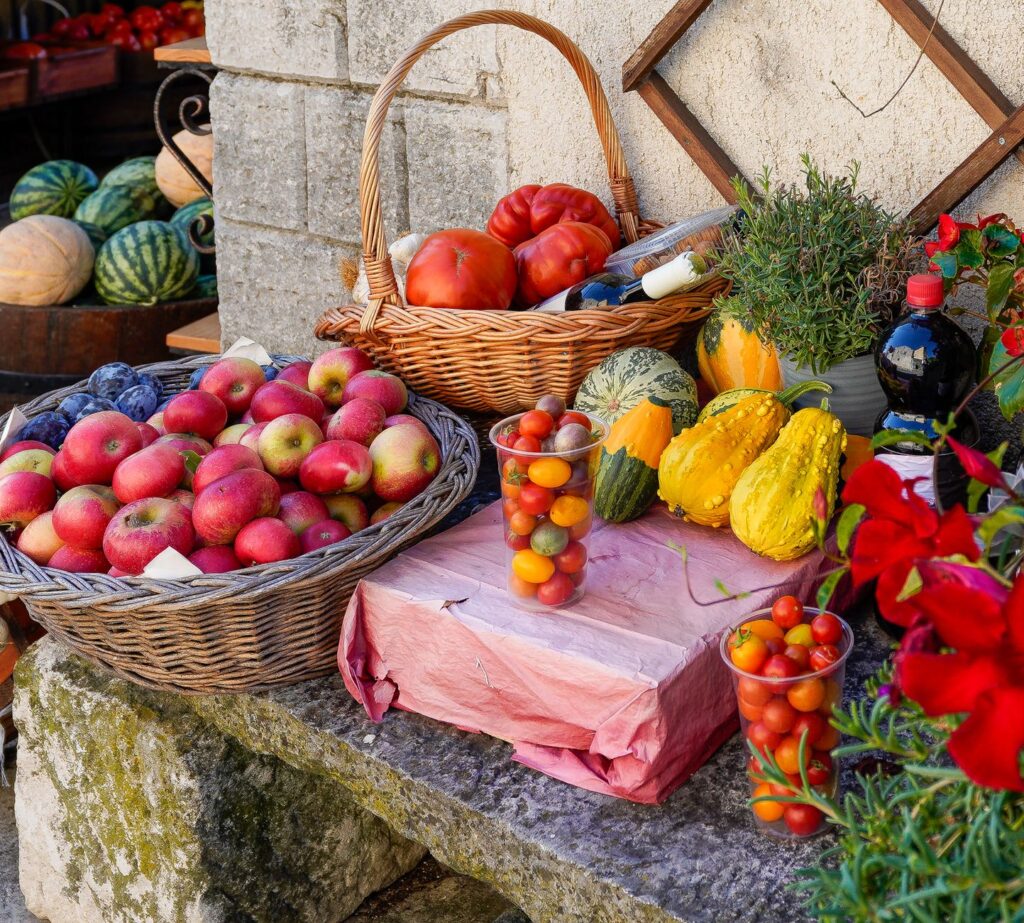
For the cyclist, these markets represent much more than mere provisioning; they are a lesson in human geography. Conversing with local producers reveals how oceanic climates and clay soils impart an unmistakable richness to dairy products. A crusty baguette, a wedge of aged cheese and fresh apples are enough to assemble an impromptu feast in the village square beside the stone fountain.
The Cider Route: From Apple to Oak Barrel
As the route pushes westward, crossing the Seine estuary, the landscape shifts subtly to reveal the Pays d’Auge, the undisputed heart of Norman fruit cultivation. In autumn, orchards burst into intense reds and yellows, heavy with small, tart apples destined for cider and calvados production. This area features dedicated cycling routes winding among centuries-old estates.
Stopping at an artisan distillery like those dotting Cambremer is an essential experience. There, master cellarmen explain the complex process of natural fermentation and subsequent distillation in copper stills. True controlled-appellation calvados requires years of aging in oak barrels before achieving its characteristic amber hue and deep aroma of baked apple and spices. A moderate tasting, approached with the caution of someone who must still keep pedaling, reveals the patience and rigor demanded by this age-old tradition.
The Memory in Stone: Lisieux and Past Vestiges
Before tackling the final stretch toward Bayeux, the path passes near Lisieux, a major pilgrimage center and a city marked by architectural contrasts. Although much of the historic center was destroyed during World War II bombings, the imposing Basilica of Saint Thérèse dominates the urban skyline, recalling the region’s intense religious devotion.

For the bicycle traveler, the outskirts of Lisieux offer a natural respite via greenways built along former railway lines. These paths dedicated to non-motorized mobility allow for safe progression, surrounded by leafy tunnels formed by deciduous trees that drop a crisp carpet under the wheels in autumn. It is an ideal transition segment before entering the theaters of modern history.
Arrival in Bayeux: Tapestries and Resistance
The journey concludes in Bayeux, the first major French city to be liberated in the summer of 1944 and one of the few to preserve its intact medieval heritage after the fighting. Entering by bicycle through cobblestone streets flanked by limestone townhouses and crossed by the Aure River offers a long-deserved sense of arrival.
Bayeux is universally famous for its 11th-century tapestry, a masterpiece of Romanesque art recounting the Norman conquest of England across seventy meters of embroidered linen. Yet exploring the city on foot once the bicycle is stowed reveals its Gothic cathedral and the British war cemetery, a sober and respectful reminder of the human costs of freedom in this corner of Europe.

Practical guide
- Best time to visit: September and October offer stable temperatures, lower tourist crowds and the visual spectacle of autumn in the apple orchards.
- Logistics and transport: French regional trains (SNCF) allow bicycles to be transported without disassembly on most lines connecting Paris to Dieppe and Caen-Bayeux.
- Bicycle type: A gravel or touring bike with medium-width tires is recommended, as the route combines secondary asphalt, paved farm lanes and occasional packed gravel sections.
- Accommodation: The region features numerous properties certified with the Accueil Vélo label, guaranteeing secure bicycle storage and basic repair tools.
- Weather: Norman weather is notoriously changeable in autumn; waterproof technical gear and modular layers are essential.
The Echo of the Journey in Memory
At the end of the journey, when panniers are unpacked in the quiet of a Norman inn and legs register accumulated miles, there remains the certainty that bicycle travel possesses a unique dimension. It is not merely about distance covered or monuments visited, but about the cadence imposed by physical effort, which allows one to synchronize personal heartbeats with the slow pulse of the land. Normandy in autumn does not announce itself with grand fanfare; it reveals itself slowly, in morning mist rising over meadows, in the quiet kindness of its inhabitants, and in the lingering taste of an apple ripened beneath the gray skies of the English Channel.
Cycling in Normandy is not a means of rapid transportation, but a precision tool for measuring time on a human scale and uncovering secrets that the motorized traveler misses entirely.
Source in EN: The New York Times (https://www.nytimes.com/2026/09/11/travel/biking-france-normandy-dieppe-bayeux.html)