
The dust that shelters empires
Arriving at the outskirts of ancient Babylon requires crossing a Mesopotamian plain where the horizon seems to dissolve into a haze of heat and mineral dust. About eighty miles south of Baghdad, the course of the Euphrates meanders like a green scar amidst the aridity, marking the territory that once harbored one of antiquity’s most dazzling metropolises. Today, the traveler finds neither the hanging gardens nor the colossal walls described by Greek chroniclers, but rather a vast expanse of baked clay mounds, bricks stamped with the seal of Nebuchadnezzar II, and a dense silence that contrasts sharply with the memory of its bustling imperial past.
Contemporary visitation to this archaeological enclave, inscribed as a UNESCO World Heritage site in 2019 following decades of neglect and looting, presents a unique challenge for the informed traveler. This is not a western-style musealized site, but rather a permanent historical landscape in active reconstruction where archaeological labor intertwines with the traces of twentieth-century interventions. The main access opens through a military checkpoint and a modest visitor center, from which the trek toward the heart of the ancient Neo-Babylonian capital begins.
The last standing palace
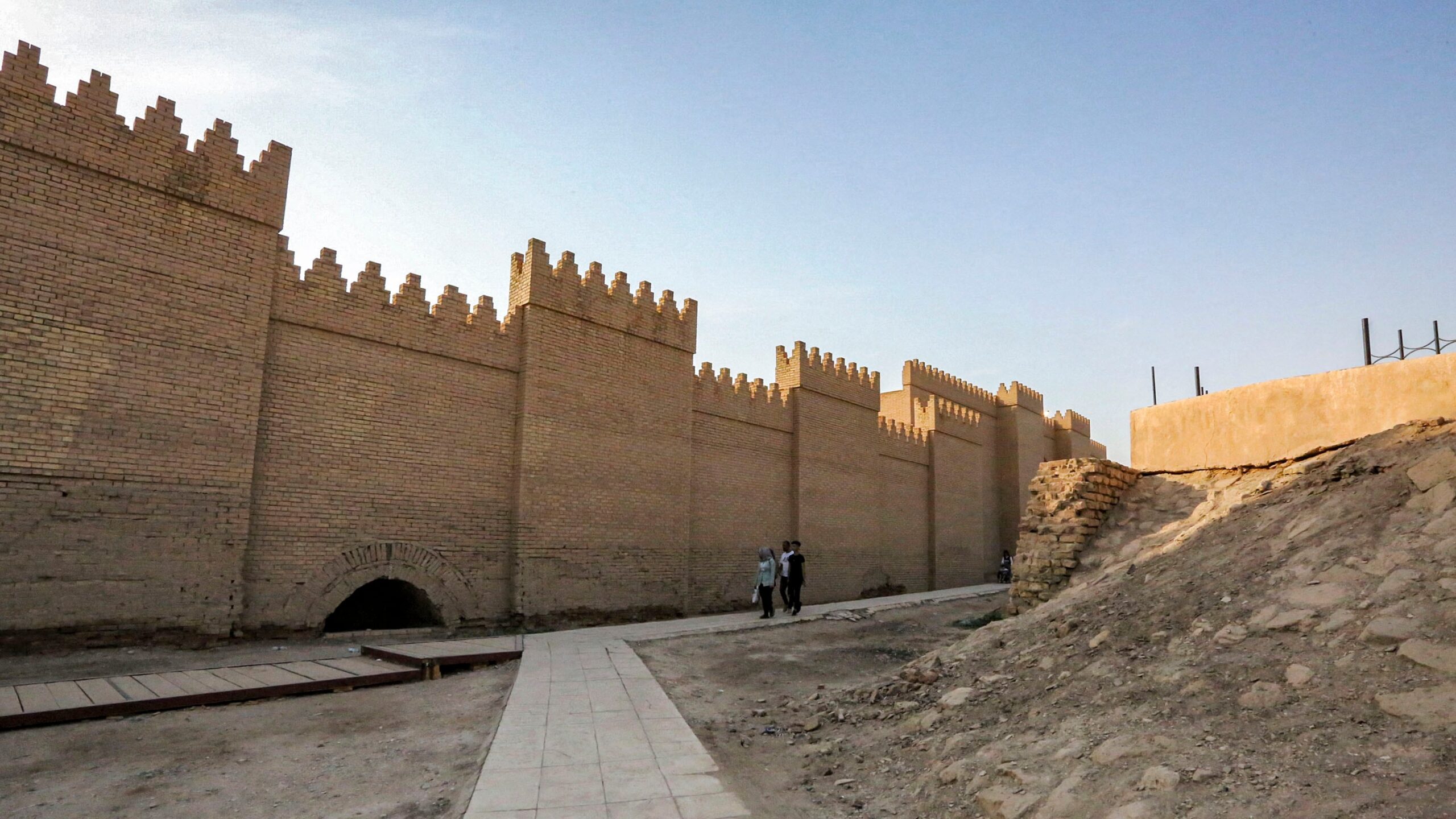
The most tangible element surviving at the site is known as the Southern Palace of Nebuchadnezzar II, a monumental structure of mudbrick and fired brick that stands like a solitary titan against the harsh Iraqi climate. Walking through its inner courtyards and vaulted corridors, the visitor experiences an immediate sense of scale: walls reach considerable heights and original pavements retain cuneiform inscriptions commemorating the monarch’s devotion to the deities Marduk and Nabu. Although much of the pictorial decoration and the famous glazed brick reliefs were removed in the early twentieth century to be reassembled in Berlin’s Pergamon Museum, the architecture retains a severe dignity.
Specialists working on-site point out that conserving this palace represents a titanic challenge due to soil salinity and groundwater seepage, exacerbated by decades of military usage during recent conflicts. Every recovered brick functions as an epigraphic document that local and international teams attempt to stabilize using chemical and physical consolidation techniques. Shoring and bracing works are visible across various flanks of the building, reminding the visitor that archaeology in Iraq is a daily act of cultural resistance.
The shadow of the lions and the myth of the gate
One of the focal points of the tour is the partial reconstruction of the renowned Ishtar Gate, whose original layout was excavated by Robert Koldewey in the early twentieth century. Although the complete original resides in Germany, the archaeological site features brick recreations that convey the imposing volume of the fortification through which New Year ritual processions once marched. A few meters away, sculpted from black basalt stone with a coarse yet striking craftsmanship, stands the famous statue of the Lion of Babylon, trampling a human enemy.
This artifact, which has miraculously survived massive destructions over the centuries, constitutes one of the few original freestanding sculptures remaining in its original context within the site. Local guides frequently pause before it to explain the symbolism of royal might and divine protection. Direct contemplation of the carved stone offers a tactile connection with ancient artisans, vastly different from the aseptic experience of viewing a work behind a European museum vitrine.
The scar of the recent past
The landscape of Babylon is unavoidably traversed by the marks of contemporary history. During Saddam Hussein’s regime, the site underwent monumental interventions that included the construction of a new presidential palace atop an adjacent artificial hill, mimicking Babylonian architectural canons with modern materials and concrete. Furthermore, the subsequent military occupation installed a logistic base in the immediate surroundings, causing considerable damage to surface archaeological strata and leaving containers and trenches whose traces remain visible on the complex’s periphery.
Today, this contemporary presidential palace functions as an interpretive center undergoing habilitation, while Iraq’s heritage authorities debate its integration into the broader tourism narrative. For the inquisitive traveler, this additional layer is fascinating: it demonstrates how the myth of Babylon has been instrumentalized by political powers across millennia. The superposition of historical strata—from Neo-Babylonian kings to the modern era—turns the site into an urban palimpsest of immeasurable sociological value.
Birs Nimrud: the enigma of Borsippa
About eighteen miles southwest of Babylon, emerging from agricultural fields like a broken tooth against the sky, stands the impressive mound of Birs Nimrud, which identifies the remains of ancient Borsippa and its celebrated temple dedicated to Nabu, the E-zida. The great ruined tower, crowned by a fragment of brick wall vitrified by ancient lightning or fires, is frequently mistaken by local visitors and romantic travelers for the remnants of the mythical Tower of Babel described in biblical texts.
Ascending the slopes of this monument offers an extraordinary panoramic view of the Mesopotamian countryside and allows one to appreciate the monumental construction effort of the Babylonians. Unlike the main site of Babylon, Birs Nimrud receives a much lower flow of visitors, imparting a deeply contemplative character to the experience. Archaeological excavations have demonstrated that the original ziggurat was rebuilt on multiple occasions, achieving remarkable geometrical sophistication still visible in the eroded profiles of its terraces.
The pulse of modern archaeology
The future of Babylon and its surrounding enclaves depends on the capacity of the Iraqi state, in collaboration with international scientific missions—especially from European and North American institutions—to equip the site with sustainable protection and research infrastructure. Over the past decade, drainage systems have been improved and buffer zones demarcated to prevent the expansion of informal urban settlements encroaching upon the historic walls.
Nevertheless, budgetary and security challenges remain latent in the region. Experts insist that the current priority is not massive monument reconstruction, which is discouraged by international conservation canons, but rather preventive preservation, systematic cataloging of thousands of fragmentary tablets, and training local specialists in heritage management. Scientific rigor currently prevails over the temptation of spectacle, ensuring future generations can continue deciphering the secrets of the Fertile Crescent.
Practical guide
How to get there: The main access to Babylon is by road from Baghdad in a journey of approximately one and a half hours. Hiring a private vehicle with a local driver is essential, and in many cases, prior authorization from Iraq’s Ministry of Culture and Tourism or coordination through an authorized incoming agency in Baghdad is required.
When to go: The optimal months to visit the region span from November to March, when daytime temperatures are moderate (between 15°C and 25°C). The Mesopotamian summer must be strictly avoided, as thermometers regularly exceed 50°C in the shade.
Accommodation: There are no mid-range or luxury hotel infrastructures in the immediate vicinity of Babylon or Hilla. The most sensible logistical base is the city of Baghdad, which features a consolidated international hotel offer and secure transport services for day excursions.
Entry requirements and security: A visa is required to enter Iraq, which in many cases can be processed upon arrival for certain nationalities or through prior consular visas. Staying informed about updated travel advisories from foreign ministries and traveling accompanied by accredited guides is fundamental.
Local tips: Dressing modestly and respectfully toward local customs is advised, along with wearing closed shoes suitable for walking on dusty and uneven terrain, and stocking up on sufficient drinking water before leaving major urban centers.
The eternal echo of the Euphrates
At dusk, when the golden desert light bathes the clay mounds and the silhouette of the Southern Palace casts long shadows across the plain, Babylon briefly reclaims the gravity of its legend. There are no tourist stridences or large crowds in this Mesopotamian refuge, only the constant whisper of wind among salt bushes and the unalterable course of the river that witnessed the birth of writing, the first codified laws, and systematic astronomy. Walking among these ancient bricks serves as a reminder that the greatest human civilizations are ultimately fragile constructions of mud destined to merge once more with the earth.
Source: El Viajero in EL PAÍS (https://elpais.com/elviajero/2026-09-01/asi-es-visitar-hoy-la-mitica-babilonia.html)


