
When the Bergensbanen convoy departs from the rationalist architecture of Oslo Central Station, few passengers are aware that they are about to enter an ecosystem of technical endurance. What begins as a placid journey through the fertile valleys of eastern Norway transforms, in just three hours, into a frontal struggle against the most hostile geography in Northern Europe. It is not merely a means of transport; it is the vital artery that, since 1909, has allowed the Scandinavian kingdom to function as an economic and social unit, overcoming the insurmountable barrier of the Scandinavian Alps.
This report breaks down the operational complexity of a line that reaches 1,222 meters in altitude at Finse, a point where asphalt does not exist and where the train is the only connection to civilization. Spanning 496 kilometers and 182 tunnels, the Bergen Line represents the triumph of human perseverance over permafrost and the blizzards that, historically, kept Norway’s two main cities isolated for more than half the year.
The Genesis of a Geological and Political Challenge
In the late 19th century, Norway faced a dilemma of identity and logistics. Bergen, the commercial capital of the west and gateway to the fjords, was more connected by sea to Newcastle or Hamburg than to its own administrative capital, Oslo (then called Christiania). Building a transmontane railway was not just a commercial necessity, but a nationalist imperative to unify a country fractured by granite massifs and millenary glaciers.

The decision to lay the track across the Hardangervidda plateau was met with technical skepticism. Engineers of the time had to face an altitude where snow does not retreat until well into July and where temperatures can plummet below -30 degrees Celsius. The construction, which lasted 34 years, required the manual labor of thousands of workers known as rallares, who bored tunnels through solid rock using dynamite and brute force, living in isolated camps that are now part of Norwegian industrial mythology.
«The Bergensbanen was not built for tourists, but to prove that Norwegian granite could be tamed by the will of a people seeking their place in modernity.»
The result was an engineering masterpiece that reduced a journey of several days by boat or weeks by horse to a mere seven-hour day. Today, that same infrastructure, though modernized with digital signaling systems and high-resistance catenaries, continues to operate on the same heroic route, maintaining its operational pulse against a nature that has never stopped reclaiming its territory.
Finse: The Epicenter of Operational Isolation
The most critical point of the route is undoubtedly Finse station. Located at 1,222 meters above sea level, it is the highest railway station in the Norwegian network and possesses a unique characteristic on the continent: there are no roads leading to it. In winter, the only access is the train; in summer, the Rallarvegen cycling route—the former service road for the builders—is added.
Operating a station in these conditions requires military-precision logistics. Finse is not just a stop for hikers or scientists studying the nearby Hardangerjøkulen glacier; it is the logistical hub for track maintenance in the high mountain sector. High-power rotary snowplows are stationed here, capable of clearing meters of accumulated snow in minutes to prevent the transcontinental corridor from being blocked.

The strategic importance of Finse is such that, during World War II, it was a site for climate testing, and decades later, its lunar landscape served to recreate the ice planet Hoth in the Star Wars saga. However, for the drivers of the state-owned company Vy, Finse represents the stretch of maximum concentration, where braking systems and traction must respond with absolute reliability to the ice sheets that form on the rails.
Engineering Against Winter: The Protection Tunnels
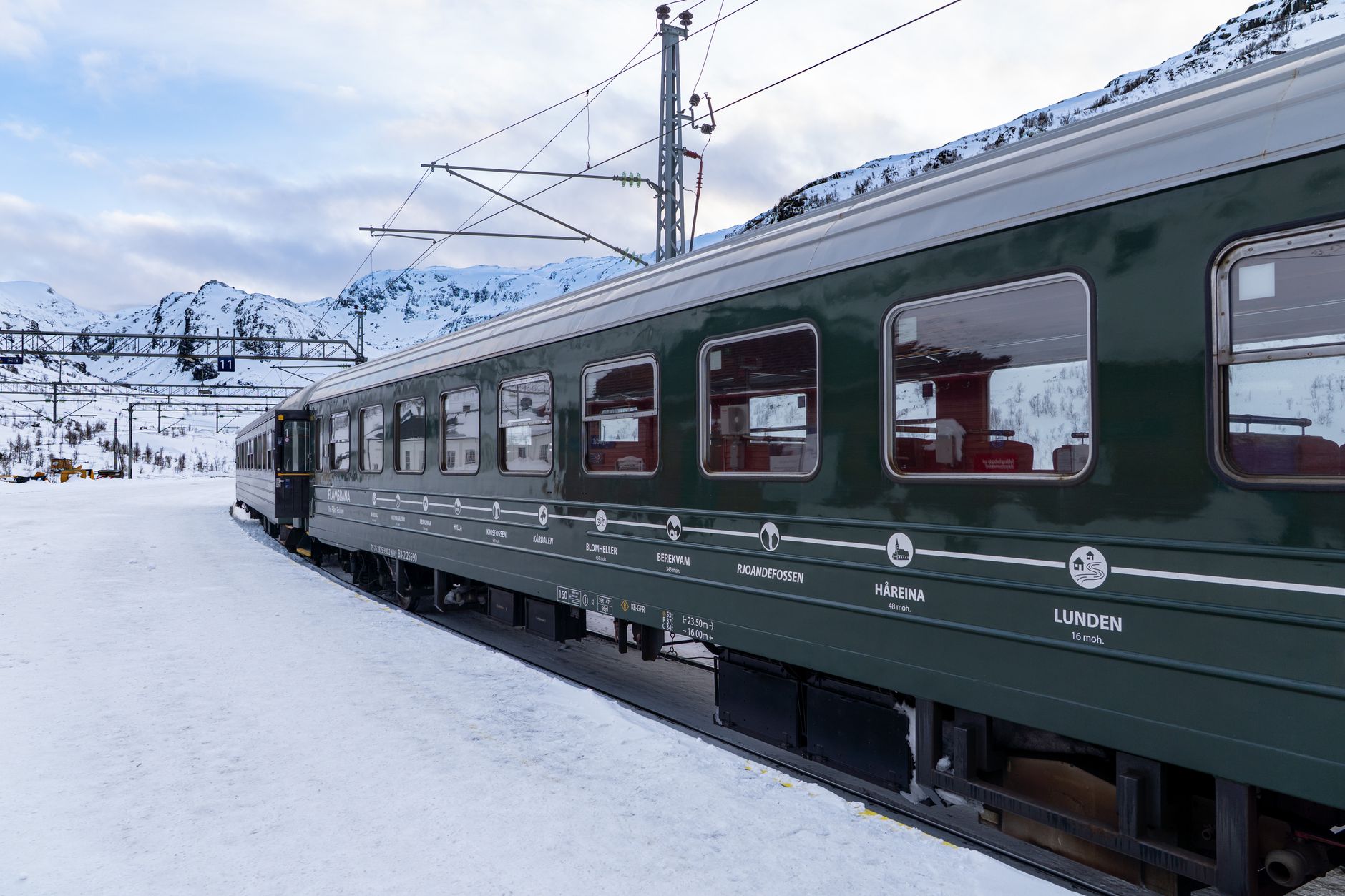
One of the most distinctive visual elements of the Bergensbanen are the snow sheds and tunnels made of wood or steel that cover open sections of the track. These structures, known as snøoverbygg, act as shields against avalanches and wind-driven snow accumulation. Without them, the line would be impassable for eight months of the year.
Over the decades, engineering has evolved to minimize the impact of the climate. The most recent and significant milestone was the opening of the Finse Tunnel in 1993. Spanning 10.3 kilometers, this tunnel eliminated the most exposed section of the line, allowing trains to run sheltered from the plateau’s worst storms. Although this work drastically improved punctuality and safety, purists lament that the train no longer reaches the original maximum elevation of 1,301 meters at Fagernut, now bypassed by the tunnel.
- Thermal Resistance: Convoys are equipped with redundant heating systems and triple-layered glass to withstand the thermal differential.
- Traction Systems: The El18 locomotives, pillars of the fleet, feature slip control systems that optimize grip on steep gradients.
- Preventive Maintenance: Inspection teams patrol the track daily to detect micro-cracks caused by metal contraction in extreme cold.
The Human Factor: Life on Board and on the Tracks
Behind the technology, the human factor remains the soul of the Bergensbanen. Conductors and cafeteria staff are not just service employees, but managers of an ephemeral community crossing the white desert. In the winter months, when the exterior landscape is reduced to absolute whiteness and the wind howls against the carriages, the interior of the train becomes a warm refuge, a microcosm of light wood and the smell of coffee and cinnamon buns (skoleboller).
For the inhabitants of intermediate villages like Geilo, Ustaoset, or Myrdal, the train is their umbilical cord. It is the transport that takes children to school, supplies mountain hotels with food, and makes the ski tourism industry viable. Norwegians’ relationship with this train is one of almost blind trust; it is the infrastructure that never fails, the iron giant that breaks through when airports close due to zero visibility.
«Crossing Hardangervidda in the middle of January is a reminder that civilization is a fragile agreement we maintain thanks to machines designed with respect for the mountain.»
Maintenance personnel, meanwhile, work in constant surveillance shifts. On stormy nights, when sensors detect excessive snow accumulation, rotary snowplows emerge from their hangars. Watching these machines in action, throwing columns of snow thirty meters away under the glare of spotlights, is to witness an industrial ballet of brute force and necessary precision.

The Myrdal-Flåm Connection: The Vertical Branch
One cannot analyze the Bergensbanen without mentioning its most famous branch: the Flåmsbana. At Myrdal station, at an altitude of 866 meters, many passengers disembark to experience one of the steepest railway descents in the world. This secondary line drops to sea level at the Aurlandsfjord in just 20 kilometers, with a gradient of 5.5% for much of its route.
Although it is one of Norway’s top tourist attractions today, its original purpose was purely logistical: connecting the high-mountain line with fjord maritime transport. The engineering of the Flåmsbana is so complex that it requires five independent braking systems, each capable of stopping the train on its own in an emergency. It is the perfect complement to the Bergensbanen, showcasing a different facet of Norwegian engineering: the ability to overcome impossible vertical drops.
Sustainability and the Future of Arctic Mobility
Norway leads the transition toward decarbonized mobility, and the Bergensbanen is a fundamental pillar of this strategy. The entire line is electrified, using hydroelectric power generated in the very mountains the train crosses. This makes the journey between Oslo and Bergen one of the long-distance routes with the lowest carbon footprint per passenger in the world.
The future of the line involves double-tracking the most congested sections near the cities and implementing the ERTMS (European Rail Traffic Management System), which will allow for more fluid and secure traffic management. However, the greatest challenge remains climate change. Paradoxically, rising global temperatures are causing wetter, heavier snowfall and an increase in the risk of landslides, requiring constant investment in slope stabilization and drainage modernization.

Practical Guide for the Bergensbanen Traveler
For those wishing to experience this journey, planning is essential, especially due to high demand and seasonal variations.
- Booking Tickets: It is recommended to use the official Vy app. «Minipris» tickets offer reduced fares if purchased weeks in advance.
- Seat Selection: Traveling from Oslo to Bergen, the best fjord landscapes at the end of the journey are better appreciated from the left side of the train, while the vastness of the plateau is spectacular from both sides.
- Luggage and Services: The train features a full cafeteria car and specific family areas (familievogn) with play zones, ideal for a 7-hour journey.
- Recommended Stops: Finse is mandatory for hiking or history enthusiasts. Geilo is the entry point for winter sports. Myrdal is the junction for the Flåmsbana.
- Season: Winter (January-March) offers the most dramatic and pure experience of the snowy plateau. Autumn (September-October) paints the valleys in ochre tones before the first snowfall.
The Echo of Iron Over the Silence of the Plateau
As it approaches Bergen, the landscape changes abruptly. The infinite white of Hardangervidda gives way to the lush green of the western valleys, to waterfalls plunging toward the sea, and finally, to the salty air of the Atlantic coast. The descent is a visual release after the white claustrophobia of the high mountains.
The Bergensbanen is, ultimately, a reminder that time is not measured the same everywhere. In the heart of Norway, time is dictated by the snow and the ability of an iron machine to keep moving forward despite everything. Stepping off the train at the Bergen terminal, under the wooden roof of its historic station, the traveler has not just crossed a country; they have witnessed the permanent truce that technology has signed with winter, a pact renewed every time the train’s whistle breaks the absolute silence of the roof of Europe.