


Introduction to the Tagus Fluvial Corridor
The territory crossed by the middle basin of the Tagus River as it winds through quartzite gorges represents one of the most fascinating testimonies of railway engineering applied to demanding Iberian topography. Far from high-speed routes that prioritize blind tunnels and aseptic viaducts over the landscape, the historic alignment meanders by adapting millimetrically to the terrain. This layout not only marked a technical milestone in the nineteenth century but completely reshaped connectivity and economic vitality in regions historically isolated by natural walls of rock.
Analyzing this corridor requires understanding the underlying geology. The Armorican quartzite folds, sculpted over millions of years by fluvial erosion, forced engineers to devise complex topographic solutions: manually excavated trenches, small lattice metal bridges, and embankments consolidated over alluvial deposits. Today, boarding this regional train is equivalent to performing an exercise in industrial archaeology in motion, where each curve reveals the relentless tension between the unyielding force of water and the tenacity of iron.
The Topography of Stone and the Railway Alignment
The construction of the railway line along the Tagus demanded a titanic deployment of labor and technical resources at a time when dynamite and steam were beginning to transform the landscape. Engineers had to trace the grade line while respecting the contour lines of the river canyon, minimizing maximum slopes to allow heavy coal locomotives to climb the valley without losing traction. The result is a track that seems to merge with the geological substrate, utilizing the exact same materials that surround it.
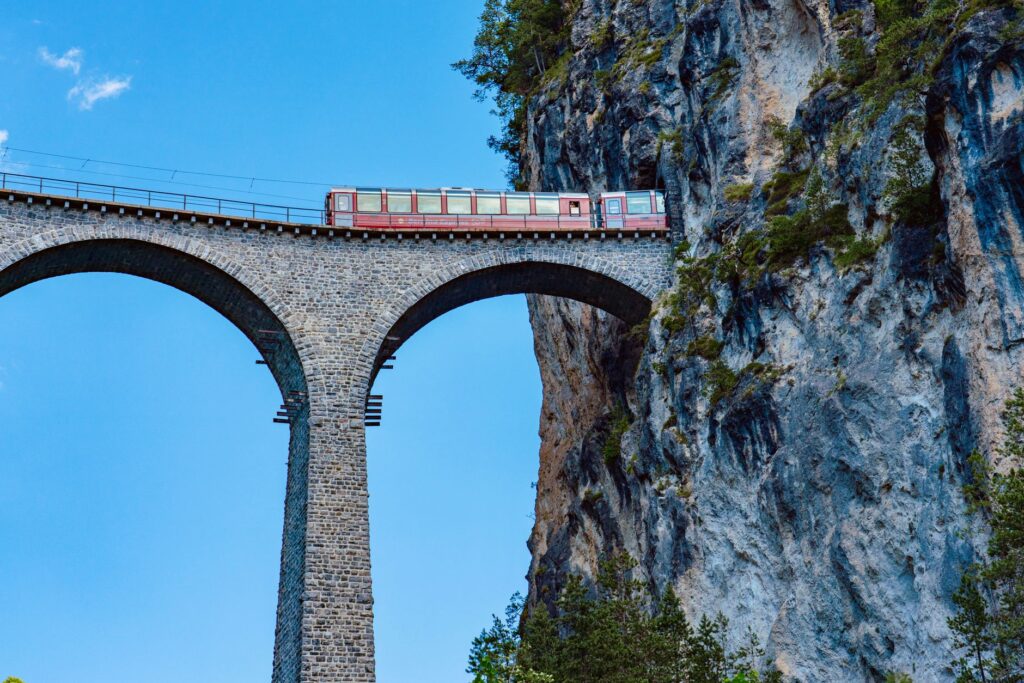
The cuts in the live rock reveal the different stratifications of quartzite and schist, forming vertical walls that act as corridors of shadow during the central hours of the day. In these sections, the rattle of wheels over rail joints acquires a particular metallic resonance, amplified by the echo of the canyon. The infrastructure is not an alien element to the environment; on the contrary, the dry-stone masonry walls supporting the ballast are already colonized by riparian vegetation and century-old lichens.
Historic Bridges and the Conquest of Abysses
One of the most prominent features of this route is the crossing structures that span tributaries and the tightest bends of the main river. Conceived under the canons of nineteenth-century civil engineering schools, these bridges combine granite ashlar abutments with modular metal decks. Current maintenance requires meticulous inspections to ensure structural integrity against material fatigue and the extreme thermal oscillations of the continental climate.

Crossing one of these viaducts offers a privileged perspective over the riverbed, where water often flows boxed between rapids and deep pools. The mathematical precision with which the loads and spans of the arches were calculated demonstrates the mastery that period designers possessed over material strength, achieving lightweight yet indestructible structures that remain operational a century and a half after their inauguration.
Life in Stone Stations and Forgotten Halts
The rhythm of the journey is marked by stops at small intermediate stations, most built with standardized architectural typologies combining exposed brick with gabled ceramic tile roofs. Although many of these facilities have lost their original freight handling or traffic-crossing functions and now operate as automated flag stops, they retain an atmosphere of timelessness highly valued by travelers seeking escape from the saturation of major logistical hubs.
Around these railway enclosures, small population nuclei historically emerged, tied to track maintenance—cantonero huts where families lived in isolation guarding specific rail segments. The figure of the track-walker, responsible for checking the tightness of fastening bolts and clearing potential rockfalls after winter storms, represents the fundamental human link that ensured the safety of a technical system so vulnerable to weather and geology.

The riverside train is not a mere means of transport, but a privileged observatory on geological slowness and the memory of water.
Today, automation has displaced ground personnel, but station architecture remains as tangible testimony to an era when the railway organized the territory in a capillary fashion. Stopping at these silent platforms allows us to gauge the human scale against the vastness of the surrounding landscape, a contrast that defines the experience of traveling along the peninsula’s secondary lines.
Environmental Impact and the Metamorphosis of the Riparian Landscape
The relationship between the railway infrastructure and the Tagus fluvial ecosystem has evolved significantly since its inception. While in the nineteenth century the works caused a significant alteration of the riverbed and slopes due to massive earthworks, over the decades the environment has rebalanced itself. Railway cuttings now act as secondary ecological corridors, where cliff-dwelling bird species and medium-sized mammals find refuge thanks to the absence of direct human pressure within the safety strip of the tracks.

On the other hand, modern management of the railway corridor requires a delicate balance between operational safety—which demands periodic clearing of invasive vegetation to prevent branches from falling onto the catenary or tracks—and the conservation of riparian biodiversity. Environmental technicians work closely with infrastructure maintenance teams to schedule cleaning operations outside the critical nesting periods of protected species inhabiting the rocky cliffs.
The Contemporary Traveler’s Experience and Deceleration
In a mobility landscape dominated by urgency and the drastic reduction of travel times, this railway line offers a radical counterpoint: the right to slowness. Sitting by the window, watching the leisurely movement of olive groves and quartzite walls, and observing how the light shifts across the river surface as the afternoon progresses constitutes a first-order aesthetic experience. It is a form of tourism that prioritizes territorial immersion over the mere overcoming of distances.
Users of this route are typically experienced travelers, hikers seeking access to Long-Distance trails running parallel to the river, and locals maintaining an emotional bond with the train in contrast to generalized road transport. The coexistence of these profiles inside the carriages generates a calm social dynamic, where the silence of the journey is only interrupted by the murmur of conversations and the steady clatter of the bogie over the ties.

Practical guide
Planning a journey along this railway corridor requires understanding regional train timetables and the operational peculiarities of a conventional single-track line. Below are the key aspects for organizing the journey with rigor and autonomy:
The Final Echo of the Rails in the Valley’s Dusk
When the sun begins to set behind the quartzite cliffs, the light acquires a golden hue that permeates the entire gorge, transforming the industrial and natural landscape into a tableau of overlapping silences. At that precise moment, the passage of the day’s final convoy resonates with a particular gravity, reminding us that these tracks remain the metallic veins through which the underground history of an indomitable territory flows. Shadows lengthen over the ballast, the current of the Tagus continues its slow millenary sculpting, and the traveler understands that the true essence of the journey lies in the ability to stop time through the window of a train that refuses to disappear.


