The Vertical Conquest of an Emerald Island
The whistle of the diesel locomotive departing from Kandy’s central station is not merely a departure warning; it is the acoustic prelude to one of 19th-century South Asia’s most daring engineering feats. Originally constructed by the British colonial administration to transport coveted coffee crops—and subsequently, following a devastating blight, the ubiquitous Ceylon tea—the railway line into Sri Lanka’s highlands defied the traditional topographical logic of the Eastern Ghats and the island’s central massif. Here, gradients exceed standard adhesion limits, forcing the convoy to snake over dizzying abysses and glide through mountain passes where morning mist clings to carriage windows like a second skin.
As the train abandons the humid heat of the lowlands and begins its relentless ascent toward Hatton and Nuwara Eliya, the landscape undergoes a radical metamorphosis. Palms and flooded rice paddies yield to hillsides sculpted with geometric precision, where thousands of dark-green tea bushes trace flawless contour lines. This is neither a simple suburban commuter service nor a decontextualized tourist attraction; it is the economic and social backbone uniting the cultural diversity of the Sinhalese lowlands with the historical isolation of the Tamil communities inhabiting the high valleys for generations.
The Millimetric Calculation of Iron in the Mist
The construction of this railway network, initiated in the 1860s, demanded a titanic engineering deployment. British engineers, supported by local labor gangs and immigrant workers, had to carve dark tunnels by hand through living rock and erect monumental bridges with no more technology than steam, dynamite, and human muscle. Among them stands the celebrated Demodara viaduct, a masterpiece of railway architecture characterized by its spiral loop, where the track passes beneath itself after describing a complete circle inside the mountain, allowing trains to overcome an abrupt elevation change without compromising structural stability.
Every wooden sleeper and steel bolt along this route bears not only the weight of the carriages but also the battering of tropical monsoons. During heavy rainy seasons, landslides and slope erosion pose a daily challenge for Sri Lanka Railways maintenance teams. Despite the technical obsolescence of certain segments and the calculated slowness of the formations, the system continues to operate with an almost anachronistic precision, resisting the pressures of rapid modernization and keeping alive a model of mobility where time seems suspended between carriage and carriage.
Iron and red brick do not merely connect populations; they sustain the geological and labor memory of a territory where the mountain dictates the rhythm of history.
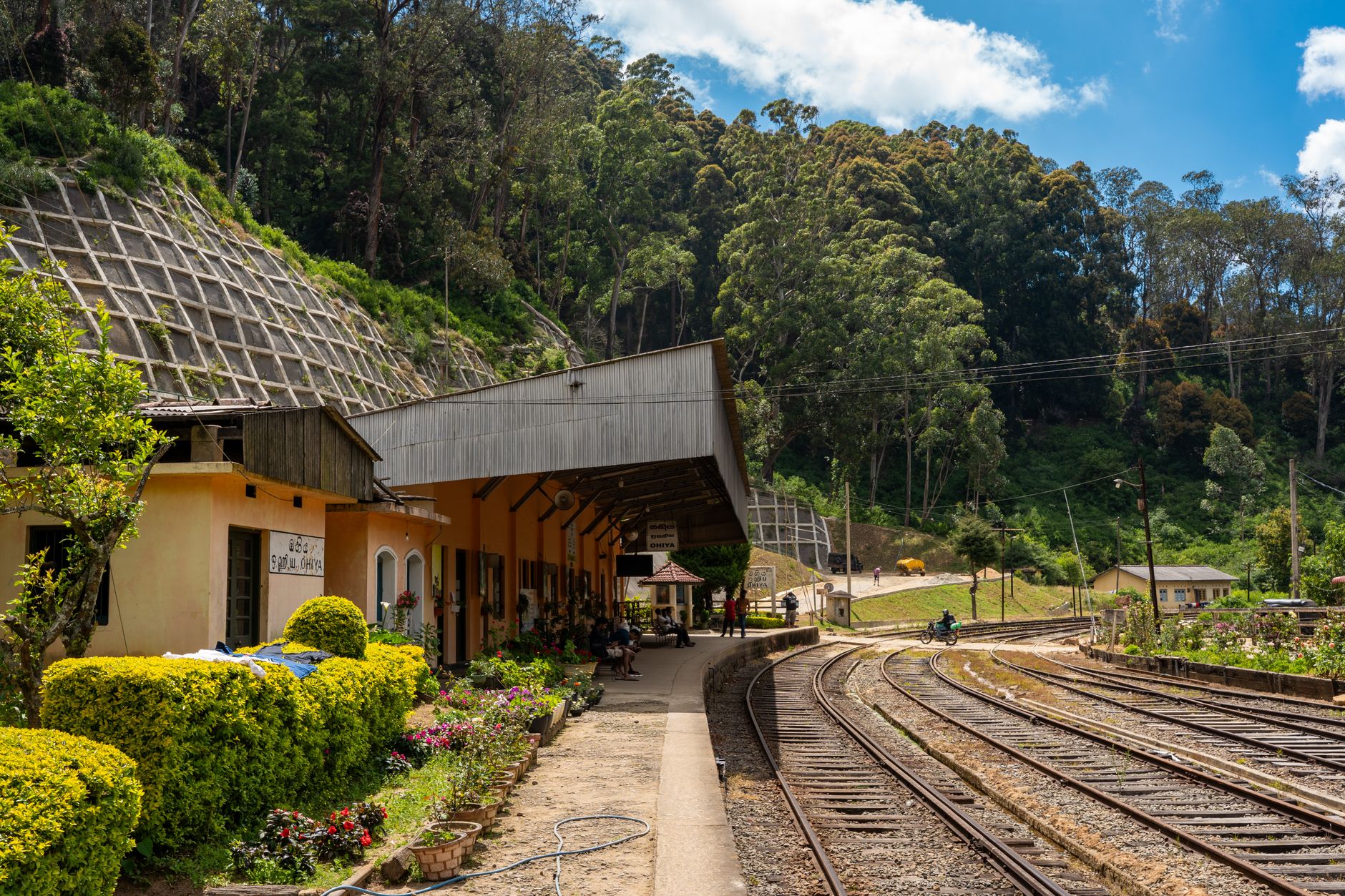
Observing the movement of trains from the natural viewpoints surrounding the Nuwara Eliya plateau reveals the magnitude of this civilizing effort. Stations retain their original Victorian aesthetic: carved timber awnings, bronze bells announcing the arrival of the convoy minutes in advance, and ticket counters where cardboard tickets are still stamped by hand. These platforms bring together international backpackers, local merchants laden with sacks of vegetables, and students making the daily commute to regional educational centers, weaving a unique social microcosm in Southeast Asia.
Life Suspended on the Threshold of Open Doors
One of the most singular characteristics of this rail journey is the permissiveness surrounding its carriage doors. On second and third-class carriages, passengers naturally lean out of the metal frames, their legs dangling over the green abyss while the convoy negotiates a tight curve. This gesture, far from being a reckless imprudence, has become the definitive symbol of freedom of movement on the subcontinent. The cool high-altitude breeze, laden with the scent of damp earth and freshly picked tea leaves, permeates the atmosphere, while the rhythmic clatter of wheels over rail joints sets an almost hypnotic cadence.
Stops at intermediate stations like Nanu Oya or Haputale reveal the human backstage of the journey. Street vendors approach carriage windows offering small newspaper parcels of warm samosas, spiced cassava crisps, and cups of strong tea loaded with condensed milk. Interactions are brief yet intense; a complicit smile, an exchange of coins, and the metallic echo of the departure bell setting the heavy machinery back into motion. Along this route, the space between seats transforms into an impromptu tearoom where cultural barriers dissolve amidst conversations about unpredictable mountain weather and international tea market prices.
Colonial Architecture and the Pulse of the Plantations
The final stretch of the route, descending toward the Ella valley flanked by towering Ella Rock and Adam’s Peak, represents the aesthetic culmination of the journey. Here, the homes of British colonial-era estate superintendents—characterized by gabled slate roofs, stone chimneys, and wide glass galleries—alternate with the modest dwellings of tea pluckers. These buildings, often converted today into boutique guesthouses or small hotels, bear witness to a past of agrarian opulence that contrasts with the harsh daily reality of the plantations.
The local economy continues to revolve around the green leaf. Four-wheel-drive trucks laden with jute sacks travel along dirt roads crossing parallel to the railway tracks, transporting the harvest to nearby processing factories, where Victorian-era wooden pulleys and iron hoppers continue to operate with surprising efficiency. This cultural landscape, repeatedly proposed for inclusion on the World Heritage list, demonstrates that transport infrastructure is not an isolated element, but rather the catalyst that shaped the demographics and economy of the entire region.
Traveling through the heights of Ceylon requires relinquishing contemporary haste; here, the destination matters less than the changing texture of the landscape unfolding beyond the window.
Maintaining these facilities requires a delicate balance between heritage preservation and the safety demands of modern transport. Although more efficient locomotives have been introduced and the partial electrification of some main branches is debated, local engineers insist on protecting the original layout, whose turning radii and masonry structures remain irreplaceable due to the extreme geometric complexity of the mountainous terrain.
Practical guide
How to get there: The main starting point for the mountain line is Kandy station, accessible via regional trains from Colombo Fort or by private vehicle via road. The total duration of the full journey to Ella ranges between 6 and 7 hours, depending on operational conditions.
Tickets and reservations: Seats in first class (observation salon) and reserved second class must be purchased weeks or months in advance through the official Sri Lanka Railways website or authorized agencies. However, unreserved second and third-class tickets are sold directly at station ticket counters on the day of travel, offering greater flexibility at the cost of standing or searching for seats in less congested sections.
Best time to visit: January to May brings the most stable and dry months in the central region, ideal for enjoying clear landscape views. The monsoon months (June to September and October to December) increase the risk of delays due to dense fog and minor landslides, though they impart an exceptional mystical character to the landscape.
Logistical tips: Always bring light winter clothing or a windbreaker jacket, as temperatures drop drastically once the train exceeds 1,800 meters of altitude in Nuwara Eliya. Protect electronic devices from ambient humidity and maintain extreme caution if you choose to lean out of the doors while the convoy is in motion.
The Faint Echo of the Last Whistle at Ella Station
When the convoy finally brakes to a halt at Ella’s modest and bustling station, golden afternoon light begins filtering through the eucalyptus canopy and the surrounding precipices. The chatter of travelers disembarking with backpacks and cameras contrasts with the stony serenity of the mountains that have guarded the valley for millennia. In that final instant, when the locomotive whistle fades and steam dissolves slowly into the cold evening air, one understands that this journey has not merely been about moving from a geographical point A to point B, but about traversing the overlapping layers of time, human endeavor, and the green memory of an island that continues to beat to the slow rhythm of iron and mist.