Geological Origins and the Challenge of Contemporary Mobility in the Caldera
The abrupt geography of Santorini, sculpted by millennia of volcanic activity and caldera collapses, has dictated the relationship between humanity and the territory for centuries. Along the steep slopes of Thira and Oia, mobility has traditionally been an exercise in physical endurance and adaptation to topography. However, the surge in mass tourism over recent decades placed immense stress on a network of traditional pathways and access routes originally designed for very modest pedestrian and animal-powered traffic. The saturation of narrow roadways and the environmental impact of internal combustion vehicles forced local authorities and transport operators to completely rethink island logistics, seeking a balance between preserving the fragile geological ecosystem and the imperative need for an efficient, clean mobility system.
Faced with this scenario of congestion, the transition toward sustainable transport models ceased to be a theoretical option and became an operational urgency. The caldera, a natural amphitheater of basalt rock and ash, acts as a sounding board where emissions and noise multiply. The introduction of electric bus fleets and the modernization of vertical infrastructure have positioned themselves as the pillars of an integrated strategy. This process aims not only to reduce the carbon footprint of the destination but also to safeguard the integrity of the cliffs against constant vibration and wear caused by heavy road traffic. The transformation of transport in Santorini thus represents a paradigmatic case study on how a highly vulnerable insular territory can redesign its connectivity without compromising its landscape identity.
The Engineering of Descent: The Evolution of the Funicular and Vertical Access
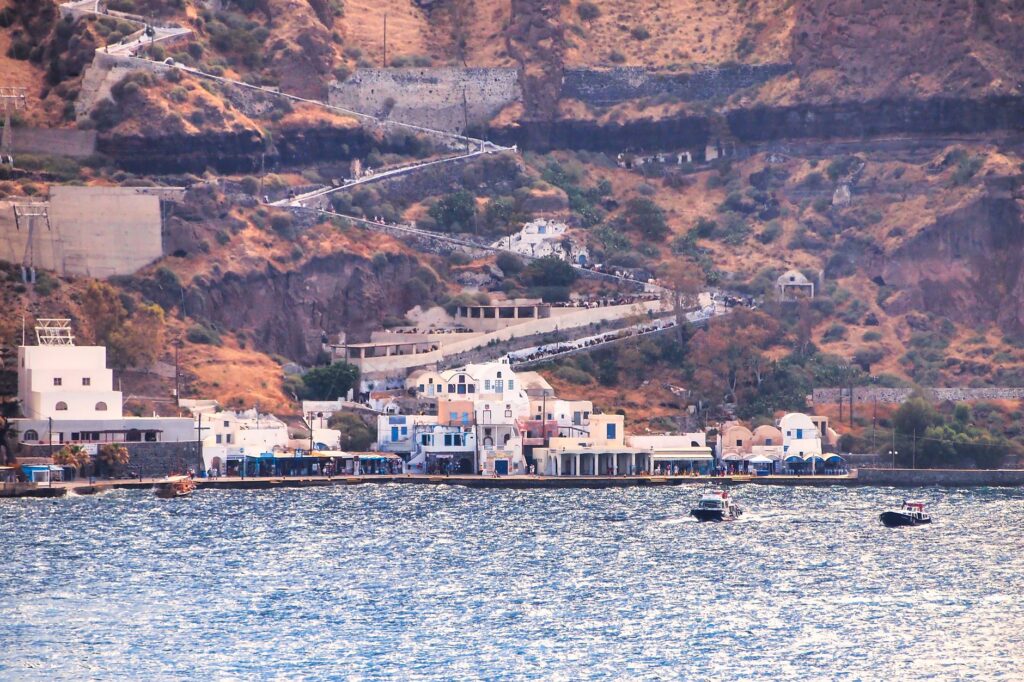
One of the most significant milestones in the reconfiguration of Santorinier transport is the modernization and expansion of the historic funicular system connecting the old port of Fira with the capital perched high on the cliffside. Originally constructed in the second latter half of the twentieth century to expedite the movement of goods and people arriving by sea, the funicular has undergone recent technological upgrades aimed at multiplying its daily passenger capacity without increasing visual impact on the volcanic rock. With carriages redesigned to optimize energy consumption and harness regenerative braking systems, this vertical infrastructure is now the backbone absorbing a large share of visitor flow, diverting them away from historic pedestrian routes.
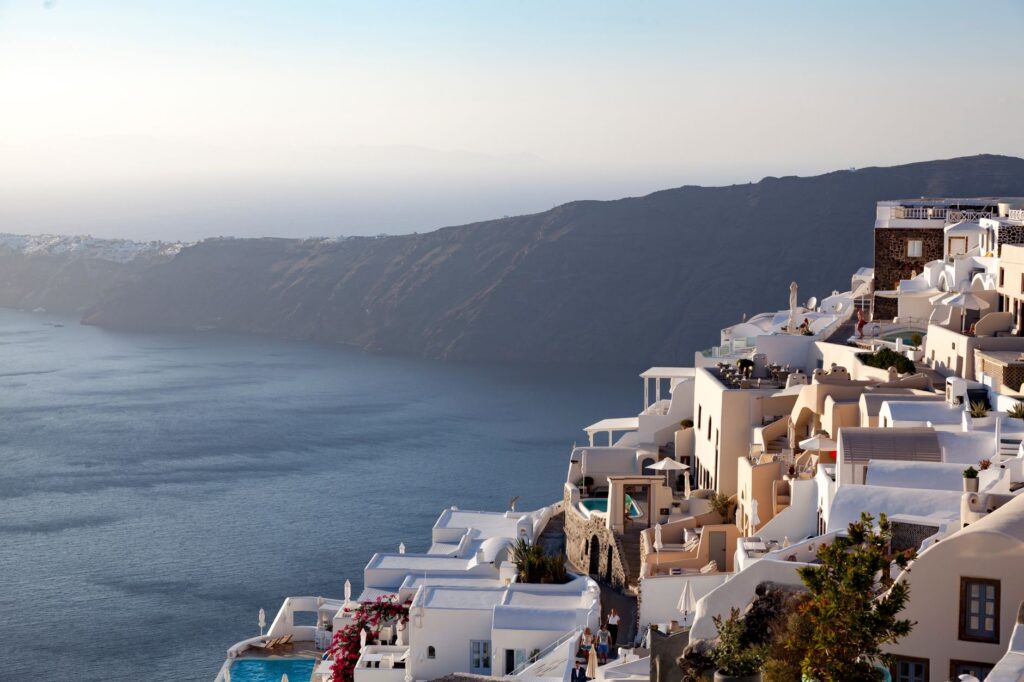
Simultaneously, authorities have drastically restricted the use of traditional donkeys as a passenger transport medium along the steep caldera steps—a practice subject to intense ethical and environmental scrutiny. Instead, the integration of state-of-the-art inclined elevators and subterranean moving walkways channels cruiser flows in an orderly, silent manner. This subterranean precision engineering minimizes surface alteration and protects geological strata from uncontrolled erosion. The result is a vertical transport system operating with a practically zero-emission profile, proving that accessibility in high-mountain insular environments can be resolved through advanced electromechanical solutions.
Electrification of the Road Network: Zero-Emission Buses on Sinuous Routes
Beyond the rim of the caldera, the road network linking the traditional villages of Akrotiri, Pyrgos, Imerovigli, and the volcanic sand beaches of the south has embarked on an accelerated decarbonization process. The island public transport company, KTEL, has gradually incorporated units powered entirely by electricity, specifically engineered to tackle the steep gradients and sharp turns of local topography. These vehicles feature high-energy-density batteries capable of completing multiple shifts of continuous service, alongside rapid-charging systems installed at strategic terminals in Fira and Oia.
The transition toward an electric fleet on mountain roads presents unique technical challenges, particularly regarding thermal management of batteries during summer months when temperatures frequently exceed normal thresholds. Engineers have implemented advanced liquid cooling systems and efficient driving algorithms that optimize performance on prolonged descents through kinetic energy recovery. This fleet renewal has not only alleviated noise pollution in residential areas but also substantially improved the travel experience for residents and travelers alike, who now traverse volcanic landscapes wrapped in notable operational silence.
True sustainability in a fragile insular territory does not lie in prohibiting movement, but in redesigning every journey so that energy gives back to the earth more than it takes.
Soft Mobility and the Recovery of Ridge Trails
Santorini’s transport strategy is not limited to substituting combustion engines with electric alternatives on major transport arteries; it also embraces a decisive commitment to soft mobility and the pedestrianization of historic centers. The scenic trail linking Fira to Oia along the rim of the caldera—a nearly ten-kilometer route over basalt rock ridges—has been the subject of rehabilitation and signage interventions to encourage walking and decouple daily commutes from automobile dependence. Peripheral parking lots have been established on the outskirts of villages, connected in turn with electric shuttle minibuses operating at steady frequencies throughout the day.
This prioritization of public space categorically favors pedestrians, cyclists, and users of electric-assist bicycles over private rental cars, a sector that historically generated severe congestion on narrow island roads. Restrictions on motorized traffic in traditional settlements during peak summer hours have transformed squares and alleyways into peaceful community spaces. Local residents perceive a remarkable recovery of urban tranquility, while travelers discover the landscape at a human scale, where the pace of movement allows them to appreciate cyclopean architecture and endemic flora adapted to volcanic soils without the filter of motorized noise.
Sustainable Maritime Logistics: Hybrid Ferries and Port Connectivity
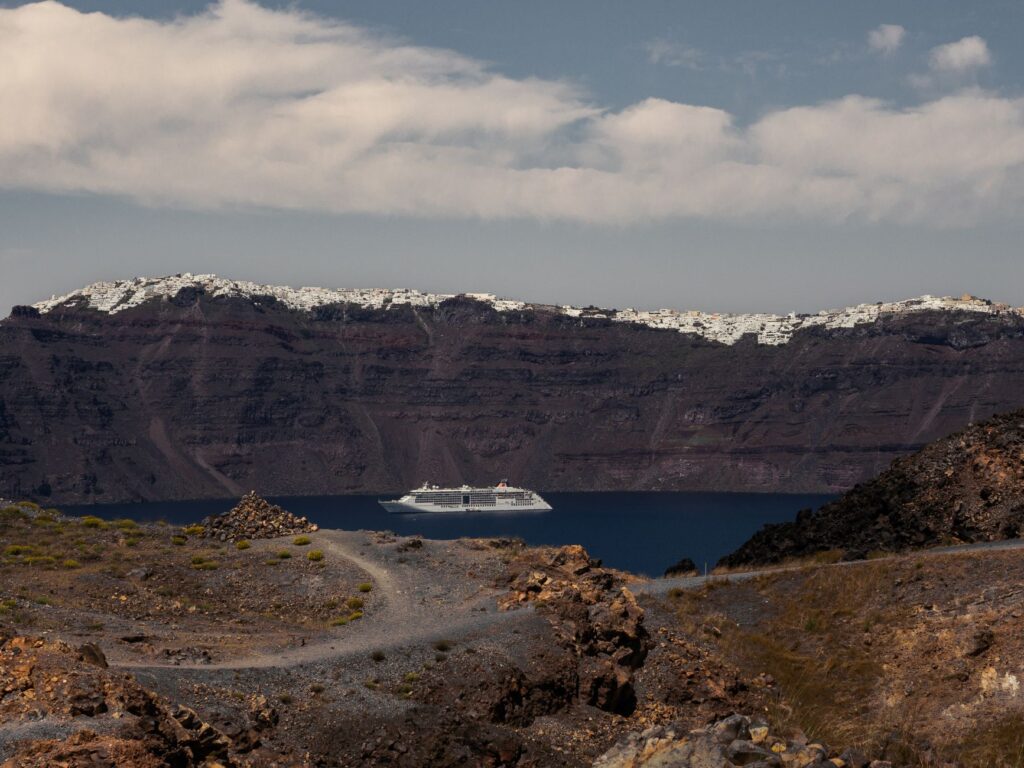
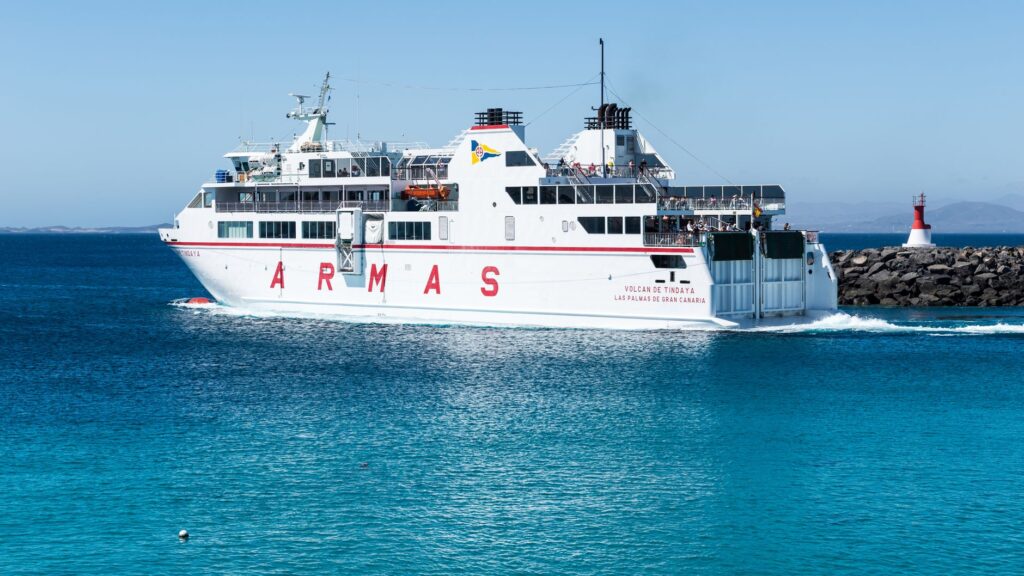
Santorini’s transport system is inseparable from its maritime connectivity, the gateway for the vast majority of visitors arriving at the port of Athinios. For years, the simultaneous arrival of large conventional ferries generated monumental bottlenecks on the single port access road—a winding cliffside route notorious for vulnerability to rockfalls. In response to this structural vulnerability, shipping operators serving the Cyclades have begun renewing their fleets by incorporating hybrid-propulsion vessels and shore-power connection systems during port stays, drastically reducing polluting emissions within the bay.
Furthermore, coordination between ferry arrivals and the departures of island electric buses has been optimized through real-time fleet management digital platforms. This prevents vehicle accumulation from slowing down port traffic and streamlines the orderly evacuation of passengers toward their respective lodgings. The intermodal integration between low-emission maritime transport and the terrestrial electric road network constitutes a fundamental advance in decoupling tourism growth from the environmental degradation of the coastline, consolidating a much cleaner and more predictable arrival and departure model.
Practical guide
How to get there: Santorini International Airport (JTR) receives regular flights from Athens and direct international connections during the summer season. By sea, high-speed ferries and hybrid vessels connect the port of Athinios with Piraeus and other Cycladic islands.
When to travel: The months of May, June, September, and October offer optimal weather conditions, lower traffic density, and moderate temperatures ideal for enjoying soft mobility and hiking.
Internal transport: Utilize KTEL’s electric bus network for travel between villages. The Fira funicular is the cleanest option for overcoming the old port’s elevation change. Electric bicycle rentals are recommended exclusively on marked routes outside high-speed main roads.
Local regulations: Unauthorized combustion vehicles are prohibited from entering the historic centers of Oia and Fira during peak summer hours. Strictly obey noise limitation and speed signs on caldera roads.
The Silent Pulse of the Volcanic Archipelago
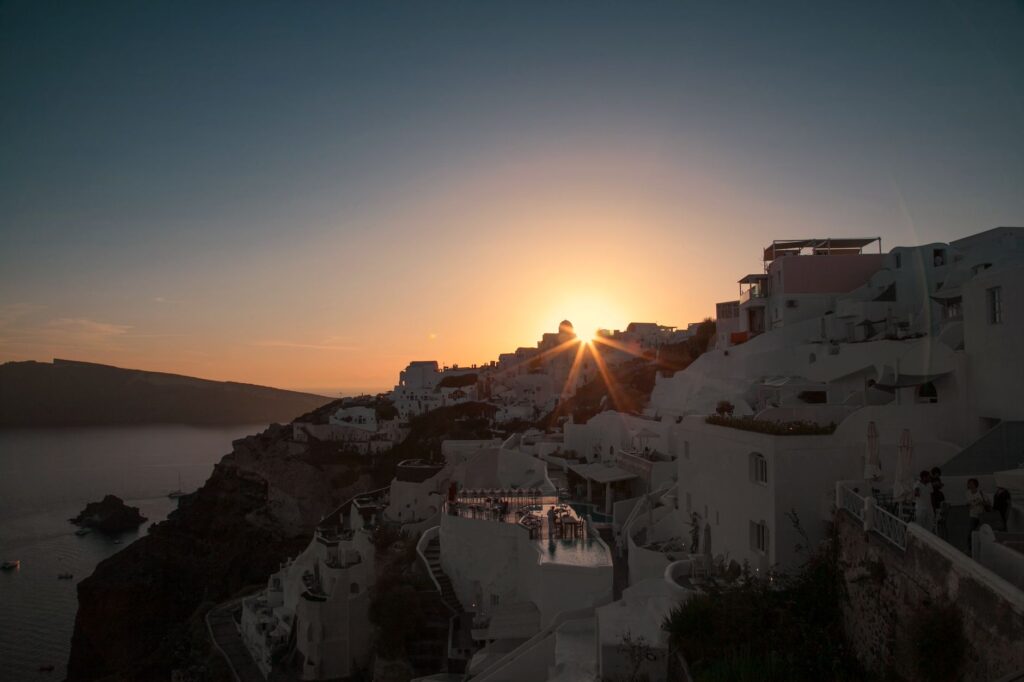
As the sun descends over the Aegean Sea, painting white-domed structures and dark caldera rocks in hues of ochre and violet, the contrast with the recent past of congestion and noise is unmistakable. The titanic effort to reconfigure mobility in Santorini proves that even the most fragile and saturated destinations can find a path toward operational sustainability without losing their soul. It is no longer the roar of engines accompanying the sunset, but the imperceptible hum of electric funiculars and the smooth rolling of buses winding along the volcanic slopes. In this restored equilibrium, the island not only protects its geological heritage but restores to the traveler the capacity to listen to the deep heartbeat of the earth.