Introduction to the oceanic frontier of the Mexican Pacific
More than four hundred kilometers off the western coast of Mexico, emerging from the abyssal depths of the North Pacific, rises the Revillagigedo Archipelago. This geographical isolation has forged one of the most pristine and dynamic marine ecosystems on the planet. Often referred to as Mexico’s Galapagos, this group of four volcanic islands—Socorro, San Benedicto, Roca Partida, and Clarión—represents a critical stronghold for global oceanic biodiversity. Far from conventional commercial routes and exposed to the region’s relentless currents, the underwater territory of Socorro offers a unique showcase for studying the interaction between active volcanism and marine megafauna.
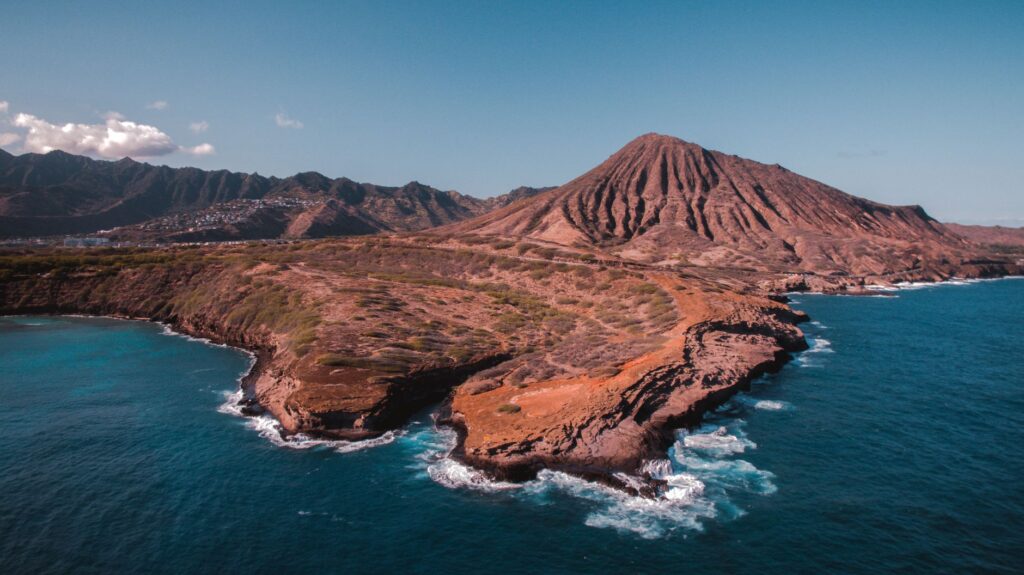
The natural history of these islands is deeply tied to their tectonic origin. Far from being detached continental fragments, they are the peaks of seamounts formed by the volcanic activity of the Cocos plate and the Pacific plate. This basaltic substrate, submerged in deep waters rich in nutrients brought by upwelling currents, creates ideal conditions for the development of complex trophic webs. Here, the near-total absence of a continental shelf means open oceanic currents crash directly against underwater cliffs, generating eddies and vertical currents that attract an impressive concentration of pelagic life.
Geological origins and offshore volcanic dynamics
The archipelago is essentially the summit of a submerged mountain range. Socorro Island, the largest of the group, houses Mount Evermann, an active volcano whose last recorded historical eruption occurred in 1993. This constant geological agitation has sculpted an abrupt underwater landscape characterized by vertical walls, basalt arches, submerged lava tubes, and gravity-defying rocky pinnacles. The morphology of the seabed is a decisive factor in local oceanography; these structures act as physical barriers that divert deep currents, pushing essential nutrients such as nitrates and phosphates toward the surface.
Recent geological research has shown that hydrothermal activity associated with these seamounts also plays a subtle yet crucial role in surrounding water chemistry. The interaction between cold seawater and hot magmatic rock releases trace elements that stimulate phytoplankton growth. This microscopic phenomenon is the foundation upon which the massive biomass characterizing the National Park is sustained. Understanding this geodynamics is fundamental for scientists seeking to unravel why this corner of the Pacific maintains such high productivity levels compared to surrounding waters, which are typically oligotrophic.
The blue highway: upwelling currents and primary productivity
Revillagigedo’s location at the confluence of different water masses creates a highly complex oceanographic system. The cold, oxygen-rich California Current meets the North Equatorial Current and the warm waters of the Gulf of California here. This convergence acts as a biological crossroad where temperate and tropical species coexist exceptionally. Upwelling events, driven by strong seasonal winds and submarine topography, force deep water to ascend into the photic zone, triggering seasonal explosions of microscopic life.
This incessant flow of nutrients feeds a dense layer of phytoplankton, which in turn supports zooplankton and small pelagic fish such as tunas, jacks, and sardines. The abundance of this intermediate link is the magnet that attracts the ocean’s apex predators. Oceanographic measurements indicate that thermal variability in the area, accentuated by global climatic phenomena like El Niño and La Niña, temporarily alters migration routes, forcing marine organisms to adapt their feeding and reproductive behaviors to an ever-changing environment.
The realm of giant mantas and oceanic sharks
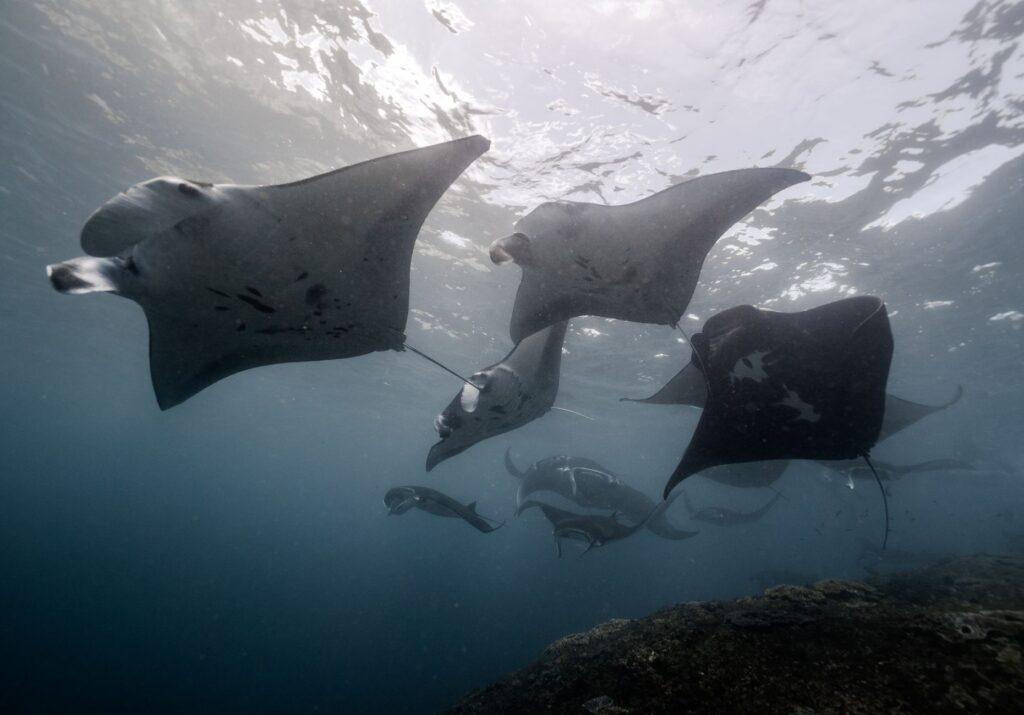
If there is an undisputed symbol of Socorro’s biological wealth, it is the giant oceanic manta ray (Mobula birostris). Unlike their coastal relatives, these specimens—whose wingspans can exceed seven meters—exhibit an interaction with divers and scientists that confounds specialists. At specific cleaning stations, such as the famous Boiler pinnacle in San Benedicto, mantas regularly gather to allow cleaner fish to remove parasites from their skin. What is extraordinary in this archipelago is the inquisitive attitude of these animals, which often approach human observers voluntarily, establishing eye contact that challenges interspecies barriers.
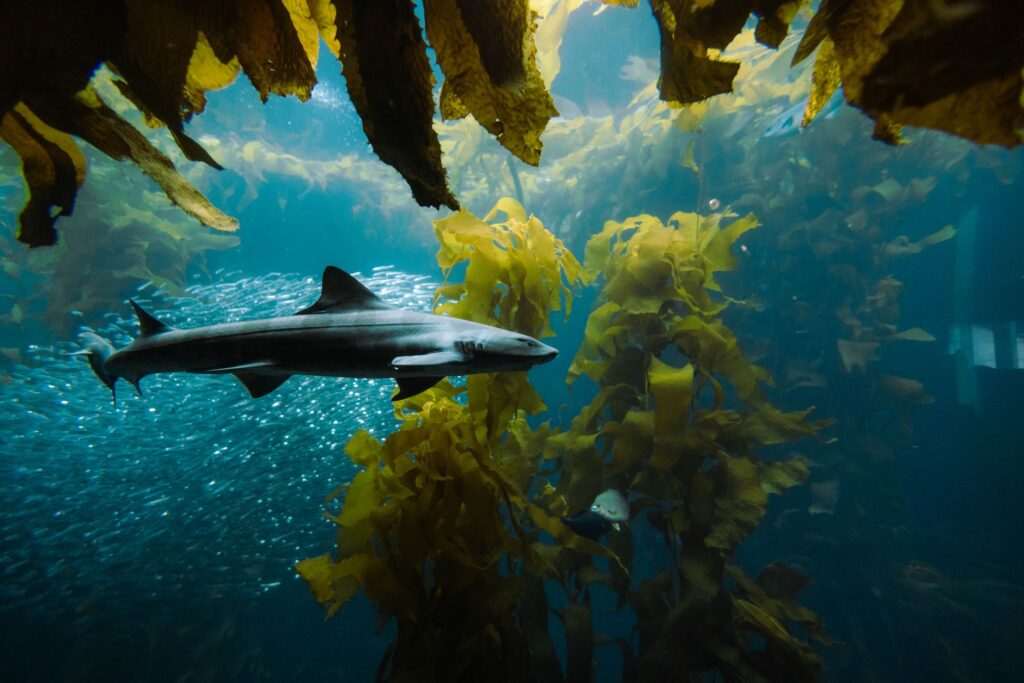
Alongside mantas, Revillagigedo’s deep waters are the undisputed domain of sharks. Populations of silvertip sharks, silky sharks, hammerheads, and the imposing tiger shark patrol the ridges and submarine channels. Roca Partida, a solitary rocky pinnacle rising barely fifty meters above the sea surface, functions as a transit station and nocturnal refuge for dozens of whitetip reef sharks crowding onto its rocky ledges. The density of these apex predators is a direct indicator of ecosystem health, demonstrating that populations are in a functional balance rarely observed in 21st-century overexploited oceans.
Migratory cetaceans: the winter stopover of humpback whales
Between the months of November and May, the archipelago undergoes an acoustic and visual transformation with the arrival of the northern population of humpback whales (Megaptera novaeangliae). After spending the summer feeding in the cold waters of Alaska, these cetaceans travel thousands of kilometers to use the protected, warm waters surrounding the islands as a breeding, calving, and nursery ground. Mothers and calves frequent the sheltered bays of Socorro Island, offering a natural spectacle where acrobatic breaches and complex songs resonate through vessel hulls.
The preservation of such a remote oceanic ecosystem does not depend on human absence, but on scientific discipline and absolute respect for the natural cycles governing the abyss.
Bioacoustic research conducted in the area has made it possible to precisely document the social structure of these marine mammals during the mating season. Male songs, which can last for hours and repeat over days, evolve and spread throughout the entire migratory population. The comprehensive protection of this marine habitat ensures that cetaceans have a sanctuary free from excessive commercial noise pollution, a critical factor for the reproductive success of a species that historically stood on the brink of extinction due to commercial whaling.

Terrestrial endemism and insular ecological connections
Although most attention is focused beneath the water’s surface, the Revillagigedo Islands also host a fascinating terrestrial biota marked by a high degree of endemism. Due to extreme isolation, bird species such as the Socorro parakeet (Icterus pustulatus sclateri) and the Socorro dove (Zenaida graysoni)—the latter extinct in the wild and recently returned via reintroduction programs—have evolved independently from their mainland counterparts. Vegetation, adapted to arid volcanic soils and freshwater scarcity, includes xerophilous scrublands and grasslands dependent on the misty moisture trapped by higher elevations.
A direct ecological connection exists between land and sea in this volcanic environment. Seabird colonies, such as blue-footed boobies and tropicbirds, nest on coastal cliffs, contributing essential nutrients via guano that enrich both terrestrial soils and the nearby marine littoral fringe. The National Park’s management considers these terrestrial-marine interactions as an indivisible system, where the disturbance of one part can trigger cascading effects throughout the delicate insular balance.
Conservation strategies and the National Park management model
The path toward the legal protection of Revillagigedo has been a milestone in Latin American environmental policy. Following decades of pressure from the scientific and conservation community to halt intensive industrial fishing in the area, the decree in 2017 expanded and converted the area into the Revillagigedo Archipelago National Park, completely banning all commercial fishing activities across its nearly 15 million hectares, making it the largest fully protected marine reserve in North America.
Surveilling such a vast and distant oceanic territory presents colossal logistical challenges. The Mexican Navy, in collaboration with the National Commission of Natural Protected Areas (CONANP), uses Vessel Monitoring Systems (VMS), coastal radars, and naval patrols to deter illegal poaching. Likewise, dive tourism operators are subject to a strict regulatory framework limiting the number of authorized vessels simultaneously operating at sensitive dive sites, demanding low-impact practices that prevent any alteration in pelagic fauna behavior.
Practical information for scientific expedition and responsible diving
Planning a trip to the Revillagigedo Archipelago National Park requires rigorous preparation, given that the islands lack terrestrial tourism infrastructure, hotels, or public services for visitors. All logistics are conducted exclusively aboard liveaboard vessels departing primarily from the ports of Cabo San Lucas or San José del Cabo on the Baja California Sur peninsula.
The open-sea journey takes approximately 24 to 30 hours each way, crossing open ocean where weather conditions can be unpredictable. The best time to visit the archipelago spans from November to May, when waters offer optimal visibility and the presence of humpback whales and large shark concentrations peaks. Between November and January, water temperatures range from 22 °C to 25 °C, requiring adequate 5 mm wetsuits, while spring months experience stronger currents but truly exceptional pelagic activity.

It is essential that travelers possess advanced diving certifications (such as Advanced Open Water) and demonstrable experience in open water with strong currents, as dives at sites like Roca Partida or The Boiler lack stable mooring lines and demand absolute buoyancy control. Absolute respect for codes of conduct—such as maintaining a safe distance from wildlife, refraining from wearing gloves to avoid touching coral, and strictly prohibiting the use of metal reef hooks in vulnerable areas—is a non-negotiable requirement imposed by environmental authorities to preserve the virginity of this oceanic sanctuary.
Visual closing: the perpetual heartbeat of the remote Pacific
At dusk, when the sun sinks into the Pacific horizon with no witnesses other than frigatebirds soaring over the basalt cliffs, the Revillagigedo Archipelago reveals its deepest dimension. Far from the noise and pressure of continental coastlines, this volcanic frontier beats with the relentless rhythm of currents and ancestral migrations. The survival of this refuge is not a geographical accident, but the result of a conscious human decision to prioritize conservation over exploitation.
Keeping the balance of these seamounts intact is the ultimate test of our capacity to safeguard the planet’s last great untamed spaces of the blue world.
Ultimately, visiting or studying Revillagigedo confronts us with the immensity and fragility of global marine ecosystems. Every manta gliding through the dark waters of San Benedicto and every whale breaching the surface at Socorro remind us that ocean health is a continuous system transcending national borders. Protecting this volcanic stronghold ensures that the wild pulse of the North Pacific continues to resonate unscathed for future generations.