


Territory, Clay, and the Pulse of a Millennial Legacy
On the banks of the Tagus River, in the heart of the Castilian plateau, Talavera de la Reina maintains an uninterrupted dialogue with fire and earth dating back to the Hispano-Muslim era, firmly establishing itself during the 16th and 17th centuries as one of Europe’s most influential pottery centers. Today, this Toledan municipality not only safeguards a tradition declared intangible cultural heritage by UNESCO, but is also experiencing a profound renaissance. In the workshops scattered across the historic quarter and its outskirts, a new generation of ceramists, art historians, and industrial designers is dedicated to unraveling the secrets of stanniferous glazes, high-temperature firings, and an iconography that merges Renaissance heritage with contemporary abstraction.
This resurgence is not merely an exercise in heritage nostalgia, but an urgent necessity to reclaim materiality in a world saturated with ephemeral objects and plastics. Local Talaveran clay, extracted from regional clay deposits, possesses unique plastic properties and porosity that demand absolute mastery of drying times and thermal shrinkage from the artisan. Unlike mass industrial ceramics, each hand-thrown or air-turned piece from Talavera bears the biological rhythm of its creator, transforming the plate, the ewer, or the large architectural mural into living documents of Spain’s social and aesthetic history.
The Alchemy of Color: Historic Pigments and Metallic Salts
The most distinctive feature of Talavera ceramics lies in its traditional chromatic palette, dominated by characteristic blues, yellows, greens, purples, and blacks against a white stanniferous background. This glazing system, perfected during the Spanish Golden Age, requires rigorous alchemy based on the use of pure metallic oxides. Cobalt provides deep, vibrant blue; antimony and toasted iron yield yellows and ochres; copper generates intense greens, while manganese contributes the dark, defined strokes that outline botanical and zoomorphic compositions.

In contemporary workshops, the preparation of these pigments remains artisanal, grinding minerals in stone mortars and adjusting proportions according to the kiln’s firing curve. Master ceramists spend weeks experimenting with stanniferous glaze baths—an opacified mixture featuring tin oxide—upon which direct painting is executed on raw ware. This technique, known as wet-on-raw underglaze, allows for no errors: once the oxide contacts the porous glaze, the line is fixed forever. The result is a vitreous surface of subtle brilliance and tactile depth that digital printing can never replicate.
Geometry and Narrative: From Renaissance Grotesques to Modern Design
Talaveran iconography has historically oscillated between Mudéjar interlacing patterns, the classical rigor of the Italian Renaissance introduced by Genoese and Flemish masters, and chinoiserie series inspired by oriental porcelain imported via the Silk Road. Today, design studios operating in the region are reinterpreting these ornamental repertoires with a lucid gaze devoid of academicism. Traditional hunting motifs, grotesque figures, and series of saints and knights now dialogue with minimalist patterns, modular architectural structures, and streamlined tableware collections destined for international fine dining.
This hybridization between historical repertoire and contemporary design demands meticulous mastery of freehand drawing. Extremely fine marten-hair brushes allow artisans to trace lines under a millimeter thick that structure complex compositions across concave and convex surfaces. Far from copying 16th-century catalogs, today’s creators decompose ancient forms, isolate botanical or geometrical fragments, and recontextualize them in utilitarian and sculptural formats that blur the traditional boundary between decorative art and fine art.
Talavera ceramics do not merely decorate a space; they impose a pause in the velocity of gaze, compelling the observer to decipher the chemical alphabet of fire and the patience of oxide upon the stanniferous white.
Architecture and Large Format: The Mural as Urban Skin
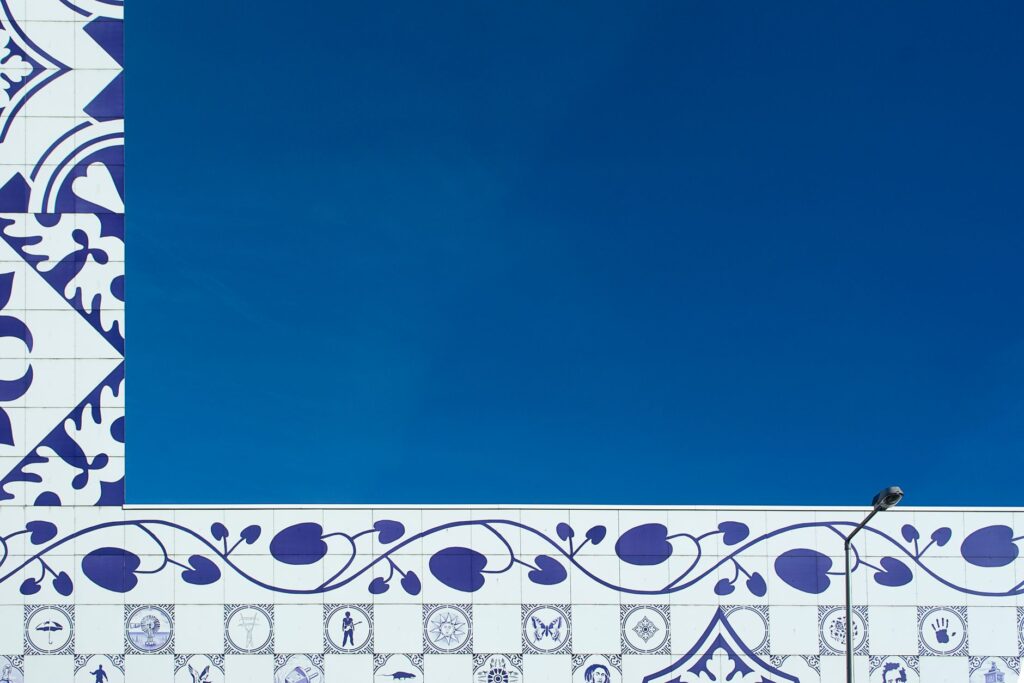
One of the fields where Talaveran ceramics has demonstrated exceptional contemporary vitality is in its integration with public and private architecture. Large azulejo panels, historically used to clad church facades, palaces, and railway stations, are experiencing unprecedented demand from architects and landscape designers seeking durable, identity-rich solutions for urban spaces and auteur residences.
Executing a large-format ceramic mural is a logistical and technical feat. Each tile, cut and numbered with millimeter precision prior to firing, forms part of a visual puzzle where the ceramist must anticipate how the glaze will behave after reaching one thousand degrees Celsius inside the kiln. Material shrinkage during vitrification can alter the overall dimensions of the work, demanding accumulated experience from the master potter that only decades of trade can provide. In the streets of Talavera and international projects spanning from Madrid to Mexico City, these murals restore human scale and enduring color to cities increasingly dominated by concrete and glass.

The Pulse of the Kiln: Sustainability, Energy, and Tradition
The renaissance of Castilian ceramics is not without contemporary challenges, particularly concerning energy sustainability and environmental preservation. Traditional wood-fired kilns, though irreplaceable for achieving certain chromatic effects and unique atmospheric reductions, have given way in many workshops to high-efficiency electric and gas kilns equipped with digital temperature control systems that drastically reduce carbon footprints and ensure consistency across firing cycles.
Furthermore, workshops actively work on recovering wash water and reusing surplus clay, which is reintroduced into the production cycle following a careful decantation process. This commitment to the circular economy directly links with the original philosophy of historical workshops, where nothing was wasted and mineral waste found new utility in preparing engobes or structural supports. Technological modernization, far from diluting the craft, acts as a protective shield against obsolescence and rising raw material costs.
Practical Information for the Traveler and Designer
For design professionals, architects, collectors, or travelers interested in exploring the reality of Talavera de la Reina ceramics, planning a stay of at least three days in the region is recommended to tour local workshops located within the historic district and industrial periphery. Securing appointments in advance is essential, as master potters divide their time between limited-run production and specialized teaching.
The mandatory starting point is the Ruiz de Luna Museum, housed in the former convent of San Agustín, which holds an exceptional collection of pieces from the 16th to the 20th centuries, offering insight into the formal and technical evolution of local pottery. Nearby, the Talavera Ceramic Center functions as a living bridge between heritage research and contemporary experimentation, collaborating closely with international designers.
For institutional or auteur acquisitions, visiting recognized artisanal workshops bearing origin denomination and quality seals directly is advised, where custom pieces can be commissioned. Local gastronomy, based on Toledan game and garden produce, along with excellent highway (A-5) and rail connectivity from Madrid—just over an hour away—make Talavera an indispensable destination for high-end cultural tourism.

The Legacy of the Future: Training, Transmission, and Resistance
The greatest triumph of Talavera’s pottery community over the past decade has been the creation of generational handover networks. Through workshop schools, specific vocational training cycles, and artistic residency programs, young people from across Europe temporarily relocate to the city to learn wheel-throwing, glaze formulation, and pictorial decoration techniques from the last consecrated masters.
This oral and practical transmission of knowledge serves as the ultimate bastion against the cultural desertification of the territory. At a time when artificial intelligence and digital fabrication promise absolute automation of form, Talavera de la Reina ceramics champion slowness, deliberate imperfection, and the tactile memory of hands as the most sophisticated form of human innovation. Each piece emerging from the smoking kiln is a reminder that true modernity consists of knowing where we come from in order to shape with dignity what is yet to come.
Clay does not lie; it records every tremor of the pulse, every hesitation of thought, and the exact temperature of the fire that transformed it into eternity.

