The Oresund Fixed Link is far more than a transport corridor joining two nations; it stands as one of the most complex civil engineering achievements in modern Europe, conceived to permanently alter the demographic and economic pulse of the Scandinavian region. Since its inauguration in the year 2000, this infrastructure has transformed a natural barrier—the marine strait separating Denmark from Sweden—into a seamless bridge for cross-border mobility. The complexity of its design responds to the pressing need to reconcile two contradictory demands: allowing the fluid transit of a massive volume of trains and automobiles without disrupting dense international maritime traffic heading toward the Baltic Sea, nor compromising the approach routes to nearby Copenhagen-Kastrup Airport.
The system’s architecture comprises three distinct structural elements that compel transport operators to coordinate high-precision technical protocols. It begins on the Danish side with a four-kilometer underwater tunnel, the Drogden, which descends beneath the seabed to safeguard the airspace of the capital aerodrome. This section is followed by an intermediate artificial island, Peberholm, built expressly to serve as a transition point where the railway and highway alignments emerge from the subsurface to rise into the open air. Finally, the assembly culminates in the imposing Copenhagen-Malmo cable-stayed bridge, an eight-kilometer structure soaring majestically above the waters, whose piers support both the double-track railway on its lower deck and the four-lane motorway on the upper platform.
Railway Integration and the Challenge of Signaling Transitions
One of the greatest technical hurdles in the daily operation of the Oresund link lies in the deep disparity between the railway systems of Denmark and Sweden. While the Danish network operates under traditional 25 kV 50 Hz electrification and uses a legacy signaling system, the Swedish infrastructure functions on 15 kV 16.7 Hz with entirely different safety protocols. This technical divergence necessitated the development of a specific generation of dual-voltage, multisystem regional trains, popularly known as the Etoga multiple units, capable of crossing the border without stopping while executing complex current-transition and speed-control maneuvers in mid-motion over Peberholm island.
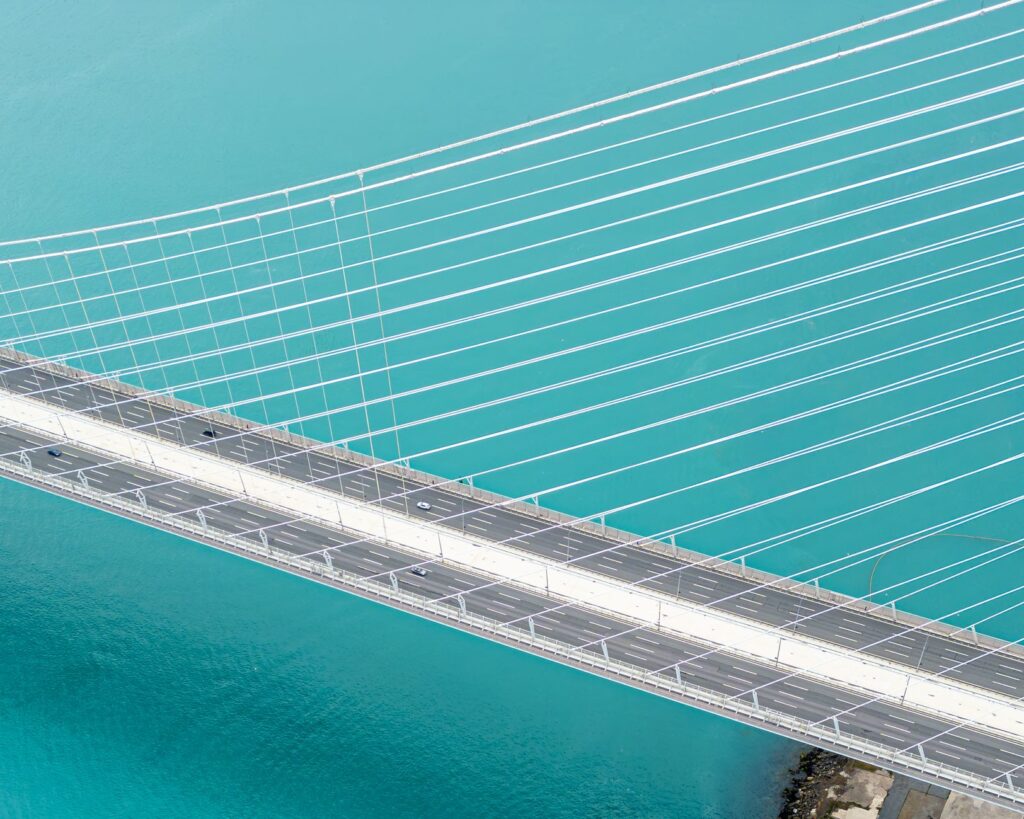
The management of this mixed railway flow, combining international high-speed trains with high-frequency regional commuter services, imposes constant pressure on traffic control centers. Any mechanical incident or power supply outage at either end of the bridge immediately impacts schedules in both countries. The railway authorities of Banedanmark and Trafikverket maintain permanent telemetric coordination to regulate timetables, prioritizing the punctuality of daily commuters crossing the strait for work or study, a demographic segment that has grown exponentially thanks to the consolidation of the wider Oresund region.
The Crucial Role of Peberholm Artificial Island in Ecology and Logistics
Peberholm, whose name was playfully coined as a counterpart to the neighboring natural island of Saltholm, is much more than a simple transition platform between tunnel and bridge. This landmass, reclaimed entirely from the sea through the deposition of millions of tons of rock and sediment excavated during underwater trenching, functions today as an open-air biological laboratory and a logistical maintenance hub. Devoid of planned agricultural or urban intervention, local flora and fauna have spontaneously colonized the territory, turning it into a protected sanctuary for migratory birds and rare plant species in northern Europe.
From a strictly operational standpoint, Peberholm houses essential electrical substations, emergency crossovers, and communication systems that ensure the redundancy of the fixed link. Technical inspection teams from both nations use this intermediate base to conduct preventive maintenance operations on both the highway platform and the railway tracks, taking advantage of nighttime windows when traffic volume subsides. The coexistence of heavy transport infrastructure with a protected ecosystem demonstrates how contemporary civil engineering can successfully integrate environmental mitigation criteria into premier international logistical corridors.
Maritime Restrictions and Navigation Beneath the Bridge Spans
While trains and cars cross above and below the strait, the marine surface of Oresund remains one of the busiest water highways on the European continent. The Flinterenden shipping channel, spanned by the elevated section of the cable-stayed bridge, demands strict surveillance by port authorities and the maritime captaincies of Copenhagen and Malmo. The main span of the bridge offers a vertical clearance of 57 meters—a considerable height that nonetheless requires large cruise ships, container vessels, and heavy cargo carriers to schedule their transits with extreme precision based on tides and adverse weather conditions.

Radar systems and electronic navigational aids installed on the bridge piers continuously monitor the position of commercial vessels to prevent catastrophic collisions with reinforced concrete structures. In situations of dense fog or gale-force winds—phenomena relatively frequent at this latitude of the Baltic Sea—maritime traffic control enforces speed restrictions and support-tug assistance protocols. This dual management, balancing the needs of terrestrial transport with the sovereignty of international shipping lanes, exemplifies the multidisciplinary complexity defining large 21st-century intermodal corridors.
Demographic Impact and the Transformation of Metropolitan Mobility
The opening of the Oresund link completely redefined the human geography of southern Sweden and eastern Denmark, merging two metropolitan areas into a single labor and cultural market of nearly four million inhabitants. Hundreds of professionals cross the border daily by train or private vehicle, a phenomenon that forced a rethinking of fiscal policies, labor regulations, and integrated public transit systems. Monthly transit passes and combined ticketing options reflect the institutional effort to reduce the bureaucratic and economic friction that traditionally separated two Scandinavian nations with sister languages yet sovereign administrations.
However, this high interdependence has also exposed structural vulnerabilities during geopolitical or sanitary crises. Recurrent reinstatements of border controls and mobility restrictions have demonstrated that the physical fluidity of an infrastructure does not always align with full political harmonization. Public transit operators have had to adapt to shifting scenarios, reconfiguring train capacity and establishing real-time multilingual information channels to mitigate passenger confusion amid unexpected police checks at Malmo Central station or Copenhagen Airport.

Maintenance and Structural Resilience Against Marine Corrosion
Subjecting a steel and prestressed concrete structure to the relentless action of salt water, ambient humidity, and freezing Baltic gales demands a permanent, technologically advanced preventive maintenance program. Engineers tasked with conserving the Oresund link deploy underwater robots and fiber-optic sensor systems embedded within foundations to detect micro-cracks or early signs of corrosion in the metal framework. The protective paint on the bridge stays undergoes regular overhauls using suspended scaffolding operating exclusively during favorable weather windows in the boreal summer.
Likewise, the infrastructure’s resilience against the foreseeable impacts of climate change, such as increased frequency of severe storms and rising mean sea levels, remains a priority on the investment agendas of the Danish and Swedish governments. Containment dikes on the Drogden tunnel access ramps have been reinforced, and automatic pumping systems updated to prevent flash flooding in subterranean sectors. These measures ensure that the corridor maintains its safety standards even under extreme weather conditions surpassing original historical design parameters.
The Future of the Corridor: Digitalization and Railway Capacity Optimization
Looking toward coming decades, the consortium owning the Oresund link and national railway companies face the challenge of increasing transport capacity without constructing new physical structures. The solution lies in the accelerated adoption of advanced digital signaling technologies, such as the European Rail Traffic Management System (ERTMS), which will reduce safety intervals between trains and increase convoy frequency per hour in both directions. This digital modernization is indispensable for absorbing projected demand growth following the completion of other strategic infrastructure projects across northern Europe.

blockquote>The fluidity of a cross-border corridor depends not solely on the strength of steel and concrete, but on the institutional capacity to synchronize regulations, technologies, and political will in constant evolution.
Thus, the Oresund bridge and tunnel cement their status as a paradigm in contemporary transport engineering, proving that sustainable connectivity requires a flawless symbiosis between digital innovation, technical rigor, and environmental sensitivity. The experience accumulated across this strait serves today as an international reference model for planning fixed links in complex maritime geographies worldwide.
Practical guide
How to get there: Primary rail access is available via Copenhagen Central Station (København H) or Copenhagen-Kastrup Airport on the Danish side, and Malmo Central (Malmo C) on the Swedish side. Regional trains operate 24 hours a day with an average frequency of twenty minutes.
When to travel: Spring and summer months offer more stable weather conditions to enjoy panoramic views from the elevated section and the train. During autumn and winter, storms may occasionally disrupt road traffic, though rail operations typically maintain reliability.
Travel requirements: As a cross-border link within the Schengen Area, carrying a valid passport or national identity document is mandatory. Nevertheless, authorities from both countries conduct random police checks at terminal access points.

Operational tips: Purchasing integrated tickets through the official apps of Skånetrafiken or DSB is strongly recommended to avoid ticket-window surcharges and streamline access to automated station turnstiles.
Photographic viewpoints: The finest vantage points for observing the scale of the structure without access restrictions include Ribersborg park in Malmo and the vicinity of Amager Strandpark beach in Copenhagen.
The final glance toward the gray waters of the Oresund strait reveals an apparent stillness contrasting with the frenetic, invisible activity pulsing beneath its surface and across its structures. As train silhouettes fade into marine mist bound for Sweden, the infrastructure confirms itself as a living work, an enduring testament to human ambition in weaving bridges across the immensity of water.