
Origins and the Geodetic Vision of the Pass
The routing of the Bernina Railway was driven neither by fleeting touristic whims nor by fortuitous commercial expansion, but by an urgent necessity to bridge the geographical divides that historically isolated the alpine valleys of southeastern Switzerland from Italian Lombardy. At the dawn of the twentieth century, mobility across this rugged terrain depended entirely on horse-drawn carriages and cobbled tracks buried under meters of snow for long winter months. The establishment of the Berninabahn company in 1906 signaled the starting pistol for one of Europe’s most daring civil engineering endeavors. The engineers of the era faced a hostile territory where natural gradients far exceeded the technical limits of conventional adhesion locomotives.
The decision to adopt a meter-gauge system with direct electrical power was far from accidental. At a time when coal represented an expensive and polluting strategic resource, the project planners capitalized on local hydroelectric energy, harnessing the rushing torrents of alpine snowmelt to feed the overhead catenary wires. This pioneering approach not only guaranteed the long-term economic viability of the project but also set a benchmark for alpine sustainability. Every kilometer of track carved into the solid rock demanded meticulous geodetic calculations, with surveyors operating under extreme weather conditions, suspended above dizzying chasms and battling gale-force winds sweeping down from surrounding glaciers.
High mountains are never conquered by brute force, but through a constant and respectful dialogue with topography, where every curve is an inevitable concession to the abyss.
As construction pushed toward the summit of the Bernina Pass—situated more than two thousand two hundred meters above sea level—technical challenges multiplied exponentially. Unstable terrain prone to avalanches and rockfalls necessitated the design of unprecedented passive protection structures, such as wind-guarded galleries and reinforced tunnels. The full inauguration of the corridor in 1910 fundamentally transformed the regional economy, allowing agricultural products, minerals, and passengers to flow uninterrupted between the Engadine and Valtelina, cementing a cross-border cooperation that remains entirely intact over a century later.
The Monumental Architecture of the Route
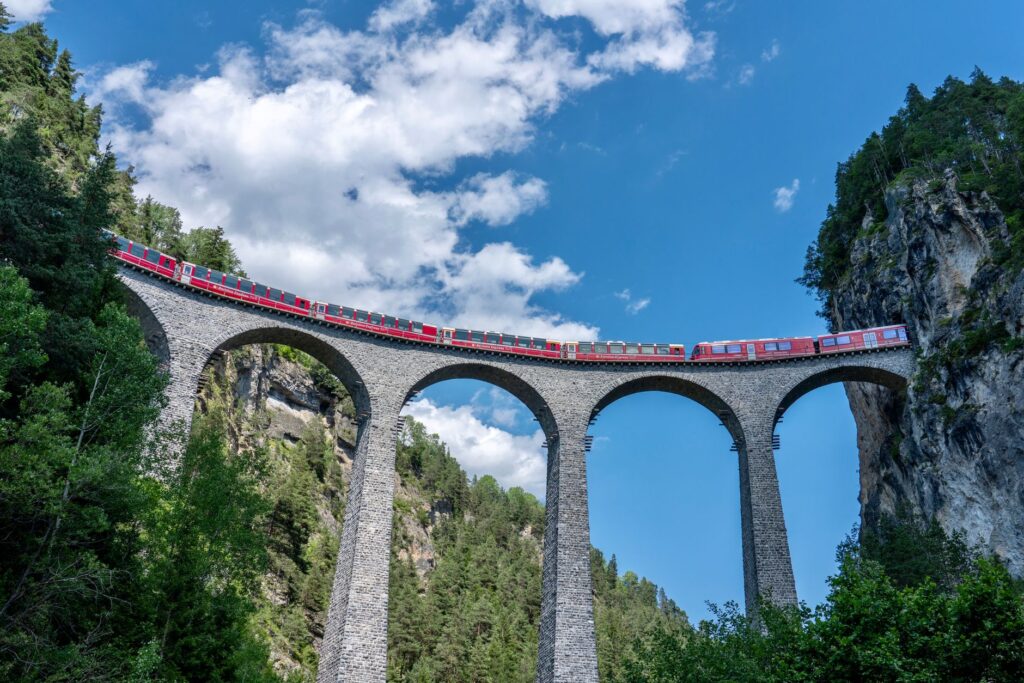
One of the greatest technical attractions of the Bernina Railway is its absolute refusal to construct multi-kilometer base tunnels. While other major alpine routes chose to pierce the bowels of mountains at low elevations, the Bernina elected to scale the cordillera in the open air, turning the dramatic topography into its primary visual signature. This design philosophy forced engineers to conceive extraordinary geometric solutions to gain elevation without exceeding the maximum seven percent gradients that its motorized units can successfully sustain.
The most celebrated example of this daring construction is the circular viaduct at Brusio. Located along the descending stretch toward Italian territory, this three-hundred-and-sixty-degree spiral bridge allows trains to gain or lose elevation within a remarkably tight radius, describing a perfect loop over themselves before continuing their journey. The structure, composed of elegant local quarried stone arches, distributes the dynamic loads of the convoys optimally, withstanding extreme thermal expansions caused by seasonal temperature contrasts. Watching a train traverse the Brusio viaduct is to witness a flawless choreography where physics and architecture converse without discord.
Alongside the Brusio loop, the corridor features a dizzying succession of metal bridges, stone viaducts, and sloping galleries that continually challenge the traveler’s perception of space. The passage through the Ospizio Bernina gorge represents the operational roof of the European adhesion railway network, a milestone where the track runs alongside glacial lakes whose waters remain frozen for much of the year. Preserving these centennial structures demands a continuous and intensive maintenance program, with specialized crews working during brief summer windows to renew railroad ties, inspect signaling systems, and stabilize shifting slopes.

Intermodal Integration and Daily Logistics
Beyond its status as a protected UNESCO World Heritage asset, the Bernina corridor operates as a vital public transport lifeline for the local communities inhabiting the Poschiavo and Bregaglia valleys. Intermodal integration constitutes the true engine of its daily efficiency. At nodal stations such as Pontresina or Poschiavo, train timetables are rigorously synchronized with the networks of Swiss postal buses, popularly known as Postauto, which penetrate lateral valleys where the railway cannot reach.
This meticulous coordination ensures that residents of remote mountain hamlets can access healthcare, educational, and administrative centers without relying on private road transport, particularly during winter when many secondary roads become impassable. Furthermore, the system allows for the transportation of light freight and mail within the standard passenger railcars, optimizing operating costs and shrinking the carbon footprint of regional logistics. Station masters and train drivers act as true territorial connectivity agents, managing passenger and cargo transfers with chronometric precision.
The steady flow of daily commuters blends seamlessly with high-end international tourism, represented principally by the renowned Bernina Express. This panoramic service, equipped with large curved windows stretching into the ceiling, attracts hundreds of thousands of visitors annually from every corner of the globe. Despite high tourist volumes, the operating company, Rhaetian Railway, has successfully balanced load capacities to prevent infrastructure saturation, maintaining an accessible and punctual service for both local residents and global travelers alike.
Operational Challenges Amid Climate Change
Maintaining high-mountain railway infrastructure in the twenty-first century entails colossal challenges driven by shifting global climate patterns. The accelerated warming of the Alps is destabilizing slopes and degrading permafrost at the higher elevations of the Bernina Pass, increasing the risk of rockfalls and mudslides that threaten the integrity of the railway line.
To mitigate these threats, civil engineering teams employ advanced monitoring technologies, including high-precision laser sensors, thermal cameras, and early warning systems installed at critical points along the route. These devices detect micro-deformations in the terrain and unusual movements in rock embankments, allowing rail traffic to be proactively halted before any incident occurs. Additionally, dynamic avalanche containment barriers have been engineered to absorb the impact of massive snow and rock volumes without compromising supporting structures.
Another daily challenge is the management of extreme winter weather. The company’s powerful rotary snowplows operate tirelessly during severe storms, carving deep trenches through deep snowdrifts to keep the communication artery open. These operations demand impeccable logistical coordination between traffic control centers, track maintenance teams, and cantonal meteorological services, proving that the survival of the line depends as much on the strength of its steel as on human resilience.
Railway Diplomacy Between Switzerland and Northern Italy
The definitive terminus of the Bernina corridor is situated in the Italian town of Tirano, an enclave where railway sovereignty subtly crosses national borders. The arrival of Swiss trains at the Italian station of Tirano constitutes a fascinating exercise in technical and operational diplomacy, requiring the seamless harmonization of safety regulations, signaling systems, and labor laws from two distinct countries.

Along the urban stretch through Tirano, convoys share the asphalt of local streets with road traffic, passing within inches of residential doorways and shopfronts in a peaceful coexistence reminiscent of historic metropolitan trams. This peculiar urban traversal demands extreme attentiveness from train drivers and constant awareness from Italian pedestrians and motorists, cementing a unique cross-border civic space across the alpine arch.
Local authorities from the Valtelina and the Canton of Graubünden collaborate closely on the joint promotion of the corridor as a axis of sustainable development. Integrated fare policies and mobility packages are actively championed to encourage the abandonment of private vehicles, enabling skiers, hikers, and cultural travelers to move freely between both nations. This cross-border mutual understanding proves that well-managed transport infrastructures act as powerful bridges of social and economic cohesion above any political boundary.
The Human Experience Aboard the Alpine Corridor
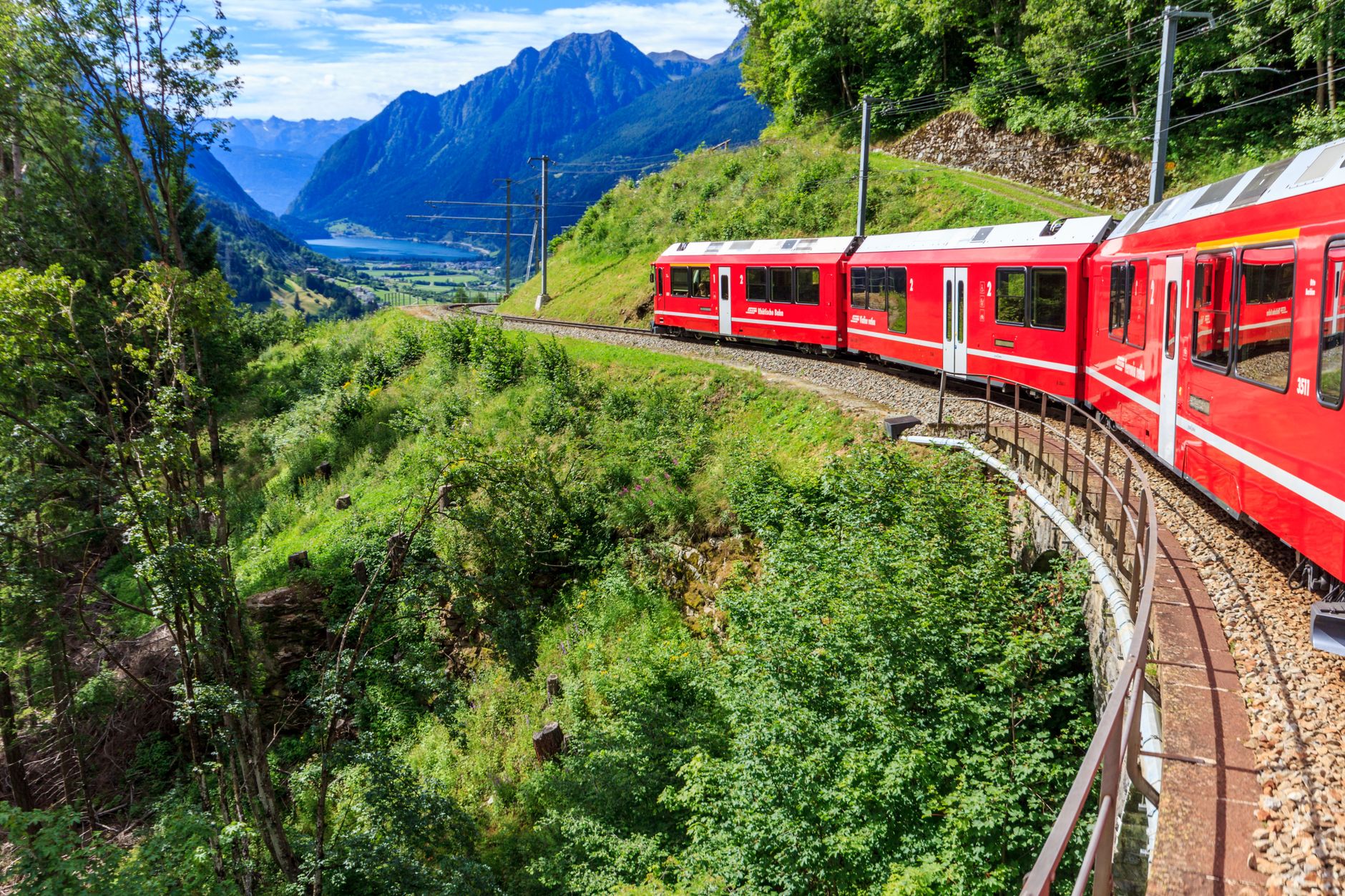
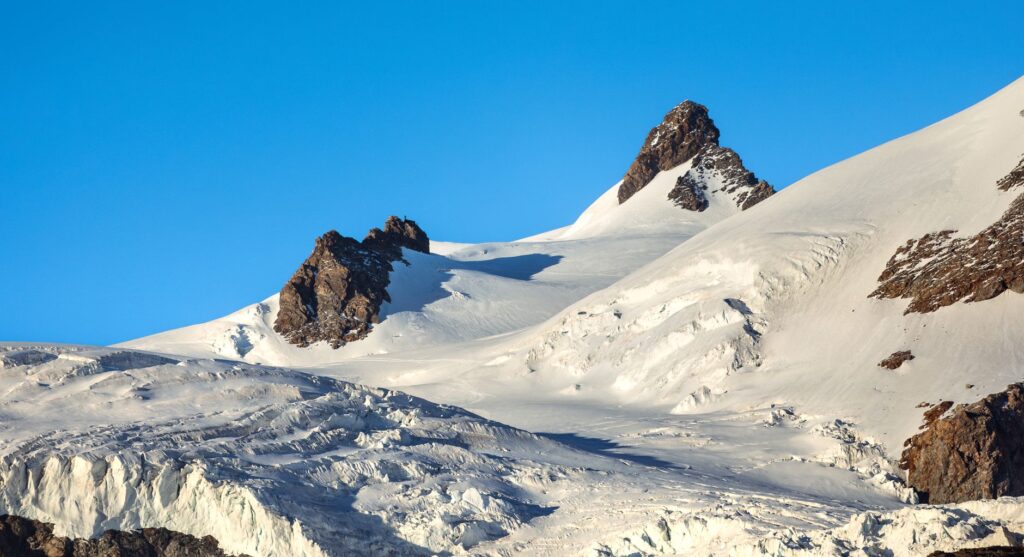
Traveling aboard the Bernina Railway transcends the conventional notion of transit, transforming into an immersive sensory journey through the vastness of the alpine landscape. From the comfort of the carriages, passengers witness a constant metamorphosis of scenery: dense conifer forests and emerald-green meadows of the lower valleys gradually give way to the austere beauty of high altitude, dominated by scree slopes, perpetual snowfields, and jagged peaks.
Human interactions inside the train reflect the cultural diversity of the passengers. A single carriage might house skiers with bulky touring gear, local hikers returning to their homes, railway engineers reviewing technical blueprints, and international travelers fascinated by historical engineering. Spontaneous conversations about hiking trails, changing weather conditions, or the history of stone viaducts weave an ephemeral yet intense community during the two-hour journey between St. Moritz and Tirano.
The true luxury of alpine travel lies not in the ostentation of the seat, but in the deliberate pause imposed by the cadenced rhythm of the track, allowing us to contemplate the world at a human scale.
Conductors and train staff play a fundamental role in shaping the atmosphere of the journey. With friendly, multilingual, and professional service, they share anecdotes about iconic viewpoints along the route, warn passengers about shifting summit weather, or explain the mechanics of braking systems on steep downward grades. This attention to the human detail turns a routine commute into an unforgettable experience etched into the memories of all who cross the pass.
Practical guide
- Getting There: The Bernina corridor links St. Moritz (Switzerland) and Tirano (Italy). St. Moritz is accessible via the Swiss Federal Railways (SBB) network from Zurich, while Tirano connects via Trenitalia from Milan.
- Tickets and Reservations: Seat reservations are not mandatory for regular regional trains operating along the route on hourly schedules. However, for the panoramic Bernina Express, advance seat reservation and a supplementary surcharge are strictly required.
- Best Time to Visit: Every season offers a distinct appeal. Summer and autumn stand out for the striking contrast between glaciers and golden forests; winter guarantees snow-covered high-mountain landscapes under optimal safety conditions.
- Luggage and Clothing: Even in summer, temperatures at the summit of the Bernina Pass (Ospizio Bernina) can drop sharply. Layered warm clothing, non-slip footwear, and high-altitude sun protection are strongly recommended.
- Connectivity and Accessibility: All major stations feature ramps and assistance services for passengers with reduced mobility. Modern trainsets include designated spaces for wheelchairs and strollers.
- Local Gastronomy: Along the route, sampling regional specialties such as pizzoccheri in the Italian Valtelina or capuns and nut tart in the Grisons valleys is highly encouraged.
Emotional Epilogue at Alp Grüm Station
When the train finally halts at the small, isolated station of Alp Grüm, situated at two thousand two hundred and twenty-two meters above sea level, time seems to suspend itself entirely. From the terrace of the historic railway refuge, the view encompasses a breathtaking panorama: the imposing Palü Glacier cascades in blue-tinted ice toward the floor of the Poschiavo Valley, while the distant murmur of melting water marks the heartbeat of the high mountains. In this secluded corner of the world, where the whispering alpine wind will provide the sole echo during long winter nights, human craftsmanship integrates with humble elegance into the sublime architecture of the earth, reminding us that true engineering greatness lies in its capacity to unite us without desecrating the landscape.