Introduction to the Arctic Edge Where the Wind Writes the Recipe
Beyond the Arctic Circle, where the Norwegian Sea crashes with ancestral fury against jagged granite cliffs, lies a territory where time is measured not in seconds, but in freezing gusts of wind and the infinite patience of the ocean. The Lofoten Islands are not merely a geographical accident of breathtaking beauty; they represent one of the most unique gastronomic sanctuaries on the planet. Here, in these coordinates where the midnight sun gives way to the perpetual darkness of winter, human survival has historically been linked to a miracle of natural preservation: air-dried fish, locally known as tørrfisk.
This report delves into the heart of this archipelago’s fishing villages to understand how an apparently austere product, devoid of salt and technological artifice, has become an object of desire for the world’s most avant-garde chefs. Far from conventional tourist routes, the true essence of Lofoten pulses during the harshest months of the year, when fishing fleets return to port laden with Arctic skrei cod, marking the beginning of a secular ritual that has barely changed since the Viking Age.
The Arrival of Skrei and the Awakening of Cold Seas
Every winter, cod migrates from the freezing, deep waters of the Barents Sea to the crystal-clear, sheltered waters of the Lofoten archipelago to spawn. This massive biological phenomenon has constituted the economic and cultural heartbeat of the region for over a thousand years. Local fishermen, equipped with thermal suits and wisdom passed down through generations, brave an unpredictable and wild sea. The capture of skrei is not just any intensive fishing industry; it is an exercise in absolute respect for the ocean’s natural cycles.

Precision in handling each captured specimen determines the final quality of the product that will hang from the gigantic wooden racks. Boats return to traditional ports such as Reine, Svolvær, or Henningsvær with specimens renowned for their firmness and the purity of their flesh, nourished in the depths of the far north. On the docks, the work is carried out with silent and efficient choreography. Each fish is gutted with meticulous precision and washed with seawater before being transported to the drying fields, where atmospheric elements will complete the masterpiece.
The Wooden Racks: The Invisible Architecture of Flavor
During the first months of the year, the coastal landscape of Lofoten is dominated by imposing pyramidal structures of untreated wood known as hjell. These drying racks, aligned facing the sea to make the most of wind currents, hold millions of cod tied by the tail in pairs. The architecture of these structures is no accident; their design allows wind to circulate freely around each piece, dehydrating it uniformly without ground moisture ruining the process.
The climate of the Lofoten Islands offers a unique and fragile meteorological balance for this purpose: temperatures that oscillate slightly above and below freezing, combined with strong winds and precipitation in the form of snow or sleet. This environment prevents the fish from rotting or over-fermenting, achieving natural dehydration that removes up to eighty percent of the water contained in the animal’s muscle while preserving its proteins, minerals, and complex amino acid profile intact.

The northern wind is not an enemy fought by man in Lofoten, but the invisible artisan quietly sculpting the flavor of the sea.
Anthropology of Brine and Suspended Time
Unlike other fishing regions worldwide where food preservation depends fundamentally on salt or intensive smoking, in Lofoten the secret lies in the absolute absence of additives. Tørrfisk is pure living matter transformed by the elements. Master dryers, guardians of deep empirical knowledge, monitor the condition of the pieces on the racks day after day. They know how to read the clouds and wind direction to determine the exact moment the fish should be removed for a second phase of maturation in dark, well-ventilated cellars.
This dry-curing process can last for several months, acquiring aromatic nuances reminiscent of the open sea, marine algae, and granitic rock minerals. In the past, this hyper-proteinaceous and lightweight food was Norway’s international currency, crossing seas in the holds of Hanseatic ships to Italy, Spain, and the rest of Europe, where it became the undisputed ingredient of iconic dishes such as bacalà alla vicentina.
From Historical Harshness to Contemporary Haute Cuisine Tables
For decades, air-dried fish was perceived in urban markets as a subsistence food—tough and demanding in its culinary preparation due to the long hours of soaking required for rehydration. However, in recent years, the New Nordic cuisine and international avant-garde chefs have rediscovered this ancestral ingredient, elevating it to the category of sustainable luxury produce. Its umami flavor profile, intense and concentrated, offers infinite technical possibilities in modern cooking.

Award-winning restaurants in Copenhagen, Oslo, and Stockholm use ultra-thin shavings of grated tørrfisk over clear broths, marine fat emulsions, or charcoal-roasted root vegetables. This culinary reinterpretation does not seek to disguise the product, but rather to enhance its honest rawness, connecting the diner with the harshness and beauty of the Arctic landscape. Contemporary haute cuisine finds in this ingredient a narrative of authenticity that is scarce in today’s globalized markets.
Circular Economy and the Total Utilization of Skrei
Sustainability in the Lofoten Islands is not a modern marketing label, but a historical necessity for survival. Absolutely nothing of the cod is wasted in this island ecosystem. The fish heads, meticulously separated during the cleaning process, are dried separately in specific structures and exported massively to countries on the African continent, especially Nigeria, where they form a fundamental ingredient to enrich traditional soups and stews.
Similarly, skrei roe and liver are used to produce essential oils and traditional preserves that form part of the daily diet of local inhabitants. This perfect circular economy ensures that pressure on marine biomass is offset by comprehensive and rigorous utilization of each specimen, a model that now inspires international organizations dedicated to the sustainable management of oceanic resources.
True sustainability is not invented in modern offices; it survives in communities that have scrupulously respected the limits of their environment for millennia.
Practical Guide for the Traveler and Curious Gastronome
Visiting the Lofoten Islands to understand their culinary culture requires planning and respect for local rhythms. The best time to witness the drying process at its peak includes the months from February to May, coinciding with the skrei fishing season. During these months, coastal villages like Svolvær, Henningsvær, and Nusfjord display their most authentic image, with racks full of fish and boats operating in the fjords.
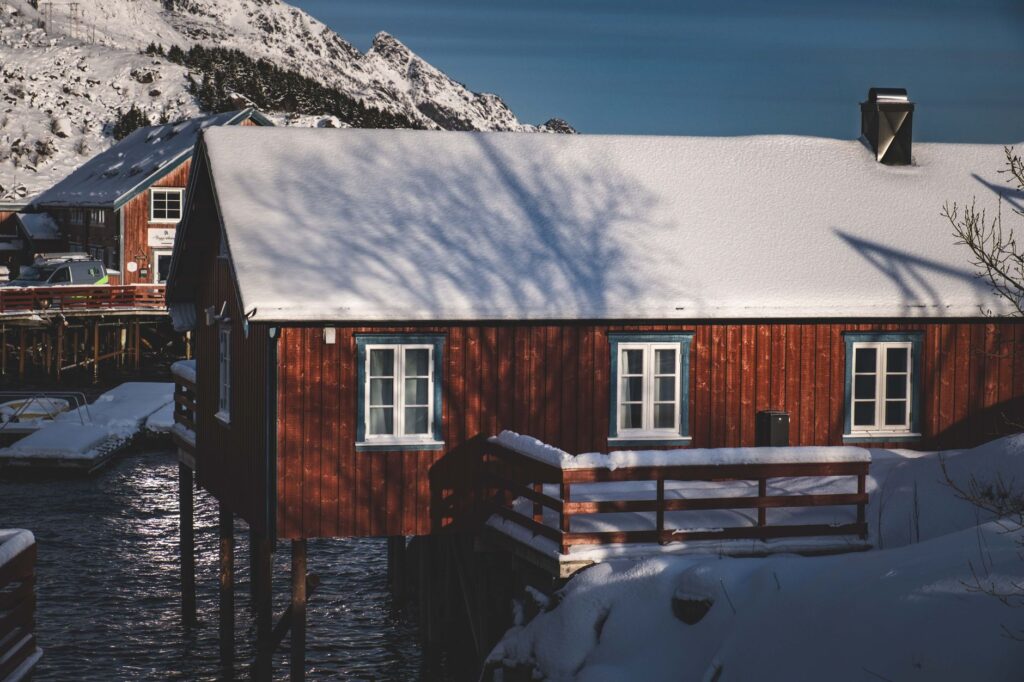
To reach the archipelago, the most efficient option is to fly from Oslo to Evenes Airport (EVE) or directly to the regional airports of Svolvær (SVJ) or Leknes (LKN), combining journeys with a vehicle rental to drive along the legendary E10 national highway. It is essential to book traditional accommodations known as rorbuer—former fishermen’s cabins restored on wooden stilts—several months in advance, especially when traveling during the Arctic spring.

Culinary visitors can enjoy local restaurants offering traditional cuisine based on fish soups, fried cod tongues, and stewed tørrfisk, alongside contemporary author proposals. It is advisable to purchase certified tørrfisk directly from local markets or specialized artisanal workshops, ensuring the product complies with traditional outdoor drying regulations without chemical additives or accelerated industrial processes.
The Future of the Salty Horizon Facing Climate Change
The future of this thousand-year-old liturgy faces new and complex global challenges. Rising temperatures in North Atlantic waters and variations in the migration routes of plankton and skrei force scientists and Lofoten fishermen to maintain constant vigilance over ecosystem balance. The preservation of this cultural heritage depends not only on international gastronomic demand, but on human capacity to protect the health of the planet’s cold seas.
Ultimately, the dried cod of the Lofoten Islands transcends the strict scope of gastronomy to become a tangible testament to human resilience. It is the result of a silent pact between man and a hostile nature, a reminder that our civilization’s deepest and most memorable flavors almost always arise from patience, respect for the cycles of the earth, and acceptance of the limits imposed by the northern wind.