
Introduction to Granada’s Guitar-Making Tradition
In the steep, labyrinthine streets of the Albaicín, where the scent of jasmine mingles with the scent of cedar and spruce dust, the history of music is not merely heard; it is sculpted by hand. Granada is not simply a monumental enclave crowned by the Alhambra, but the beating heart of global lutherie. Here, time seems to slow down inside tiny workshops where the silence is broken only by the gentle scrape of a scraper against wood or the crisp thud of a chisel mallet. Far from mass industrial production, the crafting of the Andalusian classical guitar is experiencing a profound resurgence, driven by a new generation of artisans combining centuries-old intuition with the rigor of modern acoustic physics.
The guitar-making tradition in Granada traces its roots back to the 19th century, when the Spanish school—spearheaded by Almería-born Antonio de Torres—transformed the modest salon instrument into the powerful concert vehicle we know today. In Granada, this seed germinated thanks to legendary figures like Manuel Ferrer and, later, the Bellido and Marín dynasties, turning the Cuesta de Gomérez district and its surroundings into a global sanctuary for performers and collectors. Today, this intangible heritage survives not as a static museum relic, but as a living, dynamic ecosystem that draws concert artists from around the world in search of that unique, warm, and profound voice that only carefully selected wood worked with patience can deliver.
Raw Material Selection: The Green Soul of the Instrument
The creation process of a concert guitar begins long before the luthier touches the wood, in a patient slumber that can last for decades. Granada master craftsmen acquire planks of German spruce or Canadian red cedar for the soundboard, and Indian rosewood, cypress, or maple for the back and sides. These woods must season naturally, sheltered from drafts and sudden humidity fluctuations, for at least ten to fifteen years. Every single grain is meticulously analyzed against the light; the artisan seeks the exact rigidity and perfect elasticity that will allow the soundboard to vibrate freely under string tension.

In traditional workshops, touch and hearing are just as important as any scientific measuring device. By gently tapping a spruce board with their knuckles, the luthier can determine its fundamental resonance frequency and predict how it will respond in the finished instrument. This empirical knowledge, passed down from master to apprentice for generations, forms a secret language that distinguishes a utilitarian object from a sonic work of art. Sustainability has also transformed this trade: faced with strict CITES regulations on protected tropical woods, workshops explore indigenous Iberian timbers and certified alternatives, proving that ecological innovation is fully compatible with acoustic excellence.
Geometry and Sacred Proportion: Designing the Soundboard
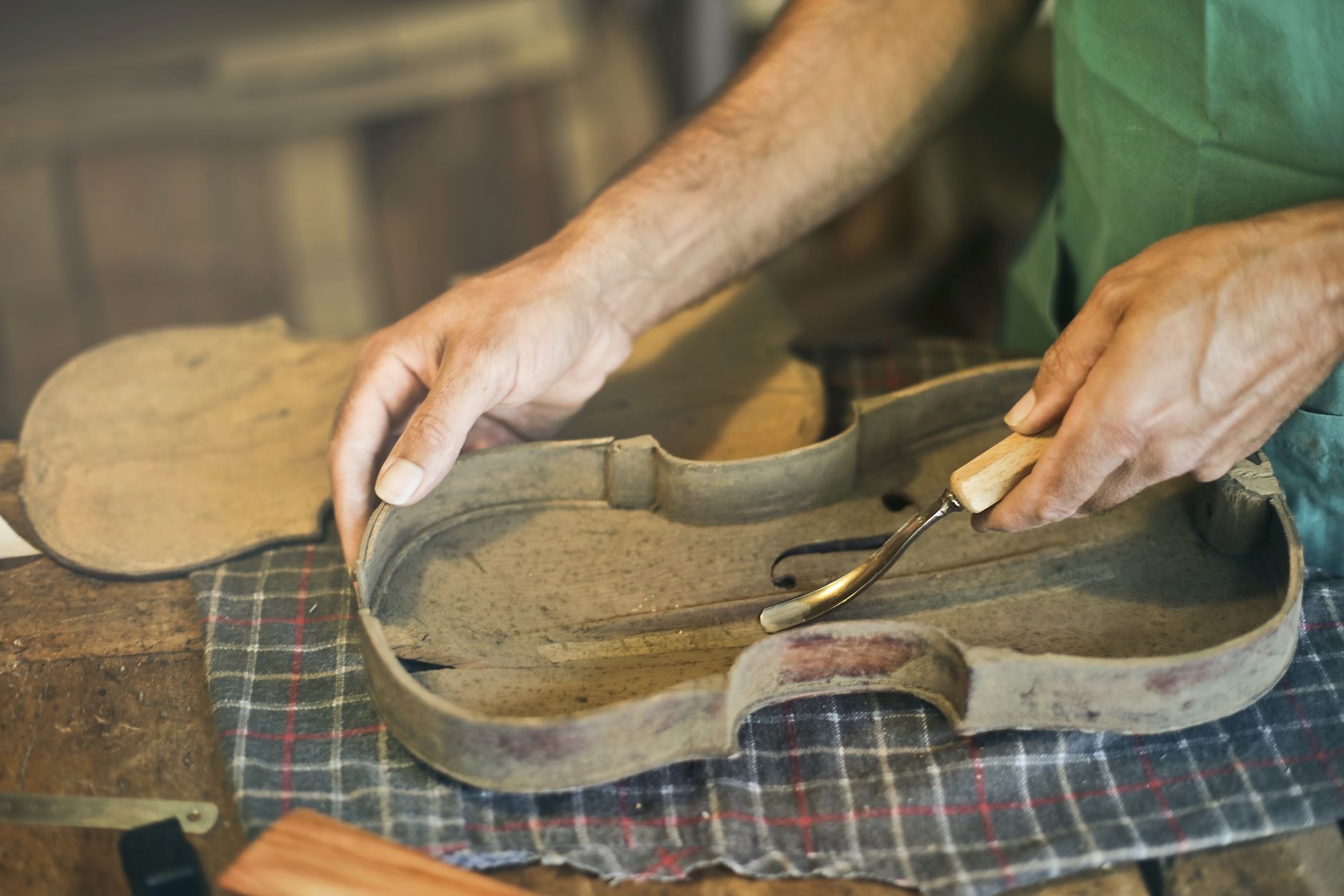
The technological heart of the classical guitar lies within: the harmonic bracing. By lifting the soundboard, a complex internal structure of spruce or cedar arranged in a fan pattern is revealed, acting much like the foundations and flying buttresses of a Gothic cathedral. Each individual strut is hand-carved and shaved down to the millimeter to balance deep bass notes, warm midrange tones, and crystal-clear trebles. Over decades, the masters of the Granada school have developed their own proprietary bracing patterns, subtly modifying traditional dimensions to give the instrument greater projection and sustain without losing the characteristic sweetness of the south.
The guitar is not merely a piece of furniture with strings; it is a living organism whose internal skeleton determines every sigh of its voice.

This delicate balance between rigidity and flexibility represents the greatest technical challenge faced by the artisan. If the soundboard is too thick, the tone will be muffled and lacking projection; if it is excessively thin, the instrument will lack core substance and its operational lifespan will be compromised. The application of modern modal analysis and laser holography techniques in advanced workshops allows artisans to visualize how wood vibrates in real time, scientifically validating what older masters knew intuitively after years of trial and error.
The Art of Bending and Joining: The Soundbox
Once the soundboard and back are designed, the next milestone in the workshop is crafting the sides. Using a metal or wooden mold, the luthier dampens the strips of rosewood or cypress and exposes them to the heat of a metal bending iron. Water vapor and precise temperature control allow the wood to bend with an almost organic grace, curving smoothly without cracking or losing structural integrity. This process requires extreme sensitivity: a second of excessive heat can char the fibers, forcing the artisan to discard a piece that took months to select.
The sides are joined to the heel block—the mahogany or cedar block supporting the neck—and secured with traditional linings and tiny wooden triangles known as peonzas, which ensure a flawless bond between the body and the plates. This three-dimensional skeleton begins to stiffen, transforming into a precise acoustic resonance chamber. The headstock, hand-carved with ornamental or geometric motifs, crowns a neck typically reinforced with ebony strips to guarantee stability against the constant tension of the strings.

French Polish: The Skin That Breathes
One of the best-kept secrets and most decisive factors in the sonority of a Granada guitar is the final finish. While mass manufacturing relies on synthetic polyurethane varnishes that smother the wood’s vibration with a thick plastic layer, traditional artisans continue to use the French polishing technique applied with a pad. This process involves dissolving natural resin flakes secreted by the Kerria lacca insect in pure alcohol, and applying them in continuous circular motions using a cotton wad wrapped inside a soft cloth.
Dozens of sessions are required, separated by drying periods and microscopic sanding with pumice stone, to obtain a translucent layer as thin as a dragonfly’s wing. This thinness is vital: by posing no mechanical resistance, it allows the soundboard to breathe and vibrate without restriction, boosting the instrument’s volume and harmonic richness. Furthermore, the scent of alcohol and natural resin permanently permeates the workshop, turning the polishing process into a multi-sensory experience that evokes centuries of artisanal tradition.

Dialogue Between Luthiers and Concert Artists: Final Tuning
The birth of a guitar does not conclude at the workbench, but in the auditorium. Granada’s finest luthiers maintain a close, symbiotic relationship with international concert artists and promising conservatory talents. Once strung for the first time, the guitar is handed over to a professional performer to undergo rigorous live execution testing. Evaluations cover fretboard comfort, nut compensation to ensure flawless intonation across all frets, and dynamic response under different plucking techniques.
A great instrument does not seek to please the maker in the workshop, but to unleash the voice carried within the guitarist upon the stage.
Based on the musician’s feedback, the artisan can make microscopic adjustments to string action or subtly file down the frets. This feedback loop ensures that Granada’s tradition does not stagnate in the past, but evolves to meet the technical and expressive demands of contemporary guitar repertoire, from Renaissance music to electroacoustic avant-gardes.
Practical Information for Visitors and Music Lovers
For travelers interested in exploring the universe of Granada lutherie, planning visits with respect and advance notice is essential. Most traditional workshops are located in residential and commercial streets of the Albaicín and around Cuesta de Gomérez. These are not interactive mega-museums, but active workspaces where silence and concentration are sacred tools. Booking appointments in advance via email or phone is mandatory, and in many cases purchasing minor accessories or sheet music is a welcome gesture of respect for the artisan’s time.

Key sector events include the Granada International Guitar Festival and open-house days periodically organized by local artisan associations. To reach historic workshops, public transport via urban microbuses climbing the Albaicín (lines C31 and C32) is the best option, as private vehicle access is strictly restricted to residents. Additionally, combining workshop visits with a tour of the Andalusian Centre for Musical Documentation, located in the Palacio de los Condes de Gabia, provides valuable historical background on the evolution of the guitar in the region.
The Future of the Craft: Generational Renewal and Sustainability
The greatest challenge facing lutherie in the 21st century is not competition from mass industrial manufacturing—whose products lack soul and durability—but ensuring solid generational renewal. Fortunately, craft schools like the Artigranada School and private apprenticeship workshops are attracting young people from all over the world, fascinated by the combination of manual labor and scientific rigor. These new apprentices learn not only traditional assembly techniques, but also computer-aided design tools and sustainable material management.
Ultimately, the renaissance of classical guitar making in Granada proves that true modernity does not mean abandoning the past, but deeply understanding it to project it into the future. In a hyperconnected and ephemeral world, a Granada luthier’s workshop stands as a precious bastion of resistance where slowness, patience, and the pursuit of sonic beauty remain the supreme values of human creation.