
The Steel Spine Across the Carpathian Ranges
The geography of Central Europe has historically been shaped by its mountain ranges, natural barriers that for centuries isolated entire communities and fragmented regional economic development. In the territory of modern-day Slovakia, the Carpathian chain presented a monumental challenge to nineteenth and early twentieth-century engineering. Connecting the interior mining valleys with the commercial arteries of the Danube required unprecedented technical solutions. Thus emerged the project to complete the central rail section that today anchors the mountainous heart of the country, an infrastructure that transformed alpine isolation into a fluid and constant communication network.
Unlike major high-speed lines that prioritize straight alignments through massive investments in direct tunnels, the route between Telgárt and Margecany was designed as an organic extension of the terrain. The Austro-Hungarian and Czechoslovak engineers who conceived the layout understood that the only way to conquer steep elevation changes was through geometric patience: tight-radius curves, sustained gradients, and a seamless visual integration with fir forests and the watercourses descending toward the Hron River. This approach not only solved an immediate logistical problem but also bequeathed to the European heritage a transport corridor where public utility coexists with an unrepeatable industrial aesthetic.
Topographical Challenges and the Ingenuity of Spiral Loops
Overcoming a steep incline within a restricted space requires solutions that defy conventional intuition. In the steepest section of the route, popularly known by railway history experts as the Telgárt loop, the railway line describes a three-hundred-and-sixty-degree ascending curve inside a helical tunnel. This design allows the train to gain elevation progressively while tracing an underground circle, emerging from the mountain at a higher level parallel to the tracks it traversed minutes earlier. Executing this feat in the 1930s marked a milestone in topographical calculation and the deployment of specialized manual labor.
Technical complexity was not limited to underground boring. The scarcity of advanced materials during periods of economic crisis compelled builders to maximize local resources. Limestone quarries located just kilometers from the alignment provided the ashlar blocks necessary to raise retaining walls and monumental arches that still support the daily passage of passenger and freight convoys. Each pillar and keystone was dimensioned to withstand relentless winter freezes and spring thaws, climatic factors that test the durability of stone materials at this Central European latitude.
Historical Viaducts: Stone Monuments Across Abysses
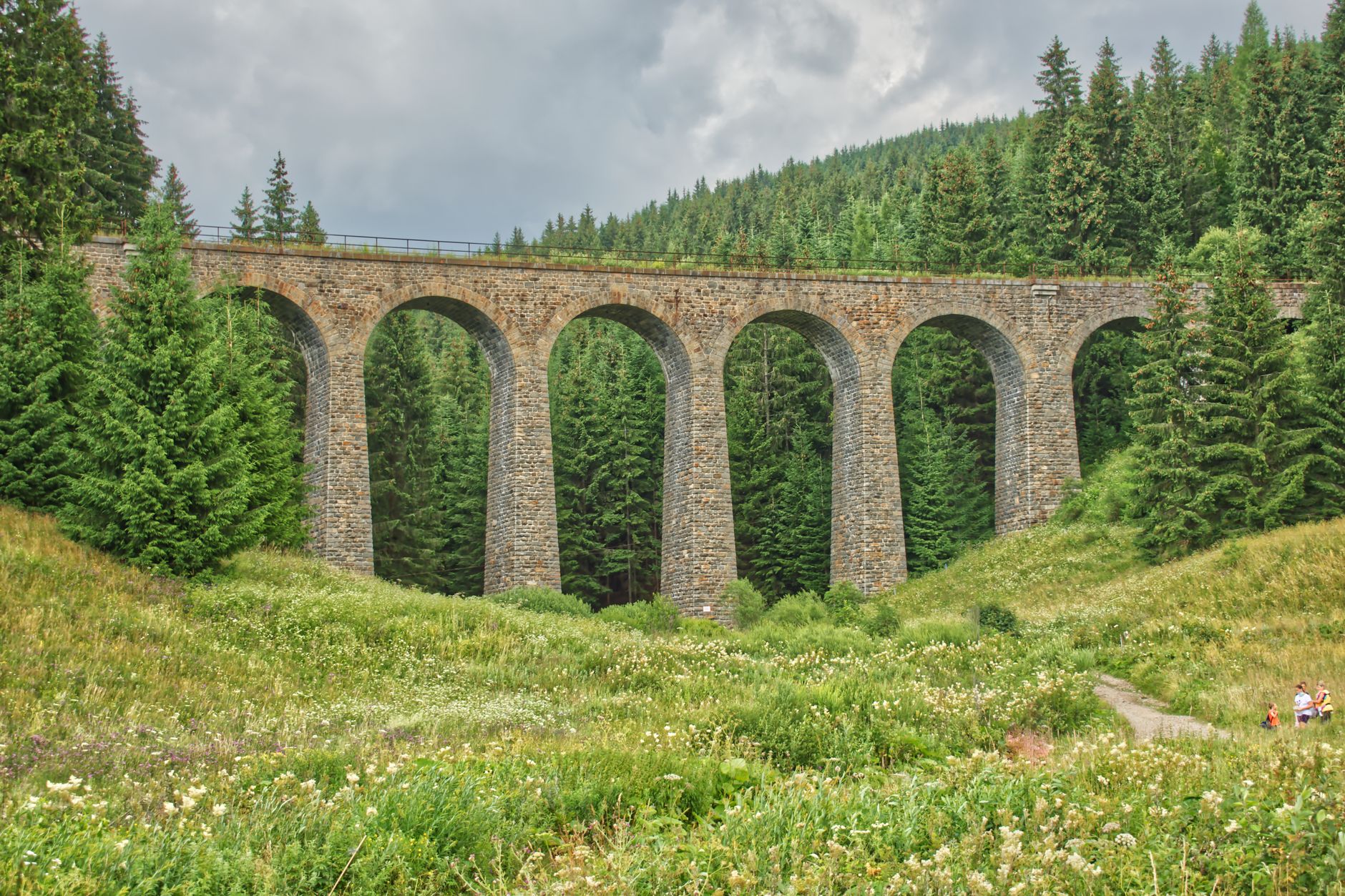
The rail journey is punctuated by a series of bridges and viaducts representing the pinnacle of civil architecture of their era. The most celebrated among them, the Telgárt viaduct, stands with its curved profile over a green valley, combining the robustness of traditional masonry with the elegance of segmental arches. This bridge is not merely a functional element; it constitutes a civil sculpture integrated into the landscape, designed to endure the continuous vibrations of heavy locomotives without losing visual harmony with the surrounding natural environment.
Along the more than one hundred kilometers comprising the main corridor toward Margecany, travelers cross dozens of similar structures spanning mountain ravines and torrents. Preserving these engineering monuments requires constant and specialized maintenance. Slovak railway authorities employ restoration techniques that safeguard the original stone, replacing deteriorated mortars with compatible formulas and conducting structural inspections using laser technology to detect micro-cracks before they compromise track safety.
The Socioeconomic Transformation of Slovak Valleys
The arrival of the railway into these mountainous districts did not stem from purely recreational criteria, but from an urgent industrial necessity. In the late nineteenth and early twentieth centuries, timber extraction, metallic ore exploitation, and artisanal manufacturing demanded a transport system capable of operating year-round, immune to heavy snowfalls that blocked bridle paths and cart tracks. The train became the engine energizing the local economy, enabling the punctual dispatch of raw materials toward the industrial hubs of Košice and Bratislava.
The railway in the Carpathians was never merely a communication route; it was the instrument that anchored rural communities to modernity without fracturing their territorial identity or their reliance on the alpine environment.
With the decline of certain traditional heavy industries in the past century, the infrastructure’s role underwent a necessary mutation. Lines that once hauled coal and timber began specializing in local passenger mobility, student transit, and, increasingly, travelers drawn to nature tourism and industrial heritage. Today, this corridor acts as an element of social cohesion, linking isolated rural villages with the country’s medium and long-distance transport networks.
Rolling Stock and the Contemporary Travel Experience
Traveling along this rail network requires understanding the duality between its historical heritage and the operational demands of the present. Regular services are operated primarily by light diesel railcars, specifically adapted to negotiate tight mountain curves and offer optimal panoramic visibility through expansive glazed surfaces. These vehicles combine efficient traction with reduced acoustic emission levels, respecting the silence of the valleys protected by surrounding national parks.
Interior comfort has evolved remarkably in recent decades, incorporating heating systems tailored to winter extremes, dedicated spaces for bicycle transport, and bilingual signage aimed at both daily commuters and the rising flow of hikers. The travel experience stands out for its leisurely, contemplative pace, offering a perspective inaccessible from the primary roads running along valley bottoms, which are frequently saturated with automotive traffic.
Logistics, Connections, and Trip Planning
Planning a journey through the Slovak Carpathian rail corridor requires familiarizing oneself with the integrated timetables of the national operator ZSSK and key interchange nodes such as Brezno, Poprad-Tatry, or Margecany. The network is synchronized to allow efficient connections with main express trains linking Bratislava with Košice. Consulting periodic maintenance notices is essential, as the complex topography demands frequent interventions on tracks and tunnels during the warmer months of the year.
- Key Origin Station: Brezno, western entry point with direct connections from Banská Bystrica.
- Eastern Interchange Node: Margecany, direct connection with Slovakia’s primary north-south rail corridor.
- Service Frequency: Regional trains operate approximately every two hours on weekdays, with frequency enhancements during peak-season weekends.
- Onboard Infrastructure: Limited spaces for bicycles; advance booking recommended during summer and holiday weekends.
- Documentation and Fares: Tickets available via the ZSSK mobile app or physical ticket counters; distance-based fares without mandatory seat reservations on regional trains.
Maintenance Challenges in Mountain Infrastructure
The longevity of a centennial railway line in an alpine setting depends entirely on the technical and financial capacity allocated to its preservation. Rockfalls, massive snow accumulations, and the wear of wooden sleepers subjected to continuous humidity and freezing cycles represent daily operational fronts for infrastructure maintenance crews. Unlike flatland routes, any incident in these gorges requires complex response protocols due to restricted access for heavy repair machinery.
In recent years, investments have focused on modernizing signaling systems and stabilizing slopes using high-strength wire mesh and retaining walls anchored into bedrock. These interventions guarantee operational safety without altering the historical physiognomy of the layout, allowing civil architectural heritage to continue fulfilling its public function well into the twenty-first century.
Sustainability and the Future of Rail Tourism in Central Europe
The rise of sustainable tourism has re-elevated secondary railway lines as viable alternatives to private vehicles. The Slovak Carpathian corridor exemplifies how historic infrastructure can be integrated into regional transport decarbonization strategies. By offering a clean, efficient alternative to access the region’s national parks, the train drastically reduces the carbon footprint associated with mass tourist mobility.
The future of this line relies on consolidating its appeal through coordinated promotion with ecotourism agencies and local authorities, ensuring visitor growth does not degrade the fragile equilibrium of mountain ecosystems. With rigorous management and absolute respect for its technical legacy, the Carpathian railway positions itself for coming decades as a model of intelligent connectivity respectful of territorial memory.