Introduction to Northern Spain’s Narrow-Gauge Network
Northern Spain has historically been shaped by an abrupt geography where the Cantabrian Mountains descend precipitously toward the Cantabrian Sea. This topography, characterized by deep river valleys, steep cliffs, and an endless succession of river mouths known as rías, traditionally made overland travel a formidable logistical challenge. During the second half of the nineteenth century and the early decades of the twentieth century, the Industrial Revolution and the exploitation of mining and industrial basins demanded the development of a transport system capable of overcoming these natural barriers. Thus, the metric-gauge railway was born—a railway network designed with a one-meter track gauge, narrower than the standard Iberian gauge, which allowed for sharper curve radii and steeper gradients, adapting with surgical precision to the terrain’s relief.
Today, this railway layout not only represents a living testimony to industrial archaeology and European civil engineering, but it also constitutes a fundamental backbone for territorial cohesion, the daily mobility of thousands of citizens, and sustainable long-distance tourism. Unlike high-speed lines that prioritize speed and direct connection between metropolises, the Transcantábrico and the metric-gauge regional and commuter services offer a different approach to the territory: a leisurely pace that allows travelers to comprehend the human scale of the landscape, the interdependence between fishing ports, historical ironworks, and the rural villages of northern Spain.
Historical Origins: From Nineteenth-Century Mining to State Integration
The origins of the narrow-gauge network in northern Spain are fragmented across multiple private initiatives driven by the urgent need to evacuate coal, iron ore, and steel products from inland deposits to shipping ports along the Cantabrian coast. Companies such as Hullera Vascongada, Ferrocarriles de Carreño, and the Economic Railway of Asturias emerged independently in the late nineteenth century, constructing isolated sections that responded to specific economic interests. These pioneering lines operated with small steam locomotives and basic infrastructure that required constant maintenance due to adverse weather conditions and the instability of the region’s clay and limestone soils.

With the passage of decades and the gradual obsolescence of these small private enterprises in the face of road transport competition, the Spanish State progressively assumed ownership and management of most of these disconnected layouts. Through the creation of public bodies such as FEVE (Narrow-Gauge Railways) in the second half of the twentieth century, the monumental task was undertaken to unify existing lines, standardize rolling stock, electrify high-density sections, and connect the terminal points to form a continuous network that, for the first time, linked the Cantabrian coast and Galicia with Castile and León via the Pajares mountain pass and the Narcea corridor.
Civil Engineering and Topographical Challenges in the Cantabrian Corridor
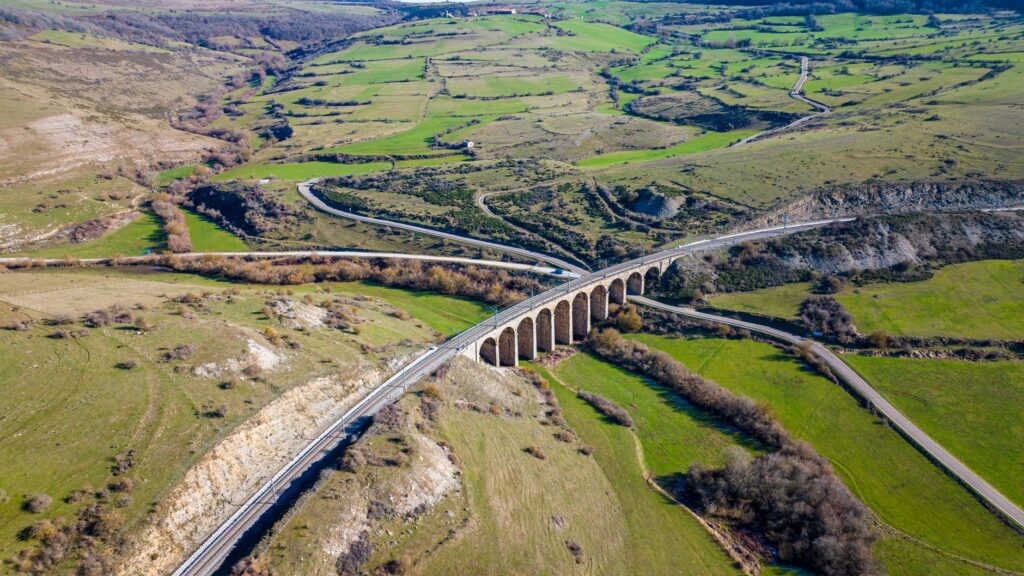
Designing, constructing, and maintaining a railway line along the Cantabrian coast has historically required truly unique civil engineering solutions. Unlike the plateau plains, where track laying responds to geometric straight-line criteria, the northern territory imposes a constant succession of physical obstacles. The engineers of the nineteenth and twentieth centuries had to project hundreds of tunnels bored through solid rock, metal lattice viaducts spanning deep river gorges, and reinforced embankments designed to withstand erosion caused by the region’s high rainfall.

The presence of numerous river basins, such as the Sella, Deva, Navia, and Nalón, required the construction of swing and metal bridges that today form part of protected industrial heritage. Likewise, the maintenance of this infrastructure represents a perpetual logistical challenge for current operators and Adif’s conservation teams. Slope failures, the corrosive action of sea salt on coastal sections, and dense Atlantic vegetation demand continuous inspections and night work to guarantee the safety of train movements. The replacement of wooden ties with monoblock concrete sleepers and the modernization of signaling and communication systems have extended the operational life of a route that, despite its age, continues to operate under high technical demands.
Rolling Stock: Technological Evolution of Metric-Gauge Trains
The transformation of the mobile fleet within the Spanish metric-gauge network reflects the very evolution of European railway technology. During the early decades, articulated steam locomotives, such as Mallet models, dominated the toughest routes thanks to their ability to negotiate sharp curves and haul loads on prolonged gradients. However, the low energy efficiency of steam and the scarcity of quality coal during certain periods prompted an ambitious dieselization process from the mid-twentieth century onward, incorporating thermal railcars that significantly improved commercial speed and passenger comfort.
In recent decades, technological renewal has given rise to modern railcar series specifically adapted to the loading gauge limitations of narrow-gauge tracks. These trains combine low-emission diesel power units with pneumatic suspension systems designed to mitigate the effect of sharp curves on passengers. Furthermore, significant improvements have been implemented regarding accessibility for passengers with reduced mobility, multifunctional spaces for bicycles, and real-time information systems, adapting a historical service to twenty-first-century mobility demands without altering the external dimensions required by the narrow track gauge.
The Transcantábrico: The Renaissance of Luxury Rail Tourism
Beyond its function as a local public service, the metric-gauge network of northern Spain achieved international renown through the development of the tourism product known as El Transcantábrico. Inaugurated in the early 1980s as Spain’s first luxury tourist train, this initiative transformed vintage passenger carriages into authentic modernist-inspired rolling salons, evoking the golden age of great European expresses like the Orient Express while adapted to the coastal and mountainous Cantabrian scale.
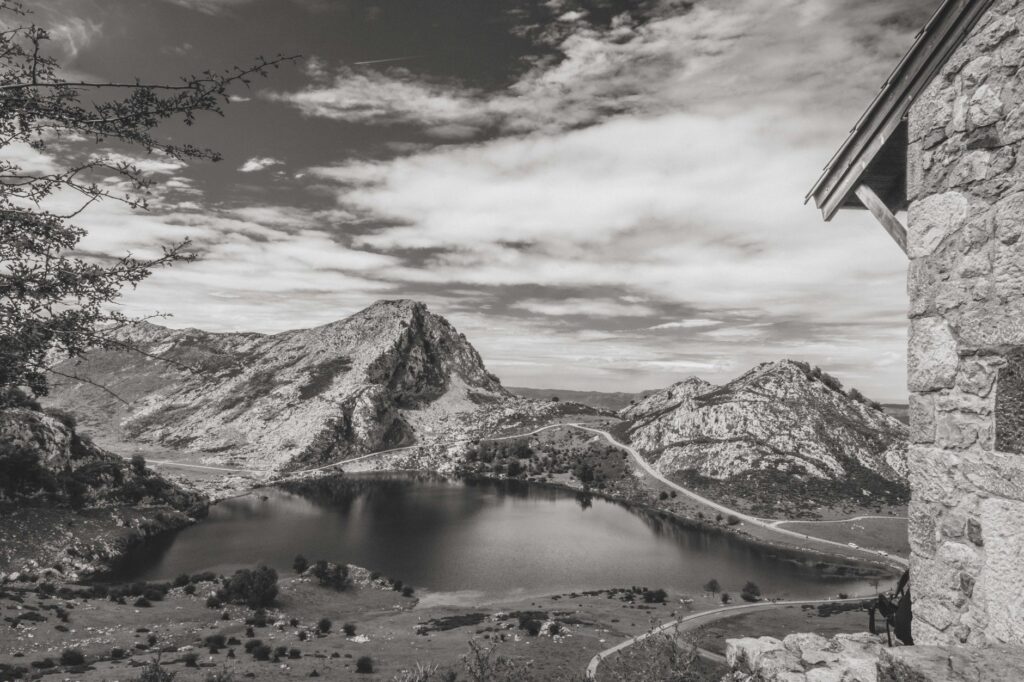
The classic itinerary, connecting San Sebastián or Bilbao with Ferrol over several days, is not merely a means of transport, but an immersive travel experience where the train functions as a floating hotel by night and an observation platform by day. Overnight stays take place with the train stationary at quiet stations to ensure passenger rest, while daytime hours are devoted to guided excursions to historical monuments, natural enclaves such as the Picos de Europa, Paleolithic rock art sanctuaries, and gastronomic experiences in traditional wineries and bakeries. This model has demonstrated that historical railway infrastructure can generate high economic and cultural added value for local communities without compromising environmental sustainability.
The narrow-gauge train is not merely a means to shorten distances, but a privileged observatory that reveals the geographical and industrial seams of northern Spain on a human and sustainable scale.
Territorial Cohesion and Daily Connectivity in the Twenty-First Century
Despite the undeniable appeal of rail tourism, the fundamental raison d’être of the metric-gauge network lies in its capacity to guarantee daily mobility for local populations. In regions such as Asturias, Cantabria, and the Basque Country, commuter services running on these tracks connect industrial valleys and residential areas with major urban centers and business parks. For many inhabitants of rural and semi-urban areas, this railway represents the only efficient and sustainable alternative to private vehicles for accessing healthcare, educational, and employment services.

However, maintaining this connectivity faces significant structural challenges in the current context of ecological and budgetary transition. Road transport competition, demographic aging in certain rural valleys, and the need for continuous investment in modernizing catenaries, tunnels, and security systems demand long-term strategic planning by public administrations. Fare integration, timetable synchronization with intercity buses, and travel time improvements are critical aspects to consolidate the railway as the backbone of sustainable mobility in northern Spain.
Practical Guide for Travelers and Railway Researchers
Planning a trip along the metric-gauge network of northern Spain requires understanding the duality of its services: on one hand, commuter and regional trains operated as public service obligations; on the other hand, high-end luxury tourist convoys operating under seasonal reservation. For independent travelers wishing to explore the Cantabrian coast using the conventional network, it is advisable to consult updated timetables on official Renfe Cercanías AM channels, as travel times can be lengthy due to the topological limitations of the layout.
- Northern Main Line: Connects Bilbao (Concordia) with Ferrol, a journey of over 650 kilometers crossing the autonomous communities of the Basque Country, Cantabria, Asturias, and Galicia.
- Meseta Connection: The section between León and Bilbao allows travelers to link the narrow-gauge system with the conventional Iberian-gauge and high-speed network.
- Bicycles Onboard: Most modern railcars permit free bicycle transport without disassembly, subject to space availability.
- Seasonal Planning: Seats on luxury tourist trains must be booked months in advance, especially during the summer and autumn months.
Luggage should be kept to a minimum due to the space available in historical and regional train compartments, and it is advisable to bring warm and waterproof clothing even in the summer months, given the unpredictability of the Atlantic climate in mountainous sections.
The Future of Metric Mobility Amid the Energy Transition
Looking ahead to the coming decades, the future of the narrow-gauge railway network in northern Spain stands at a crossroads marked by European transport decarbonization targets. While main high-speed lines have opted for full catenary electrification, the windiest and lowest-density traffic sections of the metric network present economic and technical challenges for conventional electrification. In response, railway operators and rolling stock manufacturers are exploring advanced technological alternatives, such as railcars powered by green hydrogen or high-performance batteries capable of operating on non-electrified sections.
These innovations seek to maintain the climate neutrality of the railway without undertaking massive civil works in protected natural environments or areas of high scenic value. At the same time, the digitalization of traffic management via satellite communication and radio-based train control systems promises to increase the safety and operational capacity of a century-old infrastructure. Thus, the metric-gauge network of northern Spain demonstrates that tradition and technological vanguard are not mutually exclusive, but indispensable allies to guarantee a future of sustainable, integrated mobility that respects the territory.
Conserving and modernizing the narrow-gauge railway is an act of historical and ecological responsibility that ensures the survival of rural communities and the territorial balance of northern Spain.