The water of the Nærøyfjord wakes like an obsidian mirror, undisturbed and cold. In this corner of western Norway, where near-vertical rock walls rise more than a thousand meters above sea level, silence used to be an elusive commodity during the summer season. The roar of diesel engines from tourist ferries and cruise ships echoed from wall to wall, disturbing not only the peace of the few residents in villages like Gudvangen or Bakka, but also the local wildlife. Today, however, silence has returned. A catamaran of futuristic lines glides across the water, emitting no sound other than the gentle murmur of the wake it leaves behind. There are no plumes of black smoke, no mechanical vibrations shaking the cliffs. This is the future of navigation, and it is taking place here, in the world’s most demanding testing ground.
The Silent Awakening of Nærøyfjord
The transition to sustainable maritime transport is not a distant utopia on the Norwegian coast; it is a tangible reality redefining the relationship between travel, technology, and landscape. The Nærøyfjord and the Geirangerfjord, both declared UNESCO World Heritage Sites in 2005, have become the vanguard of a radical transformation. This change is not merely a response to an abstract ecological sensitivity, but a meticulously planned national strategy to protect some of the most vulnerable ecosystems on the European continent.
For decades, mass tourism and fossil fuel dependence in local transport generated an uncomfortable paradox: travelers arrived in droves to admire pristine nature while simultaneously contributing to its degradation. Emissions of nitrogen oxides (NOx) and sulfur dioxide in the narrow fjords often exceeded air quality levels of major metropolitan areas during windless days. The need for structural change was evident, and the Norwegian response has been as bold as its own geography.

The Legal Imperative: The Law That Changed the Rules of the Game
The true catalyst for this revolution occurred in the halls of the Storting, the Norwegian parliament. Norway has decreed that by 2026, only zero-emission vessels will be allowed to sail through its UNESCO-protected fjords. This legislative resolution, adopted in 2018, marked an unprecedented milestone in the global maritime industry. By setting a strict deadline, the government not only sent a clear signal to tour operators but also forced shipyards, engineers, and energy providers to accelerate the development of technologies that many considered unfeasible on a large scale.
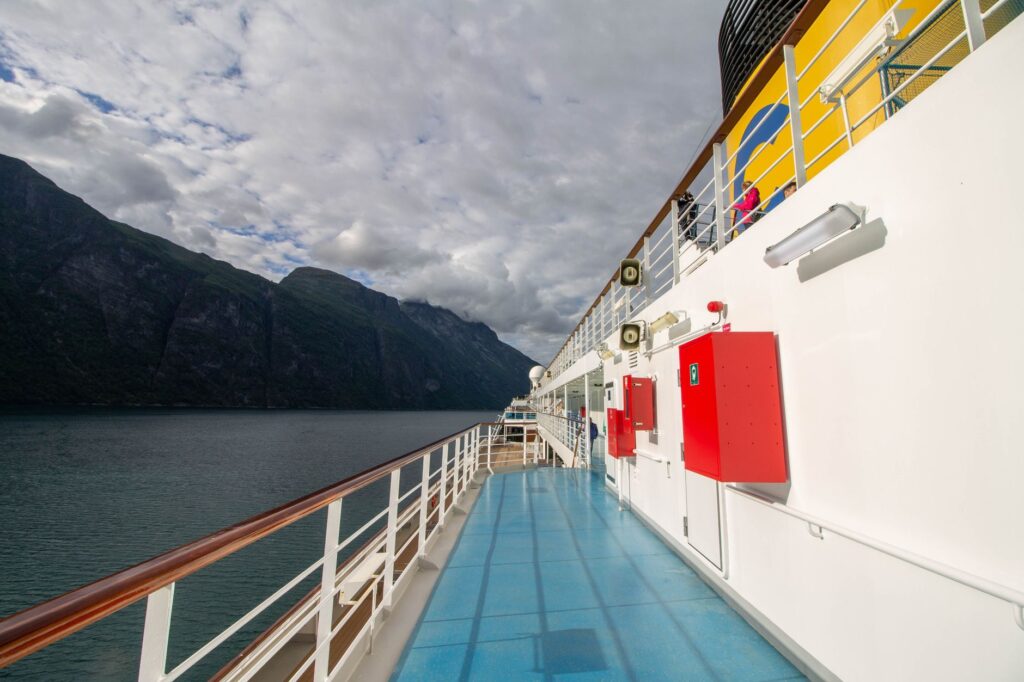
The measure will immediately affect passenger ferries, recreational boats, and, most drastically, international cruise ships. For the latter, the challenge is monumental. A modern cruise ship requires an immense amount of energy not only for propulsion but to keep the mini-cities on board operational. The 2026 regulations have forced major cruise lines to rethink their routes and invest in hybrid propulsion systems, hydrogen fuel cells, and shore-to-ship power connections for when they are docked.
«Sailing without the roar of diesel engines restores the true scale of nature, turning the journey into an act of pure contemplation.»
Engineering Silence: The Technology Aboard the Future of The Fjords
To understand the scope of this transformation, one must look at the flagship of this new era: the Future of The Fjords. Designed and built by the specialist shipyard Brødrene Aa, this 42-meter catamaran is a marvel of contemporary naval engineering. Unlike traditional steel vessels, its hull is constructed entirely from carbon fiber, an extremely lightweight material that drastically reduces the boat’s weight and, consequently, the energy required to move it.
The Future of The Fjords, an all-electric carbon-fiber catamaran, represents the pinnacle of this maritime transition. Equipped with two 450 kW electric engines and a battery pack with a total capacity of 4 MWh (equivalent to about 40 high-end electric car batteries), the vessel can cruise at 16 knots for 30 nautical miles without emitting a single gram of carbon dioxide into the atmosphere. The exterior design, inspired by the zigzagging mountain trails of the surrounding landscape, allows passengers to walk along exterior ramps that facilitate an uninterrupted panoramic view, free from the noise and smells associated with diesel combustion.
The Invisible Challenge: Onshore Infrastructure and Rural Power Grids
Building an electric boat is only half the problem; the other half, often invisible to the traveler, lies in the charging infrastructure. The Norwegian fjords are rural areas, characterized by small, isolated communities where the local electrical grid was never designed to handle the immense energy demand required to fast-charge a passenger ferry in a mere twenty-minute window.

To solve this bottleneck, a solution as ingenious as it is sustainable was designed: the Power Dock (floating charging station). This is a 40-meter-long floating carbon-fiber dock that houses a 1.2 MWh battery pack inside. The dock charges slowly from the local grid throughout the day without overloading it. When the ferry docks, it can transfer energy ultra-fast from the dock to the boat in just 20 minutes. Furthermore, the Power Dock serves a triple function: it acts as a passenger terminal, stores wastewater from the vessel to prevent dumping in the fjord, and holds consumables used on board.
«Port infrastructure in villages of barely a hundred residents proves that the energy transition is, above all, a decision of social engineering.»
Ecological Impact in Deep Waters
The absence of greenhouse gas emissions is the most obvious benefit of electrification, but it is not the only one. Underwater noise impact is one of the greatest threats to marine biodiversity in the fjords. The deep waters of these submerged valleys host populations of harbor porpoises, seals, and a rich variety of fish that rely on sound to communicate, navigate, and forage. The constant noise of propellers and traditional diesel engines creates an acoustic barrier that fragments their habitats.
Decarbonizing these routes is not just a technical achievement, but a vital respite for the fragile marine ecosystems beneath the surface. Preliminary studies by marine research institutes in Norway suggest that the reduction of low-frequency noise from electric motors allows marine mammals to recover natural behavioral patterns and reduces stress levels in local fish populations. Silence, therefore, heals both the air and the deep waters of the fjord.

Tourists of Silence: A New Ethic of Contemplative Travel
The transition to electric transport is also transforming the psychology of the traveler. Tourism in the fjords is no longer experienced as a noisy conquest of natural space, but as a respectful immersion. By eliminating engine noise, passengers on deck can hear the actual sound of waterfalls cascading from the heights, the cracking of ice on distant peaks, and the calls of nesting seabirds on the cliffs.
This shift fosters a contemplative attitude and a longer stay in the territory. Local tour operators have begun to adapt their offerings, promoting low-impact kayak excursions, guided hiking along historic trails, and cultural visits to mountain farms that were once eclipsed by the fast-paced nature of traditional cruise tourism. Slowness and ecological respect thus become the true luxury of contemporary travel.

Practical Guide for the Conscious Traveler in Norway’s Waterways
For those wishing to experience this revolution firsthand, trip planning should prioritize environmental coherence and make use of Norway’s integrated public transport network, one of the most efficient in Europe.
- How to get there sustainably: The journey begins in Bergen or Oslo. It is highly recommended to use the Bergen Line (Bergensbanen), considered one of the most beautiful train journeys in the world, and connect in Myrdal with the famous Flåm Railway (Flåmsbana), which descends dramatically to the fjord level.
- Electric Sailing: From Flåm, fully electric ferries operated by The Fjords run regular round-trip routes to Gudvangen through the Nærøyfjord. It is advisable to book tickets in advance through official channels to ensure a place on the zero-emission vessels.
- Land Mobility: Once in the fjord villages, the local bus network is transitioning rapidly to electric vehicles. For short distances, renting electric bicycles is an excellent and widely available option in Flåm and Aurland.
- Accommodation and Local Dining: Choose establishments with the national ecological certification Eco-Lighthouse (Miljøfyrtårn). Dining at local cooperatives supports the economy of these small communities and reduces the carbon footprint associated with food transport.
The Global Horizon: From the North Sea to the Rest of the Planet
The Norwegian experience in the western fjords is not an isolated success story with no possibility of replication; it is the blueprint for the future of global shipping. Lessons learned in designing ultra-lightweight carbon-fiber hulls, managing battery packs in extreme climates, and developing floating charging infrastructures are already being exported to other regions of the world, from Swiss lakes to urban ferries in New York, San Francisco, and Singapore.
By proving that electric technology is viable, safe, and economically sustainable in the harshest meteorological conditions of Northern Europe, Norway has dismantled the arguments of skeptics in the maritime sector. The path to a clean and silent ocean is long, but in the calm waters of the Nærøyfjord, that future has already begun to sail silently, leaving behind only a wake of clean water and the promise of a more livable planet.