


Introduction to the Blue Arteries of the Aegean
The Aegean Sea is much more than a vast body of water dotted with idyllic islands; it is a three-dimensional territory where connectivity relies entirely on a complex, millimeter-precise maritime transport network. For the contemporary traveler, understanding how Greek ferries operate is an essential prerequisite for any expedition that goes beyond the surface of tourist postcards. Unlike continental highways, routes here are invisible grooves traced across the waves, connecting local economies, hospitals, schools, and millions of annual visitors.
The neuralgic heart of this system is concentrated in the ports of the Attica region, principally Piraeus, the largest passenger port in Europe and one of the busiest globally. From its docks, heterogeneous fleets depart daily, ranging from massive conventional vessels to modern high-speed catamarans. The Aegean ferry system functions simultaneously as a vital public service and a colossal tourism engine. Far from being a mere vacation transit medium, ferries serve as the backbone sustaining island life throughout all twelve months of the year.
The Evolution of the Port of Piraeus: From Traditional Pier to Intermodal Hub
Piraeus has undergone a radical transformation over recent decades. What was once a chaotic labyrinth of basins and local travel agencies has been reconfigured into a highly regulated logistical and intermodal node. The Port Authority, in coordination with major shipping lines, has streamlined boarding flows to handle millions of annual passengers, particularly during the peak summer months of July and August.
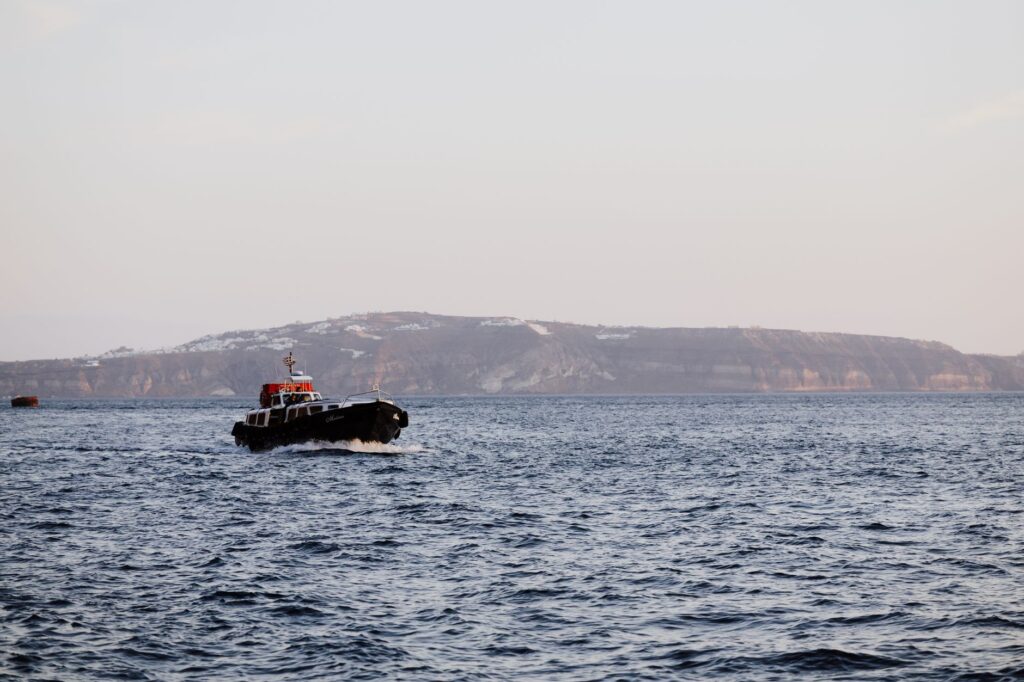
Boarding gates (known as Pyles) are distributed across kilometers of coastline. Docks E1 and E2 typically berth ships bound for the Cyclades and Crete, while E9 and E10 handle specific routes to the Dodecanese and the Northeastern Aegean. This zoning requires rigorous planning by travelers, as moving from one gate to another can take up to twenty-five minutes on foot or require the use of internal port shuttle buses.
Vessel Types: Speed Versus Capacity
Choosing the appropriate vessel type entirely defines the travel experience and shapes the overall budget. The Aegean fleet is fundamentally divided into three main operational categories, each with very distinct technical advantages and drawbacks.
- Conventional Ferries: These are the largest vessels, operated by companies such as Blue Star Ferries or Minoan Lines. They offer stable navigation, spacious lounges, open outdoor decks, and the capacity to carry hundreds of vehicles. Their cruising speed ranges around 18 to 22 knots.
- High-Speed Catamarans and Hydrofoils (Highspeed / Seajets): Designed to cut transit times in half. Speeds can exceed 35 knots. However, they are more sensitive to adverse weather conditions and lack accessible outdoor decks for passengers.
- Hybrid or Medium Conventional Vessels: These connect secondary routes within the same archipelago (local routes or Agoni Grammes), prioritizing cargo and public service over luxury or raw speed.
Navigating the Aegean requires accepting that the sea enforces its own rules, where technical punctuality frequently yields to meteorological and operational conditions.
The Critical Role of Public Service Obligation Lines
While the primary routes between Piraeus, Mykonos, Santorini, or Paros are highly lucrative and operated by multiple private companies in direct competition, dozens of smaller islands rely on so-called Public Service Obligation lines (known in Greek as Agoni Grammes). These state-subsidized routes ensure that remote islands such as Anafi, Donoussa, Psara, or Kastellorizo maintain a steady supply of provisions, fuel, mail, and passenger connections year-round.

Without these lines, the depopulation of peripheral islands would be irreversible. Shipping companies awarded these public contracts through tenders are legally bound to operate with a minimum frequency, even when ship occupancy during the low season is extremely low. For the curious traveler, these routes represent the most authentic way to understand maritime Greek life, sharing space with locals, freight handlers, and itinerant medical professionals.
Seasonality and the Etesian Factor (Meltemi)
The wind regime of the Aegean is a decisive factor that every travel planner must understand in depth. During the summer months, particularly in July and August, dry northern winds known locally as Meltemi blow across the region, easily reaching forces of 7 or 8 on the Beaufort scale and drastically altering maritime traffic.
When the Meltemi blows intensely, conventional ferries generally maintain operations with minimal incidents due to their massive size and stability, but high-speed catamarans are frequently suspended or delayed by port authorities. Consulting weather forecasts and maintaining itinerary flexibility is the golden rule to avoid getting stranded on an island port. Real-time tracking apps like MarineTraffic or official harbor master channels are indispensable tools during this period.

Ticket Digitalization and Modern Access Control
The ticketing system in Greece has evolved from traditional printed cardboard issued by physical agencies to near-complete digitalization. Today, most shipping companies offer online check-in options, allowing passengers to receive a boarding pass with a QR code directly on their smartphone or electronic device.
Despite this modernization, operational particularities persist. On large conventional vessels, pedestrian boarding takes place via the main vehicle ramp (the garage), requiring close attention to instructions from ground staff and crew. Security and identity checks have tightened significantly in recent years to comply with European port security regulations, making it advisable to arrive at the port at least 60 to 90 minutes before scheduled departure.

Island Port Infrastructure: The Challenges of Berthing
One of the most fascinating and complex aspects of navigation in the Cyclades and the Aegean is the infrastructure of arrival ports. Many historic islands possess narrow bays or reduced natural shelters that were never designed to receive modern, large-scale vessels. This forces captains into high-precision technical berthing maneuvers.
Ports such as the old port of Fira in Santorini, or small piers in Amorgos and Serifos, require ships to execute millimeter turns in confined spaces. In some cases, when sea conditions prevent safe docking at the main port, vessels divert to alternative emergency ports (such as Katapola instead of Aegiali, or Athinios instead of the old Santorini port), activating improvised bus networks to transport passengers to their final destinations.
Practical Planning: Expert Tips for Travelers
To maximize efficiency and minimize stress during a trip across the Greek archipelago, following a series of proven operational guidelines is essential:

Sustainability and the Future of Maritime Propulsion in the Aegean
Maritime transport in Greece currently faces the greatest challenge in its recent history: the energy transition and the reduction of greenhouse gas emissions. The International Maritime Organization (OMI/IMO) and the European Union require shipping lines to renew their fleets to meet decarbonization targets for 2030 and 2050.
Major companies are already experimenting with cleaner fuels, hydrodynamic hull optimization, and cold-ironing electrical connection systems at Piraeus docks to shut down auxiliary engines during port stays. Although full electrification of large long-distance ferries is still distant due to current battery technology limitations, hybridization and the use of liquefied natural gas (LNG) are already charting the course for the new generation of ships crossing the Aegean in coming decades.
The future of transportation in the archipelago will depend on balancing climate urgency with the imperative need to keep fares accessible for island residents.
Conclusion: The Persistence of Slow Travel in the Digital Age
In an era dominated by the immediacy of commercial aviation, the Aegean Sea ferry system offers a valuable temporal anomaly. Navigating aboard a ferry is not merely an act of physical displacement between two geographic points, but a gradual immersion in the geographic and cultural rhythm of the archipelago. Watching the silhouette of Piraeus blur into the hazy horizon to make way for the geometric shapes of the Cycladic islands is an experience that synthesizes the very essence of Mediterranean travel, reminding us that the journey itself remains the true destination.

